
A Novel Hydrophilic Membrane based on PAA-coated Cellulose Acetate-chitosan for PAHs Pollutant Removal
DOI:
https://doi.org/10.48048/tis.2026.12081Keywords:
Poly Aromatic Hydrocarbons, Pollutant, Cellulose acetate, Chitosan, Membrane, Poly aromatic hydrocarbons, Pollutant, Cellulose acetate, Chitosan, MembraneAbstract
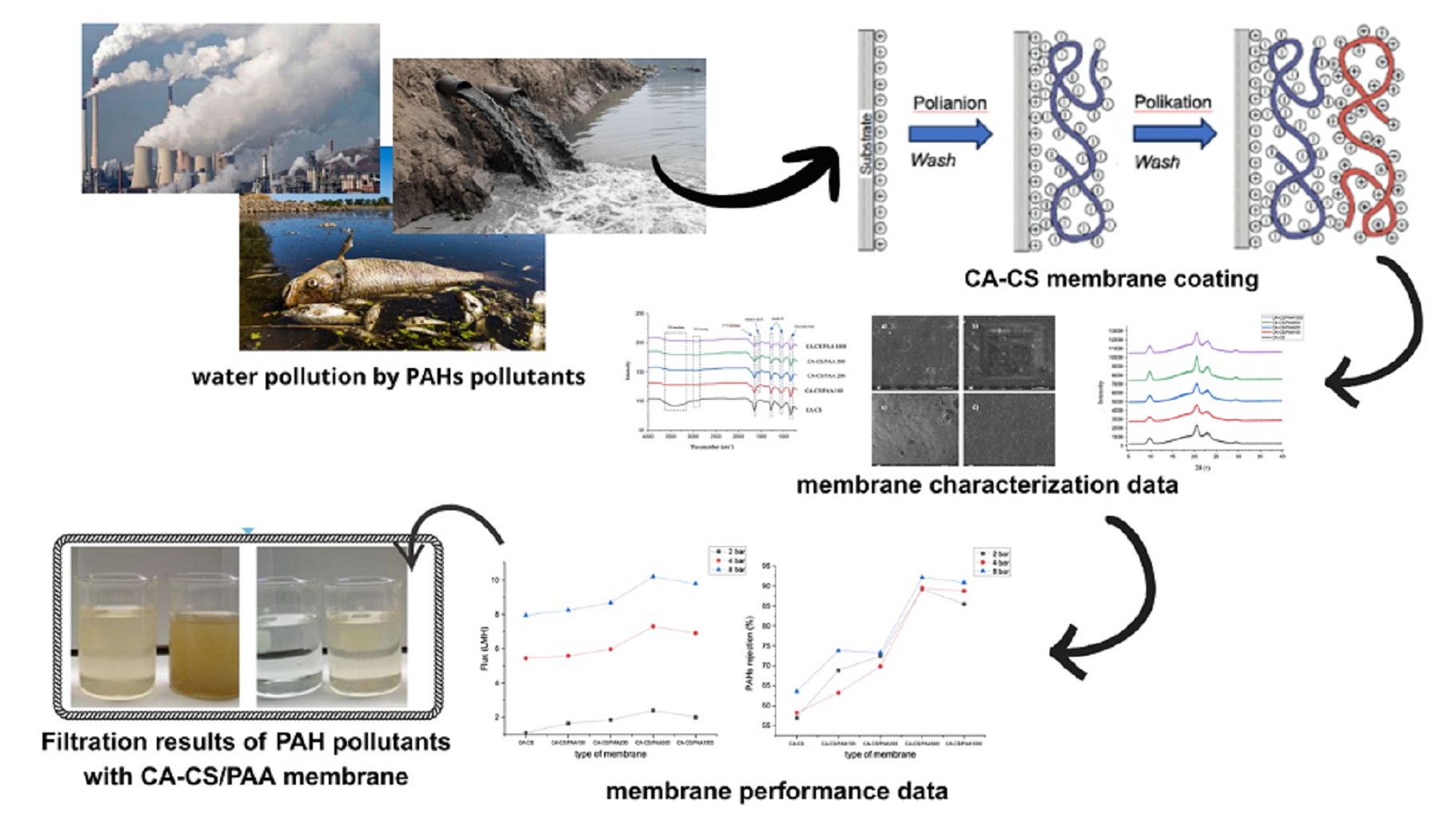
The separation of Polycyclic Aromatic Hydrocarbons (PAHs) from wastewater is essential due to its mutagenic and carcinogenic properties. Cellulose acetate-chitosan membranes (CA-CS) coated with polyelectrolyte complex poly(acrylic-acid) (PAA) at various concentrations (100, 200, 500 and 1,000 ppm) have been synthesized to improve the separation performance of PAHs. Fourier Transform Infrared (FTIR) characterization confirms the formation of polyelectrolyte complex PAA-CS through NH₃⁺/COO⁻ ion pairs (strengthening of the bands 1,560 - 1,600 and 1,410 cm−1 and attenuation of C=O at 1,730 cm−1), while Scanning Electron Microscopy (SEM) analysis and surface contours show changes from a nodular surface of CA-CS membrane to a more homogeneous layer during the coating process. X-Ray diffraction patterns indicate structural regularity in the composition. The water contact angle decreased from 65.56° in CA-CS to 36.34° after PAA coating at 500 ppm, and the swelling index increased from 48.24% to 73.95% confirming the membrane’s hydrophilic nature after coating. Mechanically, tensile strength increased with increasing PAA concentration, due to physical cross-linking via hydrogen bonds that solidified the network. Membrane performance test showed that permeate flux and PAHs rejection increased after CA-CS coating and achieved the best performance at 500 ppm PAA across all operating pressures (2 - 8 bar) with an optimum flux of 11.56 L·m−2·h−1 and optimum PAHs rejection of > 90%. In addition, the CA-CS/PAA 500 membrane also showed the best antifouling properties with the lowest Flux Decline Ratio (FDR) of 20% and the highest Flux Recovery Ratio (FRR) of 78%. Ultimately, poly(acrylic acid)-coated cellulose acetate-chitosan biopolymer-based membranes have great potential for continuously and sustainably separating PAH pollutants from wastewater.
HIGHLIGHTS
The CA-CS membrane coated with a PAA complex polyelectrolyte offers anti-fouling properties, restoring flux to up to 78%, thereby providing benefits for long-term membrane use. This high anti-fouling property is due to the membrane’s superhydrophilic nature, which affects its ability to form a hydrated layer that provides a steric effect during filtration. In addition, the use of a cellulose acetate biopolymer combined with chitosan, then coated with a PAA complex polyelectrolyte and subsequently applied to the separation of PAH pollutants from wastewater, is the latest treasure in membrane technology studies, as far as the literature search has revealed.
GRAPHICAL ABSTRACT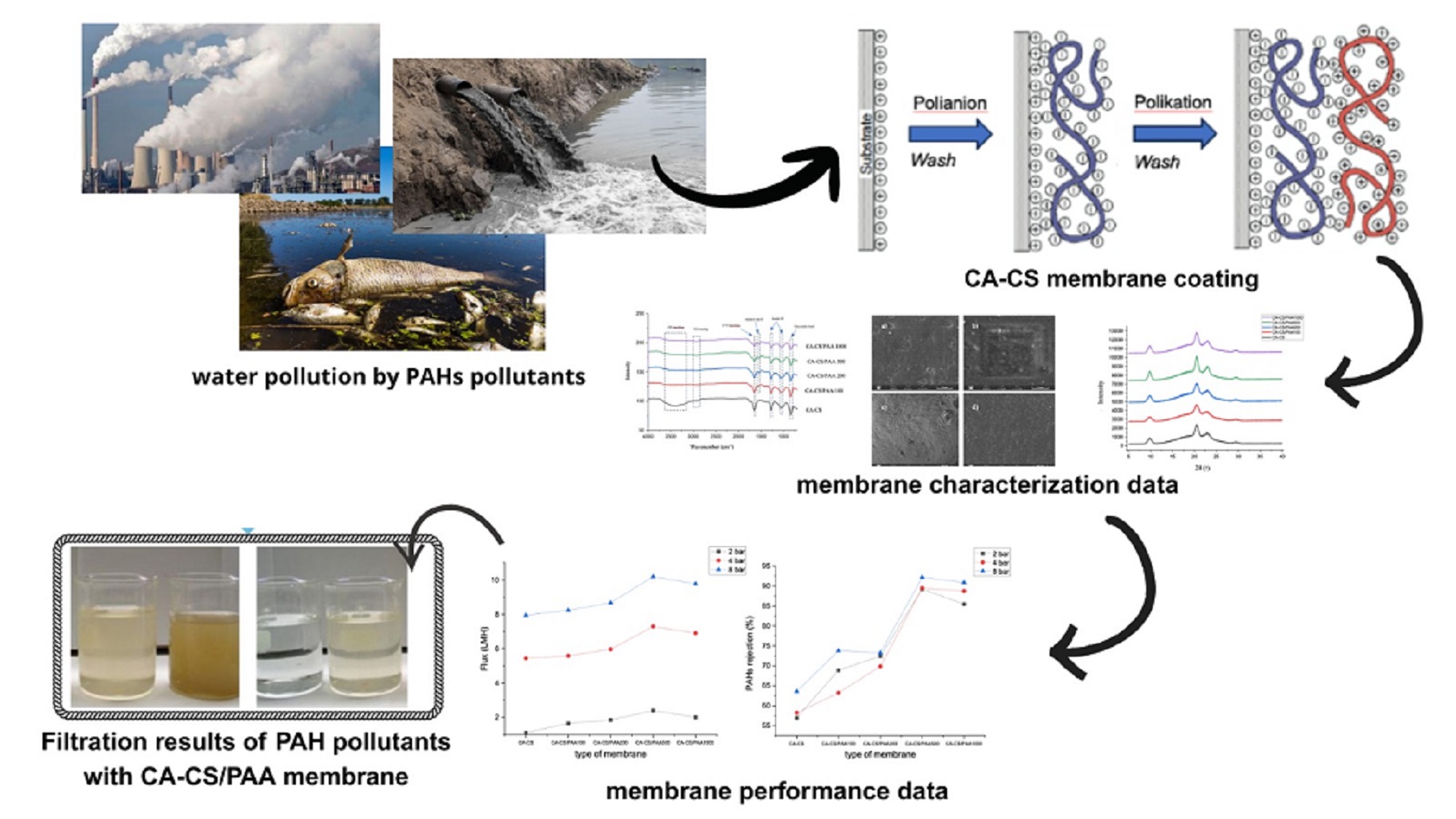
Downloads
References
IN Anyanwu, FD Sikoki and KT Semple. Risk assessment of PAHs and N-PAH analogues in sediment cores from the Niger Delta. Marine Pollution Bulletin 2020; 161, 111684.
J Conder, M Jalalizadeh, H Luo, A Bess, S Sande, M Healey and MA Unger. Evaluation of a rapid biosensor tool for measuring PAH availability in petroleum-impacted sediment. Environmental Advances 2021; 3, 100032.
V Soursou, J Campo and Y Picó. Revisiting the analytical determination of PAHs in environmental samples: An update on recent advances. Trends in Environmental Analytical Chemistry 2023; 37, e00195.
RE Jordan, MJ Cejas, HJ Costa, TC Sauer and LS McWilliams. PAH source differentiation between historical MGP and significant urban influences for sediments in San Francisco Bay. Marine Pollution Bulletin 2021; 166, 112248.
MA El-Alfy. Modeling environmental sensitivity and risk assessment of PAHs in sediments along two marine coastal areas in Egypt. Petroleum Research 2024; 9(1), 125-142.
P Takam, A Schäffer, S Laovitthayanggoon, W Charerntantanakul and P Sillapawattana. Toxic effect of polycyclic aromatic hydrocarbons (PAHs) on co-culture model of human alveolar epithelial cells (A549) and macrophages (THP-1). Environmental Sciences Europe 2024; 36(1), 176.
L Wu. Co-exposure effects of urinary polycyclic aromatic hydrocarbons and metals on lung function: Mediating role of systematic inflammation. BMC Pulmonary Medicine 2024; 24(1), 386.
J Potapowicz, M Szopińska, D Szumińska, RJ Bialik and Ż Polkowska. Sources and composition of chemical pollution in Maritime Antarctica (King George Island), part 1: Sediment and water analysis for PAH sources evaluation in the vicinity of Arctowski station. Chemosphere 2022; 288, 132637.
S He and Z Tang. Fabrication and control of porous structures via layer- by-layer assembly on PAH/PAA polyelectrolyte coatings. Biomedical Journal of Scientific and Technical Research 2023; 51(5), 43118-43121.
DW Kim, J Choi, D Kim and HT Jung. Enhanced water permeation based on nanoporous multilayer graphene membranes: The role of pore size and density. Journal of Materials Chemistry A 2016; 4(45), 17773-17781.
F Saffarimiandoab, BY Gul, RS Tasdemir, SE Ilter, S Unal, B Tunaboylu, YZ Menceloglu and İ Koyuncu. A review on membrane fouling: Membrane modification. Desalination and Water Treatment 2021; 216, 47-70.
M Lang, J Luo, Y Wan, X Wang, X Chen and G Zeng. Dual-functional reverse osmosis membranes: A novel Approach to Combat biofouling with enhanced antibacterial and Antiadhesion properties. Journal of Membrane Science 2025; 718, 123699.
Z Gao, L Xu, H Wang, X Wei, K Chen, W Wang, S Zhang and T Lin. Thermal lamination of electrospun nanofiber membrane with woven fabric and yarn embedding effect. Membranes 2025; 15(3), 95.
DP Utomo, TD Kusworo, AC Kumoro, Budiyono and TA Kurniawan. Current trend of MOFs incorporated membranes for advanced wastewater treatment. ASEAN Journal of Chemical Engineering 2023; 23(3), 370-399.
N Nasrollahi, L Ghalamchi, V Vatanpour and A Khataee. Photocatalytic-membrane technology: A critical review for membrane fouling mitigation. Journal of Industrial and Engineering Chemistry 2021; 93, 101-116.
IS Mir, A Riaz, J Fréchette, JS Roy, J Mcelhinney, S Pu, HK Balakrishnan, J Greener, LF Dumée and Y Messaddeq. Bacterial cellulose-graphene oxide composite membranes with enhanced fouling resistance for bio-effluents management. npj Clean Water 2024; 7, 111.
Z Bashir, SSM Lock, N e Hira, SU Ilyas, LG Lim, ISM Lock, CL Yiin and MA Darban. A review on recent advances of cellulose acetate membranes for gas separation. RSC Advances 2024; 14(27), 19560-19580.
A Mojiri, JL Zhou, A Ohashi, N Ozaki and T Kindaichi. Comprehensive review of polycyclic aromatic hydrocarbons in water sources, their effects and treatments. Science of The Total Environment 2019; 696, 133971.
Z Dai, L Ansaloni and L Deng. Recent advances in multi-layer composite polymeric membranes for CO2 separation: A review. Green Energy & Environment 2016; 1(2), 102-128.
A Bilal. Enhancing water purification by integrating titanium dioxide nanotubes into polyethersulfone membranes for improved hydrophilicity and anti-fouling performance. Membranes 2024; 14(5), 116.
D Kadadou, T Arumugham, L Tizani and SW Hasan. Enhanced antifouling and separation capabilities of polydopamine@Ce-MOF functionalized PES ultrafiltration membrane. npj Clean Water 2024; 7(1), 7.
L Zhu. Graphene oxide composite membranes for water purification. ACS Applied Nano Materials 2022; 5(3), 3643-3653.
H Xiao, Z Zhang, S Feng, X Wang and L Wu. Application and prospects of metal-organic frameworks in photocatalytic self-cleaning membranes for wastewater treatment. Journal of Materials Chemistry A 2024; 12(45), 31059-31073.
U Baig, A Waheed, HA Salih, A Matin, A Alshami and IH Aljundi. Facile modification of NF membrane by multi-layer deposition of polyelectrolytes for enhanced fouling resistance. Polymers 2021; 13(21), 3728.
I Ounifi. Antifouling membranes based on Cellulose Acetate (CA) blended with poly(acrylic acid) for heavy metal remediation. Polymers 2021; 11(10), 4354.
C Bai, Z Gu, P Li, R Ning and S Yu. A novel salt-swelling nanofiltration membranes for drinking water purification: High mineral ions passage and efficient organic removal. Journal of the Taiwan Institute of Chemical Engineers 2024; 159, 105473.
OK Turk, M Cakmakci, IH Zengin, D Karadag and E Yuksel. Improving PFAS rejection by ultrafiltration membranes via polyelectrolyte multilayer coating. Membranes 2025; 15(6), 172.
V Kayadoe, N Widiastuti, T Gunawan, WNW Salleh, H Fansuri, TQ Romadiansyah and AW Pratama. Fabrication of PSf/P84-blended membranes with low P84 content: Characteristics and gas separation performance. Case Studies in Chemical and Environmental Engineering 2024; 10, 100835.
M Ahmad, M Ahmed, A Ali, TA Wani, K Khalid and I Ali. Effect of the polyelectrolyte multilayers’ charge on water splitting, fluxes of ions, selectivities and current efficiencies in ion transport through membranes. Desalination 2024; 587, 117925.
C Lee, S Lee and SW Kang. Enhanced porous membrane fabrication using cellulose acetate and citric acid: Improved structural integrity, thermal stability, and gas permeability. Carbohydrate Polymers 2024; 324, 121571.
MS Shalaby. Development of highly flux antifouling RO polyethersulfone membranusing compacted woven support. Desalination and Water Treatment 2018; 127, 83-89.
S Hasima and N Kamila. Cellulose acetate from palm oil bunch waste for forward osmosis membrane in desalination of brackish water. Results in Engineering 2022; 15, 100611.
MA Junker, E te Brinke, CM Vall Compte, RGH Lammertink, J de Grooth and WM de Vos. Asymmetric polyelectrolyte multilayer nanofiltration membranes: Structural characterisation via transport phenomena. Journal of Membrane Science 2023; 681, 121718.
J Rana, G Goindi, N Kaur, S Krishna and A Kakati. Synthesis and application of cellulose acetate-acrylic acid-acrylamide composite for removal of toxic methylene blue dye from aqueous solution. Journal of Water Process Engineering 2022; 49, 103102.
AS Figueiredo, MG Sánchez-Loredo, MN de Pinho and M Minhalma. Surface-charge characterization of nanocomposite cellulose acetate/silver membranes and BSA permeation performance. Membranes 2025; 15(2), 61.
M Fathy, HR Ali, YM Moustafa and A El Shahawy. Removal of suspended matter and salts on ultrafiltration cellulose acetate/expanded polystyrene waste grafted PEG composite membrane. Desalination and Water Treatment 2020; 197, 30-40.
J Wolfs, FCM Scheelje, O Matveyeva and MAR Meier. Determination of the degree of substitution of cellulose esters via ATR-FTIR spectroscopy. Journal of Polymer Science 2023; 61(21), 2697-2707.
KLM Taaca, H Nakajima, K Thumanu, EI Prieto and MR Vasquez. Network formation and differentiation of chitosan–acrylic acid hydrogels using X-ray absorption spectroscopy and multivariate analysis of Fourier transform infrared spectra. Journal of Electron Spectroscopy and Related Phenomena 2023; 267, 14732.
J Rana, G Goindi, N Kaur, S Krishna and A Kakati. Synthesis and application of cellulose acetate-acrylic acid-acrylamide composite for removal of toxic methylene blue dye from aqueous solution. Journal of Water Process Engineering 2022; 49, 103102.
Z Sun. Enhancement of antifouling and separation properties of poly(m-phenylene isophthalamide) hybrid ultrafiltration membrane using highly crystalline poly(heptazine imide) nanosheets. Journal of Membrane Science 2025; 713, 123340.
C Li, T Rui, F He, M Liao, J Dai and T Mo. Improving the desalination performance through conical nanochannels of multilayer oxidized graphene membranes by making a trade-off between the water permeability and salt rejection. Desalination 2026; 617, 119432.
M Ahmad, M Ahmed, A Ali, TA Wani, K Khalid and I Ali. Effect of the polyelectrolyte multilayers’ charge on water splitting, fluxes of ions, selectivities and current efficiencies in ion transport through membranes. Desalination 2024; 617, 119432.
BH Vilsinski, AC de Oliveira, PR Souza and AF Martins. Polysaccharide-based polyelectrolyte multilayers fabricated via layer-by-layer approach: From preparation to applications. Progress in Organic Coatings 2024; 196, 108720.
TA Nguyen, TH Do and TD Ha. Multifunctional biocomposite membrane of bacterial cellulose/chitosan incorporated with green tea leaf extract as a smart colorimetric sensor for sustainable packaging. Trends in Sciences 2025; 22(10), 10667
SA Jasim, NML Al Maimuri, A Hashim, MH Abbas, A Hadi and H Ibrahim. Fabrication and enhancing the features of chitosan/SnO2-ZnO nanocomposites films for optoelectronics and biological applications. Trends in Sciences 2025; 22(10), 10534.
S Javed, IH Aljundi and M Khaled. High fouling-resistance of polyamide desalination-membrane modified with PEI/PAH polyelectrolyte multilayers. Journal of Environmental Chemical Engineering 2017; 5(5), 4594-4604.
MR Moradi. Polyelectrolyte multilayers modification of nanofiltration membranes to improve selective separation of mono- and multivalent cations in seawater brine. Journal of Membrane Science 2024; 691, 122224.
WA Jonkers, WM de Vos and E te Brinke. Asymmetric polyelectrolyte multilayer membranes: Influence of bottom section polycation on layer growth and retention mechanisms. Journal of Membrane Science 2024; 698, 122577.
C Wang, GK Such, A Widjaya, H Lomas, G Stevens, F Caruso and SE Kentish. Click poly(ethylene glycol) multilayers on RO membranes: Fouling reduction and membrane characterization. Journal of Membrane Science 2012; 409, 9-15.
JA Regenspurg, WA Jonkers, MA Junker, I Achterhuis, E te Brinke and WM de Vos. Polyelectrolyte multilayer membranes: An experimental review. Desalination 2024; 583, 117693.
S Ruangdit. Enhanced surface hydrophilicity of polysulfone membrane via atmospheric pressure plasma jet: a comparative evaluation with low-pressure plasma. Trends in Sciences 2025; 22(10), 10629.
MA Abbas. Surface modification of TFC-PA RO membrane by grafting hydrophilic pH switchable poly(acrylic acid) brushes. Advances in Polymer Technology 2020; 2020(1), 8281058.
V Yadav, AV Harkin, ML Robertson and JC Conrad. Hysteretic memory in pH-response of water contact angle on poly(acrylic acid) brushes. Soft Matter 2016; 12(15), 3589-3599.
MD Rossary, JKP Djunaedi, TP Riyantoro and A Setiawati. Tailoring strategy of chitosan-based hydrogel for improving wound healing: A systematic review. Trends in Sciences 2025; 22(11), 11023.
M Kang, Y Zhang, X Ding, J Xu and X Pang. Binding and activating of analgesic crotalphine with human TRPA1. Membranes 2025; 15(6), 187.
IA Khan, AU Khan, MS Butt, HA Janjua, E Uddin, KM Deen, R Sadiq and NM Ahmad. Dye removal from contaminated water through PES membranes enhanced with the incorporation of switchable polyacrylic acid grafted on graphene oxide. ACS Omega 2025; 10(26), 28178-28190.
RS Azam. MXene (Ti3C2Tx)/cellulose acetate mixed-matrix membrane enhances fouling resistance and rejection in the crossflow filtration process. Membranes 2022; 12(4), 406.
X Chen, Z Feng, J Gohil, CM Stafford, N Dai, L Huang and H Lin. Reduced holey graphene oxide membranes for desalination with improved water permeance. ACS Applied Materials & Interfaces 2020; 12(1), 1387-1394.
XL Xu, FW Lin, Y Du, X Zhang, J Wu and ZK Xu. Graphene oxide nanofiltration membranes stabilized by cationic porphyrin for high salt rejection. ACS Applied Materials & Interfaces 2016; 8(20), 12588-12593.
K Zhang, P Cheng, Y Liu and S Xia. Efficient removal of per- and polyfluoroalkyl substances by a metal-organic framework membrane with high selectivity and stability. Water Research 2024; 265, 122276.
J Wang, B Mou and S Wu. Reduction of polycyclic aromatic hydrocarbon (PAH) toxicity risks in crude rice bran oil during storage using membrane filtration. Food Control 2025; 172, 111186.
H Guo, Y Peng, Y Liu, Z Wang, J Hu, J Liu, Q Ding and J Gu. Development and investigation of novel antifouling cellulose acetate ultrafiltration membrane based on dopamine modification. International Journal of Biological Macromolecules 2020; 160, 652-659.
Published
How to Cite
Issue
Section
License
Copyright (c) 2025 Walailak University

This work is licensed under a Creative Commons Attribution-NonCommercial-NoDerivatives 4.0 International License.





