
The Synthesis of Activated Carbon from Agricultural Residues for Application as an Adsorbent Via Easy Method and Using the Innovative Simple Biomass Incinerator
DOI:
https://doi.org/10.48048/tis.2025.10189Keywords:
Activated carbon, Rubberwood twigs, Adsorbent, Iodine adsorption value, Innovative simple biomass incineratorAbstract
Activated carbon is widely used in environmental and industrial applications due to its high adsorption capacity. This research aimed to utilize agricultural waste materials—rubber wood twigs, rubber seed pods, Leucaena leucocephala wood, and coconut shells—as precursors for the production of activated carbon, addressing the increasing need for low-cost and sustainable adsorbents. Both dry and wet chemical activation methods were employed using sodium hydroxide (NaOH) in conjunction with a biomass incinerator. Among all the samples, activated carbon derived from rubber wood twigs (AC/rwt) via dry activation demonstrated the most favorable properties. Comprehensive characterization was conducted using X-ray diffraction (XRD), Brunauer–Emmett–Teller (BET) surface area analysis, transmission electron microscopy (TEM), energy-dispersive X-ray spectroscopy (EDS), scanning electron microscopy (SEM), and Fourier-transform infrared spectroscopy (FT-IR). Adsorption efficiency was evaluated through iodine number measurement and methylene blue adsorption tests. The AC/rwt sample exhibited a specific surface area of 726.60 m²/g, an iodine number of 616.73 mg/g, and a methylene blue adsorption efficiency of 99.65 %, which complies with Thailand’s industrial standard TIS 900 - 2004. Elemental analysis confirmed that carbon was the predominant element in all samples. Additionally, the pore size distribution indicated mesoporous structures ranging from 2 - 50 nm. Although commercial activated carbon outperformed in some metrics (950.02 m²/g surface area, 743.77 mg/g iodine number, and 100 % methylene blue adsorption), this study demonstrates that agricultural waste can be successfully converted into high-quality activated carbon suitable for diverse adsorbent applications.
HIGHLIGHTS
- Activated carbon from rubber wood twigs (AC/rwt) has 726.60 m²/g porosity, 616.73 mg/g iodine, surpassing Thai standards.
- AC/rwt shows 99.65 % methylene blue adsorption, proving effective use of waste for high-performance adsorbents.
- Though slightly lower than commercial counterparts, AC/rwt meets TIS standards, showcasing agricultural wastes potential for sustainable activated carbon production.
GRAPHICAL ABSTRACT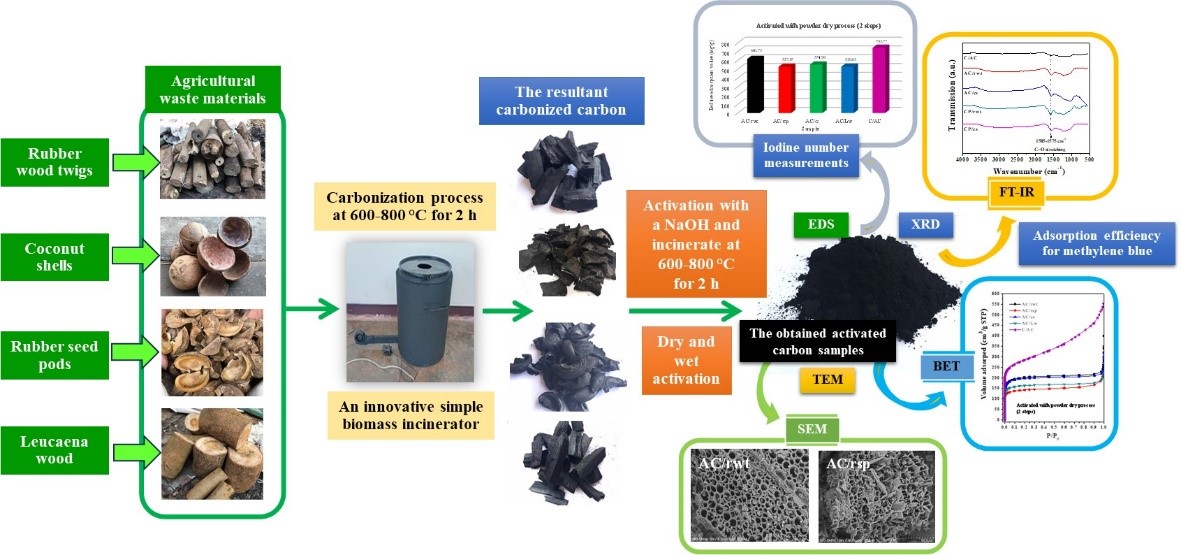
Downloads
References
Y Ngernyen and K Kamwilaisak. Activated carbon from Thailand’s biomass: A review literature. Engineering and Applied Science Research 2014; 40(2), 267-283.
N Khadhri, MEK Saad, MB Mosban and Y Moussaoui. Batch and continuous column adsorption of indigo carmine onto activated carbon derived from date palm petiole. Journal of Environmental Chemical Engineering 2019; 7(1), 102775.
K Kusmierek, A Swiątkowski, T Kotkowski, R Cherbanski and E Molga. Adsorption on activated carbons from end-of-life tyre pyrolysis for environmental applications. Part II. Adsorption from aqueous phase. Journal of Analytical and Applied Pyrolysis 2021; 158, 105206.
A Jantaboot, A Bunkham and P Aggarangsi. Production of activated carbon from corncob by combined phosphoric acid and carbon dioxide activation. Thai Science and Technology Journal 2023; 31(5), 94-107.
N Muttil, S Jagadeesan, S Chanda, M Duke and SK Singh. Production, types, and applications of activated carbon derived from waste tyres: An overview. Applied Sciences 2023; 13(1), 257.
C Bouchelta, MS Medjram, O Bertrand and J Bellat. Preparation and characterization of activated carbon from date stones by physical activation with steam. Journal of Analytical and Applied Pyrolysis 2008; 82(1), 70-77.
MJ Prauchner and F Rodriguez-Reinoso. Chemical versus physical activation of coconut shell: A comparative study. Microporous and Mesoporous Materials 2012; 152, 163-171.
AA Ceyhan, O Sahin, O Baytar and C Saka. Surface and porous characterization of activated carbon prepared from pyrolysis of biomass by two-stage procedure at low activation temperature and its adsorption of iodine. Journal of Analytical and Applied Pyrolysis 2013; 104, 378-383.
H Hadoun, Z Sadaoui, N Souami, D Sahel and I Toumert. Characterization of mesoporous carbon prepared from date stems by H₃PO₄ chemical activation. Applied Surface Science 2013; 280, 1-7.
EM Mistar, T Alfatah and MD Supardan. Synthesis and characterization of activated carbon from Bambusa vulgaris striata using two-step KOH activation. Journal of Materials Research and Technology 2020; 9(3), 6278-6286.
J Xu, J Yu, J Xu, C Shi, W Hu, J Hu and G Li. High-value utilization of waste tires: A review with focus on modified carbon black from pyrolysis. Science of The Total Environment 2020; 742, 140235.
I Jones, M Zhang, J Zhang, Z Zhang, J Penteado, J Gu and D Zhang. The application of spent tyre activated carbons as low-cost environmental pollution adsorbents: A technical review. Journal of Cleaner Production 2021; 312, 127566.
A Thammayod, W Roschat, T Leelatam, S Phewphong, B Maneerat, N Leelatam, A Thangthong, P Moonsin and V Promarak. Development of high-quality organic fertilizer from biomass waste and the application of biochar in local areas of Sakon Nakhon Province, Northeastern Thailand. Trends in Sciences 2025; 22(2), 9105.
W Roschat, S Donrussamee, P Smanmit, S Jikjak, T Leelatam, S Phewphong, K Namwongsa, P Moonsin and V Promarak. Quality improvement of crude glycerol from biodiesel production using activated carbon derived from Krabok (Irvingia malayana) seed shells. Korean Journal of Materials Research 2024; 34(1), 1-11.
AR Tobi, JO Dennis, HM Zaid, AA Adekoya and U Fahad. Comparative analysis of physiochemical properties of physically activated carbon from palm bio-waste. Journal of Materials Research and Technology 2019; 8(5), 3688-3695.
V Yang, RA Senthil, J Pan, A Khan, S Osman, L Wang, W Jiang and Y Sun. Highly ordered hierarchical porous carbon derived from biomass waste mangosteen peel as superior cathode material for high performance supercapacitor. Journal of Electroanalytical Chemistry 2019; 855, 113616.
AL Cazetta, AMM Vargas, EM Nogami, MH Kunita, MR Guilherme, AC Martins, TL Silva, JCG Moraes and VC Almeida. NaOH-activated carbon of high surface area produced from coconut shell: Kinetics and equilibrium studies from the methylene blue adsorption. Chemical Engineering Journal 2011; 174(1), 117-125.
T Sarawanan, NS Mahat, MN Rusli and MAA Zaini. Two-stage adsorber optimization of NaOH-prewashed oil palm empty fruit bunch activated carbon for methylene blue removal. Chemical Product and Process Modeling 2023; 18(3), 383-390.
MA Yahya, CW Zanariah, CW Ngah, MA Hashim and Z Al-Qodah. Preparation of activated carbon from desiccated coconut residue by chemical activation with NaOH. Journal of Materials Science Research 2016; 5(1), 24-31.
TA Khan, R Rahman and EA Khan. Adsorption of malachite green and methyl orange onto waste tyre activated carbon using batch and fixed-bed techniques: Isotherm and kinetics modeling. Modeling Earth Systems and Environment 2017; 3, 38.
S Lv, C Li, J Mi and H Meng. A functional activated carbon for efficient adsorption of phenol derived from pyrolysis of rice husk, KOH-activation and EDTA-4Na-modification. Applied Surface Science 2020; 510, 145425.
D Pathania, S Sharma and P Singh. Removal of methylene blue by adsorption onto activated carbon developed from Ficus carica bast. Arabian Journal of Chemistry 2017; 10(1), S1445-S1451.
Z Xu, J Chen, X Zhang, Q Song, J Wu, L Ding, C Zhang, H Zhu and H Cui. Template-free preparation of nitrogen-doped activated carbon with porous architecture for high-performance supercapacitors. Microporous and Mesoporous Materials 2019; 276, 280-291.
B Wang, J Qiu, H Feng, E Sakai and T Komiyama. KOH-activated nitrogen doped porous carbon nanowires with superior performance in supercapacitors. Electrochimica Acta 2016; 190, 229-239.
TM Dao and LL Tran. Synthesis of activated carbon from macadamia nutshells activated by H₂SO₄ and K₂CO₃ for methylene blue removal in water. Bioresource Technology Reports 2020; 12, 100583.
RJ Ramalingam, M Sivachidambaram, JJ Vijaya, HA Al-Lohedan and MR Muthumareeswaran. Synthesis of porous activated carbon powder formation from fruit peel and cow dung waste for modified electrode fabrication and application. Biomass and Bioenergy 2020; 142, 105800.
S Rovani, AG Rodrigues, LF Medeiros, R Cataluna, EC Lima and AN Fernandes. Synthesis and characterization of activated carbon from agroindustrial waste-preliminary study of 17β-estradiol removal from aqueous solution. Journal of Environmental Chemical Engineering 2016; 4(2), 2128-2137.
A Kumar and HM Jena. Preparation and characterization of high surface area activated carbon from Fox nut (Euryale ferox) shell by chemical activation with H₃PO₄. Results in Physics 2016; 6, 651-658.
E Santoso, R Ediati, Y Kusumawati, H Bahruji, DO Sulistiono and D Prasetyoko. Review on recent advances of carbon-based adsorbent for methylene blue removal from wastewater. Materials Today Chemistry 2020; 16, 100233.
MJ Ahmed and SK Theydan. Microporous activated carbon from Siris seed pods by microwave-induced KOH activation for metronidazole adsorption. Journal of Analytical and Applied Pyrolysis 2013; 99, 101-109.
Y Luo, J Street, P Steele, E Entsminger and V Guda. Activated carbon derived from pyrolyzed pinewood char using elevated temperature, KOH, H3PO4, and H2O2. BioResources 2016; 11(4), 10433-10447.
M Blachnio, A Derylo-Marczewska, B Charmas, M Zienkiewicz-Strzalka, V Bogatyrov and M Galaburda. Activated carbon from agricultural wastes for adsorption of organic pollutants. Molecules 2020; 25(21), 5105.
LKCD Souza, JC Martins, DP Oliveira, CS Ferreira, AAS Gonçalves, RO Araujo, JDS Chaar, MJF Costa, DV Sampaio, RR Passos and LA Pocrifka. Hierarchical porous carbon derived from acai seed biowaste for supercapacitor electrode materials. Journal of Materials Science: Materials in Electronics 2020; 31, 12148-12157.
Y Elmaguana, N Elhadiri, M Bouchdoug, M Benchanaa and A Jaouad. Optimization of preparation conditions of activated carbon from walnut cake using response surface methodology. Moroccan Journal of Chemistry 2018; 6, 92-105.
M Thommes, K Kaneko, AV Neimark, JP Olivier, F Rodriguez-Reinoso, J Rouquerol and KSW Sing. Physisorption of gases, with special reference to the evaluation of surface area and pore size distribution (IUPAC Technical Report). Pure and Applied Chemistry 2015; 87(9-10), 1051-1069.
AI Osman, J Blewitt, JK Abu-Dahrieh, C Farrell, AH Al-Muhtaseb, J Harrison and DW Rooney. Production and characterization of activated carbon and carbon nanotubes from potato peel waste and their application in heavy metal removal. Environmental Science and Pollution Research 2019; 26, 37228-37241.
MS Shamsuddin, NRN Yusoff and MA Sulaiman. Synthesis and characterization of activated carbon produced from kenaf core fiber using H₃PO₄ activation. Procedia Chemistry 2016; 19(9), 558-565.
D Bergna, T Varila, H Romar and U Lassi. Comparison of the properties of activated carbons produced in one-stage and two-stage processes. Journal of Carbon Research 2018; 4(3), 41.
KY Foo and BH Hameed. Preparation of activated carbon from date stones by microwave-induced chemical activation: Application for methylene blue adsorption. Chemical Engineering Journal 2011; 170(1), 338-344.
HR Pouretedal and N Sadegh. Effective removal of amoxicillin, cephalexin, tetracycline and penicillin G from aqueous solutions using activated carbon nanoparticles prepared from vine wood. Journal of Water Process Engineering 2014; 1, 64-73.
H Boulika, ME Hajam, MH Nabih, NI Kandria and A Zerouale. Activated carbon from almond shells using an eco-compatible method: Screening, optimization characterization, and adsorption performance testing. RSC Advances 2022; 12(53), 34393-34403.
NS Abdullah, MH Hussin, S Sharifuddin and MAM Yusoff. Preparation and characterization of activated carbon from Moringa oleifera seed pod. Science International 2017; 29(1), 7-11.
PJ Osvaldo, LC Andre, CG Ralph, OB Erica, IPAF Souza, AC Martins, T Asefa and VC Almeida. Synthesis of ZnCl₂ activated carbon from macadamia nut endocarp (Macadamia integrifolia) by microwave-assisted pyrolysis: Optimization using RSM and methylene blue adsorption. Journal of Analytical and Applied Pyrolysis 2014; 105, 166-176.
WM El-Sayed, MH El-Kalyoubi, MM Mostafa and SA Farghal. Nutritional evaluation of roselle (Hibiscus sabdariffa L.) and its application in biscuit supplementation. Arab Universities Journal of Agricultural Sciences 2019; 27(5), 2563-2572.
SO Salami and AJ Afolayan. Evaluation of nutritional and elemental compositions of green and red cultivars of roselle: Hibiscus sabdariffa L. Scientific Reports 2021; 11, 1030.
S Phewphong, W Roschat, K Namwongsa, A Wonam, T Kaisri, P Duangpakdee, T Leelatam, P Moonsin and V Promarak. Evaluation of the nutritional, minerals, and antioxidant potential of roselle (Hibiscus sabdariffa Linn.) seeds from Roi Et Province in the Northeastern Region of Thailand. Trends in Sciences 2023; 20(6), 6664.
Published
How to Cite
Issue
Section
License
Copyright (c) 2025 Walailak University

This work is licensed under a Creative Commons Attribution-NonCommercial-NoDerivatives 4.0 International License.





