
In-Situ Synthesis of AgNPs using Boesenbergia Rotunda L. Extract as Reducing Agent Development of Antibacterial and UV Protective Muslin Fabrics
DOI:
https://doi.org/10.48048/tis.2025.9476Keywords:
Antimicrobial, Fingerroot, Muslin fabric, Silver nanoparticlesAbstract
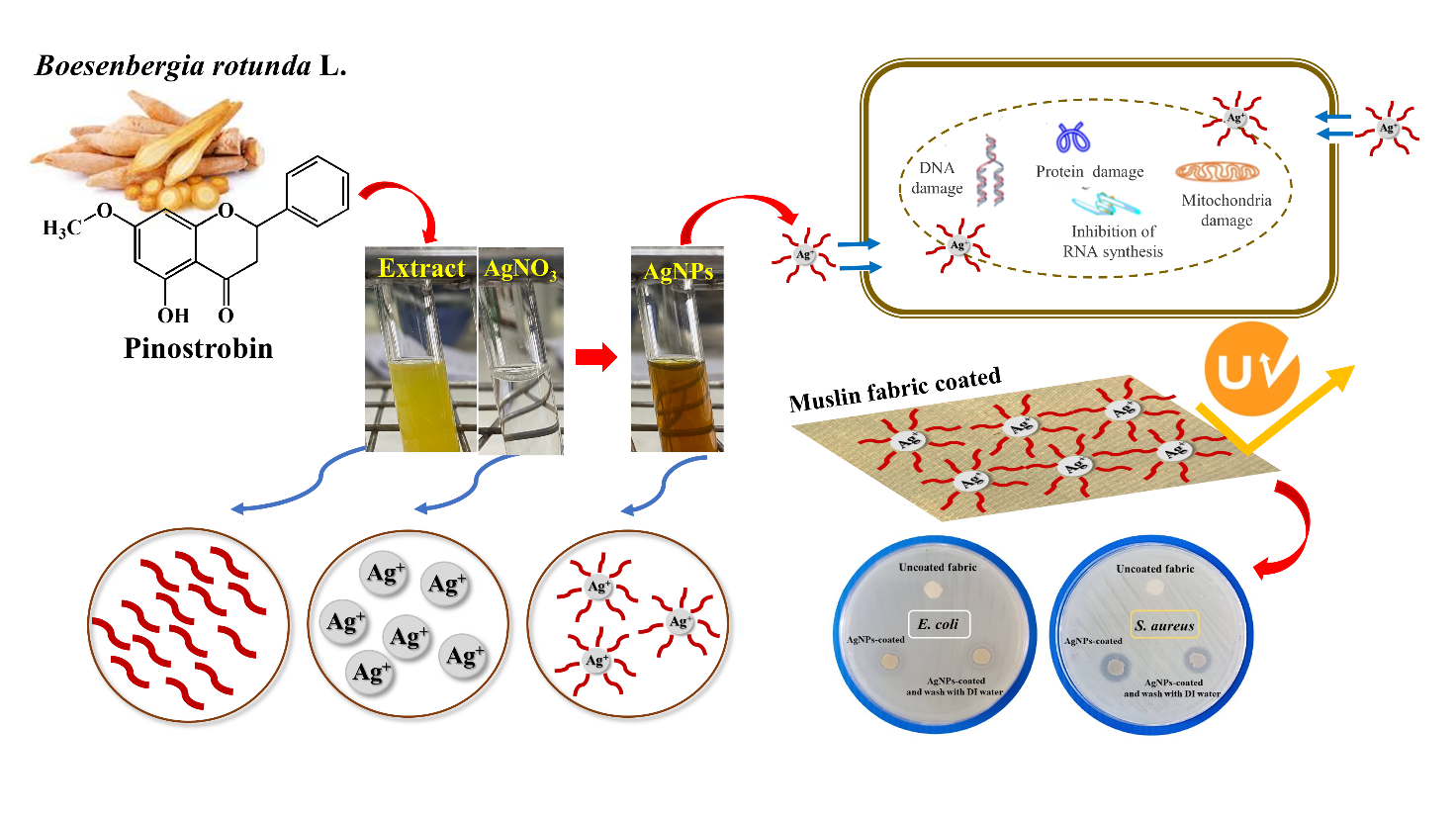
Muslin fabrics functionalized with silver nanoparticles (AgNPs) need to be produced via green synthesis to protect against ultraviolet (UV) radiation and antibacterial activity. In this study, we performed the green synthesis of AgNPs functionalized with fingerroot (Boesenbergia rotunda (L.) Mansf.) extract. The main bioactive component of fingerroot was investigated via GC-MS. The primary ingredient in fingerroot, pinostrobin, was shown to be the most prevalent, based on the GC-MS data. An eco-friendly approach involves obtaining such textile materials by AgNP synthesis directly (in situ) on muslin fabrics. The chemical linkages of colloidal AgNPs to the cellulosic structure were characterized and confirmed by FTIR, SEM, and EDX analyses. Compared to uncoated muslin fabric, AgNP-coated fabric provides excellent protection, with a UV protection factor (UPF) value of 43.30 and Insufficient protection, with a UPF value of 6.42. The antibacterial activity of AgNP-coated fabric was investigated, revealing greater inhibitory effects against Staphylococcus aureus (gram-positive) and Escherichia coli (gram-negative) microbial strains. A wash durability test was also performed on the treated fabric, and the findings showed that it could maintain strong antibacterial activity for up to 10 wash cycles. All of these findings pointed to the AgNPs produced in this study as a potentially useful ingredient for creating fabrics with strong antibacterial and UV protection properties.
HIGHLIGHTS
- Green synthesis of silver nanoparticles (AgNPs) functionalized with fingerroot extract was performed, with pinostrobin identified as the primary bioactive component through GC-MS analysis.
- AgNP-coated muslin fabric exhibited excellent UV protection (UPF 43.30) and effective antibacterial activity against Staphylococcus aureus and Escherichia coli microbial strains.
- The AgNP coating demonstrated durability, retaining superior bacterial inhibitory activity even and UV protection ability after 10 wash cycles. Highlighting its promising material for preparing textiles with good antibacterial activity and UV protection.
GRAPHICAL ABSTRACT

Downloads
References
X Han and X Gong. In situ one-pot method to prepare robust superamphiphobic cotton fabrics for high buoyancy and good antifouling. ACS Applied Materials and Interfaces 2021; 13(26), 31298-31309.
X Zhang, P Li, Z Liu and H Wang and P Zhu. Eco-friendly multifunctional coating for polyester-cotton blended fabrics with superior flame retardancy and antibacterial properties. International Journal of Biological Macromolecules 2024; 271(2), 132407.
BW Hartanto and DS Mayasari. Environmentally friendly non-medical mask: An attempt to reduce the environmental impact from used masks during COVID 19 pandemic. Science of the Total Environment, 2021; 760(4), 144143.
CM Clase, EL Fu, A Ashur, RC Beale, IA Clase, MB Dolovich, MJ Jardine, M Joseph, G Kansiime, JFE Mann, R Pecoits-Filho, WC Winkelmayer and JJ Carrero. Forgotten technology in the COVID-19 pandemic: Filtration properties of cloth and cloth masks-a narrative review. Mayo Clinic Proceedings 2020; 95(10), 2204-2224.
M Rehan, HM Mashaly, MS Abdel‑Aziz, RM Abdelhameed and AS Montaser. Viscose fibers decorated with silver nanoparticles via an in‑situ green route: UV protection, antioxidant activities, antimicrobial properties, and sensing response. Cellulose 2024; 31, 5899-5930.
P Sundararajan and SP Ramasamy. Development of sustainable, eco-friendly antimicrobial finishing of cotton fabric using prodigiosin of Serratia marcescens SP1. Progress in Organic Coatings 2024; 188, 108216.
AV Mueller, MJ Eden, JM Oakes, C Bellini and LA Fernandez. Quantitative method for comparative assessment of particle removal efficiency of fabric masks as alternatives to standard surgical masks for PPE. Matter 2020; 3(3), 950-962.
X Luo, Z Li, J Shen, L Liu, H Chen, Z Hu, I Krucinska and J Yao. A facile strategy to achieve efficient flame-retardant cotton fabric with durable and restorable fire resistance. Chemical Engineering Journal 2022; 430(3), 132854.
N Rahmatian, S Abbasi, MT Yaraki and N Abbasi. Echinophora platyloba extract-mediated green synthesis of silver nanoparticles: Fine-tuning the size towards enhanced catalytic and antibacterial properties. Journal of Molecular Liquids 2023; 391(A), 123327.
S Patel and N Patel. Tectona grandis seed mediated green synthesis of silver nanoparticles and their antibacterial activity. Trends in Sciences. 2023; 20(5), 5104.
MM El-Zawahry, HS El-Khatib, GM Shokry and HG Rashad. One-pot robust dyeing of cotton fabrics with multifunctional chamomile flower dyes. Fibers and Polymers 2022; 23(8), 2234-2249.
P Szczyglewska, A Feliczak-Guzik and I Nowak. Nanotechnology-general aspects: A chemical reduction approach to the synthesis of nanoparticles. Molecules 2023; 28(13), 4932.
G Rajkumar and R Sundar. Sonochemical-assisted eco-friendly synthesis of silver nanoparticles (AgNPs) using avocado seed extract: Naked-eye selective colorimetric recognition of Hg2+ ions in aqueous medium. Journal of Molecular Liquids 2022; 368(A), 120638.
S Anis, WC Liew, AM Marsin, II Muhamad, SH Teh and AZM Khudzari. Microwave-assisted green synthesis of silver nanoparticles using pineapple leaves waste. Cleaner Engineering and Technology 2023; 15(1), 100660.
MMI Masum, MM Siddiqa, KA Ali, Y Zhang, Y Abdallah, E Ibrahim and B Li. Biogenic synthesis of silver nanoparticles using Phyllanthus emblica fruit extract and its inhibitory action against the pathogen Acidovorax oryzae strain RS-2 of rice bacterial brown stripe. Frontiers in microbiology 2019; 10, 820.
Hemlata, PR Meena, AP Singh and KK Tejavath. Biosynthesis of silver nanoparticles using Cucumis prophetarum aqueous leaf extract and their antibacterial and antiproliferative activity against cancer cell lines. ACS omega 2020; 5(10), 5520-5528.
P Porrawatkul, R Pimsen, A Kuyyogsuy, N Teppaya, A Noypha, S Chanthai and P Nuengmatcha. Microwave-assisted synthesis of Ag/ZnO nanoparticles using Averrhoa carambola fruit extract as the reducing agent and their application in cotton fabrics with antibacterial and UV-protection properties. RSC Advances 2022; 12(24), 15008-15019.
Z Zulfiqar, R Rashad, M Khan, M Summer, Z Saeed, M Pervaiz, S Rasheed, B Shehzad, F Kabir and S Ishaq. Plant-mediated green synthesis of silver nanoparticles: Synthesis, characterization, biological applications, and toxicological considerations: A review. Biocatalysis and Agricultural Biotechnology, 2024; 57, (103121).
NQ Hop and NT Son. Boesenbergia rotunda (L.) Mansf.: A review of phytochemistry, pharmacology, and pharmacokinetics. Current Organic Chemistry 2023, 27(21), 1842-1856.
L Suhaimi, E Dwi, S Bahtiar, R Desiasni, F Widyawati and S Ali. Biosynthesis and characterization of micro structured zinc oxide (ZnO) thin films using fingerroot (Boesenbergia rotunda) extract by dip coating technique. AIP Conference Proceedings 2024; 3026, 030003.
P Wongwitthayakool and M Pudla. Thermal properties of acrylic resin denture base material containing silver nanoparticle synthesized from aqueous extract of Boesenbergia rotunda.
Key Engineering Materials 2018; 777, 173-177.
A Kara and B Ozcelik. Green synthesis of chitosan-coated silver nanoparticles (ch-agnps): harnessing nature for sustainable and safe nanomaterial production. Journal of The Institute of Science and Technology 2024; 7(3), 1319-1341.
JU Kim, MS Gong and JG Kim. Preparation of Ag/ZnO-coated cotton fabrics with UV blocking and antibacterials properties. Cellulose Chemistry and Technology 2018; 52(5-6), 475-484.
HT San, HEF Khine, B Sritularak, E Prompetchara, C Chaotham, CT Che and K Likhitwitayawuid. Pinostrobin: An adipogenic suppressor from fingerroot (Boesenbergia rotunda) and its possible mechanisms. Foods 2022; 11(19), 3024.
V Maduraimuthu, JK Ranishree, RM Gopalakrishnan, B Ayyadurai, R Raja and K Heese. Antioxidant activities of photoinduced phycogenic silver nanoparticles and their potential applications. Antioxidants 2023; 12(6), 1298.
M Nakhjavani, V Nikkhah, MM Sarafraz, S Shoja and M Sarafraz. Green synthesis of silver nanoparticles using green tea leaves: Experimental study on the morphological, rheological and antibacterial behaviour. Heat and Mass Transfer 2017; 53(10), 3201-3209.
BH Rathod, SS Rani, N Kartheek and AA Kumar. UV spectrophotometric method development and validation for the quantitative estimation of indinavir sulphate in capsules. International Journal of Pharmacy and Pharmaceutical Sciences 2014; 6(6), 598-601.
YM Kim, M Lubinska-Szczygeł, YS Park, J Deutsch, A Ezra, P Luksrikul, RMB Shafreen and S Gorinstein. Characterization of bioactivity of selective molecules in fruit wines by FTIR and NMR spectroscopies, fluorescence and docking calculations. Molecules 2023; 28(16), 6036.
NJ Elahi, S Masoud, T Danial, H Alireza and D Majid. Ammonia sensing and cytotoxicity of the biosynthesized silver nanoparticle by Arabic gum (AG). Recent Patents on Biotechnology 2019; 13(3), 228-238.
HR El-Seedi, MS Omara, AH Omar, MM Elakshar, YM Shoukhba, H Duman, S Karav, AK Rashwan, AH El-Seedi, HA Altaleb, H Gao, A Saeed, OA Jefri, Z Guo and SAM Khalifa. Updated review of metal nanoparticles fabricated by green chemistry using natural extracts: Biosynthesis, mechanisms, and applications. Bioengineering 2024; 11(11), 1095.
K Seku, SS Hussaini, M Hussain, MA Siddiqui, N Golla, R Dachepalli and B Reddy. Synthesis of Frankincense gum stabilized AgNPs by microwave irradiation and their catalytic, antioxidant, and antibacterial properties. Physica E: Low-Dimensional Systems and Nanostructures 2022; 140(1), 115169.
P Tooklang, S Audtarat, K Chaisen, J Thepsiri, A Chingsungnoen, P Jittabut and T Dasri. Functionalization of silver nanoparticles coating cotton fabrics through hydrothermal synthesis for improved antimicrobial properties. Nano Express 2024; 5(2), 025009.
SS Dash, S Samanta, S Dey, B Giri and SK Dash. Rapid green synthesis of biogenic silver nanoparticles using Cinnamomum tamala leaf extract and its potential antimicrobial application against clinically isolated multidrug-resistant bacterial strains. Biological Trace Element Research 2020; 198, 681-696.
P Sivaranjana, ER Nagarajan, N Rajini, N Ayrilmis, AV Rajulu and S Siengchin. Preparation and characterization studies of modified cellulosic textile fabric composite with in situ-generated AgNPs coating. Journal of Industrial Textiles 2021; 50(7), 1111-1126.
AH Labulo, OA Davi and AD Terna. Green synthesis and characterization of silver nanoparticles using Morinda lucida leaf extract and evaluation of its antioxidant and antimicrobial activity. Chemical Papers 2022; 76(12), 7313-7325.
PR More, S Pandit, AD Filippis, G Franci, I Mijakovic and M Galdiero. Silver nanoparticles: Bactericidal and mechanistic approach against drug resistant pathogens. Microorganisms 2023; 11(2), 369.
TS Kim, JR Cha and MS Gong. Investigation of the antimicrobial and wound healing properties of silver nanoparticle-loaded cotton prepared using silver carbamate. Textile Research Journal 2018; 88(7), 766-776.
OK Alebeid and T Zhao. Review on: Developing UV protection for cotton fabric. The Journal of the Textile Institute 2017, 108(12), 2027-2039.
N Chen, CK Liu, EM Brown and N Latona. Environment-friendly treatment to reduce photoyellowing and improve UV-blocking of wool. Polymer Degradation and Stability 2020; 181, 109319.
Downloads
Published
How to Cite
Issue
Section
License
Copyright (c) 2025 Walailak University

This work is licensed under a Creative Commons Attribution-NonCommercial-NoDerivatives 4.0 International License.





