
Selective Fluorescence Quenching Sensor for Trace Determination of Iron (Fe2+/Fe3+) in Water Sample Using Natural Carbon Dots (CDs) Synthesized by Microorganisms from Leech Lime (Citrus hystrix DC.) Fermentation Extract
DOI:
https://doi.org/10.48048/tis.2025.10639Keywords:
Carbon dots, Graphene quantum dots, Fluorescence, Quenching effect, Leech lime extract, Metal ionsAbstract
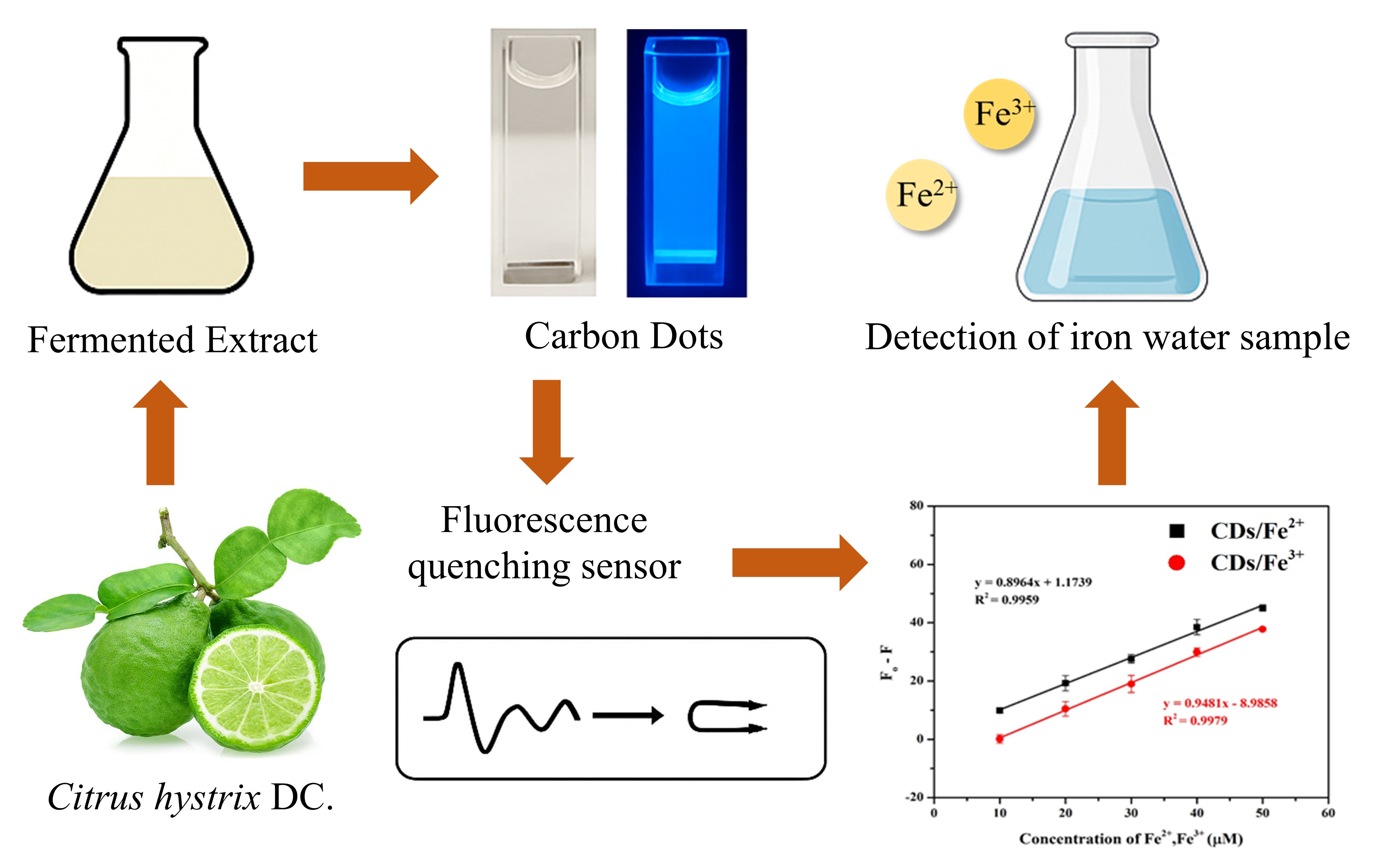
This study presents a green and low-cost fluorescence sensing platform for the simultaneous detection of Fe²⁺ and Fe³⁺ ions (total iron) in water using carbon dots (CDs) synthesized via natural fermentation of Citrus hystrix DC. (leech lime) fruit. The hypothesis is that functional groups on the surface of biosynthesized CDs can selectively coordinate with both iron oxidation states, resulting in effective fluorescence quenching. The CDs were characterized using UV-Vis spectroscopy, fluorescence spectroscopy, FTIR and TEM, confirming their spherical morphology and strong blue emission at 454 under 330 nm excitation. Experimental optimization was performed for key sensing parameters, including pH, ionic strength (NaCl), EDTA concentration, reaction time and temperature. Under optimized conditions (pH 4, 5 mM EDTA, 0.1 M NaCl, 50 °C, 10 min reaction), a linear fluorescence quenching response was observed in the 30 - 100 µM total iron range, with a limit of detection (LOD) of 8.05 µM and limit of quantification (LOQ) of 26.85 µM. The method demonstrated high selectivity toward iron ions over 20 other metal ions and negligible interference from chloride and carbonate. Recovery tests in drinking and tap water samples yielded values between 86.65% - 115.06%, validating the method’s applicability for real-world water monitoring. This work highlights the potential of naturally derived CDs as effective and environmentally sustainable probes for trace iron analysis in environmental samples.
HIGHLIGHTS
- The carbon dots were successfully synthesized from leech lime fermentation extract.
- Selective fluorescence sensor for iron determination was successfully optimized.
- The developed sensing probe is a good method for the Fe2+/Fe3+ detection.
GRAPHICAL ABSTRACT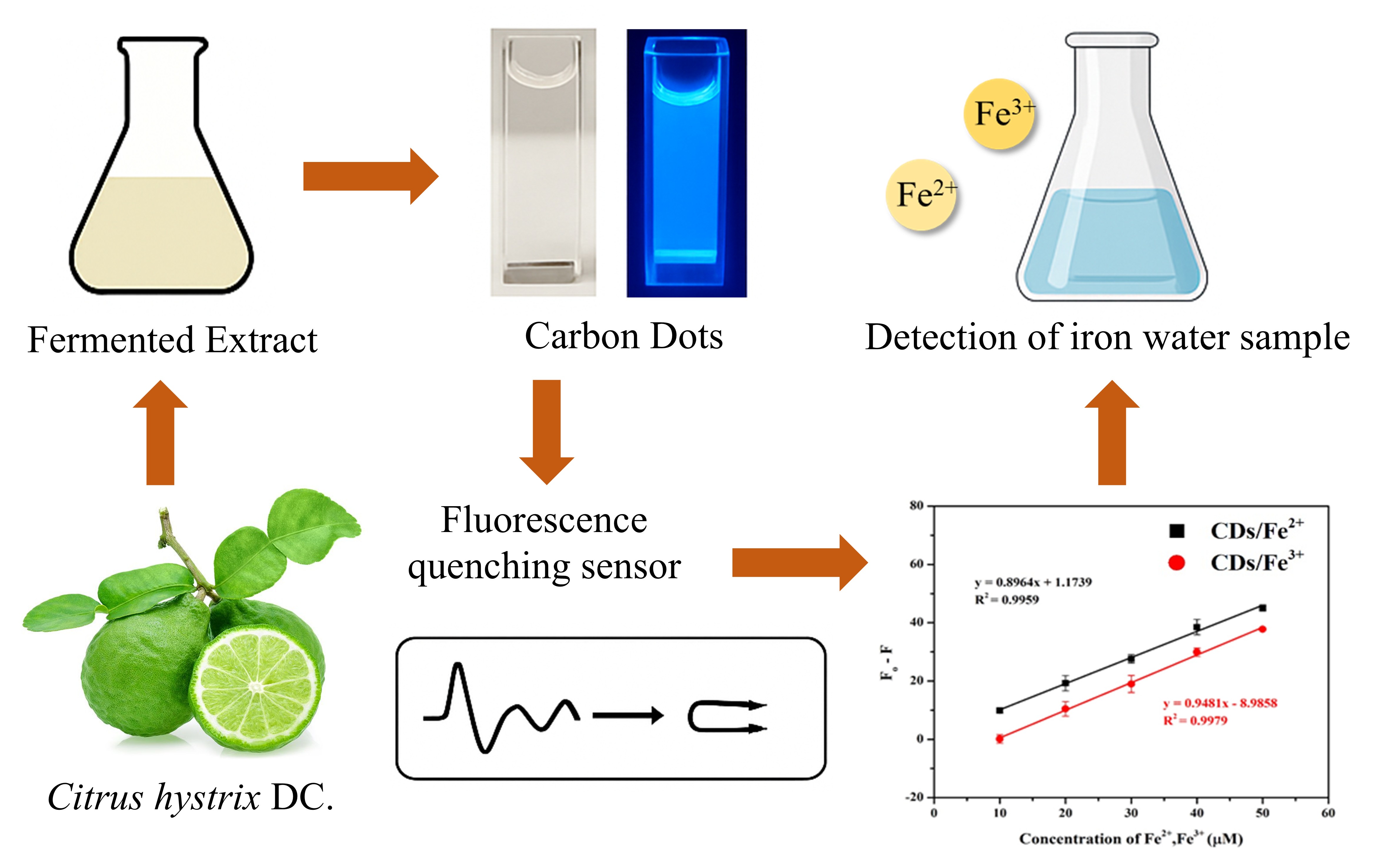
Downloads
References
Y Li, J Chen, Y Wang, H Li, J Yin, M Li, L Wang, H Sun and J Chen. Large-scale direct pyrolysis synthesis of excitation-independent carbon dots and analysis of ferric (III) ion sensing mechanism. Applied Surface Science 2021; 538, 148151.
Z Arif, S Sugiarti, E Rohaeti and I Batubara. A Sensor (Optode) Based on Cellulose Triacetate Membrane for Fe(III) Detection in Water Samples. Chemistry 2024; 6(1), 81-94.
E Piskin, D Cianciosi, S Gulec, M Tomas and E Capanoglu. Iron absorption: Factors, limitations and improvement methods. ACS Omega 2022; 7(24), 20428-21358.
T Rolić, M Yazdani, S Mandić and S Distante. Iron metabolism, Calcium, Magnesium and Trace elements: A review. Biological Trace Element Research 2025; 203, 2216-2225.
F Liu, Y Jiang, C Fan, L Zhang, Y Hua, C Zhang, N Song, Y Konga and H Wang. Fluorimetric and colorimetric analysis of total iron ions in blood or tap water using nitrogen-doped carbon dots with tunable fluorescence. New Journal of Chemistry 2018; 42(12), 9676-9683.
H Shumoy and K Raes. Dissecting the facts about the impact of contaminant iron in human nutrition: A review. Trends in Food Science & Technology 2021; 116, 918-927.
J Suebphanpho, A Hasodsong, P Supprung and J Boonmak. Dual-mode luminescence and colorimetric sensing for Al3+ and Fe2+/Fe3+ ions in water using a zinc coordination polymer. Spectrochimica Acta Part A: Molecular and Biomolecular Spectroscopy 2025; 330, 125729.
P Patil, S Shinde and S Sahoo. Fe3+ selective pyrimidine based chromogenic and fluorogenic chemosensor. Trends in Sciences 2022; 19(23), 4487.
MA Ebrahimzadeh, Z Hashemi and P Biparva. A multifunctional quinoxaline-based chemosensor for colorimetric detection of Fe3+ and highly selective fluorescence turn-off response of Cu+2 and their practical application. Spectrochimica Acta Part A: Molecular and Biomolecular Spectroscopy 2023; 302, 123092.
B Lal, S Kumar, V Singh, RK Tittal, G Singh, J Singh and VD Ghule. Ampyrone linked 1,2,3-triazole based chemosensor for selective detection of Fe(II and III) ions. Inorganic Chemistry Communications 2025; 172,113692.
Y Tian, J Liu, J Qiao, F Ge, Y Yang and Q Zhang. Advancements in electrochemical sensingTechnology for Heavy Metal Ions Detection. Food Chemistry: X 2025; 25, 102204.
Y Zhou, X Yang, WJ Jang, M Yan and J Yoon. Binding- and activity-based small molecule fluorescent probes for the detection of Cu+, Cu2+, Fe2+ and Fe3+ in biological systems. Coordination Chemistry Reviews 2025; 522, 216201.
S Baruah, P Hazarika, A Konwar, KK Hazarika and S Hazarika. Synergistic optical sensing of heavy metal ions using Mesua Ferrea derived carbon dot embedded Alginate based biopolymeric film as a sensor platform. International Journal of Biological Macromolecules 2025; 286, 138227.
F Wang, Y Zhang, H Li, W Gong, J Han, S Jiang, D Li and Z Yao. Application of carbon quantum dots as fluorescent probes in the detection of antibiotics and heavy metals. Food Chemistry 2025; 463(Part 1), 141122.
FK Algethami and HN Abdelhamid. Heteroatoms-doped carbon dots as dual probes for heavy metal detection. Talanta 2024; 273, 125893.
A Kausar. Review multifunctional hybrids of graphene quantum dots with inorganic nanoparticles (Metal, Metal Oxide and MOF) - topical state and evolutions. Trends in Sciences 2025; 22(6), 9924.
P Wang, C Chen, H Ren and E Duan. A review of carbon dots in synthesis strategies, photoluminescence mechanisms and applications in wastewater treatment. Chinese Chemical Letters 2024; 36(9), 110725.
YD Yat, HCY Foo, IS Tan, MK Lam, PL Show and BWL Ng. Synthesis of carbon quantum dots via electrochemically-induced carbon dioxide nanobubbles exfoliation of graphite for heavy metal detection in wastewater. Journal of Environmental Chemical Engineering 2024; 12(3), 112715.
J Peng, W Gao, BK Gupta, Z Liu, R Romero-Aburto, L Ge, L Song, LB Alemany, X Zhan,G Gao, SA Vithayathil, BA Kaipparettu, AA Marti, T Hayashi, JJ Zhu and PM Ajayan. Graphene quantum dots derived from carbon fibers. Nano Letters 2012; 12(2), 844-849.
TN Nguyen, PA Le and VBT Phung. Facile green synthesis of carbon quantum dots and biomass-derived activated carbon from banana peels: Synthesis and investigation. Biomass Conversion and Biorefinery 2022; 12, 2407-2416.
X Long and S Wu. Exploring the next super fluorescent carbon Dots: Hydrothermal synthesis of Dual-Function ultra-bright blue fluorescent carbon dots with a quantum yield of 75.4%. Microchemical Journal 2024; 207, 112035.
C Ren, C Tian, M Zhang, F Li, Y Li, F Zhang, J Zhang, G Chen and J Tang. The fluorescence properties of nitrogen-doped carbon dots by microwave green approaches. Journal of Molecular Structure 2025; 1319(Part 2), 139364.
D Uriarte, C Domini and M Garrido. New carbon dots based on glycerol and urea and its application in the determination of tetracycline in urine samples. Talanta 2019; 201, 143-148.
ZC Yang, M Wang, AM Yong, SY Wong, XH Zhang, H Tan, AY Chang, X Li and J Wang. Intrinsically fluorescent carbon dots with tunable emission derived from hydrothermal treatment of glucose in the presence of monopotassium phosphate. Chemical Communications 2011; 47(42), 11615-11617.
CEI Torres, TES Quezada, OV Kharissova, H Zeng, BI Kharisov, EL Hipólito, LM Torres-Martínez and LT González. Facile synthesis of hollow carbon fiber/carbon quantum dots composite aerogels for oil sorption. Geoenergy Science and Engineering 2023; 231(Part A), 212401.
KK Gudimella, T Appidi, HF Wu, V Battula, A Jogdand, AK Rengan and G Gedda. Sand bath assisted green synthesis of carbon dots from citrus fruit peels for free radical scavenging and cell imaging. Colloids and Surfaces B: Biointerfaces 2021; 197, 111362.
PM Sreepian, P Rattanasinganchan and A Sreepian. Antibacterial efficacy of Citrus hystrix (makrut lime) essential oil against clinical multidrug-resistant methicillin-resistant and methicillin-susceptible Staphylococcus aureus isolates. Saudi Pharmaceutical Journal 2023; 31(6), 1094-1103.
S Srifuengfung, N Bunyapraphatsara, V Satitpatipan, C Tribuddharat, VB Junyaprasert, W Tungrugsasut and V Srisukh. Antibacterial oral sprays from kaffir lime (Citrus hystrix DC.) fruit peel oil and leaf oil and their activities against respiratory tract pathogens. Journal of Traditional and Complementary Medicine 2020; 10(6), 594-598.
N Kooltheat, L Kamuthachad, M Anthapanya, N Samakchan, RP Sranujit, P Potup, A Ferrante and K Usuwanthim. Kaffir lime leaves extract inhibits biofilm formation by Streptococcus mutans. Nutrition 2016; 32, 486-490.
Y Yuandani, AW Septama, LR Nasution, D Dwinanti, DP Rambe, K Ramadhani and WR Manurung. Immunomodulatory effects of citrus species ethanol extracts on cellular immune responses in wistar rats and mice. Trends in Sciences 2024; 21(12), 8390.
M Lubinska-Szczygieł, A Różańska, J Namieśnik, T Dymerski, RB Shafreen, M Weisz, A Ezra and S Gorinstein. Quality of limes juices based on the aroma and antioxidant properties. Food Control 2018; 89, 270-279.
SB Hussain, CY Shi, LX Guo, HM Kamran, A Sadka and YZ Liu. Recent advances in the regulation of citric acid metabolism in citrus fruit. Critical Reviews in Plant Sciences 2017; 36(4), 241-256.
Y Chen, Y Wu, B Weng, B Wang and C Li. Facile synthesis of nitrogen and sulfur co-doped carbon dots and application for Fe(III) ions detection and cell imaging. Sensors and Actuators B: Chemical 2016; 223, 689-696.
SNAM Yazid, SF Chin, SC Pang and SM Ng. Detection of Sn(II) ions via quenching of the fluorescence of carbon nanodots. Microchimica Acta 2013; 180, 137-143.
D Xu, F Lei, H Chen, L Yin, Y Shi and J Xie. One-step hydrothermal synthesis and optical properties of self-quenching-resistant carbon dots towards fluorescent ink and as nanosensors for Fe3+ detection. RSC Advances 2019; 9(15), 8290-8299.
N Wang, H Chai, X Dong, Q Zhou and L Zhu. Detection of Fe(III)EDTA by using photoluminescent carbon dot with the aid of F− ion. Food Chemistry 2018; 258, 51-58.
J Yue, L Li, L Cao, M Zan, D Yang, Z Wang, Z Chang, Q Mei, P Miao and WF Dong. Two-Step hydrothermal preparation of carbon dots for calcium ion detection. ACS Applied Materials & Interfaces 2019; 11(47), 44566-44572.
X Jin and GG Botte. Electrochemical technique to measure Fe(II) and Fe(III) concentrations simultaneously. Journal of Applied Electrochemistry 2009; 39, 1709-1717.
X Gong, W Lu, MC Paau, Q Hu, X Wu, S Shuang, C Dong and MMF Choi. Facile synthesis of nitrogen-doped carbon dots for Fe3+ sensing and cellular imaging. Analytica Chimica Acta 2015; 861, 74-84.
N Tirawanchai, K Kengkoom, D Isarangkul, J Burana-osot, T Kanjanapruthipong, S Chantip, P Phattanawasin, U Sotanaphun and S Ampawong. A combination extract of kaffir lime, galangal and lemongrass maintains blood lipid profiles, hepatocytes and liver mitochondria in rats with nonalcoholic steatohepatitis. Biomedicine & Pharmacotherapy 2020; 124, 109843.
D Nugroho, R Benchawattananon, J Janshongsawang, N Pimsin, P Porrawatkul, R Pimsen, P Nuengmatcha, P Nueangmatcha and S Chanthai. Ultra-trace analysis of chromium ions (Cr3+/Cr6+) in water sample using selective fluorescence turn-off sensor with natural carbon dots mixed graphene quantum dots nanohybrid composite synthesis by pyrolysis. Arabian Journal of Chemistry 2024; 17(1), 105443.
A Iqbal, Y Tian, X Wang, D Gong, Y Guo, K Iqbal, Z Wang, W Liu and W Qin. Carbon dots prepared by solid state method via citric acid and 1,10-phenanthroline for selective and sensing detection of Fe2+ and Fe3+. Sensors and Actuators B: Chemical 2016; 237, 408-415.
P Song, L Zhang, H Long, M Meng, T Liu, Y Yin and R Xi. A multianalyte fluorescent carbon dots sensing system constructed based on specific recognition of Fe(III) ions. RSC Advances 2017; 7(46), 28637-28646.
L Zhao, Y Wang, X Zhao, Y Deng and Y Xia. Facile synthesis of Nitrogen-Doped carbon quantum dots with chitosan for fluorescent detection of Fe3+. Polymers 2019; 11(11), 1731.
SR Zhang, SK Cai, GQ Wang, JZ Cui and CZ Gao. One-step synthesis of N, P-doped carbon quantum dots for selective and sensitive detection of Fe2+ and Fe3+ and scale inhibition. Journal of Molecular Structure 2021; 1246, 131173.
X Wang, X. Zu, T Wang, Y Zhao, Y Liang, X Wang, Q Chai, Y Zhang, H Chen and H Wang. N, S-Doped carbon dots prepared by peanut protein isolates and cysteamine as highly sensitive fluorescent sensors for Fe2+, Fe3+ and lactoferrin. Polymers 2023; 15, 216.
S Lei, N Chang, J Zhang and H Wang. Dopamine functionalized S, N co-doped carbon dots as a fluorescent sensor for the selective detection of Fe3+ and Fe2+ in water. Analytical Sciences 2021; 37, 851-857.
Published
How to Cite
Issue
Section
License
Copyright (c) 2025 Walailak University

This work is licensed under a Creative Commons Attribution-NonCommercial-NoDerivatives 4.0 International License.





