
Multifunctional Cotton Fabrics Coated with Banana Peel-Synthesized ZnO Nanoparticles
DOI:
https://doi.org/10.48048/tis.2025.9852Keywords:
Antibacterial activity, Banana peel, Cotton fabric, Green synthesis, Multifunctional textiles ZnO nanoparticles, UV protectionAbstract
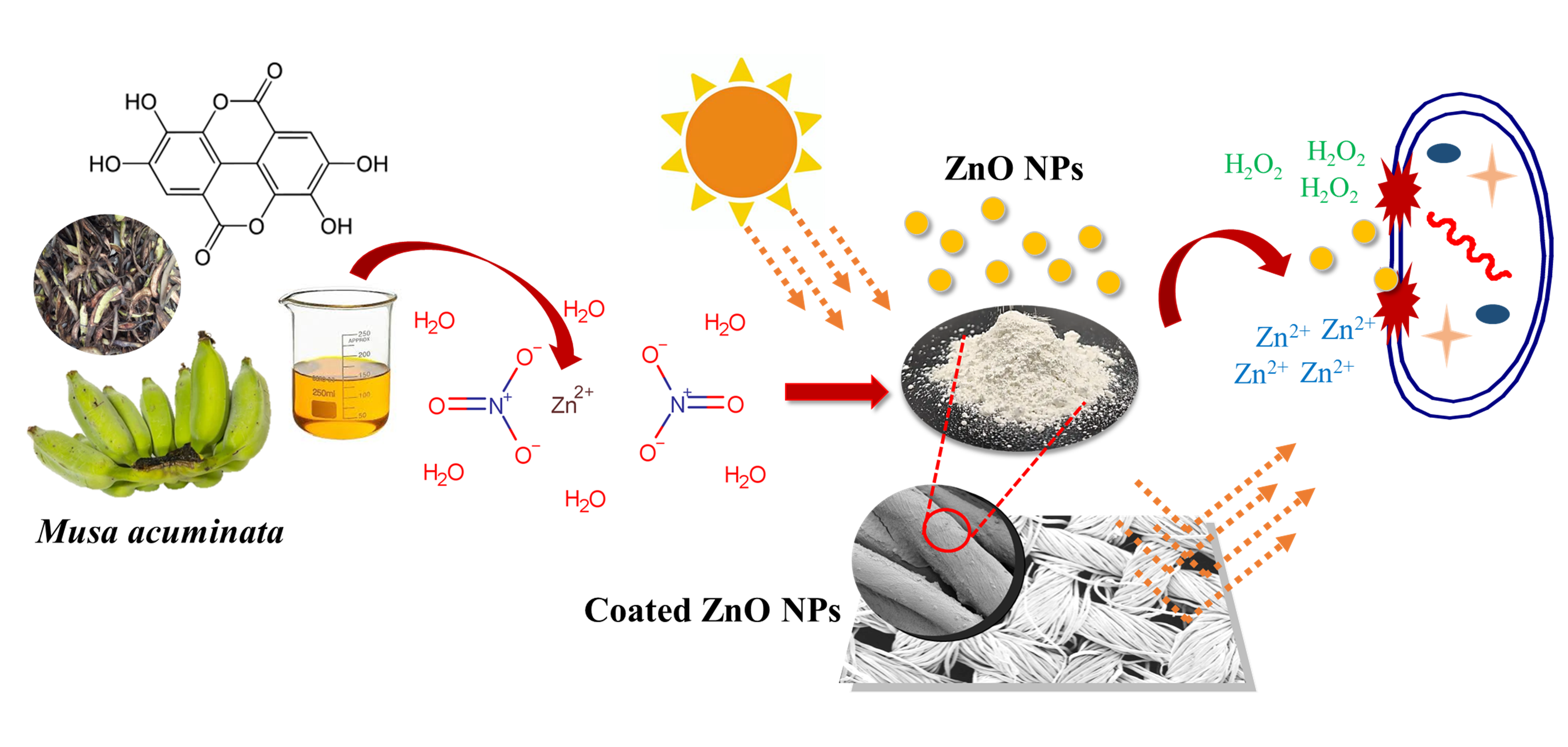
This research presents an environmentally friendly approach for synthesizing zinc oxide (ZnO) nanoparticles using banana peel extract as a natural reducing and stabilizing agent. The synthesis avoids hazardous chemicals, aligning with green chemistry principles. The ZnO nanoparticles were characterized using XRD, SEM, EDX, TEM, and FTIR techniques, confirming their crystalline structure, uniform morphology, and successful phytochemical interaction. The ZnO nanoparticles were coated onto cotton fabrics via an ultrasonication method, ensuring even deposition. The coated fabrics demonstrated enhanced UV protection with a UV protection factor (UPF) of 82.67, categorized as excellent protection, and retained strong UV-blocking properties even after 20 washing cycles. The fabrics also exhibited significant antibacterial activity, effectively inhibiting Staphylococcus aureus (zone of inhibition: 26.17 mm) and Escherichia coli. This antibacterial performance was attributed to the release of reactive oxygen species (ROS) and Zn2+ ions, which disrupt bacterial cell walls. This study highlights the dual functionality of ZnO-coated fabrics in providing UV protection and antibacterial properties while maintaining their durability and eco-friendliness. The findings demonstrate the potential of utilizing green-synthesized nanoparticles in developing multifunctional textiles for applications in healthcare, protective clothing, and environmental sustainability.
HIGHLIGHTS
- ZnO nanoparticles were synthesized using banana peel extract, offering an eco-friendly and sustainable method aligned with green chemistry.
- Cotton fabrics coated with ZnO nanoparticles showed excellent UV protection (UPF = 82.67) and antibacterial properties, retaining durability after 20 washes.
- The coated fabrics effectively inhibited Staphylococcus aureus and Escherichia coli, driven by reactive oxygen species (ROS) and Zn2+ ion release.
- This approach highlights the potential of agricultural waste in developing multifunctional, sustainable textiles for healthcare and protective clothing.
GRAPHICAL ABSTRACT
Downloads
References
TMA Elmaaty, H Elsisi, G Elsayad, H Elhadad and MR Plutino. Recent advances in functionalization of cotton fabrics with nanotechnology. Polymers 2022; 14(20), 4273.
RM Attia, NM Yousif and MH Zohdy. Electrical conductivity and mechanical properties of conductive cotton fabrics. Journal of Industrial Textiles 2022; 51(S2), 3149S-3175S.
L Lv, W Zhao, X Zhong and H Fu. Fabrication of magnetically inorganic/organic superhydrophobic fabrics and their applications. ACS Applied Materials & Interfaces 2020; 12(40), 45296-45305.
Z Kashif, M Yasin Naz, A Maqbool, S Shukrullah, M Irfan, SNF Mursal, S Rahman and MAMM Ali. Study of dual Z-scheme photocatalytic response of TiO2/Ag/ZnO coating on plasma-modified cotton fabric for self-cleaning application. AIP Advances 2024; 14(1), 015222.
MM Rashid, M Zorc, B Simončič, I Jerman and B Tomšič. In-situ functionalization of cotton fabric by TiO2: The influence of application routes. Catalysts 2022; 12(11), 1330.
U Arfa, M Alshareef, N Nadeem, A Javid, Y Nawab, KF Alshammari and U Zubair. Sunlight-driven photocatalytic active fabrics through immobilization of functionalized doped titania nanoparticles. Polymers 2023; 15(13), 2775.
H Zhou, Q Li, Z Zhang, X Wang and H Niu. Recent advances in superhydrophobic and antibacterial cellulose based fibers and fabrics: Bio inspiration, strategies, and applications. Advanced Fiber Materials 2023; 5(5), 1555-1591.
Y Guo, C Li, X Li, H Xu, W Chen, K Fang, L Zhang, R Li and R Xie. Fabrication of superhydrophobic cotton fabric with multiple durability and wearing comfort via an environmentally friendly spraying method. Industrial Crops & Products 2023; 194, 116359.
S Sfameni, T Lawnick, G Rando, A Visco, T Textor and MR Plutino. Functional silane-based nanohybrid materials for the development of hydrophobic and water-based stain resistant cotton fabrics coatings. Nanomaterials 2022; 12(19), 3404.
S Li, H Quan, L Ai, S Bi, Q Li and R You. Facile preparation of superhydrophobic cotton fabric using silicone oil and inorganic nanoparticles. AATCC Journal of Research 2023; 10(1), 51-59.
Y Suzumoto, M Okuda and I Yamashita. Fabrication of zinc oxide semiconductor nanoparticles in the apoferritin cavity. Crystal Growth & Design 2012; 12(8), 4130-4134.
MT Noman, N Amor and M Petru. Synthesis and applications of ZnO nanostructures (ZONSs): A review. Critical Reviews in Solid State and Materials Sciences 2021; 47(2), 99-141.
W Sricharussin, P Threepopnatkul and N Neamjan. Effect of various shapes of zinc oxide nanoparticles on cotton fabric for UV-blocking and anti-bacterial properties. Fibers and Polymers 2011; 12(8), 1037-1041.
Y Wang, J Liu, T Wang, LZ Liu, C Tian, Y Cui, W Shao, X Hua, Y Shi and Y Wang. Antibacterial properties and mechanism of nanometer zinc oxide composites. Food Packaging and Shelf Life 2023; 40, 101167.
P Petkova, A Francesko, I Perelshtein, A Gedanken and T Tzanov. Simultaneous sonochemical-enzymatic coating of medical textiles with antibacterial ZnO nanoparticles. Ultrasonics Sonochemistry 2016; 29, 244-250.
IM El-Nahhal, NMA Ashgar, N Amara, M Selmane and MM Chehimi. Stabilization of nano-structured ZnO particles onto the surface of cotton fibers using different surfactants and their antimicrobial activity. Ultrasonics Sonochemistry 2017; 38, 478-487.
CR Mendes, G Dilarri, CF Forsan, VMR Sapata, PRM Lopes, PB Moraes, RN Montagnolli,
H Ferreira and ED Bidoia. Antibacterial action and target mechanisms of zinc oxide nanoparticles against bacterial pathogens. Scientific Reports 2022; 12(1), 2658.
K Qia, X Xinga, A Zadad, M Lia, Q Wanga, S Liue, H Linb and G Wang. Transition metal doped ZnO nanoparticles with enhanced photocatalytic and antibacterial performances: Experimental and DFT studies. Ceramics International 2020; 46(2), 1494-1502.
MA Qamar, M Javed and S Shahid. Designing and investigation of enhanced photocatalytic and antibacterial properties of 3d (Fe, Co, Ni, Mn and Cr) metal-doped zinc oxide nanoparticles. Optical Materials 2022; 126, 112211.
S Nadeem, T Munawar, F Mukhtar, MN Rahman, M Riaz and F Iqbal. Enhancement in the photocatalytic and antimicrobial properties of ZnO nanoparticles by structural variations and energy bandgap tuning through Fe and Co co-doping. Ceramics International 2021; 47(8), 11109-11121.
K Singh, Nancy, H Kaur, PK Sharma, G Singh and J Singh. ZnO and cobalt decorated ZnO NPs: Synthesis, photocatalysis and antimicrobial applications. Chemosphere 2023; 313, 137322.
YH Ng, YH Leung, FZ Liu, AMC Ng, MH Gao, CMN Chan, AB Djurišić, FCC Leung and WK Chan. Antibacterial activity of ZnO nanoparticles under ambient illumination-The effect of nanoparticle properties. Thin Solid Films 2013; 542, 368-372.
S Raha and M Ahmaruzzaman. ZnO nanostructured materials and their potential applications: Progress, challenges and perspectives. Nanoscale Advances 2022; 4(8), 1868-1925.
SS Wagh, VS Kadam, CV Jagtap, DB Salunkhe, RS Patil, HM Pathan and SP Patole. Comparative studies on synthesis, characterization and photocatalytic activity of Ag doped ZnO nanoparticles. ACS Omega 2023; 8(8), 7779-7790.
N Talreja, D Chauhan and M Ashfaq. Photo-antibacterial activity of 2-dimensional (2D)-based hybrid materials: Effective treatment strategy for controlling bacterial infection. Antibiotics 2023; 12(2), 398.
BR Khanam, MKJ Nidhi, H Nagaraja, T Manjunatha, B Angadi, BU Reddy and K Udaykumar. Physicochemical and therapeutic studies of microwave-synthesized ZnO and Cr-doped ZnO nanoparticles for biomedical applications. Inorganic Chemistry Communications 2024; 170(3), 113454.
S Rajaboopathi and S Thambidurai. Synthesis of bio-surfactant based Ag/ZnO nanoparticles for better thermal, photocatalytic and antibacterial activity. Materials Chemistry and Physics 2019; 223, 512-522.
BR Khanam, NC Prachalith, HA Ayub, N Kousar, SS Kulkarni, J Thipperudrappa and UV Khadke. Green synthesis of silver nanoparticles using Plumeria obtusa leaves extract and concentration dependent physio-optic properties. Materials Today: Proceedings 2023; 92, 1568-1574.
BR Khanam, NC Prachalith, B Angadi, BU Reddy and K Udaykumar. The effect of reaction and annealing temperatures on physicochemical properties of highly stable ZnO nanoparticles synthesized via a green route using Plumeria obtusa L. New Journal of Chemistry 2023; 47(41), 19122-19137.
S Raha and Md Ahmaruzzaman. ZnO nanostructured materials and their potential applications: Progress, challenges and perspectives. Nanoscale Advances 2022; 4(8), 1868-1925.
S Mondal. Nanomaterials for UV protective textiles. Journal of Industrial Textiles 2022; 51(4), 5592S-5621S.
BR Khanam, MG Kotresh and UV Khadke. Enhanced crystallographic and physicochemical properties of chromium-embedded ZnO nanoparticles. Chemical Physics Impact 2024; 8, 100518.
K Kachare, S Shendage, S Matwal, M Walvekar, S Vhanbatte, JY Chang and A Ghule. Bio-mediated synthesized zinc oxide coated on cotton fabric for antibacterial and wound healing application. Surface & Coatings Technology 2024; 491, 131171.
S Marfu’ah, SM Rohma, F Fanani, EN Hidayati, DW Nitasari, TR Primadi, E Ciptawati, S Sumari and F Fajaroh. Green synthesis of ZnO nanoparticles by using banana peel extract as capping agent and its bacterial activity. IOP Conference Series: Materials Science and Engineering 2020; 833(1), 012076.
J Ruangtong, JT Thienprasert and NPT Thienpraser. Green synthesized ZnO nanosheets from banana peel extract possess anti-bacterial activity and anti-cancer activity. Materials Today Communications 2020; 24, 101224.
M Krasovska, V Gerbreders, E Sledevskis, A Gerbreders, I Mihailova, E Tamanis and A Ogurcovs. Hydrothermal synthesis of ZnO nanostructures with controllable morphology change. Crystal Engineering Communications 2020; 22(8), 1346-1358.
R Rathore and N Kaurav. The structural and optical properties of ZnO nanoparticles synthesized via thermal decomposition. Materials Today: Proceedings 2022; 54(3), 624-627.
C Mallikarjunaswamy, VL Ranganatha, R Ramu, Udayabhanu and G Nagaraju. Facile microwave assisted green synthesis of ZnO nanoparticles: Application to photodegradation, antibacterial and antioxidant. Journal of Materials Science: Materials in Electronics 2020; 31(2), 1004-1021.
EA Rania, P Gallia, W Magnus and N Omer. Synthesis of ZnO nanoparticles by co-precipitation method for solar driven photodegradation of Congo red dye at different pH. Photonics and nanostructures - Fundamentals and Applications 2018; 32, 11-18.
L Manmohan, S Praveen, S Lakhvinder and R Chhotu. Photocatalytic degradation of hazardous Rhodamine B dye using sol-gel mediated ultrasonic hydrothermal synthesized of ZnO nanoparticles. Results in Engineering 2023; 17, 100890.
CV Manzano, L Philippe and A Serrà. Recent progress in the electrochemical deposition of ZnO nanowires: Synthesis approaches and applications. Critical Reviews in Solid State and Materials Sciences 2021; 47(5), 772-805.
A Kistana, S Mohanb, S Mahalakshmic, A Jayanthia, AJ Ramyad and P Siva Karthike. Sol-gel technique, characterization and photocatalytic. Main Group Chemistry 2024; 23(1), 17-30.
ST Karam and AF Abdulrahman. Green synthesis and characterization of ZnO nanoparticles by using thyme plant leaf extract. Photonics 2022; 9, 594.
AT Shuga, MHE Ahmed and M Malik. ZnO nanoparticles prepared via a green synthesis approach: Physical properties, photocatalytic and antibacterial activity. Journal of Physics and Chemistry of Solids 2024; 160, 110313.
K Kachare, S Shendage, S Matwal, M Walvekar, S Vhanbatte, JY Chang and A Ghule. Bio-mediated synthesized zinc oxide coated on cotton fabric for antibacterial and wound healing application. Surface & Coatings Technology 2024; 491, 131171.
B Saha, A Saha, P Das, A Kakati, A Banerjee and P Chattopadhyay. A comprehensive review of ultraviolet radiation and functionally modified textile fabric with special emphasis on UV protection. Heliyon 2024; 10, e40027.
S Anandan, M Mahadevamurthy, MA Ansari, MA Alzohairy, MN Alomary, SF Siraj, SH Nagaraja, M Chikkamadaiah, LT Ramachandrappa, HKN Krishnappa, AE Ledesma, AK Nagaraj and A Urooj. Biosynthesized ZnO-NPs from Morus indica attenuates methylglyoxal-induced protein glycation and RBC damage: In-vitro, in-vivo and molecular docking study. Biomolecules 2019; 9(12), 882.
NK Hemanth Kumar, M Murali, A Satish, SB Singh, HG Gowtham, HM Mahesh, TR Lakshmeesha, KN Amruthesh and S Jagannath. Bioactive and biocompatible nature of green synthesized zinc oxide nanoparticles from Simarouba glauca DC.: An endemic plant to Western Ghats, India. Journal of Cluster Science 2020; 31, 523-534.
SM Abegunde, MA Adebayo and EF Olasehinde. Green synthesis of ZnO nanoparticles and its application for methyl green dye adsorption. Green Energy and Resources 2024; 2, 100073.
K Haiouani, S Hegazy, H Alsaeedi, M Bechelany and A Barhoum. Green synthesis of hexagonal-like ZnO nanoparticles modified with phytochemicals of clove (Syzygium aromaticum) and Thymus capitatus extracts: Enhanced antibacterial, antifungal, and antioxidant activities. Materials 2024; 17(17), 4340.
O Intharaksa, S Nanan, N Patdhanagul, T Panphojan, T Srikakul, N Tantisuwichwong,
N Tantisuwichwong and R Dulyasucharit. Preparation of magnetic CuO/Fe3O4/ZnO photocatalyst for complete degradation of methylene blue under natural sunlight irradiation. Journal of Physics and Chemistry of Solids 2023; 182, 111577.
S Ghayempour and M Montazer. Ultrasound irradiation based in-situ synthesis of star-like Tragacanth gum/zinc oxide nanoparticles on cotton fabric. Ultrasonics Sonochemistry 2017; 34, 458-465.
S Mahalakshmi, N Hema and PP Vijaya. In vitro biocompatibility and antimicrobial activities of zinc oxide nanoparticles (ZnO NPs) prepared by chemical and green synthetic route - a comparative study. Journal of Bionanoscience 2020; 10(1), 112-121.
NA Ibrahim, AA Nada, AG Hassabo, BM Eid, AMN El-Deen and NY Abou-zeid. Effect of different capping agents on physicochemical and antimicrobial properties of ZnO nanoparticles. Chemical Papers 2017; 71, 1365-1375.
A Giedraitienė, M Ružauskas, R Šiugždinienė, S Tučkutė, K Grigonis and D Milčius. ZnO nanoparticles enhance the antimicrobial properties of 2-sided-coated cotton textile. Nanomaterials 2024; 14(15), 1264.
K Ghule, AV Ghule, BJ Chen and YC Ling. Preparation and characterization of ZnO nanoparticles coated paper and its antibacterial activity study. Green Chemistry 2006; 8(12), 1034-1041.
L Wang and M Muhammed. Synthesis of zinc oxide nanoparticles with controlled morphology. Journal of Materials Chemistry 1999; 9(11), 2871-2878.
MW Mazhar, MIM Maqbool, AAMA Alshehri, SS Alhelaify, OM Alharthy, M Shukry and SM Sayed. Green synthesis of anethole-loaded zinc oxide nanoparticles enhances antibacterial strategies against pathogenic bacteria. Scientific Reports 2024; 14(1), 24671.
J Nan, Y Chu, R Guo and P Chen. Research on the antibacterial properties of nanoscale zinc oxide particles comprehensive review. Frontiers in Materials 2024; 11, 1449614.
HM Yusof, NA Rahman, R Mohamad, UH Zaidan and AA Samsudin. Antibacterial potential of biosynthesized zinc oxide nanoparticles against poultry-associated foodborne pathogens: An in vitro study. Animals 2021; 11(7), 2093.
KR Raghupathi, RT Koodali and AC Manna. Size-dependent bacterial growth inhibition and mechanism of antibacterial activity of zinc oxide nanoparticles. Langmuir 2011; 27(7), 4020-4028
X Bellanger, P Billard, R Schneider, L Balan and C Merlin. Stability and toxicity of ZnO quantum dots: Interplay between nanoparticles and bacteria. Journal of Hazardous Materials 2015; 283, 110-116.
R Brayner, R Ferrari-Iliou, N Brivois, S Djediat, MF Benedetti and F Fiévet. Toxicological impact studies based on Escherichia coli bacteria in ultrafine ZnO nanoparticles colloidal medium. Nano Letters 2006; 6(4), 866-870.
A Azam, AS Ahmed, M Oves, MS Khan, SS Habib and A Memic. Antimicrobial activity of metal oxide nanoparticles against Gram-positive and Gram-negative bacteria: A comparative studies. International Journal of Nanomedicine 2012; 7, 6003-6009.
A Sirelkhatim, S Mahmud, A Seeni, NHM Kaus, LC Ann, SKM Bakhori, H Hasan and D Mohamad. Review on zinc oxide nanoparticles: Antibacterial activity and toxicity mechanism. Nano Micro Letters 2015; 7(3), 219-242.
Z Motaghi. An economical dyeing process for cotton and wool fabrics and improvement their antibacterial properties and UV protection. Journal of Natural Fibers 2018; 15(6), 777-788.
Published
How to Cite
Issue
Section
License
Copyright (c) 2025 Walailak University

This work is licensed under a Creative Commons Attribution-NonCommercial-NoDerivatives 4.0 International License.





