
Analysis of Volatile Organic Compounds, Antioxidant, Tyrosinase Inhibitory, and Antimicrobial Activities of Essential Oils from Citronella Grass and Kaffir Lime
DOI:
https://doi.org/10.48048/tis.2025.9434Keywords:
Essential oils, Citronella grass, Kaffir lime, Antioxidants, Tyrosinase inhibition, Antimicrobial activitiesAbstract
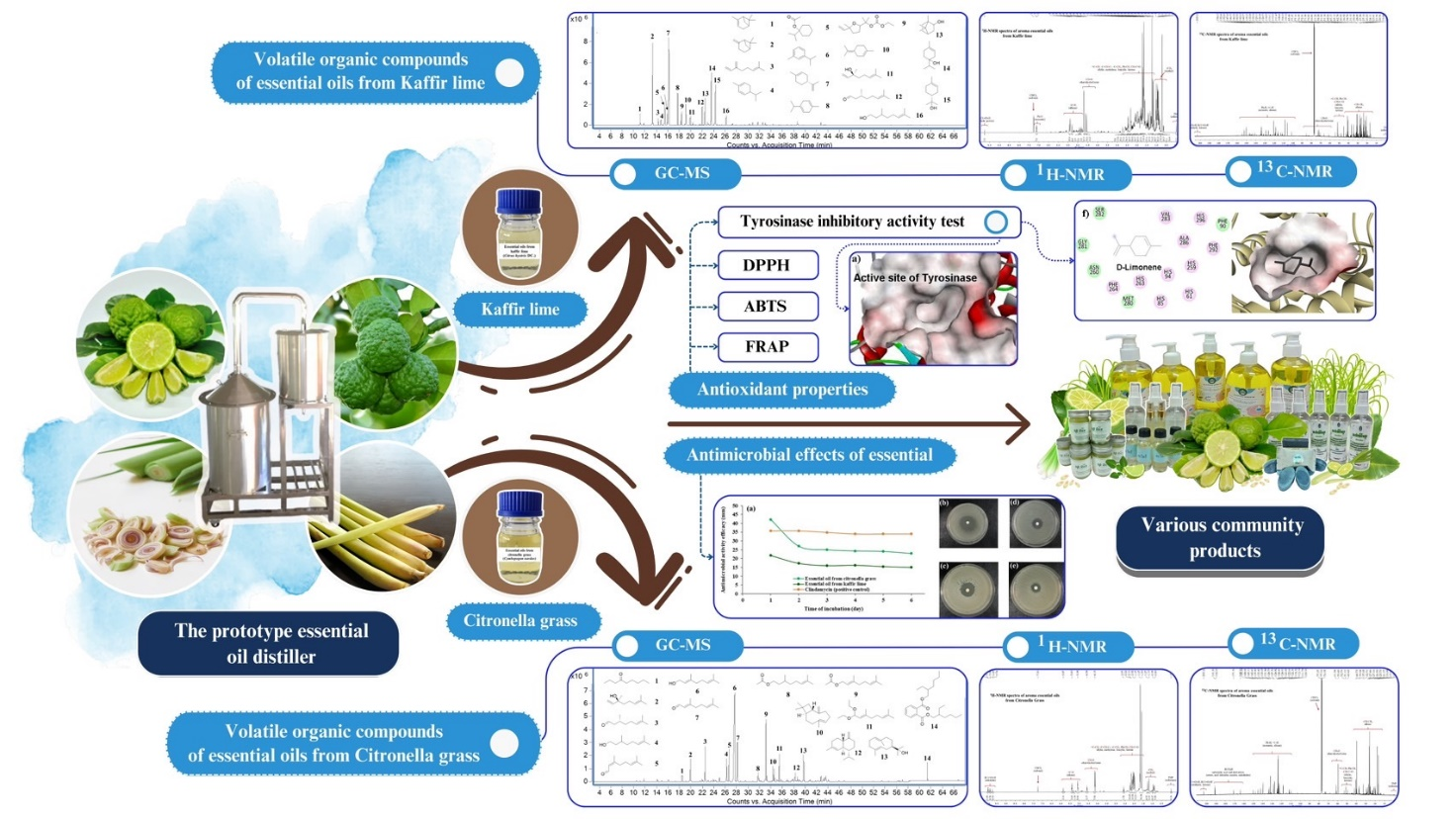
This research investigates the volatile organic compounds (VOCs), antioxidant properties, and antimicrobial effects of essential oils from citronella grass and kaffir lime, aiming to assess their potential as natural alternatives to synthetic chemicals in community products. Essential oils were extracted using a prototype distiller, yielding 1.67 % (v/w) from citronella grass and 2.36 % (v/w) from kaffir lime. The chemical compositions were analyzed using gas chromatography-mass spectrometry (GC-MS) and nuclear magnetic resonance (NMR). Antioxidant activities were assessed through assays for 2,2-diphenyl-1-picrylhydrazyl radicals (DPPH•), 2,2'-azino-bis(3-ethylbenzothiazoline-6-sulfonic acid radicals (ABTS•+), and ferric reducing antioxidant power (FRAP). Tyrosinase inhibition and antimicrobial activity were evaluated, with molecular docking studies supporting the findings. Major components in citronella grass oil included geraniol (35.99 % w/w), geranyl acetate (10.73 % w/w), α-citral (7.34 % w/w), and β-citral (5.72 % w/w), while kaffir lime oil contained D-limonene (20.72 % w/w) and (-)-β-pinene (20.19 % w/w). Antioxidant assays revealed lower free radical scavenging activities for both oils compared to Trolox, attributed to their non-polar nature. Citronella grass oil exhibited superior free radical scavenging, due to its molecular structure and electron-donating groups. Tyrosinase inhibition assays showed kaffir lime oil was more effective (IC50 = 195.68 µg/mL) than citronella grass oil (IC50 = 380.45 µg/mL), likely due to smaller, ring-structured molecules. These observations are supported by molecular docking studies. Antibacterial tests demonstrated higher potency of citronella grass oil over kaffir lime oil and clindamycin, with its smaller molecular size enhancing bacterial cell wall interactions. Stability tests revealed that citronella grass oil was initially more effective against Staphylococcus aureus but its activity declined by 45 % on the 2nd day, while still outperforming kaffir lime oil. Essential oils with smaller, simpler molecules provide rapid action but may lose effectiveness over time, whereas complex molecules offer stable, long-term inhibition. Both citronella grass and kaffir lime oils show potential as natural alternatives to synthetic chemicals and can be utilized in products such as soaps, creams, lotions, and disinfectants.
HIGHLIGHTS
- Essential oil yields: 1.67 % (v/w) citronella, 2.36 % (v/w) kaffir lime; key components: Geraniol, citrals, D-limonene, β-pinene.
- Citronella oil had higher antioxidant activity than both oils and Trolox.
- Kaffir lime oil (IC50 = 195.68 µg/mL) was more effective in tyrosinase inhibition than citronella (IC50 = 380.45 µg/mL).
- Citronella oil showed superior antibacterial activity compared to kaffir lime and clindamycin.
- Both oils are valuable in natural products like soaps, creams, lotions, and repellents.
GRAPHICAL ABSTRACT
Downloads
References
S Phewphong, W Roschat, K Namwongsa, A Wonam, T Kaisri, P Duangpakdee, T Leelatam, P Moonsin and V Promarak. Evaluation of the nutritional, minerals, and antioxidant potential of roselle (Hibiscus sabdariffa Linn.) seeds from Roi Et Province in the northeastern region of Thailand. Trends in Sciences 2023; 20(6), 6664.
AC Hughes. Understanding the drivers of Southeast Asian biodiversity loss. Ecosphere 2017; 8(1), e01624.
MA Devi, D Sahoo, TB Singh and Y Rajashekar. Antifungal activity and volatile organic compounds analysis of essential oils from Cymbopogon species using solid-phase microextraction-gas chromatography-mass spectrometry. Journal of Agricultural and Food Research 2021; 3, 100110.
E Husni, US Putri and Dachriyanus. Chemical content profile of essential oil from Kaffir lime (Citrus hystrix DC.) in Tanah Datar Regency and antibacterial activity. Advances in Health Sciences Research 2021; 40, 174-181.
MA Devi, D Sahoo, TB Singh and Y Rajashekar. Toxicity, repellency, and chemical composition of essential oils from Cymbopogon species against red flour beetle Tribolium castaneum Herbst (Coleoptera: Tenebrionidae). Journal of Consumer Protection and Food Safety 2020; 15, 181-191.
K Youcef-Ettoumi, Y Zouambia and N Moulai-Mostefa. Chemical composition, antimicrobial, and antioxidant activities of Algerian Citrus sinensis essential oil extracted by hydrodistillation assisted by electromagnetic induction heating. Journal of Food Science and Technology 2021; 58(8), 3049-3055.
MA Raspo, MB Vignola, AE Andreatta and HR Juliani. Antioxidant and antimicrobial activities of citrus essential oils from Argentina and the United States. Food Bioscience 2020; 36, 100651.
HZA Kamal, TNNT Ismail, EM Arief and KT Ponnuraj. Antimicrobial activities of citronella (Cymbopogon nardus) essential oil against several oral pathogens and its volatile compounds. Padjadjaran Journal of Dentistry 2020; 32(1), 1-7.
T Jumepaeng, R Jantayota, S Hemmood, S Komolwanich, S Wuthisarn, D Luthria and S Chanthai. Determination and comparison of volatile aroma compounds in fresh and dried leaves samples of citronella grass, lemongrass, and citronella incense products by micro-hydrodistillation. Acta Chromatographica 2014; 26(1), 177-190.
S Chanthai, S Prachakoll, C Ruangviriyachai and DL Luthria. Influence of extraction methodologies on the analysis of five major volatile aromatic compounds of citronella grass (Cymbopogon nardus) and lemongrass (Cymbopogon citratus) grown in Thailand. Journal of AOAC International 2012; 95(3), 763-772.
D Aripin, E Julaeha, M Dardjan and A Cahyanto. Chemical composition of Citrus spp. and oral antimicrobial effect of Citrus spp. peels essential oils against Streptococcus mutans. Padjadjaran Journal of Dentistry 2015; 27(1), 1-11.
Y Ho, N Suphrom, K Daowtak, P Potup, Y Thongsri and K Usuwanthim. Anticancer effect of Citrus hystrix DC. leaf extract and its bioactive constituents citronellol and citronellal on the triple-negative breast cancer MDA-MB-231 cell line. Pharmaceuticals 2020; 13(12), 476.
S Preecharram, S Posoongnoen, T Thummawongsa, T Sripakdee, S Tawil, N Poomsuk and J Jandaruang. Proximate composition and antioxidant activity of young flattened rice (Khao-Mao). Trends in Sciences 2023; 20(4), 6575.
S Preecharram, S Phosri, T Theansungnoen, W Roschat, S Arthan, S Lasopha and J Jandaruang. Nutritional values and their potential applications in food products of Krabok seed (Irvingia malayana). Trends in Sciences 2024; 21(1), 7316.
F Moller, F Fratianni, F Nazzaro, I Amri, H Kouki, M Khammassi, L Hamrouni, P Malaspina, L Cornara, S Khedhri, B Romano, DC Maresca, A Ianaro, G Ercolano and VD Feo. Essential oil composition, antioxidant activity and leaf micromorphology of five Tunisian Eucalyptus species. Antioxidants 2023; 12(4), 867.
AC Moller, C Parra, B Said, E Werner, S Flores, J Villena, A Russo, N Caro, I Montenegro and A Madrid. Antioxidant and anti-proliferative activity of essential oil and main components from leaves of Aloysia polystachya harvested in Central Chile. Molecules 2021; 26(1), 131.
T Masuda, D Yamashita, Y Takeda and S Yonemori. Tyrosinase inhibitor screening among extracts of seashore plants and identification of potent inhibitors from Garcinia subelliptica. Bioscience, Biotechnology, and Biochemistry 2005; 69(1), 197-201.
Ö Özer, B Mutlu and B Kıvçak. Antityrosinase activity of some plant extracts and formulations containing ellagic acid. Pharmaceutical Biology 2007; 45(6), 519-524.
P Srisuksomwong, L Kaenhin and L Mungmai. Collagenase and tyrosinase inhibitory activities and stability of facial cream formulation containing cashew leaf extract. Cosmetics 2023; 10(1), 17.
MJ Frisch, GW Trucks, HB Schlegel, GE Scuseria, MA Robb, JR Cheeseman, G Scalmani, V Barone, B Mennucci, GA Petersson, H Nakatsuji, M Caricato, X Li, HP Hratchian, AF Izmaylov, J Bloino, G Zheng, JL Sonnenberg, M Hada, M Ehara, …, DJ Fox. Gaussian 09, Revision A.1. Gaussian Inc., Connecticut, 2009.
WT Ismaya, HJ Rozeboom, A Weijn, JJ Mes, F Fusetti, HJ Wichers and BW Dijkstra. Crystal structure of Agaricus bisporus mushroom tyrosinase: Identity of the tetramer subunits and interaction with tropolone. Biochemistry 2011; 50(24), 5477-5486.
GM Morris, R Huey, W Lindstrom, MF Sanner, RK Belew, DS Goodsell and AJ Olson. AutoDock4 and AutoDockTools4: Automated docking with selective receptor flexibility. Journal of Computational Chemistry 2009; 30(16), 2785-2791.
J Gasteiger and M Marsili. A new model for calculating atomic charges in molecules. Tetrahedron Letters 1978; 19(34), 3181-3184.
GM Morris, DS Goodsell, RS Halliday, R Huey, WE Hart, RK Belew and AJ Olson. Automated docking using a Lamarckian genetic algorithm and an empirical binding free energy function. Journal of Computational Chemistry 1998; 19(14), 1639-1662.
D Systèmes. Discovery studio visualizer, V24.1.0.23298. Dassault Systèmes, San Diego, 2024.
MAD Bilal and MA Hossain. Antibacterial activity of different crude extracts of Suaeda maritima used traditionally for the treatment of hepatitis. Biocatalysis and Agricultural Biotechnology 2019; 22, 101383.
RMS Al-Hadhrami and MA Hossain. Evaluation of antioxidant, antimicrobial and cytotoxic activities of seed crude extracts of Ammi majus grown in Oman. Egyptian Journal of Basic and Applied Sciences 2016; 3(4), 329-334.
PS Kakaraparthi, KVNS Srinivas, JK Kumar, AN Kumar, DK Rajput and VUM Sarma. Variation in the essential oil content and composition of Citronella (Cymbopogon winterianus Jowitt.) in relation to the time of harvest and weather conditions. Industrial Crops and Products 2014; 61, 240-248.
H Wu, J Li, Y Jia, Z Xiao, P Li, Y Xie, A Zhang, R Liu, Z Ren, M Zhao, C Zeng and C Li. Essential oil extracted from Cymbopogon citronella leaves by supercritical carbon dioxide: Antioxidant and antimicrobial activities. Journal of Analytical Methods in Chemistry 2019; 2019, 8192439.
DCJ Weng, J Latip, SA Hasbullah and H Sastrohamidjojo. Optimal extraction and evaluation on the oil content of citronella oil extracted from Cymbopogon nardus. Malaysian Journal of Analytical Sciences 2015; 19(1), 71-76.
HN Siti, S Mohamed and Y Kamisah. Potential therapeutic effects of Citrus hystrix DC and its bioactive compounds on metabolic disorders. Pharmaceuticals 2022; 15(2), 167.
YN Anggraeny, S Setiasih, S Puspito, S Widodo, W Wardi, PW Prihandini, A Antonius, N Istiqomah, B Haryanto, A Kurniawati, M Muhlisin, I Prihartini, DT Ramsiati, WI Wulansari and R Indriatie. Profile of secondary metabolites of Citrus hystrix DC from several solvents and its potential as an antibacterial substance. IOP Conference Series: Earth and Environmental Science 2024; 1292, 12018.
R Budiarto, R Poerwanto, E Santosa, D Efendi and A Agusta. Preliminary study on antioxidant and antibacterial activity of Kaffir lime (Citrus hystrix DC) leaf essential oil. Applied Research in Science and Technology 2021; 1(2), 58-65.
M Olszowy and AL Dawidowicz. Essential oils as antioxidants: Their evaluation by DPPH, ABTS, FRAP, CUPRAC, and β-carotene bleaching methods. Chemical Monthly 2016; 147(12), 2083-2091.
Z You, Y Li, M Chen, VKW Wong, K Zhang, X Zheng and W Liu. Inhibition of plant essential oils and their interaction in binary combinations against tyrosinase. Food & Nutrition Research 2022. https://doi.org/10.29219 /fnr.v66.8466
Z Aumeeruddy-Elalfi, A Gurib-Fakim and MF Mahomoodally. Kinetic studies of tyrosinase inhibitory activity of 19 essential oils extracted from endemic and exotic medicinal plants. South African Journal of Botany 2016; 103, 89-94.
CT Chang, WL Chang, JC Hsu, Y Shih and ST Chou. Chemical composition and tyrosinase inhibitory activity of Cinnamomum cassia essential oil. Botanical Studies 2013; 54(1), 10.
T Feng, Z Hu, S Song, L Yao, M Sun, X Zhu and J Lu. The antioxidant and tyrosinase inhibition properties of essential oil from the peel of Chinese Torreya grandis Fort. RSC Advances 2019; 9(72), 42360-42366.
R Matsuura, H Ukeda and M Sawamura. Tyrosinase inhibitory activity of citrus essential oils. Journal of Agricultural and Food Chemistry 2006; 54(7), 2309-2313.
K Crampon, A Giorkallos, M Deldossi, S Baud and LA Steffenel. Machine-learning methods for ligand-protein molecular docking. Drug Discovery Today 2022; 27(1), 151-164.
I Asiamah, SA Obiri, W Tamekloe, FA Armah and LS Borquaye. Applications of molecular docking in natural products-based drug discovery. Scientific African 2023; 20, e01593.
PC Agu, CA Afiukwa, OU Orji, EM Ezeh, IH Ofoke, CO Ogbu, EI Ugwuja and PM Aja. Molecular docking as a tool for the discovery of molecular targets of nutraceuticals in disease management. Scientific Reports 2023; 13(1), 13398.
MA Roselan, N Zakaria, NH Faujan, MAM Latif, SMM Faudzi, HA Hadi and SE Ashari. In vitro cytotoxicity assay, mushroom tyrosinase inhibitory activity and release analysis of kojic monooleate nanodelivery system and in silico molecular docking study against 2Y9X target enzyme. Journal of Drug Delivery Science and Technology 2021; 66, 102764.
MP Mishra, S Rath, SS Swain, G Ghosh, D Das and RN Padhy. In vitro antibacterial activity of crude extracts of nine selected medicinal plants against UTI causing MDR bacteria. Journal of King Saud University - Science 2017; 29(1), 84-95.
M Angane, S Swift, K Huang, CA Butts and SY Quek. Essential oils and their major components: An updated review on antimicrobial activities, mechanisms of action, and their potential application in the food industry. Foods 2022; 11(3), 464.
F Xiang, J Bai, X Tan, T Chen, W Yang and F He. Antimicrobial activities and mechanism of the essential oil from Artemisia argyi Levl. et Van. var. argyi cv. Qiai. Industrial Crops and Products 2018; 125, 582-587.
A Maurya, J Prasad, S Das and AK Dwivedi. Essential oils and their application in food safety. Frontiers in Sustainable Food Systems 2021; 5, 653420.
DN Wilson. Ribosome-targeting antibiotics and mechanisms of bacterial resistance. Nature Reviews Microbiology 2014; 12, 35-48.
TJ Cho, SM Park, H Yu, GH Seo, HW Kim, SA Kim and MS Rhee. Recent advances in the application of antibacterial complexes using essential oils. Molecules 2020; 25, 1752.
S Burt. Essential oils: Their antibacterial properties and potential applications in foods - A review. International Journal of Food Microbiology 2004; 94(3), 223-253.
JK Johnson and MM Laughon. Antimicrobial agent dosing in infants. Clinical Therapeutics 2016; 38(9), 1948-1960.
SF Elhabal, R Abdelmonem, RME Nashar, MFM Elrefai, AME Hamdan, NA Safwat, MS Shoela, FE Hassan, A Rizk, SL Kabil, NA El-Nabarawy, AA Taha and M El-Nabarawi. Enhanced antibacterial activity of clindamycin using molecularly imprinted polymer nanoparticles loaded with polyurethane nanofibrous scaffolds for the treatment of acne vulgaris. Pharmaceutics 2024; 16(7), 947.
FF Rodrigues, CI Lino, VLS Oliveira, I Zaidan, ISF Melo, AV Braga, SOAM Costa, MI Morais, BCM Barbosa, YFGD Costa, NF Moreira, MS Alves, AD Braga, FS Carneiro, AFS Carvalho, CM Queiroz-Junior, LPS Sousa, FAA Amaral, RB Oliveira, MM Coelho and RR Machado. A clindamycin acetylated derivative with reduced antibacterial activity inhibits articular hyperalgesia and edema by attenuating neutrophil recruitment, NF-κB activation, and tumor necrosis factor-α production. International Immunopharmacology 2023; 122, 110609.
GA Albarellos and MF Landoni. Current concepts on the use of antimicrobials in cats. The Veterinary Journal 2009; 180, 304-316.
SY Tong, JS Davis, E Eichenberger, TL Holland and VG Fowler. Staphylococcus aureus infections: Epidemiology, pathophysiology, clinical manifestations, and management. Clinical Microbiology Reviews 2015; 28, 603-661.
D Jamrozy, F Coll, AE Mather, SR Harris, EM Harrison, A MacGowan, A Karas, T Elston, ME Török, J Parkhill and SJ Peacock. Evolution of mobile genetic element composition in an epidemic methicillin-resistant Staphylococcus aureus: Temporal changes correlated with frequent loss and gain events. BMC Genomics 2017; 18(1), 684.
SM George, S Karanovic, DA Harrison, A Rani, AJ Birnie, FJ Bath-Hextall, JC Ravenscroft and HC Williams. Interventions to reduce Staphylococcus aureus in the management of eczema. Cochrane Database of Systematic Reviews 2019; 10(10), CD003871.
AV Belkum, DC Melles, J Nouwen, WBV Leeuwen, WV Wamel, MC Vos, HFL Wertheim and HAL Verbrugh. Co-evolutionary aspects of human colonization and infection by Staphylococcus aureus. Infection, Genetics and Evolution 2009; 9, 32-47.
Downloads
Published
How to Cite
Issue
Section
License
Copyright (c) 2024 Walailak University

This work is licensed under a Creative Commons Attribution-NonCommercial-NoDerivatives 4.0 International License.





