
Antibacterial and Antioxidant Activities of Red Rice/Brown Rice, Si Boo Gan Tang Rice and its Rice Bran Extracts
DOI:
https://doi.org/10.48048/tis.2025.9504Keywords:
Biological properties, Si Boo Gan Tang Rice Extract, Si Boo Gan Tang Rice bran Extract, Antibacterial activity, Scanning electron microscope, Antioxidant activity, Phenolic compounds, Flavonoid compoundAbstract
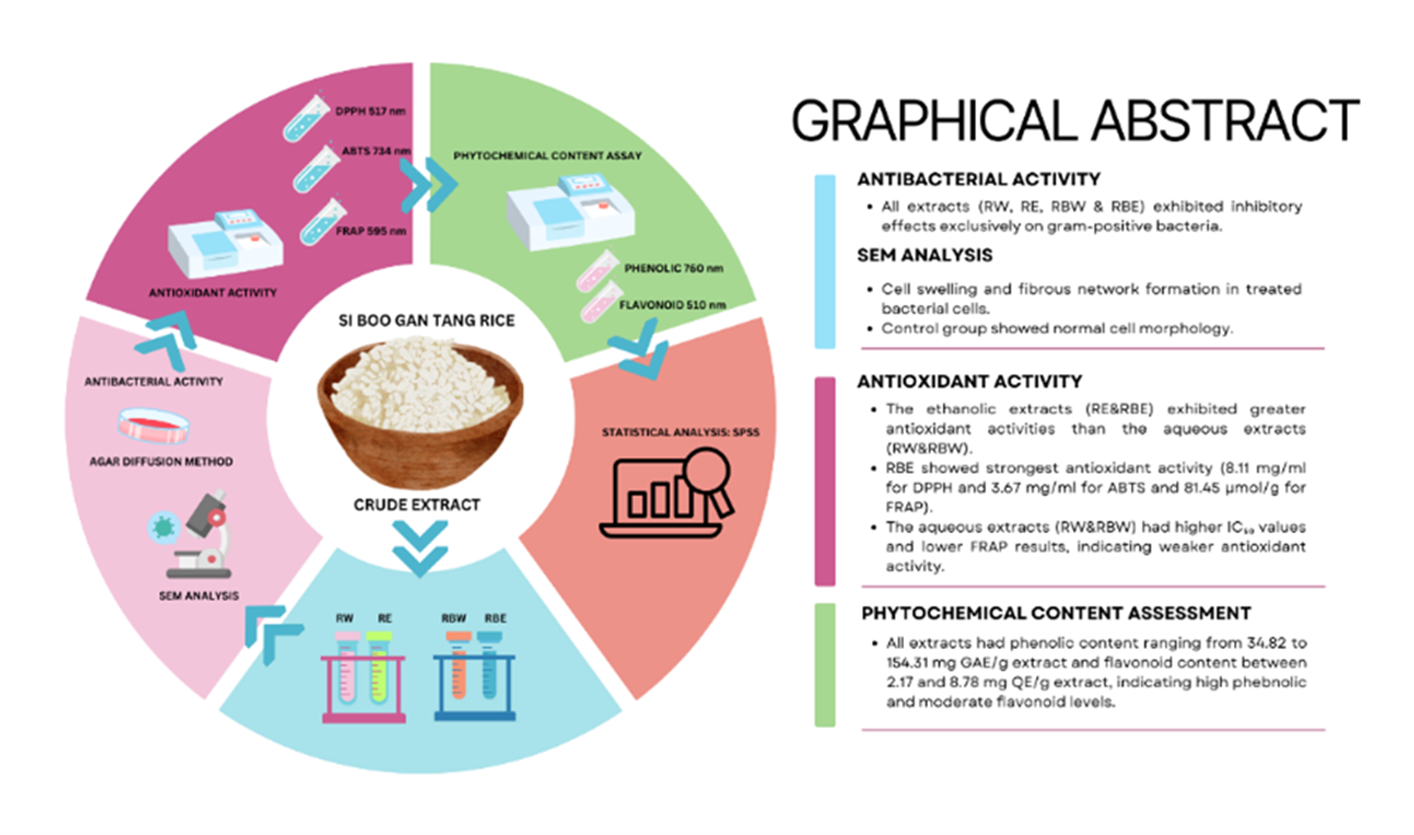
This study aimed to assess the biological properties of Si Boo Gan Tang Rice and bran extract. Antibacterial activity was evaluated using the agar well diffusion method, revealing inhibitory effects exclusively on gram-positive bacteria by both ethanolic Si Boo Gan Tang Rice (RE) and bran (RBE) extract. The inhibition zone of RE to methicillin-resistant Staphylococcus aureus (MRSA142), Staphylococcus aureus TISTR517, Bacillus cereus ATCC 11778, and Micrococcus luteus TISTR 884 was 2.07 ± 0.06, 1.94 ± 0.07, 1.95 ± 0.03, and 2.04 ± 0.03 cm, respectively. For RBE, the inhibition zones to methicillin-resistant S. aureus (MRSA142), Staphylococcus aureus TISTR517, B. cereus ATCC 11778, and M. luteus TISTR 884 were 2.07 ± 0.06, 2.00 ± 0.04, 1.67 ± 0.04, and 2.42 ± 0.56 cm, respectively. Scanning electron microscope (SEM) analysis indicated changes in the morphology of Staphylococcus aureus TISTR517 and Methicillin-resistant Staphylococcus aureus (MRSA142) cells treated with the RE and RBE, characterized by cell swelling and the formation of a fibrous network around them, contrasting with the control group. Antioxidant activity was assessed via DPPH, ABTS, and FRAP assay. The RBE displayed significant antioxidant potential, with IC50 values of 0.78 and 0.69 mg/mL in the DPPH and ABTS assays, respectively. Conversely, the aqueous rice bran (RBW) extract had IC50 values of 3.83 and 0.90 mg/mL in the same assays. For the RE, IC50 values were 1.11 mg/mL (DPPH) and 0.78 mg/mL (ABTS), while the aqueous rice (RW) extract had IC50 values of 4.45 mg/mL (DPPH) and 1.75 mg/mL (ABTS). In the FRAP assay, all the extracts RW, RBW, RE and RBE demonstrated ferric level reductions of 37.82, 36.85, 56.24, and 81.45 µmol/g extract, respectively. Phenolic content in the extracts ranged from 34.82 to 154.31 mg GAE/g extract, while flavonoid concentrations varied between 2.17 and 8.78 mg QE/g extract.
HIGHLIGHTS
- All extracts showed inhibitory effects exclusively on gram-positive bacteria, particularly effective against Staphylococcus aureus and Methicillin-Resistant Staphylococcus aureus (MRSA142).
- The ethanolic rice bran extract (RBE) demonstrated the highest antioxidant activity, with lowest IC50 values in DPPH (8.11 mg/mL) and ABTS (3.67 mg/mL) assays, and a highest FRAP value (81.45 µmol/g).
- All extracts exhibited significant phenolic content, ranging from 34.82 to 154.31 mg GAE/g extract, contributing to their potent antioxidant properties.
GRAPHICAL ABSTRACT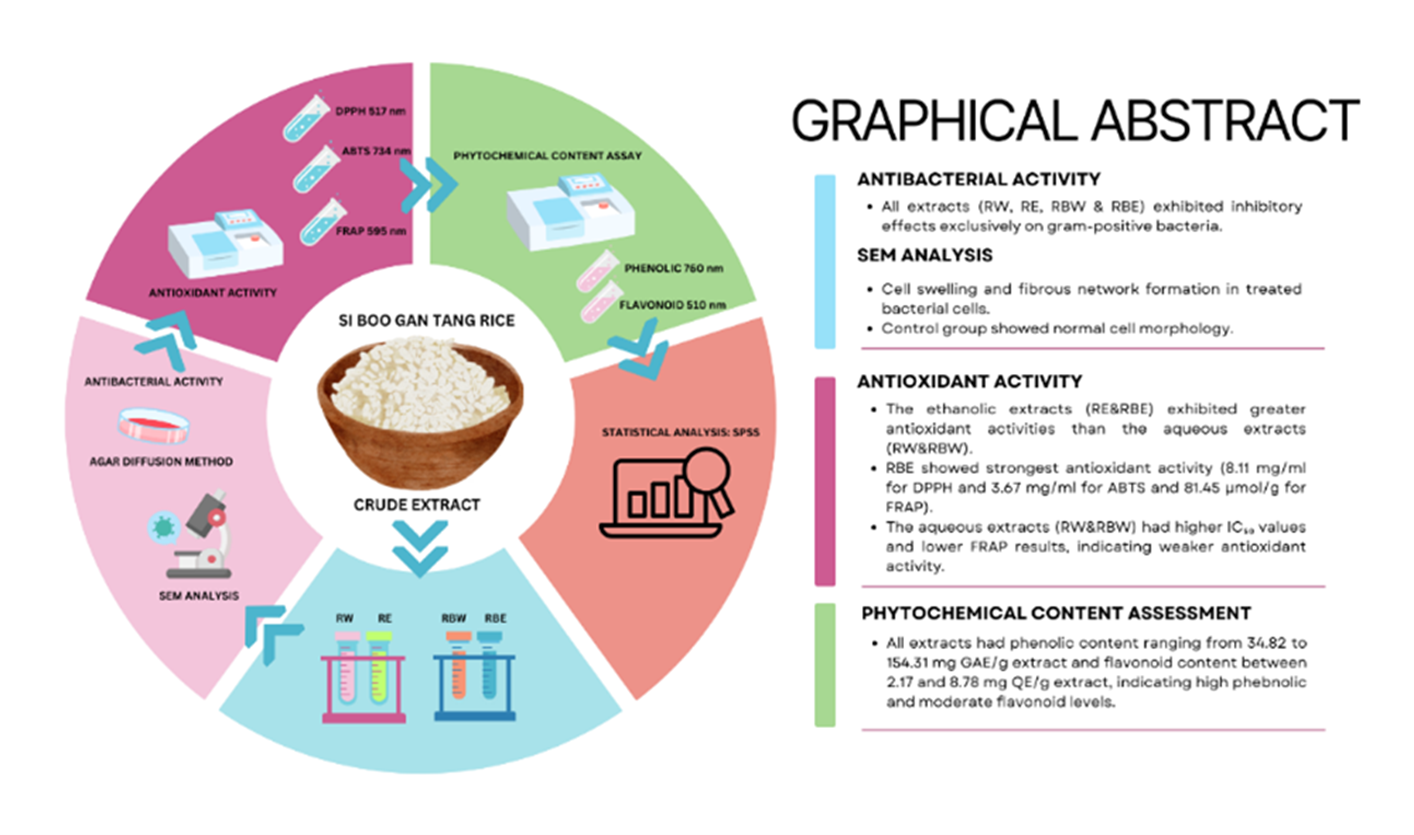
Downloads
References
N Chairek. 2018, Solvent extraction of active ingredients from germinated sangyod rice. Master Thesis. Prince of Songkla University, Songkhla, Thailand.
A Moongngarm, N Daomukd and S Khumpika. Chemical compositions, phytochemicals, and antioxidant capacity of rice bran, ricebran layer, and rice germ. APCBEE Procedia 2012; 2, 73-79.
T Laokuldilok, C Shoemaker, S Jongkaewwattana and V Tulyathan. Antioxidants and antioxidant activity of several pigmented rice brans. Journal of Agricultural and Food Chemistry 2011; 59(1), 193-199.
X Wu, L Gu, J Holden, D Haytowitz, S Gebhardt, G Beecher and RL Prior. Development of a database for total antioxidant capacity in foods: A preliminary study. Journal of Food Composition and Analysis 2004; 17(3-4), 407-422.
J Akash, S Rishu and G Nidhi. Anxiety disorder: An overview. ResearchGate, Berlin, Germany, 2010.
O Somsap and M Lertcanawanichakul. Characteristic and the mode of action of Bacteriocin produced by Brevibacillus laterosporus SA14 which isolated from the air. International Journal of Agricultural Technology 2013; 9(5), 1319-1331.
O Somsap, G Piboonpol, K Payanglee and C Daengrot. Antibacterial and antioxidant activity of nam-nam fruit extract. Princess of Naradhiwas University Journal 2019; 11(2), 156-167.
T Pattananandecha, S Apichai, S Sirilun, J Julsrigival, K Sawangrat, F Ogata, N Kawasaki, B Sirithunyalug and C Saenjum. Anthocyanin profile, antioxidant, anti-inflammatory, and antimicrobial against foodborne pathogens activities of purple rice cultivars in northern Thailand. Molecules 2021; 26(17), 5234.
K Kabploy, P Saengsawang, C Romyasamit, S Sangkanu, W Kitpipit, T Thomrongsuwannakij, T Wongtawan, M Daus, ML Pereira and W Mitsuwan. Sangyod rice bran extract enhances Lacticaseibacillus paracasei growth during the exponential phase and antibacterial activity of L. paracasei supernatant against zoonotic and foodborne pathogens. Veterinary World. 2022; 15(10), 2466-2474.
S Surin, P Seesuriyachan, P Thakeow, S You and Y Phimolsiripol. Antioxidant and antimicrobial properties of polysaccharides from rice brans. Chiang Mai Journal of Science 2018; 45(3), 1372-1382.
A Bains, A Najda, P Chawla, J Klepacka, SB Dhull, PK Sadh, MA Khan and R Kaushik. Formulation and characterization of gum arabic stabilized red rice extract nanoemulsion. Polymers 2022; 14(10), 1938.
G Burlacchini, A Sandri, A Papetti, I Frosi, F Boschi, MM Lleo and C Signoretto. Evaluation of antibacterial and antibiofilm activity of rice husk extract against staphylococcus aureus. Pathogens 2024; 13(1), 80.
X Sun, T Zhou, C Wei, W Lan, Y Zhao, Y Pan and VCH Wu. Antibacterial effect and mechanism of anthocyanin rich Chinese wild blueberry extract on various foodborne pathogens. Food Control 2018; 94, 155-161.
Y Ma, S Ding, Y Fei, G Liu, H Jang and J Fang. Antimicrobial activity of anthocyanins and catechins against foodborne pathogens Escherichia coli and Salmonella. Food Control 2019; 106, 106712.
H Chen, W Yu, G Chen, S Meng, Z Xiang and N He. Antinociceptive and antibacterial properties of anthocyanins and flavonols from fruits of black and non-black mulberries. Molecules 2017; 23(4), 4.
N Sharma, V Tiwari, S Vats, A Kumari, V Chunduri, S Kaur, P Kapoor and M Garg. Evaluation of anthocyanin content, antioxidant potential and antimicrobial activity of black, purple and blue colored wheat flour and wheat-grass juice against common human pathogens. Molecules 2020; 25(24), 5785.
G Yuan, Y Guan, H Yi, S Lai, Y Sun and S Cao. Antibacterial activity and mechanism of plant flavonoids to gram‑positive bacteria predicted from their lipophilicities. Scientific Reports 2021; 11, 10471.
J Zeng, D Chen, C Lv, K Qin, Q Zhou, N Pu, S Song and X Wang. Antimicrobial and anti‑biofilm activity of Polygonum chinense L.aqueous extract against Staphylococcus aureus. Scientific Reports 2022; 12, 21988.
K Wachirasiri, S Wanlapa, S Siricoon and Y Subkaree. Bioactive activities of peptides extracted from Khao Dowk Mali 105 defatted rice bran. Huachiew Chalermprakiet Science and Technology Journal 2022; 8(1), 28-40.
C Kaewpiboon and N Boonnak. Evaluation of the biological activities of sung yod germinated brown rice extract soaking in pandanus leaf extract. Thai Science and Technology Journal 2020; 28(11), 1977-1985.
I Koodkaew and P Sukonkhajorn. Antioxidant and anti-tyrosinase properties of stem, leaf, flower and seed from garden balsam. Khon Kaen Agriculture Journal 2018; 46(1), 1243-1247.
P Jaroennon, J Nuanchankong, S Sangwanna, C Jaengklang and P Saenprakob. Antioxidant activity, phenolic and flavonoid contents from dark rice bran water extracts. Research and Innovation Science and Technology Journal 2022; 3(2), 89-95.
A Phaungseang and S Rattanakon. 2019, Extraction of rice bran bioactive compounds using hydrothermal treatment with ultrasonic-assisted extraction. Master Thesis. Srinakharinwirot University, Bangkok, Thailand.
WH Talib, AI Mahmod, D Awajan, RA Hamed and IH Al-Yasari. Immunomodulatory, anticancer, and antimicrobial effects of rice bran grown in iraq: An in vitro and in vivo study. Pharmaceuticals 2022; 15(12), 1502.
V Teeranachaideekul, A Wongrakpanich, J Leanpolchareanchai, K Thirapanmethee and C Sirichaovanichkarn. Characterization, biological activities and safety evaluation of different varieties of Thai pigmented rice extracts for cosmetic applications. Pharmaceutical Sciences Asia 2018; 45(3), 140-153.
X Zha, J Wang, X Yang, H Liang, L Zhao, S Bao, J Luo, Y Xu and B Zhou. Antioxidant properties of polysaccharide fractions with different molecular mass extracted with hot-water from rice bran. Carbohydrate Polymers 2009; 78(3), 570-575.
Y Chen, M Xie, S Nie, C Li and Y Wang. Purification, composition analysis and antioxidant activity of a polysaccharide from the fruiting bodies of Ganoderma atrum. Food Chemistry 2008; 107(1), 231-241.
TC Lo, CA Chang, K Chiu, P Tsay and J Jen. Correlation evaluation of antioxidant properties on the monosaccharide components and glycosyl linkages of polysaccharide with different measuring methods. Carbohydrate Polymers 2011; 86(1), 320-327.
Q Liu, G Tian, H Yan, X Geng, Q Cao, H Wangn and TB Ng. Characterization of polysaccharides with antioxidant and hepatoprotective activities from the wild edible mushroom Russula vinosa Lindblad. Journal of Agricultural and Food Chemistry 2014; 62(35), 8858-8866.
P Chanchalad and S Thawornchinsombut. Antioxidant properties of rice bran hydrolysates derived from different Thai rice sources extracted by subcritical alkaline water combined with enzymatic hydrolysis. In: Proceedings the 14th KU-KPS Conference, Bangkok, Thailand. 2017.
M Ghoneum and S Gollapudi. Modified arabinoxylan rice bran (MGN-3/Biobran) sensitizes human T cell leukemia cells to death receptor (CD95)-induced apoptosis. Cancer Letters 2003; 201(1), 41-49.
V Seechamnanturakit, T Karrila, C Sontimuang and A Sukhoom. The natural pigments in pigmented rice bran and their relation to human health: A literature review. King Mongkut’s University of Technology North Bangkok International Journal of Advanced Science and Technology 2018; 11(1), 3-13.
Y Shao, F Xu, X Sun, J Bao and T Beta. Identification and quantification of phenolic acids and anthocyanins as antioxidants in bran, embryo and endosperm of white, red and black rice kernels (Oryza sativa L.). Journal of Cereal Science 2014; 59(2), 211-218.
JK Kim, SY Lee, SM Chu, SH Lim, S Suh, Y Lee, H Cho and S Ha. Variation and correlation analysis of flavonoids and carotenoids in korean pigmented rice (Oryza sativa L.) cultivars. Journal of Agricultural and Food Chemistry 2010; 58(24), 12804-12809.
Published
How to Cite
Issue
Section
License
Copyright (c) 2025 Walailak University

This work is licensed under a Creative Commons Attribution-NonCommercial-NoDerivatives 4.0 International License.





