
Pinostrobin Exerts Inhibitory Effects on Adipogenesis and Adipocyte-Induced MCF-7 Breast Cancer Cell Proliferation and Migration
DOI:
https://doi.org/10.48048/tis.2024.8125Keywords:
Breast cancer, Pinostrobin, Adipogenesis, Boesenbergia rotunda (L.), AdipocytesAbstract
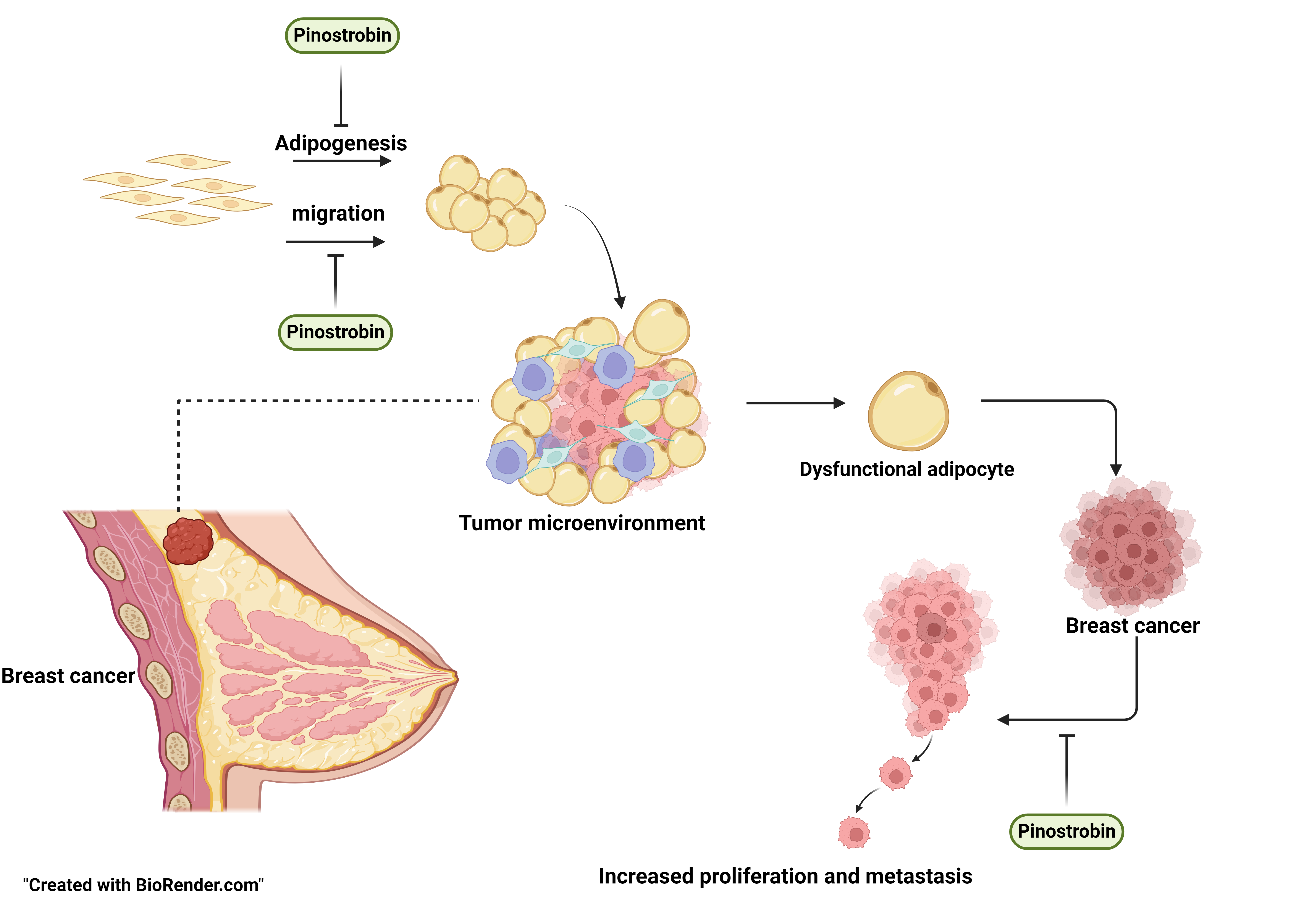
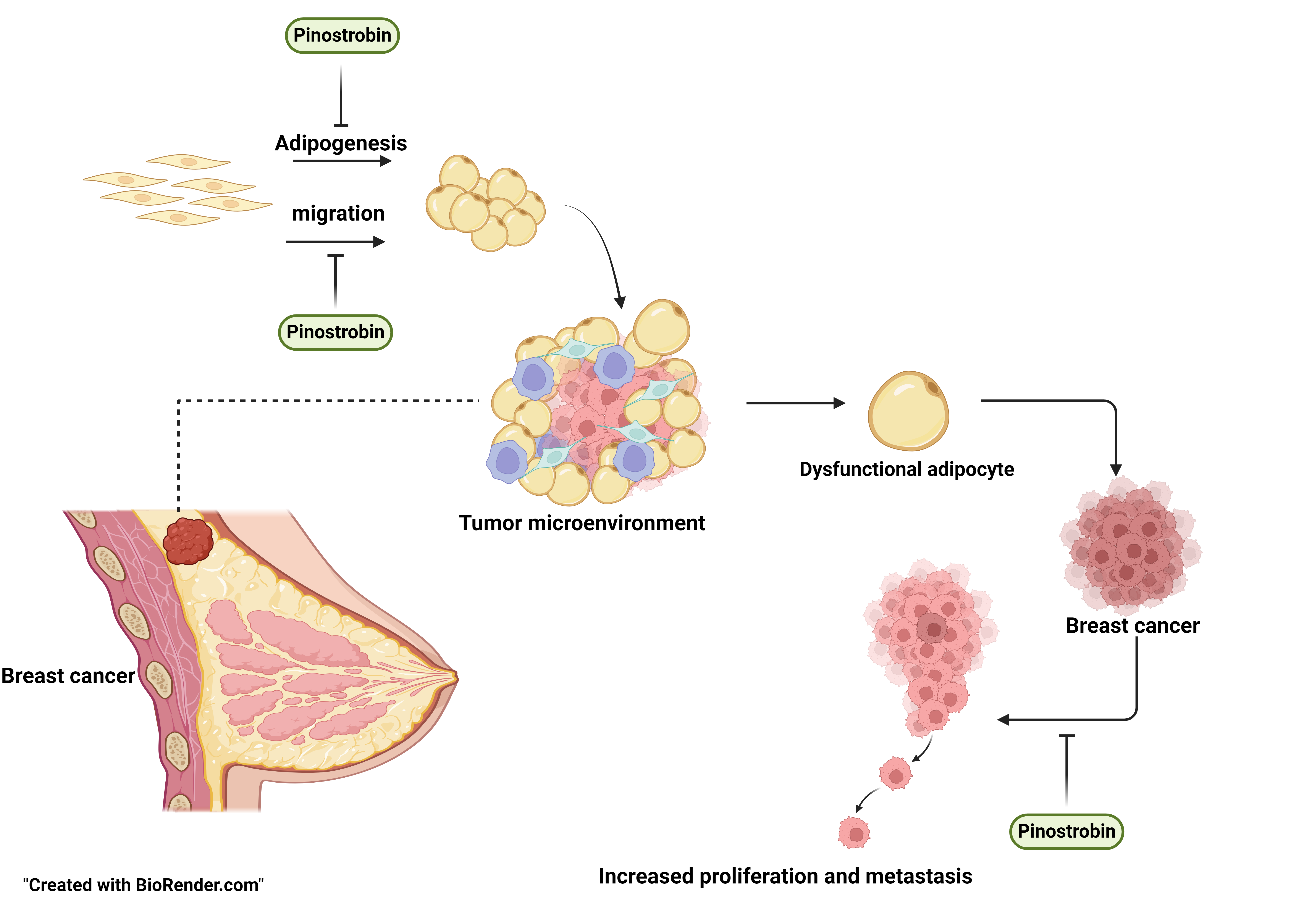
Dysfunctional adipose tissue contributes to several diseases, including diabetes, cardiovascular disease, and some cancers. Among the global female population, breast cancer is a cancer type that is increasing gradually in annual cases, while it also has the highest mortality rate. Recent evidence indicates that accumulation of the adipose tissue mass contributes to the progression of breast cancer proliferation and metastasis. The purposes of this study are to investigate the effects of pinostrobin - a compound extracted from Boesenbergia rotunda (L.) - on 3T3-L1 preadipocyte differentiation and migration as well as its inhibitory effects on adipocyte-induced MCF-7 proliferation and migration. This study revealed that pinostrobin at a concentration of 0 to 25 µM was not toxic to the 3T3-L1 cells and treatment with 25 µM pinostrobin dramatically reduced the adipogenesis of 3T3-L1 compared to untreated cells, as measured by both Oil Red O and Nile red fluorescence staining. In addition, the migratory ability of 3T3-L1 was reduced at 6 h post-treatment measured by wound healing migration assay. An indirect co-culture system of MCF-7 and an adipocyte-conditioned medium revealed a further increase in the ability of the MCF-7 to migrate and proliferate. Interestingly, treatment with pinostrobin at a concentration of 25 µM could suppress cell migration and inhibit the colony formation of MCF-7 breast cancer cells in the context of this co-culture system. Based on the findings of this study, pinostrobin could be a promising therapeutic candidate as a novel cancer treatment drug used in patients with obesity-related breast cancer in the future.
HIGHLIGHTS
- Pinostrobin extracted from Boesenbergia rotunda (L.) inhibits breast cancer cell proliferation and migration in an indirect co-culture system of adipocytes and MCF-7 cells.
- Pinostrobin significantly suppresses 3T3-L1 adipocyte differentiation and migration.
GRAPHICAL ABSTRACT
Downloads
References
F Bray, J Ferlay, I Soerjomataram, RL Siegel, LA Torre and A Jemal. Global cancer statistics 2018: GLOBOCAN estimates of incidence and mortality worldwide for 36 cancers in 185 countries. CA Cancer J. Clin. 2018; 68, 394-424.
CP Wild, E Weiderpass and BW Stewart. World cancer report: Cancer research for cancer prevention. International Agency for Research on Cancer, Lyon, France, 2020.
F Cmrečak, I Andrašek, V Gregov and L Beketić-Orešković. Obesity and cancer. Libr. Oncol. 2020; 48, 89-102.
ED Rosen and OA MacDougald. Adipocyte differentiation from the inside out. Nat. Rev. Mol. Cell Biol. 2006; 7, 885-96.
FM Gregoire, CM Smas and HS Sul. Understanding adipocyte differentiation. Physiol. Rev. 1998; 78, 783-809.
C Sun, S Mao, S Chen,W Zhang and C Liu. PPARs-orchestrated metabolic homeostasis in the adipose tissue. Int. J. Mol. Sci. 2021; 22, 8974.
QA Wang, F Zhang, L Jiang, R Ye, Y An, M Shao, C Tao, RK Gupta and PE Scherer. Peroxisome proliferator-activated receptor γ and its role in adipocyte homeostasis and thiazolidinedione-mediated insulin sensitization. Mol. Cell. Biol. 2018; 38, e00677-17.
D Rosen, CH Hsu, X Wang, S Sakai, MW Freeman, FJ Gonzalez and BM Spiegelman. C/EBPalpha induces adipogenesis through PPARgamma: A unified pathway. Genes Dev. 2002; 16, 22-6.
MI Lefterova, Y Zhang, DJ Steger, M Schupp, J Schug, A Cristancho, D Feng, D Zhuo, CJ Stoeckert, XS Liu and MA Lazar. PPARgamma and C/EBP factors orchestrate adipocyte biology via adjacent binding on a genome-wide scale. Genes Dev. 2008; 22, 2941-52.
X Liu, Q Xu, W Liu, G Yao, Y Zhao, F Xu, T Hayashi, H Fujisaki, S Hattori, SI Tashiro, S Onodera, M Yamato and T Ikejima. Enhanced migration of murine fibroblast-like 3T3-L1 preadipocytes on type I collagen-coated dish is reversed by silibinin treatment. Mol. Cell. Biochem. 2018; 441, 35-62.
C Attané and C Muller. Drilling for oil: Tumor-surrounding adipocytes fueling cancer. Trends Cancer 2020; 6, 593-604.
SJ Wakil and LA Abu-Elheiga. Fatty acid metabolism: A target for metabolic syndrome. J. Lipid Res. 2009; 50, S138-S143.
AG Waks and EP Winer. Breast cancer treatment: A review. J. Am. Med. Assoc. 2019; 321, 288-300.
Y Tokumaru, M Oshi, E Katsuta, L Yan, JL Huang, M Nagahashi, N Matsuhashi, M Futamura, K Yoshida and K Takabe. Intra tumoral adipocyte-high breast cancer enrich for metastatic and inflammation-related pathways but associated with less cancer cell proliferation. Int. J. Mol. Sci. 2020; 21, 5744.
E Katsuta, L Yan, M Nagahashi, A Raza, JL Sturgill, DE Lyon, OM Rashid, NC Hait and K Takabe. Doxorubicin effect is enhanced by sphingosine-1-phosphate signaling antagonist in breast cancer. J. Surg. Res. 2017; 219, 202-13.
M Oshi, Y Tokumaru, FA Angarita, L Lee, L Yan, R Matsuyama, I Endo and K Takabe. Adipogenesis in triple-negative breast cancer is associated with unfavorable tumor immune microenvironment and with worse survival. Sci. Rep. 2021; 11, 12541.
M Picon-Ruiz, C Morata-Tarifa, JJ Valle-Goffin, ER Friedman and JM Slingerland. Obesity and adverse breast cancer risk and outcome: Mechanistic insights and strategies for intervention. CA Cancer J. Clin. 2017; 67, 378-97.
GM Cragg and DJ Newman. Plants as a source of anti-cancer agents. J. Ethnopharmacol. 2005; 100, 72-9.
RL Singhal, YA Yeh, N Prajda, E Olah, GWJ Sledge and G Weber. Quercetin down-regulates signal transduction in human breast carcinoma cells. Biochem. Biophys. Res. Commun. 1995; 208, 425-31.
AA Farooqi, M Pinheiro, A Granja, F Farabegoli, S Reis, R Attar, UY Sabitaliyevich, B Xu and A Ahmad. EGCG mediated targeting of deregulated signaling pathways and non-coding RNAs in different cancers: Focus on JAK/STAT, Wnt/β-Catenin, TGF/SMAD, NOTCH, SHH/GLI, and TRAIL mediated signaling pathways. Cancers 2020; 12, 951.
M Farhan, MF Ullah, M Faisal, AA Farooqi, UY Sabitaliyevich, B Biersack and A Ahmad. Differential methylation and acetylation as the epigenetic basis of resveratrol’s anticancer activity. Medicines 2019; 6, 24.
H Yu, Q Zhang, AA Farooqi, J Wang, Y Yue, L Geng and N Wu. Opportunities and challenges of fucoidan for tumors therapy. Carbohydr. Polym. 2024; 324, 121555.
NK Patel, G Jaiswal and KK Bhutani. A review of biological sources, chemistry, and pharmacological activities of pinostrobin. Nat. Prod. Res. 2016; 30, 2017-27.
JC Le Bail, L Aubourg and G Habrioux. Effects of pinostrobin on estrogen metabolism and estrogen receptor transactivation. Cancer Lett. 2000; 156, 37-44.
HD Smolarz, E Mendyk, A Bogucka-Kocka and J Kocki. Pinostrobin-an anti-leukemic flavonoid from Polygonum lapathifolium L. ssp. nodosum (Pers.) Dans. Z Naturforsch. C J. Biosci. 2006; 61, 64-8.
HT San, HE Khine, B Sritularak, E Prompetchara, C Chaotham, CT Che and K Likhitwitayawuid. Pinostrobin: An adipogenic suppressor from fingerroot (Boesenbergia rotunda) and its possible mechanisms. Foods 2022; 11, 3024.
FJ Ruiz-Ojeda, AI Rupérez, C Gomez-Llorente, A Gil and CM Aguilera. Cell models and their application for studying adipogenic differentiation in relation to obesity: A review. Int. J. Mol. Sci. 2016; 17, 1040.
C Devi, T Tang and M Corbex. Incidence and risk factors for breast cancer in three distinct subtypes south-east asian ethnic group: Chinese, malay, and natives of Sarawak, Malaysia. Int. J. Cancer 2012; 131, 2869-77.
L Wiyono, RA Rahmawanti, BC Edina, NN Azizah, F Fadilah, RI Paramita and EH Purwaningsih. Isolation, synthesis nanoparticle, and in-vitro test of Pinostrobin from Kaempferia Pandurata on MCF-7 and MDAMB-231 breast cancer cell. Res. J. Pharm. Tech. 2020; 13, 2797-801.
J Li and X Han. Adipocytokines and breast cancer. Curr. Probl. Cancer 2018; 42, 208-14.
Y Manabe, S Toda, K Miyazaki and H Sugihara. Mature adipocytes, but not preadipocytes, promote the growth of breast carcinoma cells in collagen gel matrix culture through cancer-stromal cell interactions. J. Pathol. 2003; 201, 221-8.
Q Wu, B Li, Z Li, J Li, S Sun and S Sun. Cancer-associated adipocytes: Key players in breast cancer progression. J. Hematol. Oncol. 2019; 12, 95.
T Leibovich-Rivkin, Y Liubomirski, B Bernstein, T Meshel and A Ben-Baruch. Inflammatory factors of the tumor microenvironment induce plasticity in nontransformed breast epithelial cells: EMT, invasion, and collapse of normally organized breast textures. Neoplasia 2013; 15, 1330-46.
PG Morris, CA Hudis, D Giri, M Morrow, DJ Falcone, XK Zhou, B Du, E Brogi, CB Crawford, L Kopelovich, K Subbaramaiah and AJ Dannenberg. Inflammation and increased aromatase expression occur in the breast tissue of obese women with breast cancer. Cancer Prev. Res. 2011; 4, 1021-9.
NM Iyengar, CA Hudis and AJ Dannenberg. Obesity and cancer: Local and systemic mechanisms. Annu. Rev. Med. 2015; 66, 297-309.
M Nagahashi, A Yamada, E Katsuta, T Aoyagi, W Huang, KP Terracina, NC Hait, JC Allegood, J Tsuchida, K Yuza, M Nakajima, M Abe, K Sakimura, S Milstien, T Wakai and S Spiegel. Targeting the SphK1/S1P/S1PR1 axis that links obesity, chronic inflammation, and breast cancer metastasis. Can. Res. 2018; 78, 1713-25.
S Łukasiewicz, M zeczelewski, A Forma, J Baj, R Sitarz and A Stanisławek. Breast cancer-epidemiology, risk factors, classification, prognostic markers, and current treatment strategies-an updated review. Cancers 2021; 13, 4287.
J Gyamfi, Y Lee, BS Min and J Choi. Niclosamide reverses adipocyte induced epithelial-mesenchymal transition in breast cancer cells via suppression of the interleukin-6/STAT3 signalling axis. Sci. Rep. 2019; 9, 11336.
S Rahayu, M Indrayudha and P Indrayudha. Apoptosis induction activity and inhibition of MCF-7 cell proliferation in active isolate of butterfly pea flower (Clitoria ternatea L.). Trend. Sci. 2023; 20, 5518.
ANJ Imanuddin, Ika Wiani, Ari Hardianto and T Herlina. Flavonoids from extract butanol of twigs erythrina crista-galli against the breast cancer cell line within in silico method. Trend. Sci. 2023; 20, 5350.
VR Johnson, TB Washington, S Chhabria, EH Wang, K Czepiel, KJC Reyes and FC Stanford. Food as medicine for obesity treatment and management. Clin. Ther. 2022; 44, 671-81.
L Trigueros, S Peña, AV Ugidos, E Sayas-Barberá, JA Pérez-Álvarez and E Sendra. Food ingredients as anti-obesity agents: A review. Crit. Rev. Food Sci. Nutr. 2013; 53, 929-42.
Downloads
Published
How to Cite
Issue
Section
License
Copyright (c) 2024 Walailak University

This work is licensed under a Creative Commons Attribution-NonCommercial-NoDerivatives 4.0 International License.





