
Evaluation of Acute Toxicity of Ethanolic Extract from Fruit of Cyanometra cauliflora in ICR Mice
DOI:
https://doi.org/10.48048/tis.2024.8091Keywords:
Cyanometra cauliflora L., Biochemical parameter, Histopathology, Kidney, LiverAbstract
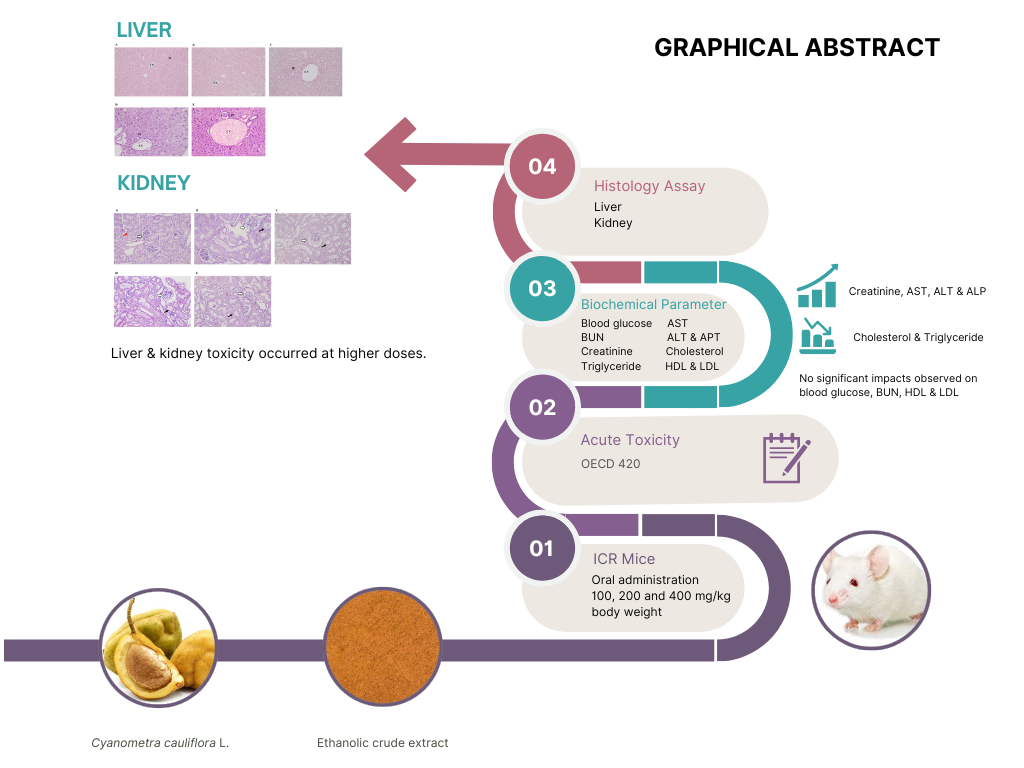
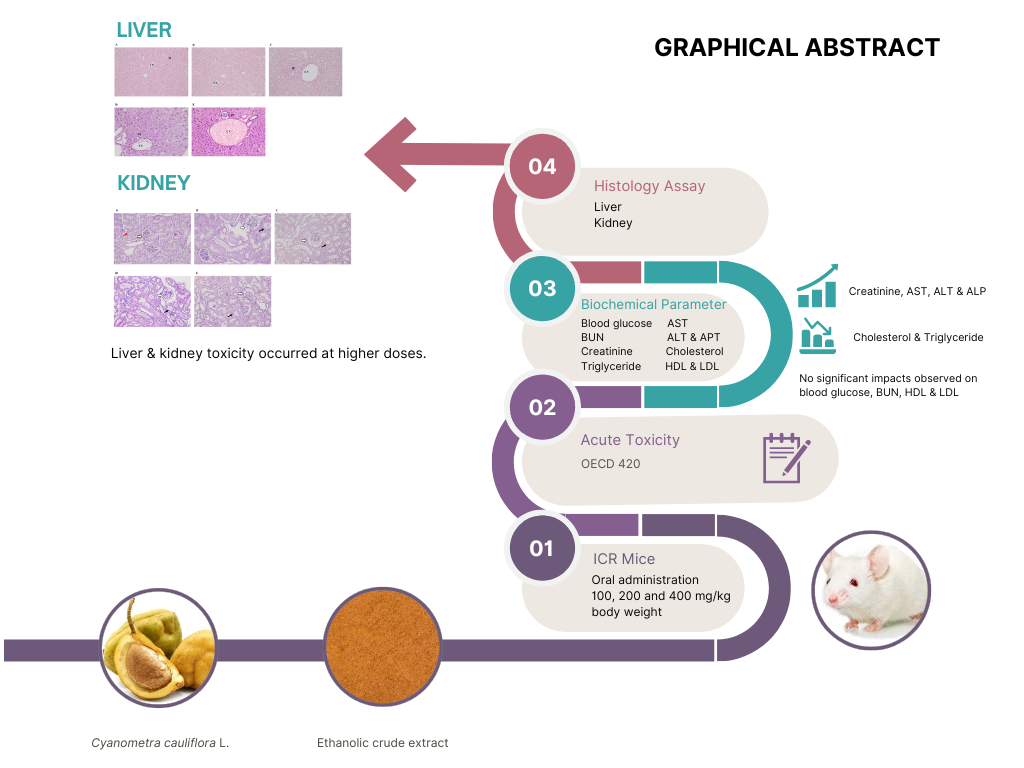
This research aims to investigate the acute toxicity profile of the ethanolic extract derived from Cyanometra cauliflora fruit, a plant commonly found in Southeast Asia. Male ICR mice were divided into 5 groups and administered varying oral doses of C. cauliflora extract: 100, 200 and 400 mg/kg body weight. Subsequently, the effects on both histological and biochemical parameters were meticulously examined post-experimentation. The results indicated no significant alterations in blood glucose or blood urea nitrogen (BUN) levels attributable to C. cauliflora extract administration. Nevertheless, a noteworthy elevation in creatinine, aspartate transaminase (AST), and alkaline phosphatase (ALP) levels was observed across all groups treated with C. cauliflora extract in comparison to controls (p < 0.05). Intriguingly, the extract consistently elicited a reduction in triglyceride levels across all administered doses, while cholesterol levels exhibited a decline specifically at the 400 mg/kg body weight dose. Notably, the levels of low-density lipoprotein (LDL) and high-density lipoprotein (HDL) remained unaltered throughout the experimentation. Histological assay suggested signs of hepatocellular damage, portal dilation and infiltration of inflammatory cells across all C. cauliflora-treated groups, alongside indications of kidney atrophy and other abnormalities.
These findings collectively suggest structural and functional modifications induced by C. cauliflora extract. In summary, while the administration of C. cauliflora extract did not exert significant changes in blood glucose and BUN levels, it did lead to heightened levels of creatinine and liver enzyme markers. Furthermore, liver and kidney damage were discerned at doses ranging from 100 to 400 mg/kg body weight, underscoring the imperative need to optimize extract concentrations to mitigate potential cytotoxic effects. These findings can be further explored to understand the processes behind the observed effects and to assess potential therapeutic applications or safety considerations associated with the use of C. cauliflora extract in clinical settings.
HIGHLIGHTS
- A hepatic and renal toxicity profile was detected in the ethanolic fruit extract of Cyanometra cauliflora, despite the absence of fatalities.
- The ethanolic fruit extract of cauliflora L. lowered cholesterol and triglyceride levels.
- Prolonged ingestion could be detrimental.
GRAPHICAL ABSTRACT
Downloads
References
L Kharchoufa, M Bouhrim, N Bencheikh, SE Assri, A Amirou, A Yamani, M Choukri, H Mekhfi and M Elachouri. Acute and subacute toxicity studies of the aqueous extract from Haloxylon scoparium Pomel (Hammada scoparia (Pomel)) by oral administration in rodents. Biomed. Res. Int. 2020; 2020, 4020647.
World Health Organization. WHO guidelines on safety monitoring of herbal medicines in pharmacovigilance systems. World Health Organization, Geneva, Switzerland, 2004.
A Roy, A Khan, I Ahmad, S Alghamdi, BS Rajab, AO Babalghith, MY Alshahrani, S Islam and R Islam. Flavonoids as bioactive compound from medicinal plants and its therapeutic applications. Biomed. Res. Int. 2022; 2022, 5445291.
A Licata, FS Macaluso and A Craxi. Herbal hepatotoxicity: A hidden epidemic. Intern. Emerg. Med. 2012; 8, 13-22.
SA Jordan, DG Cunningham and R Marles. Assessment of herbal medicinal products: Challenges, and opportunities to increase the knowledge base for safety assessment. Toxicol. Appl. Pharmacol. 2010; 243, 198-216.
A Jitareanu, A Trifan, M Vieriu, IC Caba, I Martu and L Agoroaei. Current trends in toxicology assessment of herbal medicines: A narrative review. Processes 2023; 11, 83.
T Alelign, D Chalchisa, N Fekadu, D Solomon, T Sisay, A Debella and B Petros. Evaluation of acute and sub-acute toxicity of selected traditional antiurolithiatic medicinal plant extracts in Wister albino rats. Toxicol. Rep. 2020; 7, 1356-65.
Y Zhang, R Tian, H Wu, X Li, S Li and L Bian. Evaluation of acute and sub-chronic toxicity of Lithothamnion sp. in mice and rats. Toxicol. Rep. 2020; 7, 852-8.
AA Eboo, D Sani, MM Suleiman, A Ahmad and AZ Hassan. Acute and sub-chronic toxicity evaluation of the crude methanolic extract of Diospyrus mespiliformix hochst ex a. Dc (ebenaceae) and it’s fractions. Toxicol. Rep. 2020; 7, 1138-44.
SE Osagie-Eweka, NEJ Orhue, EKI Omogbai and FC Amaechina. Oral acute and sub-chronic toxicity assessment of aqueous left extract of Simarouba glauca DC (Paradise tree). Toxicol. Rep. 2021; 8, 239-47.
AF Abd Aziz and M Iqbal. Antioxidant activity and phytochemical composition of Cynometra cauliflora. J. Exp. Integr. Med. 2013; 3, 337.
NZA Wahab, A Azizul, N Badya and N Ibrahim. Antiviral activity of an extract from leaves of the tropical plant Cyanometra cauliflora. Phcog. J. 2021; 13, 752-7.
BA Samling, Z Assim, WY Tong, CR Leong, S Ab Rashid, NNSNM Kamal, M Muhamad and WN Tan. Cyanometra cauliflora L.: An indigenous tropical fruit tree in Malaysia bearing essential oils and their biological activities. Arabian J. Chem. 2021; 14, 103302.
S Anliza and N Rachmawati. Cytotoxicity activity of ethanol extract in Namnam leaves (Cyanometra cauliflora L.) to hela cell. Walisongo J. Chem. 2021; 4, 107-12.
T Tajudin, N Mat, AB Siti-Aishah, AAM Yusran, A Alwi and AM Ali. Cytotoxicity, antiproliferative effects and apoptosis induction of methanolic extract of Cynometra cauliflora Linn. whole fruit on human promyelocytic leukemia HL-60 cells. Evid. Base. Compl. Alternative Med. 2012; 2012, 127373.
OA Somsap, G Piboonpol, K Payanglee and C Daengrot. Antibacterial and antioxidant activity of Nam-Nam fruit extract. Princess Naradhiwas Univ. J. 2019; 11, 156-67.
S Sabina, R Serrano, K Hasan, IBM da Silva, J Rocha, N Islam and O Silva. The genus Cyanometra: A review of ethnomedicine, chemical, and biological data. Plants 2022; 11, 3504.
K Sukchai. Cyanometra cauliflora flower extract on antibacterial and antioxidant activity. Princess Naradhiwas Univ. J. 2023; 14, 158-68.
A Seyedan, Z Mohamed, MA Alshagga, S Koosha and MA Alshawsh. Cyanometra cauliflora Linn. Attenuates metabolic abnormalities in high-fat diet-induced obese mice. J. Ethnopharmacol. 2019; 236, 173-82.
Organization for Economic Development. Guideline for testing of chemicals. Guidance no. 425. Organization for Economic Development. French, 2022.
K Kosala, MA Widodo, S Santoso and S Karyono. In vitro and in vivo anti-inflammatory activities of Coptosapelta flavescens Korth root’s methanol extract. J. Appl. Pharmaceut. Sci. 2018; 8, 042-8.
K Muhammad, SM Mohd, S Pinaki, RS Moklesur, D Arindam and KD Sreemoy. Evaluation of the acute and sub-acute toxicity of the ethanolic extract of Pericampylus glaucus (Lam.) Merr. in BALB/c mice. J. Acute Dis. 2015; 4, 309-15.
R Abid and R Mahmood. Acute and sub-acute oral toxicity of ethanol extract of Cassia fistula fruit in male rats. Avicenna J. Phytomed. 2019; 9, 117-25.
JW Mbiri, K Ogila, P Kisangau and M Gicheru. Acute and sub-acute oral toxicity profile of root bark methanol extract of Carissa Edulis Vahl. Phcog. J. 2023; 15, 253-8.
MY Ali, NEN Rumpa, S Paul, MS Hossen, EM Tanvir, T Hossan, M Saha, N Alam, N Karim, I Khalil and SH Gan. Antioxidant potential, subacute toxicity, and beneficiary effects of methanolic extract of pomelo (Citrus grandis L. Osbeck) in long evan rats. J. Toxicol. 2019; 2019, 2529569.
FCN Okwesili, CN Paul, EJ Parker and UR Ikecukwu. Phytochemical, antihyperglycemic and lipid profile effects of methanol extract fraction of Ricinus comminus seeds in alloxan induced diabetic male wistar albino. Asian J. Biochem. 2016; 11, 24-33.
A Yessoufou, J Gbenou, O Grissa, A Hichami, AM Simonin, Z Tabka, M Moudachirou, K Moutairou and NA Khan. Anti-hyperglycemic effects of three medicinal plants in diabetic pregnancy: Modulation of T cell proliferation. BMC Compl. Altern. Med. 2013; 13, 77.
L gebremeskel, KB Tuem and T Teklu. Evaluation of antidiabetic effect of ethanolic leaves extract of Becium grandiflorum Lam. (Lamiaceae) in streptozotocin-induced diabetic mice. Diabetes Metab. Syndr. Obes. 2020; 13, 1481-9.
MM Hassan, S Uddin, A Bhowmik, A Ashraf, MM Islam and B Rokeya. Phytochemical screening and antidiabetic effects of fruit rind of Momordica dioica roxb. on streptozocin induced type 2 diabetic rats. Heliyon 2022; 8, e08771.
E Jere, CC Ezeala and L Prashar. Phytochemical studies and blood glucose lowering effect of Zambian cultivars of Piliostigma thonningii in alloxan-induced diabetic rats. Med. J. Zambia 2021; 48, 70-7.
S Alam, MR Sarker, TN Sultana, NR Chowdhury, MA Rashid, NI Chaity, C Zhao, J Xiao, EE Hafez, SA Khan and IN Mohamed. Antidiabetic phytochemicals from medicinal plants: Prospective candidates for new drug discovery and development. Front. Endocrinol. 2022; 13, 800714.
YG Zeleka, SA Atnafie and TJ Aragaw. Anti-diabetic activities of hydro-methanolic crude extract and solvent fractions of Heteromorpha arborescens (Apiaceae) leaves in mice. J. Exp. Pharmacol. 2023; 15, 107-21.
AG Ayele, P Kumar and E Engidawork. Antihyperglycemic and hypoglycemic activities of the aqueous leaf extract of Rubus Erlangeri Engl (Rosacea) in mice. Metab. Open 2021; 11, 100118.
A Aghajanyan, Z Movsisyan and A Trchounian. Antihyperglycemic and antihyperlipidemic activity of hydroponic Stevia rebaudiana aqueous extract in hyperglycemia induced by immobilization stress in rabbits. Biomed. Res. Int. 2017; 2017, 9251358.
M Khan, Z Manzoor, M Rafig, SH Munawar, MY Waqas, H Majeed, SZA Shah, R Hussain, HI Hussain, T Tahir, K Kotwica-Mojzych and M Mojzych. Phytochemical screening, anti-inflammatory, and antidiabetic activities of different extracts from Caralluma edulis plant. Molecules 2022; 27, 5346.
GD Geresu, S Umer, M Araelassie, G Ashebir and E Makonnen. Hepatoprotective effects of crude stem bark extracts and solvent fractions of Cordia Africana against acetaminophen-induced liver injury in rats. Can. J. Gastroenterol. Hepatol. 2022; 2022, 1449286.
S Khalid, M Arshad, K Raza, S Mahmood, F Siddique, N Aziz, S Khan, W Khalid, A Al-Farga and F Aqlan. Assessment of hepatoprotective, nephroprotective efficacy, and antioxidative potential of Moringa oleifera leaf powder and ethanolic extract against PCOS-induced female albino mice (Mus Musculus). Food Sci. Nutr. 2023; 11, 7206-17.
A Kamnate, OA Somsap, P Singdam, G Piboonpol and W Pantong. Evaluation of acute and subacute oral toxicity induced by ethanol extract of Boletus griseipurpureus Corner in male mice: Blood parameters and histopathological studies. J. Appl. Pharmaceut. Sci. 2024; 14, 184-91.
G Nouioura, M Tourabi, A Tahraoui, K El-Yagoubi, S Maache, H Elfatemi, B Lyoussi and E Derwich. Assessment of the acute and subacute toxicity of the aqueous extract of Moroccan Ferula communis fruit in a mouse model. Saudi Pharmaceut. J. 2023; 31, 101701.
L Thangavelu, SR Balusamy, R Shanmugam, S Sivanesan, E Devaraj, V Rajagopalan, DN Veeraiyan, DK Chellappan, K Dua, YJ Kim and H Perumalsamy. Evaluation of the sub-acute toxicity of Acacia catechu Willd seed extract in a Wistar albino rat model. Ragul. Toxicol. Pharmacol. 2020; 113, 104640.
G Lum and S Leal-Khouri. Significance of low serum urea nitrogen concentrations. Clin. Chem. 1989; 35, 639-40.
K Donkor, LNK Okine, WKM Abotsi and E Woode. Acute and sub-chronic toxicity studies of aqueous extract of root bark of Cassia Sieberiana D.C. in rodents. J. Appl. Pharmaceut. Sci. 2014; 4, 084-9.
MA Akanji, MT Yakubu and MI Kazeem. Hypolipidemic and toxicological potential of aqueous extract of Rauwolfia vomitoria Afzel root in Wistar rats. J. Med. Sci. 2013; 13, 253-60.
TI Solikhah, TA Wijaya, DA Pavita, RK Miftakhurrozaq, HM Raharjo, MN Yunita and F Fikri. The effect of sapodilla leaf extract (Manilkara zapota L.) on lipid profiles of alloxan-induced diabetic mice. Phcog. J. 2023; 15, 286-9.
SA Ferreira, AG Guimaraes, FC Ferrari, CM Carneiro, NCN de Paiva and DAS Guimaraes. Assessment of acute toxicity of the ethanolic extract of Lychnophora pinaster (Brazilian arnica). Revista Brasileira Farmacognosia 2014; 24, 553-60.
ALM Kognou, AD Tchamgoue, LRY Tchokouaha, D Ngima, P Nthenge-Ngumbau, PVT Fokou, AT Tchinda, GA Agbor, R Madeleine, E Etame, RS Mouokeu, CE Gueiffier, RS Pawar, AS Mouelle and RAN Ngane. Acute and sub-chronic toxicity studies of Dichaetanthera africana (Hook. F.) Jacq. Fel. (Melastomataceae) stem bark ethanol extract. J. Appl. Pharmaceut. Sci. 2018; 8, 147-55.
T Ogunmoyole and OJ Agunbiade. Aqueous extract of Zingiber officinale attenuates carbon tetrachloride induced hepatorenal injury in albino rats. J. Phytopharmacol. 2023; 12, 173-81.
A Namjoo, M MirVakili, H Shirzad and M Faghani. Biochemical, liver and renal toxicities of Melissa officinals hydroalcoholic extract on balb/C mice. J. HerbMed Pharmacol. 2013; 2, 35-40.
A Vysakh, K Jayesh, LR Helen, M Jyothis and MS Latha. Acute oral toxicity and anti-inflammatory evaluation of methanolic extract of Rotula aquatica roots in Wistar rats. J. Ayurveda Integr. Med. 2020; 11, 45-52.
Downloads
Published
How to Cite
Issue
Section
License
Copyright (c) 2024 Walailak University

This work is licensed under a Creative Commons Attribution-NonCommercial-NoDerivatives 4.0 International License.





