
Assessment of the Physicochemical, Nutritional Composition, and Biological Properties of a Novel Vinegar Derived from a Local Thai Champuling Fruit (Baccaurea polyneura hook.f)
DOI:
https://doi.org/10.48048/tis.2025.10495Keywords:
Baccaurea polyneura Hook.f., Champuling, Fruit vinegar, Functional food, Antioxidant, Antibacterial, Antifungal, Anti-adipogenesisAbstract
Fruit vinegar is globally recognized for its bioactive compounds and is associated with a variety of health-promoting properties. This study investigates the physicochemical and nutritional composition and the biological properties of novel vinegar produced from a local Thai wild fruit called “champuling” (Baccaurea polyneura Hook.f.). The total soluble solids (TSS), peak acetic acid, pH, phenolics, flavonoids, and carotenoids, along with the biological properties, including cytotoxicity, anti-adipogenesis, and antibacterial and antifungal activity of champuling vinegar (JCV), were measured. Throughout the fermentation process, characteristic changes were observed, including a reduction in total soluble solids, increased alcohol and acetic acid levels, and a decline in pH. Nutritionally, 100 mL of JCV contained 0.78 g of protein, 18.04 g of carbohydrates, 75.39 kcal of total energy, and significant amounts of vitamin B, predominantly niacin (B3), pantothenic acid (B5), and biotin (B7). JCV also exhibited notable phenolic, flavonoid, and carotenoid compounds, contributing to strong antioxidant capacity as shown by 69.84 and 84.65% inhibition by DPPH and ABTS assays, respectively. In addition to its antioxidant potential, JCV demonstrated antibacterial activity against several pathogenic bacteria by inhibiting P. aeruginosa, E. coli, and B. subtilis. Cytotoxicity tests showed that JCV was non-toxic at a dilution ratio of 1:100 to human proximal tubular cells (HK-2) and mouse fibroblast cells (3T3-L1). At this same dilution, JCV significantly inhibited adipocyte differentiation, suggesting anti-adipogenic potential. However, under conditions of glutamate-induced neurotoxicity using neuroblastoma cells (SH-SY5Y) as a model, JCV did not exhibit neuroprotective effects. This study demonstrated the inclusive evaluation of champuling vinegar (JCV), highlighting its potent antioxidant, antibacterial, and anti-adipogenic effects. These multifunctional bioactivities position JCV as a promising functional food ingredient or nutraceutical for managing metabolic disorders and microbial control. Further studies in animal models and clinical trials are essential to validate its efficacy, safety, and mechanisms, paving the way for its therapeutic development and future applications.
HIGHLIGHTS
- Champuling vinegar (JCV) contains significant bioactive compounds, including phenolics, flavonoids, and carotenoids, along with antioxidant properties.
- Nutritionally, JCV contains proteins, carbohydrates, and significant amounts of vitamins B3, B5, and B7.
- JCV exhibits selective antibacterial effects by inhibiting the growth of P. aeruginosa, E. coli, and B. subtilis.
- JCV is not toxic to normal cells but exerts anti-adipogenic properties, suggesting its potential as a candidate for further investigation in obesity and metabolic disorder research.
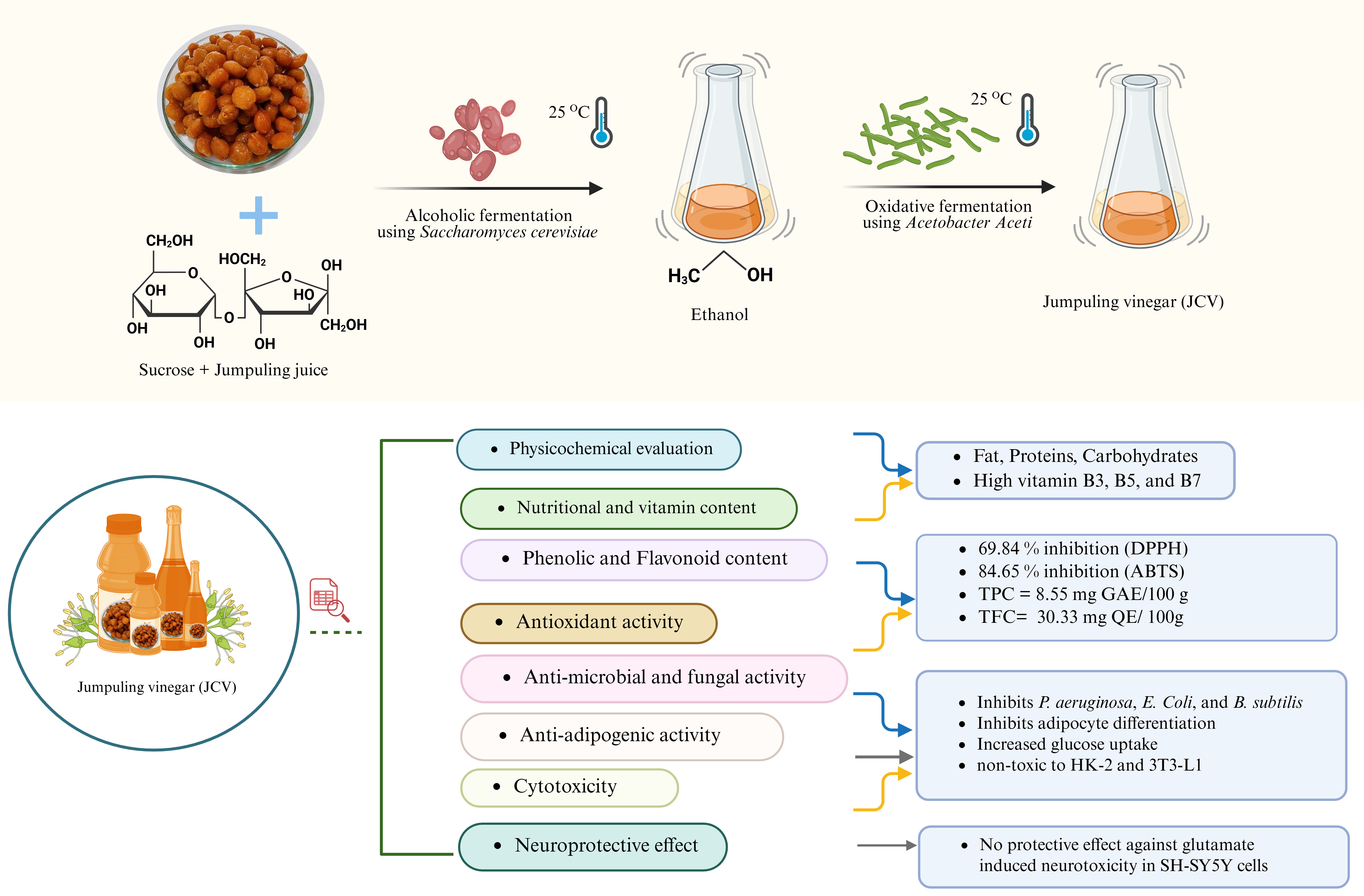
GRAPHICAL ABSTRACT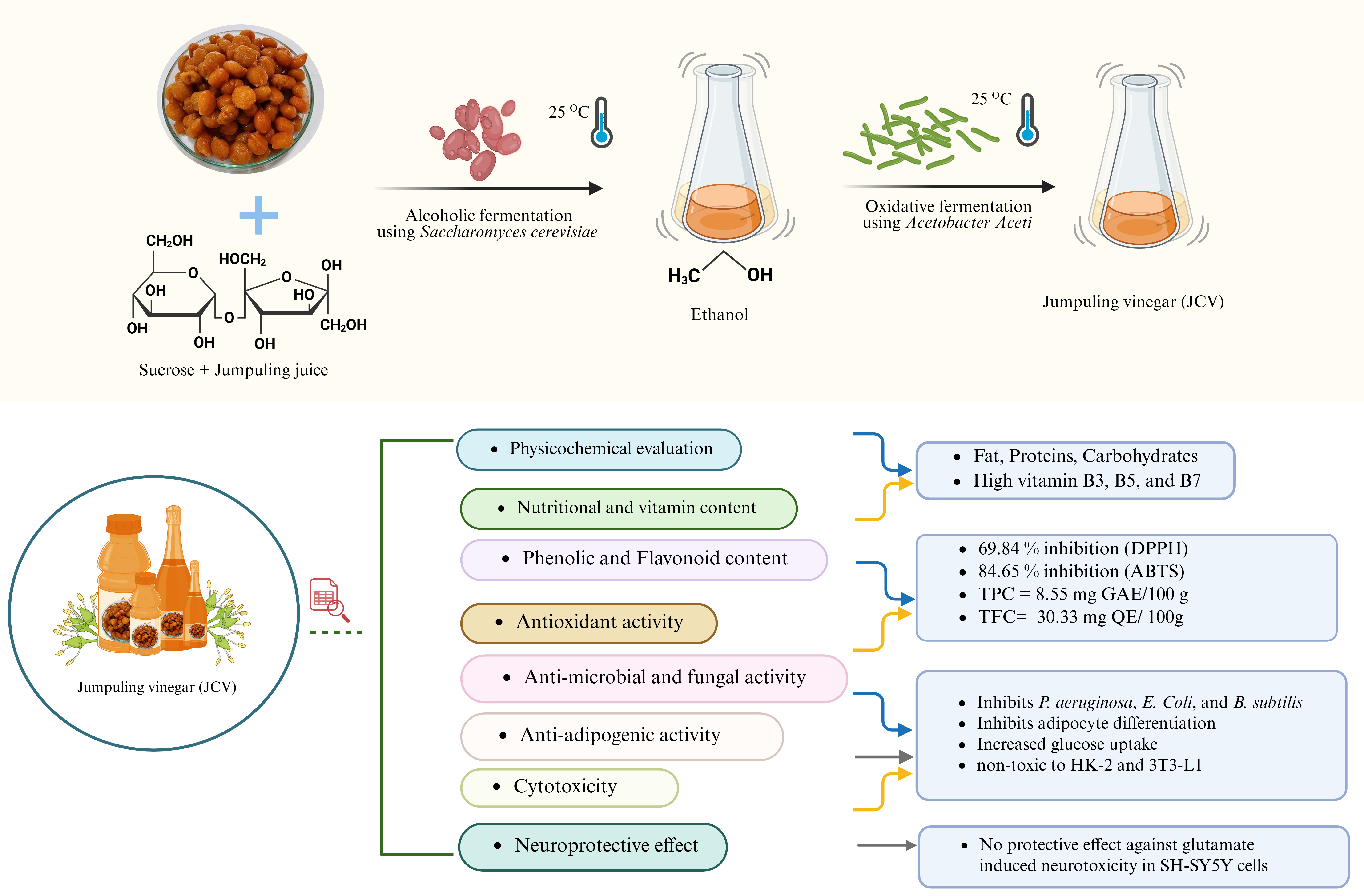
Downloads
References
SAM Khalifa, RM El-Shabasy, HE Tahir, DM Abo-Atya, A Saeed, TZ Abolibda, Z Guo, X Zou, D Zhang, M Du, G Kai, DG Buccato, M Daglia, C Zhao and HR El-Seedi. Vinegar - a beneficial food additive: Production, safety, possibilities, and applications from ancient to modern times. Food & Function 2024; 15(20), 10262-10282.
B Perumpuli and N Dilrukshi. Vinegar: A functional ingredient for human health. International Food Research Journal 2022; 29(5), 959-974.
CW Ho, AM Lazim, S Fazry, UKHH Zaki and SJ Lim. Varieties, production, composition and health benefits of vinegars: A review. Food Chemistry 2017; 221, 1621-1630.
U.S. Food and Drug Administration, Available at: https://www.fda.gov/media/71937/download, accessed April 2025.
Ministry of Public Health. Notification of the Ministry of Public Health (no. 204): Vinegar. Prachachon, Bangkok, Thailand, 2000.
P Saithong, J Permpool and S Nitipan. Antioxidant and anthocyanin-rich vinegar fermented from Thai colored rice varieties. Trends in Sciences 2024; 21(6), 7532.
W Senghoi and WK Klangbud. Antioxidants inhibit the growth of foodborne pathogens, and reduce nitric oxide activity in LPS-stimulated RAW 264.7 cells of nipa palm vinegar. PeerJ 2021; 9, e12151.
MK Wali and MM Abed. Antibacterial activity of acetic acid against different types of bacteria causes food spoilage. Plant Archives 2019; 19(1), 1827-1831.
S Hosoda, Y Kawazoe, T Shiba, S Numazawa and A Manabe. Anti-obesity effect of ginkgo vinegar, a fermented product of ginkgo seed coat, in mice fed a high-fat diet and 3T3-L1 preadipocyte cells. Nutrients 2020; 12(1), 230.
F Asejeje, MA Abiola, B Ben-Azu, AM Adeosun, O Ighodaro and A Ajayi. Apple cider vinegar attenuates lipopolysaccharide-induced neurobehavioral deficits in mice. Nutrire 2020; 45, 1-9.
S Jafarirad, MR Elahi, A Mansoori, A Khanzadeh and MH Haghighizadeh. The improvement effect of apple cider vinegar as a functional food on anthropometric indices, blood glucose and lipid profile in diabetic patients: A randomized controlled clinical trial. Frontiers in Clinical Diabetes and Healthcare 2023; 4, 1288786.
H Barrong, H Coven, A Lish, SN Fessler, P Jasbi and CS Johnston. Daily vinegar ingestion improves depression and enhances niacin metabolism in overweight adults: A randomized controlled trial. Nutrients 2024; 16(14), 2305.
S Tripathi and PM Mazumder. Neuroprotective efficacy of apple cider vinegar on zinc-high fat diet-induced monoamine oxidase alteration in murine model of AD. Journal of the American Nutrition Association 2022; 41(7), 658-667.
SD Tehrani, M Keshani, MH Rouhani, SA Moallem, M Bagherniya and A Sahebkar. The effects of apple cider vinegar on cardiometabolic risk factors: A systematic review and meta-analysis of clinical trials. Current Medicinal Chemistry 2023; 30(12), 1234-1245.
K Awang, M Mohd Khairulazhar, A Mohd Nor, AR Razali, A Rusli and O Mohd Khairuddin. Diversity, distribution and conservation of Baccaurea species in the home gardens and orchards in Malaysia. The Malayan Nature Journal 2018; 70(3), 333-339.
K Chayamarit and PC van Welzen. Euphorbiaceae (genera A-F). Flora of Thailand 2005; 8(1), 107-119.
e-Flora of Thailand, Available at: http://www.dnp.go.th/botany/detail.aspx?type=flora&id=8018, accessed April 2025.
K Awang, MS Mat Ali, H Salahuddin and SS Mohamad. Distribution, morphological variations, utilization and conservation of Baccaurea polyneura Hook.f. (jentik-jentik) in Malaysia. Malayan Nature Journal 2020; 72(4), 345-357.
S Lasaman, M Alee and PS Sinchai. Determination of antioxidants content from the crude extract in Baccaurea polyneura Hook.f. In: Proceedings of the 6th National Academic Conference on Science and Technology Network in the Southern Region: Science and Technology with New Lifestyles for Sustainability, Nakhon Si Thammarat, Thailand. 2025, p. 123-130.
AOAC International. Official methods of analysis of the association of official analytical chemists. 17th ed. AOAC International, Maryland, United States, 2000.
B Yingngam, M Monschein and A Brantner. Ultrasound-assisted extraction of phenolic compounds from Cratoxylum formosum ssp. formosum leaves using central composite design and evaluation of its protective ability against H2O2-induced cell death. Asian Pacific Journal of Tropical Medicine 2014; 7S1, S497-S505.
SA Makanjuola, VN Enujiugha, OS Omoba, Sanni DM. Optimization and prediction of antioxidant properties of a tea-ginger extract. Food Science & Nutrition 2015;3(6):505–517.
S Lalou, E Hatzidimitriou, M Papadopoulou, VG Kontogianni, CG Tsiafoulis and IP Gerothanassis. Beyond traditional balsamic vinegar: Compositional and sensorial characteristics of industrial balsamic vinegars and regulatory requirements. Journal of Food Composition and Analysis 2015; 43, 175-184.
U Habiba, I Alam, L Aunsary, F Jubayer, P Karmoker, MA Alim and MAR Mazumder. Exploring the potential of wild date palm (Phoenix Sylvestris L. Roxb) fruits for vinegar production in Bangladesh. Applied Food Research 2024; 4(2), 100628.
PABN Perumpuli, MMA Buddhika and MN Kaumal. Production of antioxidant-rich tomato vinegar: An alternative to coconut vinegar in culinary production. The Journal of Food Science and Technology 2022; 59(6), 1234-1245.
A Kiełb, K Perkowska, A Kaźmierczak, W Izdebska, P Sornek and A Borkowska. Apple cider vinegar in folk and modern medicine: A historical review and current scientific evidence. Quality in Sport 2024; 21, 54339.
D Ousaaid, H Mechchate, H Laaroussi, C Hano, M Bakour, El Ghouizi, RA Conte, B Lyoussi and I El Arabi. Fruits vinegar: Quality characteristics, phytochemistry, and functionality. Molecules 2022; 27(1), 222.
L Feng, M Xu, W Zeng, X Zhang, S Wang, Z Yao, T Zhou, S Shi, J Cao and L Chen. Evaluation of the antibacterial, antibiofilm, and anti-virulence effects of acetic acid and the related mechanisms on colistin-resistant Pseudomonas aeruginosa. BMC Microbiology 2022; 22(1), 306.
P Lund, A Tramonti and D De Biase. Coping with low pH: Molecular strategies in neutralophilic bacteria. FEMS Microbiology Reviews 2014; 38(6), 1091-1125.
T Xia, B Zhang, W Duan, J Zhang and M Wang. Nutrients and bioactive components from vinegar: A fermented and functional food. Journal of Functional Foods 2020; 64, 103681.
P Denev, M Kratchanova, M Ciz, A Lojek, O Vasicek, P Nedelcheva, D Blazheva, R Toshkova, E Gardeva, L Yossifova, P Hyrsl and L Vojtek. Biological activities of selected polyphenol-rich fruits related to immunity and gastrointestinal health. Food Chemistry 2014; 157, 37-44.
A Aguilera-Méndez, D Boone-Villa, R Nieto-Aguilar, S Villafaña-Rauda, AS Molina and JV Sobrevilla. Role of vitamins in the metabolic syndrome and cardiovascular disease. Pflugers Archives 2022; 474(1), 117-140.
Thai Dietetic Association. Dietary reference intake for Thais 2020. Bureau of Nutrition, Department of Health, Ministry of Public Health, Nonthaburi, Thailand, 2020.
Q Liu, GY Tang, CN Zhao, RY Gan and HB Li. Antioxidant activities, phenolic profiles, and organic acid contents of fruit vinegars. Antioxidants 2019; 8(4), 78.
D Rotariu, E Babeș, DM Ţiț, M Moisi, C Bustea, M Stoicescu, A Radu, C Vesa, T Behl, AF Bungau and S Bungău. Oxidative stress - complex pathological issues concerning the hallmark of cardiovascular and metabolic disorders. Biomedicine & Pharmacotherapy 2022; 152, 113238.
W Duan, T Xia, B Zhang, S Li, C Zhang, C Zhao, J Song and M Wang. Changes of physicochemical, bioactive compounds and antioxidant capacity during the brewing process of zhenjiang aromatic vinegar. Molecules 2019; 24(21), 3935.
K Jia, S Xue, Y Du, L Peng, W Chen, X Yu, X Cao, R Fang and Z Li. Antimicrobial and antioxidant properties of hawthorn vinegar. Microbiology Research 2024; 15(4), 2048-2055.
El Abdali, Y Saghrouchni, H Kara, M Mssillou, I Allali, A Jardan, YAB Kafkas, NE El-Assri, EM Nafidi, HA Bourhia, M Bourhia, KS Almaary, N Eloutassi and A Bouia. Exploring the bioactive compounds in some apple vinegar samples and their biological activities. Plants 2023; 12, 3850.
B Zou, G Xiao, Y Xu, J Wu, Y Yu and M Fu. Persimmon vinegar polyphenols protect against hydrogen peroxide-induced cellular oxidative stress via Nrf2 signalling pathway. Food Chemistry 2018; 255, 23-30.
F Harrison, A Blower, C de Wolf and E Connelly. Sweet and sour synergy: Exploring the antibacterial and santibiofilm activity of acetic acid and vinegar combined with medical-grade honeys. Microbiology 2023; 169(7), 001351.
C Cortesia, C Vilcheze, A Bernut, W Contreras, K Gomez, J de Waard, WR Jacobs, L Kremer and H Takiff. Acetic acid, the active component of vinegar, is an effective tuberculocidal disinfectant. mBio 2014; 5(2), 10-1128.
M Rozenblat, O Last, S Fisher and M Ziv. Acetic acid treatment for toe web infection caused by Pseudomonas aeruginosa combined with fungal infection: A case series of ten patients. Dermatologic Therapy 2019; 32(3), e12883.
M Adamczak, M Ożarowski and TM Karpiński. Anti-bacterial activity of some flavonoids and organic acids widely distributed in plants. Journal of Clinical Medicine 2019; 9(1), 109.
L Bouarab-Chibane, V Forquet, P Lantéri, L Léonard-Akkari and N Oulahal. Antibacterial properties of polyphenols: Characterization and QSAR (quantitative structure-activity relationship) models. Frontiers in Microbiology 2019; 10, 829.
SB Lesmana, R Djuanda and VK Sugiaman. Cytotoxicity test of apple cider vinegar as a root canal irrigant against fibroblast cells. ODONTO: Dental Journal 2022; 9(2), 158-167.
T Kawai, MV Autieri and R Scalia. Adipose tissue inflammation and metabolic dysfunction in obesity. American Journal of Physiology Cell Physiology 2021; 320(3), C375-C391.
JM Lim, YJ Yoo, SH Lee, TH Jang, KK Seralathan, EY Lee, DY Jeong and BT Oh. Anti-inflammatory, anti-lipogenesis, and anti-obesity benefits of fermented Aronia vinegar evaluated in 3T3-L1 cells and high-fat diet induced C57BL/6 mice. Food Biotechnology 2022; 36(4), 328-350.
N Nicosia, M Giovenzana, P Misztak, J Mingardi and L Musazzi. Glutamate-mediated excitotoxicity in the pathogenesis and treatment of neurodevelopmental and adult mental disorders. International Journal of Molecular Sciences 2024; 25(12), 6521.
Published
How to Cite
Issue
Section
License
Copyright (c) 2025 Walailak University

This work is licensed under a Creative Commons Attribution-NonCommercial-NoDerivatives 4.0 International License.





