
Molecular Identification of Spirogyra Species Using rbcL Markers and Their Chemical Compositions
DOI:
https://doi.org/10.48048/tis.2026.12119Keywords:
Spirogyra, Phylogenetic, Chemical compound, Spirogyra, rbcL markers, Phylogenetic, Chemical compoundAbstract
Spirogyra are green algae that occur widespread in freshwater habitats across northeastern Thailand, yet its species diversity and chemical characteristics remain poorly understood. This study presents a novel integrated approach combining morphological identification, rbcL-based molecular analysis, and chemical profiling (LC-MS and FTIR) to comprehensively characterize Thai Spirogyra species. Six Spirogyra samples were collected from different water resources in Sakon Nakhon province and identified using both morphological characteristics and ribulose-bisphosphate carboxylase (rbcL) gene sequences. The sequence data of the rbcL gene was analyzed by using the database of the National Center for Biotechnology Information (NCBI). The results found that 6 Spirogyra samples were able to be identified as 3 Spirogyra submaxima and 1 sample each of S. fluviatilis, S. maxima, and S. chungkingensis. All Spirogyra samples were extracted with ethanol, yielding 6 crude ethanol extracts (SPE1 - SPE6). The chemical compositions were analyzed using Liquid Chromatography-Mass Spectrometry (LC-MS). LC-MS analysis of the 6 crude ethanol extracts revealed a total of 60 compounds, of which thirty were consistently detected across all Spirogyra samples, while the remaining compounds were specific to individual extracts. In addition, the FTIR profiles of SPE1-SPE6 were examined using the ATR-FTIR technique. The FTIR spectra indicated similar functional groups across samples, with absorption bands attributed to hydroxyl groups, CH₂ and CH₃ stretching vibrations, and carbonyl functionalities. These findings demonstrate that integrating morphological, genetic, and chemical analyses provides a more reliable framework for distinguishing Spirogyra species and reveals locality-specific chemical variation that may be valuable for future biochemical and taxonomic research.
HIGHLIGHTS
- Molecular identification of 6 Spirogyra species was performed using the rbcL marker.
- Morphological characteristics of 6 Spirogyra specimens were described and compared.
- Phylogenetic relationships among 6 Spirogyra samples were constructed using Maximum Likelihood and Neighbor-Joining methods based on the rbcL gene locus.
- Comparative analysis of the chemical compositions of 6 Spirogyra species collected from different water resources was conducted.
GRAPHICAL ABSTRACT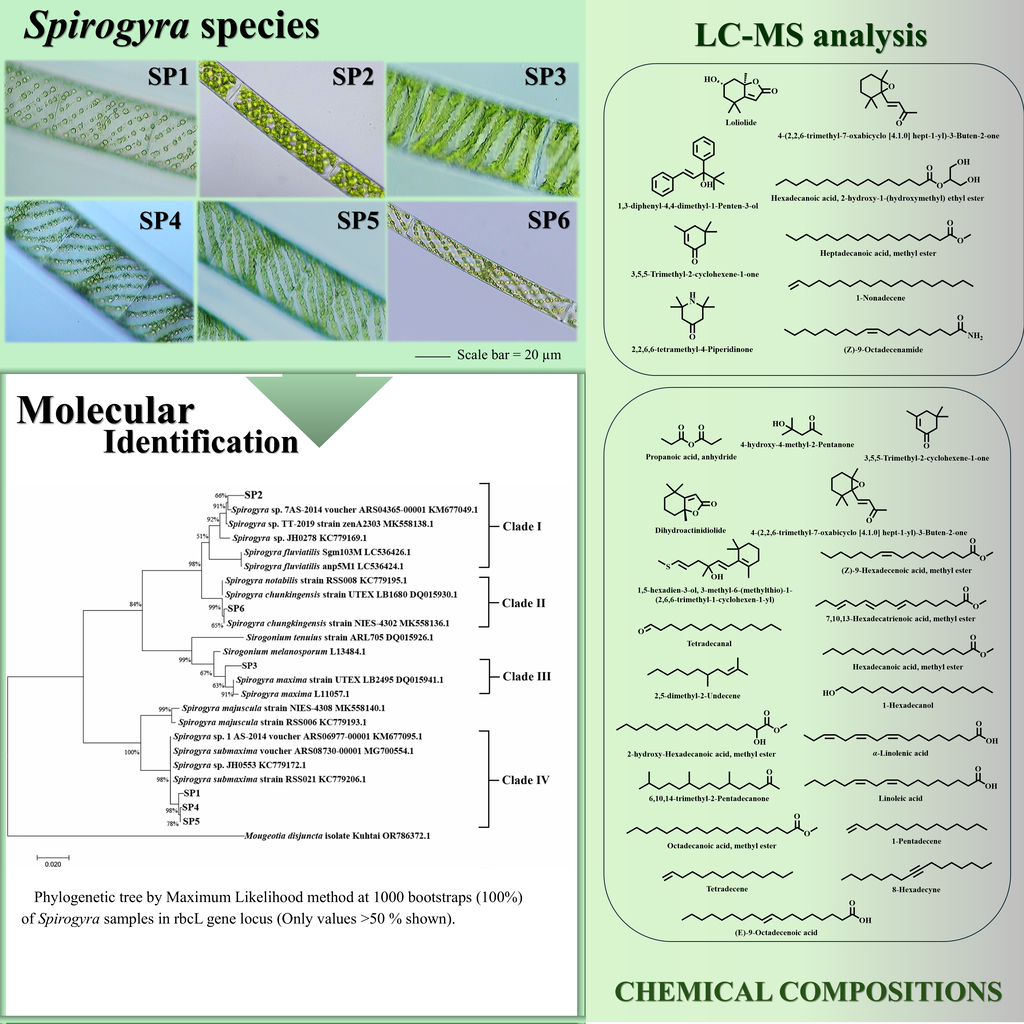
Downloads
References
S Thiamdao and Y Peerapornpisal. Diversity of edible freshwater macroalgae in Mekong and Nan Rivers. Journal of Fisheries Technology Research 2009; 3(1), 115-124.
S Nagabhushana and SG Malammanavar. The occurrence of genus Spirogyra (Zygnemataceae, Chlorophyceae) from the ponds of Shivamogga district and it’s distributional additions to the algal flora of Karnataka, India. International Journal of Botany Studies 2021; 6(3), 103-115.
C Permann, N Gierlinger and A Holzinger. Zygospore of the green alga Spirogyra: new insight from structural and chemical imaging. Frontiers in Plant Science 2022; 13, 1080111.
Y Peerapornpisal. Freshwater algae in Thailand. 3rd ed. Department of Biology, Faculty of Science, Chiang Mai University, Chiang Mai, 2015, p. 204-205.
S Thiamdao and Y Peerapornpisal. Morphological observation of Spirogyra elliosospora Transeau, an edible freshwater macroalgae. Journal of The Microscopy Society of Thailand 2011; 4(2), 94-97.
MD Guiry and GM Guiry. Algaebase - world-wide electronic publication, National University of Ireland, Galway, Available at: https://www.algaebase.org/search/genus/detail/?genus_id=43564, accessed September 2025.
HA Berry and CA Lembi. Effect of temperature and irradiance on the seasonal variation of a Spirogyra (Chlorophyta) population in a Midwestern Lake (USA). Journal of Phycology 2000; 36, 841-851.
T Takano, S Higuchi, H Ikegaya, R Matsuzaki, M Kawachi, F Takahashi and H Nozaki. Identification of 13 Spirogyra species (Zygnemataceae) by traits of sexual reproduction induced under Laboratory culture conditions. Scientific Reports 2019; 9(1), 7458.
P Wongsawad and Y Peerapornpisal. Molecular identification and phylogenetic relationship of green algae, Spirogyra elliosospora (Chlorophyta) using ISSR and rbcL markers. Saudi Journal of Biological Sciences 2014; 21, 505-510.
CS Drummond, J Hall, KG Karol, CF Delwiche and RM McCourt. Phylogeny of Spirogyra and Sirogonium (Zygnematophyceae) based on rbcL sequence DATA 1. Journal of Phycology 2005; 41(5), 1055-1064.
B Yongkhamcha and N Buddhakala. Phytochemical compositions, nutritional contents, cytotoxicity and anti-inflammatory activity of different extracts from Spirogyra neglecta (Hassall) Kützing. Trends in Sciences 2023; 20(4), 6528.
J Prarthana and KR Maruthi. Screening of phytochemicals & bioactive antibacterial activity in Spirogyra sp. International Journal of Advanced Research 2017; 5(7), 1145-1154.
Z Shah, SL Badshah, A Iqbal, Z Shah, AH Emwas and M Jaremko. Investigation of important biochemical compounds from selected freshwater macroalgae and their role in agriculture. Chemical and Biological Technologies in Agriculture 2022; 9(1), 9.
J Wizi, L Ni, WK Darkwah and L Xianglan. Analysis of bioactive compounds from different algae samples extracted with ultrasound: Characterization, phytochemical contents and antioxidant potentials. Pharmacognosy Research 2022; 14(1), 35-44.
S Nagabhushana, ASK Yohannan, SG Malammanavar, A Raman and G Packiaraj. Phytochemical constituents and bio-potentiality of Spirogyra porticalis (O.F. Müller) Dumortier from the perennial pond of Karnataka, India. Notulae Scientia Biologicae 2025; 17(2), 12300-12300.
N Sitthiwong. Pigment and nutritional value of Spirogyra spp. in Sakon Nakhon, Nakhon Phanom and Mukdahan Provinces. Progress in Applied Science and Technology 2019; 9(1), 10-21.
N Sitthiwong, J Sumangka, S Michaitrakun and K Sotthisawad. Total phenolic compound and antimicrobial activity of Spirogyra spp. Progress in Applied Science and Technology 2024; 14(1), 65-72.
DM John, BA Whitton and AJ Brook. The freshwater algal flora of the british isles: An identification guide to freshwater and terrestrial algae. 2nd ed. Cambridge University Press, Cambridge, 2011, p. 587-602.
R Stancheva, JD Hall, RM McCourt and RG Sheath. Identity and phylogenetic placement of Spirogyra species (Zygnematophyceae, Charophyta) from California streams and elsewhere. Journal of Phycology 2013; 49, 588-607.
P Wilkie, AD Poulsen, D Harris and LL Forrest. The collection and storage of plant material for DNA extraction: the teabag method. Gardens’ Bulletin Singapore 2013; 65(2), 231-234.
S Arthan, J Jandaruang and K Namwongsa. Screening of antioxidant, anti-tyrosinase, antibacterial, alpha-glucosidase inhibitory activities and chemical profile from roots of Indigofera suffruticosa. Moroccan Journal of Chemistry 2025; 13(3), 1442-1460.
EI Abdel-Aal, AM Haroon and J Mofeed. Successive solvent extraction and GC - MS analysis for the evaluation of the phytochemical constituents of the filamentous green alga Spirogyra longata. The Egyptian Journal of Aquatic Research 2015; 4(3), 233-246.
J Kumar, D Priyanka, AB Tayade, D Gupta, O Chaurasia, DK Upreti, K Toppo, R Arora, MR Suseela and RB Srivastava. Chemical composition and biological activities of trans-Himalayan alga Spirogyra porticalis (Muell.) Cleve. PloS One 2015; 10(2), e0118255.
DH Mohammed and MA Al-katib. Active and phenolic compounds in Spirogyra sp. PDNA1 is an antibiotic for some bacteria and fungi. Al-Kitab Journal for Pure Sciences 2023; 7(1), 100-113.
J Sun, Y Song, J Zhang, Z Huang, H Huo, J Zheng, Q Zhang, Y Zhao, J Li and P Tu. Characterization and quantitative analysis of phenylpropanoid amides in eggplant (Solanum melongena L.) by high performance liquid chromatography coupled with diode array detection and hybrid ion trap time-of-flight mass spectrometry. Journal of Agricultural and Food Chemistry 2015; 63(13), 3426-3436.
AR Sherwood, JM Neumann, M Dittbern-Wang and KY Conklin. Diversity of the green algal Spirogyra (Conjugatophyceae) in the Hawaiian Islands. Phycologia 2018; 57(3), 331-344.
P Wongsawad and Y Peerapornpisal. Morphological and molecular profiling of Spirogyra from northeastern and northern Thailand using inter simple sequence repeat (ISSR) markers. Saudi Journal of Biological Sciences 2015; 22(4), 382-389.
M El-Sheekh, M Schagerl, M Gharieb and GA Elsoud. Induction of sexual reproduction and zygospore patterns in the filamentous green alga Spirogyra link (Conjugatophyceae: Zygnematales). Journal of BioScience and Biotechnology 2017; 6(2), 147-154.
K Phinyo, K Saeku, W Nunto, J Pekkoh and T Prasertsin. Morphological and molecular characterization of Spirogyra species from water bodies in Chiang Rai Province, Thailand: Insights into bioactivity and antioxidant potential. Sains Malaysiana 2024; 53(5), 1093-1104.
P Wongsawad and Y Peerapornpisal. Ecological relevance and physical morphology of green algae, Spirogyra sp. In northern Thailand. Journal of Yala Rajabhat University 2013; 8(1), 1-8.
R Hainz, C Wober and M Schagerl. The relationship between Spirogyra (Zygnematophyceae, Streptophyta) filament type groups and environmental conditions in Central Europe. Aquatic Botany 2009; 91(3), 173-180.
S Sriwattana, N Chokumnoyporn and C Brennan. Chemical composition and sensory profile of Spirogyra neglecta (Hassall) Kützing. International Journal of Food Science and Technology 2024; 59(12), 9336-9344.
MN Khalid and M Shameel. Studies on the phycochemistry and biological activity of Spirogyra rhizoides (Chlorophycota). Pakistan Journal of Botany 2012; 44(5), 1815-1820.
A Juneja, RM Ceballos and GS Murthy. Effects of environmental factors and nutrient availability on the biochemical composition of algae for biofuels production: A review. Energies 2013; 6(9), 4607-4638.
C Lopes, JMC Obando, TCD Santos, DN Cavalcanti and VL Teixeira. Abiotic factors modulating metabolite composition in brown algae (Phaeophyceae): Ecological impacts and opportunities for bioprospecting of bioactive compounds. Marine Drugs 2024; 22(12), 544.
Y Zhao, J Zhou, L Chen, S Li, Y Yin, A Jeyaraj, S Liu, J Zhuang, Y Wang, X Chen and X Li. Allelopathic effect of Osmanthus fragrans changes the soil microbial community and increases the soil nutrients and the aroma quality of tea leaves. Journal of Agricultural and Food Chemistry 2025; 73(22), 13818-13831.
RZ Mehrizi, AF Bafghi, N Vahid, MRS Ardakani, MN Meybodi and H Zare-Zardini. Evaluation of the anti-Leishmanial activity of the hydroalcoholic extract of green algae (Spirogyra): Investigation of weight indicators (lesion size and organ weights) in BALB/c Mice. Acta Parasitologica 2025; 70(1), 51.
B Ghazala and M Shameel. Phytochemistry and bioactivity of some freshwater green algae from Pakistan. Pharmaceutical Biology 2008; 43(4), 358-369.
I Ahmad, FM Sarim, B Ullah, R Ullah and T Sageretia. Phytotoxic and cytotoxic activities of 3 species of Spirogyra. Pakistan Journal of Plant Sciences 2012; 18(1), 69-72.
Z Djezzar, A Aidi, H Rehali, S Ziad and T Othmane. Characterization of activated carbon produced from the green algae Spirogyra used as a cost-effective adsorbent for enhanced removal of copper (ii): Application in industrial wastewater treatment. RSC Advances 2024; 14(8), 5276-5289.
A Mansoori, N Singh, SK Dubey, TK Thakur, N Alkan, SN Das and A Kumar. Phytochemical characterization and assessment of crude extracts from Lantana camara L. for antioxidant and antimicrobial activity. Frontiers in Agronomy 2020; 2, 582268.
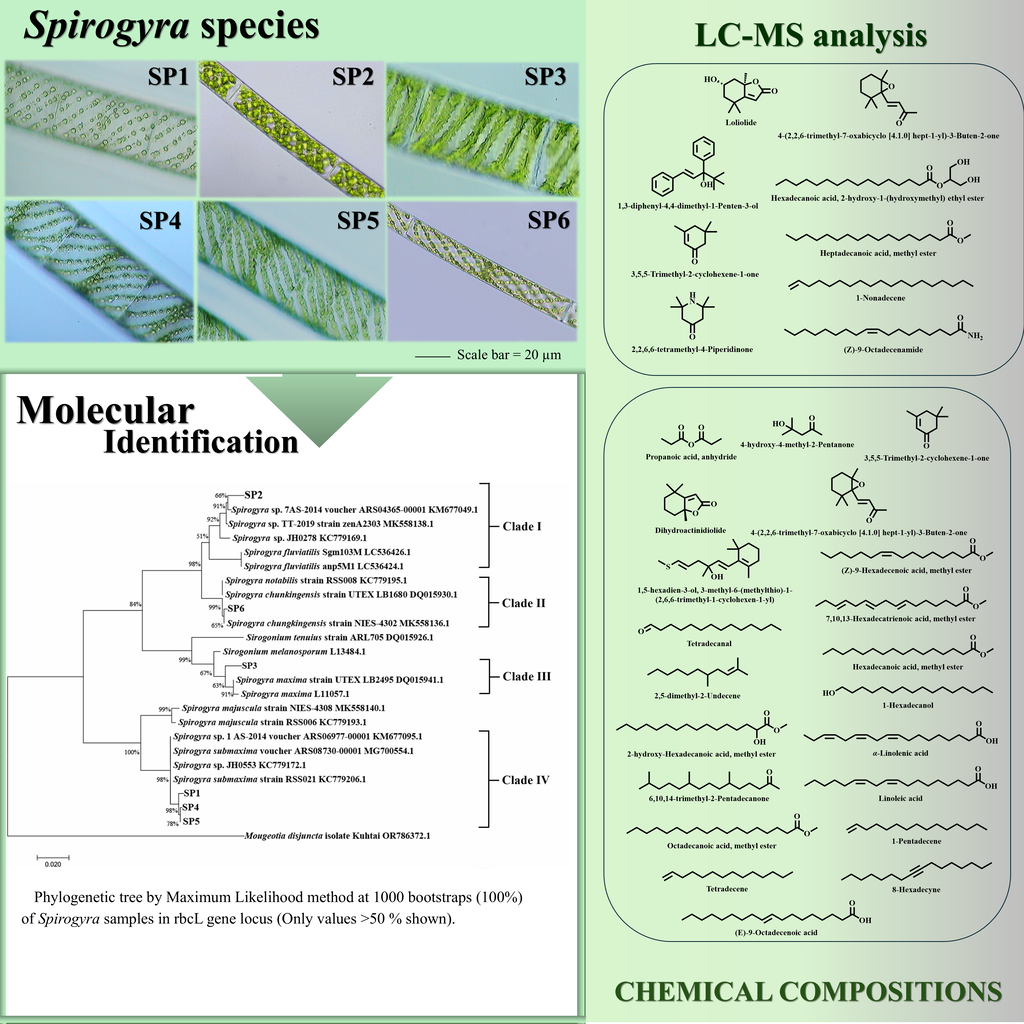
Published
How to Cite
Issue
Section
License
Copyright (c) 2025 Walailak University

This work is licensed under a Creative Commons Attribution-NonCommercial-NoDerivatives 4.0 International License.





