
Bioactivities of Leaf Extracts from Urceola polymorpha (Pierre) D.J.Middleton & Livsh., Hyptis suaveolens (L.) Poit, and Passiflora foetida L. Leaf: Antioxidant, Antibacterial, Cytotoxic and Anti-tyrosinase Potential with Molecular Docking Analysis
DOI:
https://doi.org/10.48048/tis.2025.10162Keywords:
Antibacterial, Antioxidant, Total phenolic, Weed, Anti-tyrosinase, Molecular dockingAbstract
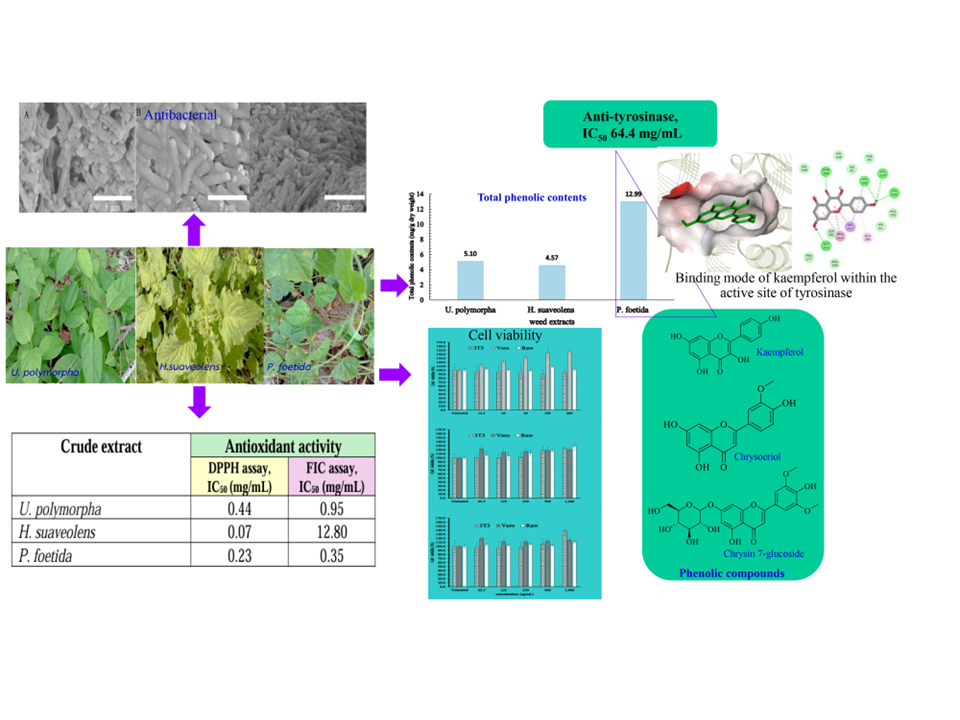
Weeds are naturally occurring plants, often lacking economic value and potentially harming cash crops. However, some weeds contain beneficial compounds, and with proper research, they could be utilized to their fullest potential. In this study, leaf weeds extracted from Urceola polymorpha (Pierre) D.J.Middleton & Livsh., Hyptis suaveolens (L.) Poit, and Passiflora foetida L. were analyzed for their phenolic content, antioxidant activity, antibacterial activity, and cytotoxicity. Among these, P. foetida exhibited the highest phenolic content at 12.99 mg/g dry extract. The extract of H. suaveolens demonstrated the strongest DPPH radical scavenging activity, with an IC50 value of 0.07 mg/mL, while P. foetida had the highest activity in the FIC assay with an IC50 is 0.35 mg/mL. In antibacterial assays, P. foetida had the lowest minimum inhibitory concentrations (MIC) of 0.50 mg/mL against B. subtilis, with scanning electron microscopy revealing cell membrane damage. All extracts were found to be non-toxic to fibroblast (3T3), epithelial (Vero), and macrophage cells (RAW 264.7). LC-MS analysis identified flavonoids as the main phenolic compounds in P. foetida. Furthermore, P. foetida showed tyrosinase inhibition with an IC50 of 64.04 mg/mL, supported by molecular docking studies (∆Gbinding between –8.12 to –7.38 kcal/mol). This research highlighted these weed extracts as potential sources of bioactive compounds with valuable biological properties.
HIGHLIGHTS
Leaf weeds extracted from Urceola polymorpha (Pierre) D.J.Middleton & Livsh., Hyptis suaveolens (L.) Poit, and Passiflora foetida L. as potential sources of phenolic compounds with antioxidant and antibacterial activity, and non-toxic to normal cells. Phytochemicals and anti-tyrosinase activity were investigated in the P. foetida leaf extract. The binding efficiency of active compounds against tyrosinase was examined based on silico molecular docking simulation. This research highlighted these weed extracts as potential sources of bioactive compounds with valuable biological properties.
GRAPHICAL ABSTRACT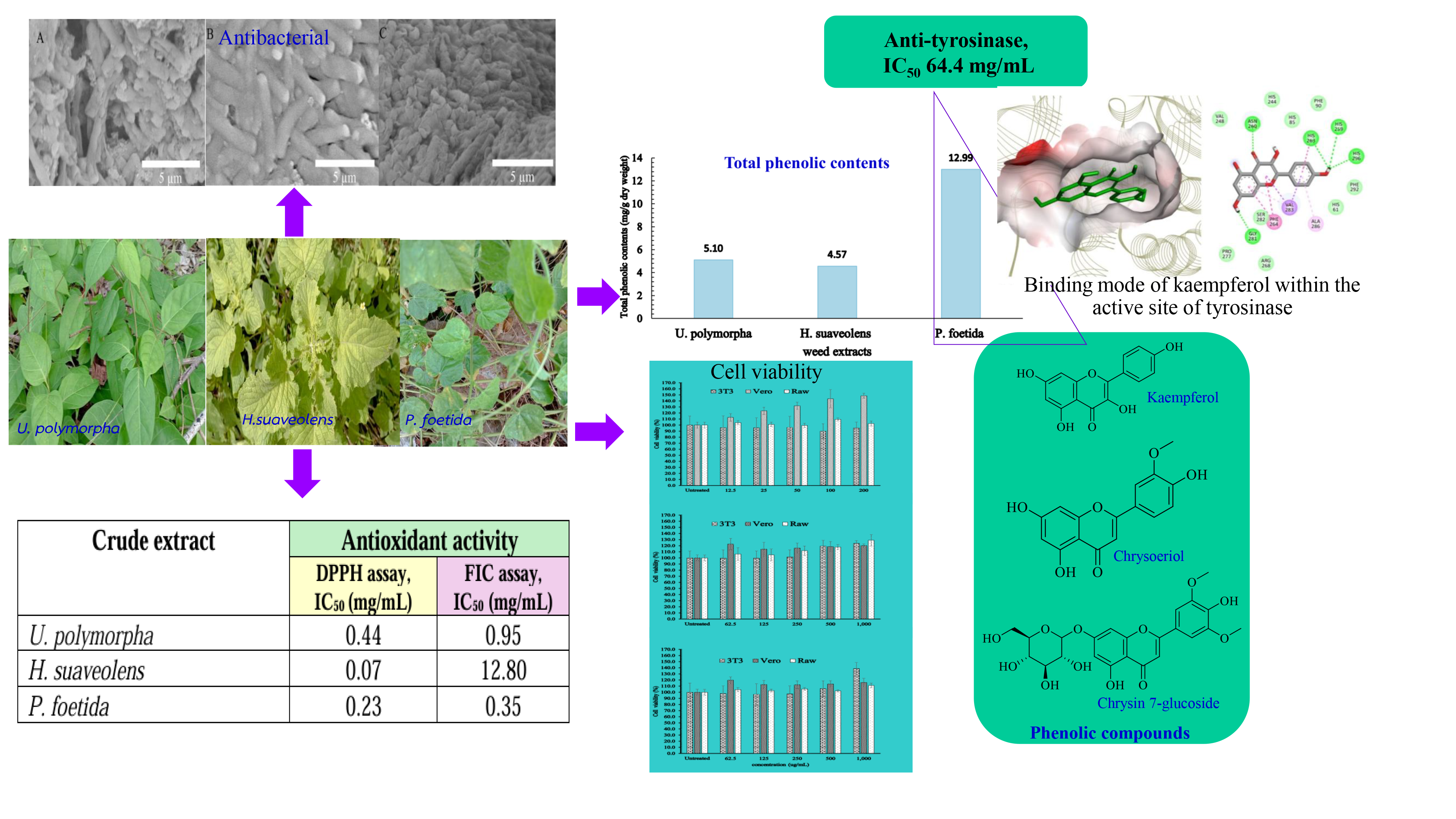
Downloads
References
M Rudrapal, SJ Khairnar, J Khan, AB Dukhyil, MA Ansari, MN Alomary, FM Alshabrmi, S Palai, PK Deb and R Devi. Dietary polyphenols and their role in oxidative stress-induced human diseases: Insights into protective effects, antioxidant potentials and mechanism (s) of action. Frontiers in Pharmacology 2022; 13, 806470.
JA Jesus, JHG Lago, MD Laurenti, ES Yamamoto and LFD Passero. Antimicrobial activity of oleanolic and ursolic acids: An update. Evidence-Based Complementary and Alternative Medicine 2015; 2015(1), 620472.
J Daduang, S Vichitphan, S Daduang, P Hongsprabhas and P Boonsiri. High phenolics and antioxidants of some tropical vegetables related to antibacterial and anticancer activities. African Journal of Pharmacy and Pharmacology 2011; 5(5), 608-615.
A Sangchan. 2018, Inhibitory effect of Thai vegetables extracts onnactivity of lipase, alpha-amylase,trypsin and alcohol dehydrogenase. Master Thesis. Burapha University, Chonburi, Thailand.
P Karuppiah and M Mustaffa. Antibacterial and antioxidant activities of Musa sp. leaf extracts against multidrug resistant clinical pathogens causing nosocomial infection. Asian Pacific Journal of Tropical Biomedicine 2013; 3(9), 737-742.
P Junsathian, S Nakamura, S Katayama and S Rawdkuen. Antioxidant and antimicrobial activities of Thai edible plant extracts prepared using different extraction techniques. Molecules 2022; 27(19), 6489.
DNR Sari, SD Anitasari and IC Uliyah. Antibacterial activity of several types of weed extracts on the growth of Escherichia coli. Bioactivities 2023; 1(1), 18-23.
DC Bridges. Impact of weeds on human endeavors. Weed Technology 1994; 8(2), 392-395.
N Poomsuk, M Dinawong, P Phimbupha, A Wisetsai, P Pattumma and S Arthan. α-glucosidase and tyrosinase inhibitory guided isolation, identification of major compound and in silico study from edible mushroom Coprinus comatus. Suranaree Journal of Science and Technology 2024; 31(4), 30217.
S Preecharram, S Phosri, T Theansungnoen, W Roschat, S Arthan, S Lasopha and J Jandaruang. Nutritional values and their potential applications in food products of Krabok seed (Irvingia malayana). Trends in Science 2024; 21(1), 7316.
J Jandaruang and S Preecharram. Determination of biochemical compositions and antioxidant activities of Hom Mali 105 rice. Creative Science 2020; 12(1),146-154.
S Preecharram, S Posoongnoen, T Thummawongsa, T Sripakdee, S Tawil, N Poomsuk and J Jandaruang. Proximate composition and antioxidant activity of young flattened rice (Khao-Mao). Trends in Science 2023; 20(4), 6575.
S Preecharram, S Posoongnoen, T Thummavongsa, W Pasom, S Panyakom, T Sripakdee and J Jandaruang. Values, bioactive compound, antioxidant activities of brown rice and germinated brown rice, and the pellet products. Cretive Science 2025; 17(1), 257996.
L Orzali, MT Valente, V Scala, S Loreti and N Pucci. Antibacterial activity of essential oils and Trametes versicolor extract against Clavibacter michiganensis subsp. michiganensis and Ralstonia solanacearum for seed treatment and development of a rapid in vivo assay. Antibiotics 2020; 9(9), 628.
J Kommanee, S Preecharram, S Daduang, Y Temsiripong, A Dhiravisit, Y Yamada and S Thammasirirak. Antibacterial activity of plasma from crocodile (Crocodylus siamensis) against pathogenic bacteria. Annals of Clinical Microbiology and Antimicrobials 2012; 11, 22.
B Situmeang, RT Swasono and TJ Raharjo. Antioxidant, photoprotective, and cytotoxic activities of tristaniopsis merguensis leaf fractions with molecular docking study of potential fraction. Karbala International Journal of Modern Science 2024; 10(3), 5.
Z Zhu, B Zhong, Z Yang, W Zhao, L Shi, A Aziz, A Rauf, ASM Aljohani, FA Alhumaydhi and HAR Suleria. LC-ESI-QTOF-MS/MS characterization and estimation of the antioxidant potential of phenolic compounds from different parts of the lotus (Nelumbo nucifera) seed and rhizome. ACS Omega 2022; 7(17), 14630-14642.
S Phosri, K Kiattisin, A Intharuksa, R Janon, TN Nongkhai and T Theansungnoen. Anti-aging, anti-acne, and cytotoxic activities of Houttuynia cordata extracts and phytochemicals analysis by LC-MS/MS. Cosmetics 2022; 9(6), 136.
H-X Cui, F-F Duan, S-S Jia, F-R Cheng and K Yuan. Antioxidant and tyrosinase inhibitory activities of seed oils from Torreya grandis Fort. ex Lindl. BioMed Research International 2018; 2018, 5314320.
M Frisch, G Trucks, H Schlegel, G Scuseria, M Robb, J Cheeseman, G Scalmani, V Barone, G Petersson, H Nakatsuji, X Li, M Caricato, AV Marenich, J Bloino, BG Janesko, R Gomperts, B Mennucci, HP Hratchian, JV Ortiz, AF Izmaylov, …, DJ Fox. Gaussian 16, Revision C.01. Gaussian, Wallingford, 2016.
WT Ismaya, HJ Rozeboom, A Weijn, JJ Mes, F Fusetti, HJ Wichers and BW Dijkstra. Crystal structure of Agaricus bisporus mushroom tyrosinase: Identity of the tetramer subunits and interaction with tropolone. Biochemistry 2011; 50(24), 5477-5486.
GM Morris, R Huey, W Lindstrom, MF Sanner, RK Belew, DS Goodsell and AJ Olson. AutoDock4 and AutoDockTools4: Automated docking with selective receptor flexibility. Journal of Computational Chemistry 2009; 30(16), 2785-2791.
SJ Weiner, PA Kollman, DA Case, UC Singh, C Ghio, G Alagona, S Profeta and P Weiner. A new force field for molecular mechanical simulation of nucleic acids and proteins. Journal of the American Chemical Society 1984; 106(3), 765-784.
J Gasteiger and M Marsili. A new model for calculating atomic charges in molecules. Tetrahedron Letters 1978; 19(34), 3181-3184.
A Asadzadeh, A Fassihi, P Yaghmaei and M Pourfarzam. Docking studies of some novel kojic acid derivatives as possible tyrosinase inhibitors. Biomedical and Pharmacology Journal 2015; 8(2), 535-545.
GM Morris, DS Goodsell, RS Halliday, R Huey, WE Hart, RK Belew and AJ Olson. Automated docking using a Lamarckian genetic algorithm and an empirical binding free energy function. Journal of Computational Chemistry 1998; 19(14), 1639-1662.
Ds BIOVIA, Dassault Systèmes, Discovery Studio Visualizer, V24.1.0.23298, San Diego: Dassault Systèmes, 2024.
AA Adedapo, FO Jimoh, S Koduru, AJ Afolayan and PJ Masika. Antibacterial and antioxidant properties of the methanol extracts of the leaves and stems of Calpurnia aurea. BMC Complementary and Alternative Medicine 2008; 8, 53.
J Hayat, M Akodad, A Moumen, M Baghour, A Skalli, S Ezrari and S Belmalha. Phytochemical screening, polyphenols, flavonoids and tannin content, antioxidant activities and FTIR characterization of Marrubium vulgare L. from 2 different localities of Northeast of Morocco. Heliyon 2020; 6(11), e05609.
AH Umar, D Ratnadewi, M Rafi, YC Sulistyaningsih and H Hamim. Phenolics profile and antioxidant activities of in vitro propagules and field-raised plant organs of Curculigo latifolia. Journal of Applied Pharmaceutical Science 2023; 13(4), 168-185.
JWA Bezerra, AR Costa, FC Rodrigues, FABD Cunha, VBD Silva, AA Boligon and MM Anraku. Mesosphaerum suaveolens (L.) Kuntze (pignut) a medicinal plant with antioxidant potential and abundant polyphenols. Revista Cubana de Plantas Medicinales 2019; 24(1), 1-14.
JWA Bezerra, FC Rodrigues, AR Costa, KS Pereira, NR Vieira, GDO Lôbo, SAD Menezes, FAG Neto, JTP Filho, PHS Bomtempo, TDC Pereira, HC Tavares, TG Ribeiro, ARDS Costa, SMD Sousa, JFSD Santos, HDM Coutinho and MFBM Braga. Mesosphaerum suaveolens (Lamiacae): Source of antimicrobial and antioxidant compounds. Research Society and Development 2020; 9(8), e575986161.
Y Tandoro, PS Widyawati, TDW Budianta and G Sumargo. Phytochemical identification and antioxidant activity of Passiflora foetida fruits and leaves extracts: A comparative study. International Journal of Pharmacy and Pharmaceutical Sciences 2020; 12(6), 55-58.
M Guo, C Perez, Y Wei, E Rapoza, G Su, F Bou-Abdallah and ND Chasteen. Iron-binding properties of plant phenolics and cranberry’s bio-effects. Dalton Transactions 2007; 43, 4951-4961.
DB Adimpong, KI Sørensen, L Thorsen, B Stuer-Lauridsen, WS Abdelgadir, DS Nielsen, PMF Derkx and L Jespersen. Antimicrobial susceptibility of Bacillus strains isolated from primary starters for African traditional bread production and characterization of the bacitracin operon and bacitracin biosynthesis. Applied and Environmental Microbiology 2012; 78(22), 7903-7914.
A Bendini, L Cerretani, L Pizzolante, TG Toschi, F Guzzo, S Ceoldo, AM Marconi, F Andreetta and M Levi. Phenol content related to antioxidant and antimicrobial activities of Passiflora spp. extracts. European Food Research and Technology 2006; 223, 102-109.
MR Vaquero, MR Alberto and MCMD Nadra. Antibacterial effect of phenolic compounds from different wines. Food Control 2007; 18(2), 93-101.
MJ Simão, TJS Barboza, MG Vianna, R Garcia, E Mansur, ACPR Ignacio and G Pacheco. A comparative study of phytoconstituents and antibacterial activity of in vitro derived materials of four Passiflora species. Annals of the Brazilian Academy of Sciences 2018; 90(3), 2805-2813.
R Puupponen‐Pimiä, L Nohynek, C Meier, M Kähkönen, M Heinonen, A Hopia and KM Oksman‐Caldentey. Antimicrobial properties of phenolic compounds from berries. Journal of Applied Microbiology 2001; 90(4), 494-507.
D Vattem, YT Lin, RG Labbe and K Shetty. Antimicrobial activity against select food-borne pathogens by phenolic antioxidants enriched in cranberry pomace by solid-state bioprocessing using the food grade fungus Rhizopus oligosporus. Process Biochemistry 2004; 39(12), 1939-1946.
L Liang, A Amin, WY Cheung, R Xu, R Yu, J Tang, X Yao and C Liang. Parameritannin A-2 from Urceola huaitingii enhances doxorubicin-induced mitochondria-dependent apoptosis by inhibiting the PI3K/Akt, ERK1/2 and p38 pathways in gastric cancer cells. Chemico-Biological Interactions 2020; 316, 108924.
S Musika and K Indrapichate. Cytotoxicity and apoptosis induction of Mintweed (Hyptis suaveolens L. Poit) leaf extracts on human T-leukemia cell line, Jurkat cells. World Journal of Pharmacy and Pharmaceutical Sciences 2014; 3, 304-317.
JWA Bezerra, AR Costa, MAPD Silva, MI Rocha, AA Boligon, JBTD Rocha, LM Barros and JP Kamdem. Chemical composition and toxicological evaluation of Hyptis suaveolens (L.) Poiteau (Lamiaceae) in Drosophila melanogaster and Artemia salina. South African Journal of Botany 2017; 113, 437-442.
S Chivapat, M Bunjob, A Shuaoprom, J Bansidhi, P Chavalittumrong, A Rangsripipat and P Sincharoenpokai. Chronic toxicity of Passiflora foetida L. extract. International Journal of Applied Research in Natural Products 2011; 4, 24-31.
K Ponsuwan, S Nathabumroong, R Lekphrom, S Sorin, C Saengboonmee, T Senawong, S Tontapha and FT Schevenels. Passifetilactones A-E, fatty acid lactones from the fruit and flowers of Passiflora foetida with cytotoxic activity. Journal of Natural Products 2024; 87(6), 1652-1659.
YF Yang, XY Lai, GY Lai, ZD Jiang, H Ni and F Chen. Purification and characterization of a tyrosinase inhibitor from Camellia pollen. Journal of Functional Foods 2016; 27, 140-149.
A Farasat, M Ghorbani, N Gheibi and H Shariatifar. In silico assessment of the inhibitory effect of four flavonoids (Chrysin, Naringin, Quercetin, Kaempferol) on tyrosinase activity using the MD simulation approach. Journal of Biotechnology, Computational Biology and Bionanotechnology 2020; 101(3), 193-204.
Published
How to Cite
Issue
Section
License
Copyright (c) 2025 Walailak University

This work is licensed under a Creative Commons Attribution-NonCommercial-NoDerivatives 4.0 International License.





