
Characterization of Intelligent Packaging from Chitosan-Cassava Starch with Butterfly Pea Flower Extract and Gambier Catechin as Freshness Sensor
DOI:
https://doi.org/10.48048/tis.2026.12075Keywords:
Bio-sensor, Butterfly pea anthocyanins, Cassava starch, Chitosan shrimp, Co-pigmentation, Food freshness, Food packaging, Bio-sensor, Butterfly pea anthocyanins, Cassava starch, Chitosan, Co-pigmentation, Food freshness, Food packagingAbstract
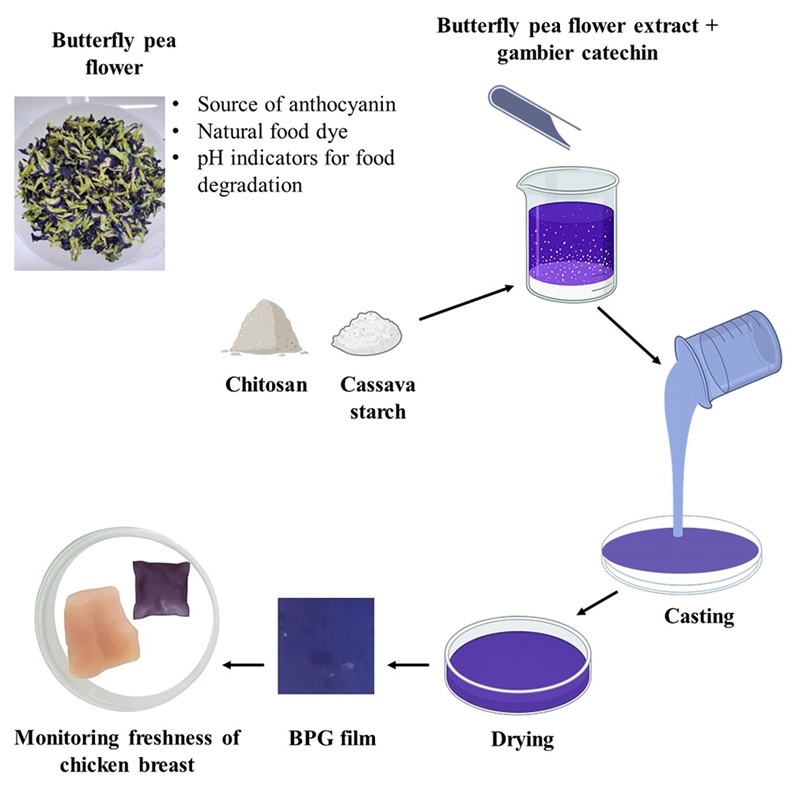
The increasing environmental concerns associated with conventional plastic packaging have accelerated research into biopolymer-based alternatives for sustainable food packaging. Starch and chitosan have emerged as promising biodegradable materials, while the incorporation of bioactive and natural pigments enables the development of intelligent packaging systems. Anthocyanins from butterfly pea flower extract, stabilized through co-pigmentation with gambier catechins, provide pH-sensitive functionality for monitoring food quality and safety. This study contributes to the formulation of intelligent biopolymer films as pH sensors for assessing chicken freshness under varying storage conditions. The production of intelligent film used various concentrations of butterfly pea flower extract and gambier (BPG) (5%, 10% and 15%) incorporated into chitosan-cassava starch solution. The physical properties of the film were observed following the analysis of the color response of the BPG extract and intelligent film. Then, the BPG intelligent film was applied to monitoring chicken breast freshness for 72 h at 7 and 25 °C. The color and pH changes were observed every 24 h. The BPG intelligent film significantly increased film thickness, moisture content, solubility, water vapor transmission rate (WVTR), and water vapor permeability (WVP). The color of the BPG extract and BPG film shifted from purple to green at pH levels between 2 and 11. When applied to chicken breast, the color of the BPG film will change from purple to green due to the decay in the chicken breast which is indicated by an increase in pH. Based on the research results, it can be concluded that BPG extract mixed with the film matrix can act as a freshness indicator in chicken breast stored at cold or room temperature. The color change that occurs is clearly visible (does not fade) due to the co-pigmentation of gambier.
HIGHLIGHTS
- Butterfly pea flower as an anthocyanin source is incorporated into a biopolymer matrix made from chitosan-cassava starch.
- Anthocyanin from butterfly pea flower extract is a pH-sensitive pigment that will produce color changes.
- A chitosan-cassava starch film supplemented with butterfly pea flower extract was used to monitor the freshness of chicken breasts.
- The intelligent film applied to the chicken breasts exhibited color changes during storage, indicating that the samples were deteriorating.
GRAPHICAL ABSTRACT
Downloads
References
SBH Hashim, HE Tahir, L Liu, J Zhang, X Zhai, AA Mahdi, FN Awad, MM Hassan, Z Xiaobo and S Jiyong. Intelligent colorimetric pH sensoring packaging films based on sugarcane wax/agar integrated with butterfly pea flower extract for optical tracking of shrimp freshness. Food Chemistry 2022; 373, 131571.
W Grzebieniarz, J Tkaczewska, L Juszczak, A Kawecka, P Krzysciak, N Nowak, P Guzik, M Kasprzak, M Janik and E Jamroz. The influence of aqueous butterfly pea (Clitoria ternatea) flower extract on active and intelligent properties of furcellaran Double-Layered films - in vitro and in vivo research. Food Chemistry 2023; 413, 135612.
KS Dhami, R Asrey, OP Awasthi and A Bhowmik. Pre and postharvest treatments of methyl jasmonate: Maintain quality and shelf-life of Kinnow mandarin fruit during cold storage. South African Journal of Botany 2022; 151, 808-815.
MS Firouz, K Mohi-Alden and M Omid. A critical review on intelligent and active packaging in the food industry: Research and development. Food Research International 2021; 141, 110113.
ZU Arif, MY Khalid, MF Sheikh, A Zolfagharian and M Bodaghi. Biopolymeric sustainable materials and their emerging applications. Journal of Environmental Chemical Engineering 2022; 10(4), 108159.
S Bharti, S Jaiswal, VP Sharma, and Inamuddin. Perspective and challenges. In: Green Sustainable Process for Chemical and Environmental Engineering and Science. 1st ed. Elsevier, 2023, pp. 171-183.
S Bhowmik, D Agyei and A Ali. Bioactive chitosan and essential oils in sustainable active food packaging: Recent trends, mechanisms, and applications. Food Packaging and Shelf Life 2022; 34, 100962.
P Fei, F Zeng, S Zheng, Q Chen, Y Hu and J Cai. Acylation of blueberry anthocyanins with maleic acid: Improvement of the stability and its application potential in intelligent color indicator packing materials. Dyes and Pigments 2021; 184, 108852.
P Rana, N Murmu, SK Padhan and SN Sahu. Butterfly pea (Clitoria ternatea) extract as a green analytical tool for selective colorimetric detection of bisulphate (HSO4−) ion in aqueous medium. Spectrochimica Acta Part A: Molecular and Biomolecular Spectroscopy 2020; 237, 118376.
G Jiang, X Hou, X Zeng, C Zhang, H Wu, G Shen, S Li, Q Luo, M Li, X Liu, A Chen, Z Wang and Z Zhang. Preparation and characterization of indicator films from carboxymethyl-cellulose/starch and purple sweet potato (Ipomoea batatas (L.) lam) anthocyanins for monitoring fish freshness. International Journal of Biological Macromolecules 2020; 143, 359-372.
H Yong and J Liu. Recent advances in the preparation, physical and functional properties, and applications of anthocyanins-based active and intelligent packaging films. Food Packaging and Shelf Life 2020; 26, 100550.
NM Thuy, Q Minh, TC Ben, MTT Nguyen, HTN Ha and NV Tai. Identification of anthocyanin compounds in Butterfly Pea Flowers (Clitoria ternatea L.) by ultra performance liquid chromatography/ultraviolet coupled to mass spectrometry. Molecules 2021; 26(15), 4539.
S Khanifah, ADK Legowo, S Sholihun and AD Nugraheni. Physical properties of polyvinyl alcohol/chitosan films with the addition of anthocyanin extract from Butterfly Pea for food packaging applications. Indonesian Journal of Chemistry 2023; 23(4), 1021.
SK Mary, RR Koshy, J Daniel, JT Koshy, LA Pothen and S Thomas. Development of starch based intelligent films by incorporating anthocyanins of butterfly pea flower and TiO2 and their applicability as freshness sensors for prawns during storage. RSC Advances 2020; 10(65), 39822-39830.
GP Narayanan, P Radhakrishnan, P Baiju and AM S. Fabrication of Butterfly Pea Flower anthocyanin-incorporated colorimetric indicator film based on gelatin/pectin for monitoring fish freshness. Food Hydrocolloids for Health 2023; 4, 100159.
R Pramitasari, Marcel and D Lestari, Co-pigmentation with catechin derived from Indonesian gambier increases the stability of black rice anthocyanin in isotonic sports drinks during one-month storage in 4 °C. Food Research 2022; 6(2), 118 - 123.
C Tan, GB Celli, MJ Selig and A Abbaspourrad. Catechin modulates the copigmentation and encapsulation of anthocyanins in polyelectrolyte complexes (PECs) for natural colorant stabilization. Food Chemistry 2018; 264, 342-349.
VR Santoso, R Pramitasari and DSB Anugrah. Development of indicator film based on cassava starch–chitosan incorporated with Red Dragon Fruit Peel anthocyanins–gambier catechins to detect Banana ripeness. Polymers 2023; 15(17), 3609.
L Wu, S Lv, D Wei, S Zhang, S Zhang, Z Li, L Liu and T He. Structure and properties of starch/chitosan food packaging film containing ultra-low dosage GO with barrier and antibacterial. Food Hydrocolloids 2023; 137, 108329.
R Pazla, Antonius, N Jamarun, Elihasridas, Z Ikhlas, Y Fitri, ES Rohaeni, Usman, O Rostiana, Waryat, Setyadjit, M Lintang, A Yani, GH Joseph, L Marlina and Ardinal. Encapsulated Gambir catechin-palm fatty acid distillate as an antibacterial and antioxidant feed additive and its effects on rumen fermentation products. Results in Engineering 2025; 27, 105914.
S-H Yu, M-L Tsai, B-X Lin, C-W Lin and F-L Mi. Tea catechins-cross-linked methylcellulose active films for inhibition of light irradiation and lipid peroxidation induced β-carotene degradation. Food Hydrocolloids 2015; 44, 491-505.
M Latos-Brozio and A Masek. The application of (+)-catechin and polydatin as functional additives for biodegradable polyesters. International Journal of Molecular Sciences 2020; 21(2), 414.
S Jia, H Shen, D Wang, S Liu, Y Ding and X Zhou. Novel NaCl reduction technologies for dry-cured meat products and their mechanisms: A comprehensive review. Food Chemistry 2024; 431, 137142.
H Niua, M Zhang, D Shen, AS Mujumdar and Y Ma. Sensing materials for fresh food quality deterioration measurement: A review of research progress and application in supply chain. Critical Reviews in Food Science and Nutrition 2024; 64(22), 8114-8132.
Q-S Ren, K Fang, X-T Yang and J-W Han. Ensuring the quality of meat in cold chain logistics: A comprehensive review. Trends in Food Science & Technology 2022; 119, 133-151.
F Yi, F Hou, S Zhan, L Song, R Zhang, X Han, X Sun and Z Liu. Preparation, characterization and application of pH-responsive smart film based on chitosan/zein and red radish anthocyanin. International Journal of Biological Macromolecules 2023; 253, 127037.
SA Siddiqui, X Yang, RK Deshmukh, KK Gaikwad, NA Bahmid and R Castro-Munoz. Recent advances in reinforced bioplastics for food packaging – a critical review. International Journal of Biological Macromolecules 2024; 263, 130399.
MP Bimantio, A Wulandari and IBB Partha. The application of potato starch-based (Amylum solani) edible coating on Tomatoes (Solanum lycopersicum L.). Journal of Agri-Food Science and Technology 2025; 6(2), 87-97.
TA Ermawati and SN Rahmadhia. Physico-chemical characteristics of edible film from breadfruit starch (Artocarpus altilis) and beeswax. Advances in Food Science, Sustainable Agriculture, and Agroindustrial Engineering 2023; 6(4), 325-337.
P Singh, VK Pandey, R Singh, K Singh, KK Dash and S Malik. Unveiling the potential of starch-blended biodegradable polymers for substantializing the eco-friendly innovations. Journal of Agriculture and Food Research 2024; 15, 101065.
I Kusuma, A Ma’arif and SN Rahmadhia, Starch based for intelligent food packaging: A review. BIO Web of Conferences 2024; 146, 01099.
O Dangles and J-A Fenger. The chemical reactivity of anthocyanins and its consequences in food science and nutrition. Molecules 2018; 23(8), 1970.
L Li and Q Li. Advancements in chitosan–anthocyanin composite films: Sustainable food preservation with biodegradable packaging. Foods 2025; 14(10), 1721.
Y Huang, Q Yao, R Wang, L Wang, J Li, B Chen, F Liu and X-A Zeng. Development of starch-based films with enhanced hydrophobicity and antimicrobial activity by incorporating alkyl ketene dimers and chitosan for mango preservation. Food Chemistry 2025; 467, 142314.
X Huang, K Zhang, Z Li, J Zhang, X Zhai, N Zhang, L Du and Z Qin. Exploring the integration of anthocyanins with functional materials in smart food packaging: From stabilization to application. Foods 2025; 14(16), 2896.
S Rawdkuen, A Faseha, S Benjakul and P Kaewprachu. Application of anthocyanin as a color indicator in gelatin films. Food Bioscience 2020; 36, 100603.
SN Rahmadhia, AA Sidqi and YA Saputra. Physical properties of tapioca starch-based film indicators with anthocyanin extract from Purple Sweet Potato (Ipomea batatas L.) and response to pH changes. Sains Malaysiana 2023; 52(6), 1685-1697.
N Hidayah, MS Hawa, B Purwono and SN Rahmadhia. Development of packaging film from purple heart (Tradescantia pallida) anthocyanin for fish freshness indicator. Trends in Sciences 2025; 22(7), 10077.
EN Arifani and RR Tamalea. Edible film based on arrowroot starch and glycerol. Journal of Agri-Food Science and Technology 2024; 5(1), 33-43.
D Aprilia, SN Rahmadhia, S Amelia and N Hidayah. Physicochemical properties and microbial inhibition on biofilms cassava starch with green cayenne pepper leaf extract (Capsicum Frutescens L). Jurnal Keteknikan Pertanian 2023; 11(2), 153-164.
SN Rahmadhia, YA Saputra, T Juwitaningtyas and WM Rahayu. Intelligent packaging as a pH-Indicator based on cassava starch with addition of Purple Sweet Potato extract (Ipomoea batatas L.). Journal of Functional Food and Nutraceutical 2022; 4(1), 37-47.
A Ponnusamy, A Khan, T Prodpran, J-W Rhim and S Benjakul. Multifunctional fish gelatin film incorporated with chitosan carbon dots and butterfly pea flower anthocyanins for active/smart packaging of Pacific white shrimp. Food Bioscience 2024; 62, 105483.
SN Rahmadhia, U Santoso and S Supriyadi. Physical characteristics of active packaging based on methyl cellulose with the addition of glutaraldehyde and Klutuk Banana (Musa balbisiana Colla) leaf extract. Planta Trop. Planta Tropika: Jurnal Agrosains (Journal of Agro Science) 2019; 7(2), 130-136.
NA Hidayati, MW Wijaya, VP Bintoro, S Mulyani and Y Pratama. Development of biodegradable smart packaging from chitosan, polyvinyl alcohol (PVA) and Butterfly Pea Flower’s (Clitoria ternatea L.) anthocyanin extract. Food Research 2021; 5(3), 307-314.
A Boonsiriwit, M Lee, M Kim, P Inthamat, U Siri¬patrawan and YS Lee. Hydroxypropyl methyl¬cellulose/microcrystalline cellulose biocomposite film incorporated with Butterfly Pea anthocyanin as a sustainable pH-responsive indicator for intelligent food-packaging applications. Food Bioscience 2021; 44, 101392.
E Jamroz, J Tkaczewska, M Zajac, P Guzik, L Juszczak, A Kawecka, K Turek, M Zimowska and A Wojdylo. Utilisation of soybean post-production waste in single- and double-layered films based on furcellaran to obtain packaging materials for food products prone to oxidation. Food Chemistry 2022; 387(1), 132883.
E Jamroz, P Kopel, L Juszczak, A Kawecka, Z Bytesnikova, V Milosavljevic and M Makarewicz. Development of furcellaran-gelatin films with Se-AgNPs as an active packaging system for extension of mini kiwi shelf life. Food Packaging and Shelf Life 2019; 21, 100339.
K Han, A Sathiyaseelan, Y Lu, KM Kim and M-H Wang. Agar/carboxymethyl cellulose composite film loaded with hydroxyapatite nanoparticles for bone regeneration. Cellulose 2024; 31, 9319-9334.
IA Channa, J Ashfaq, M Wasti, AG Memon, M Hasan, MA Shar, A AlHazaa and A Tiliakos. pH-responsive halochromic films based on carboxymethyl cellulose infused with anthocyanin or curcumin dye extracts for smart packaging applications. Hybrid Advances 2025; 10, 100476.
L Gao, H Sun, M Nagassa, X Li, H Pei, S Liu, Y Gu and S He. Edible film preparation by anthocyanin extract addition into acetylated cassava starch/sodium carboxymethyl cellulose matrix for oxidation inhibition of pumpkin seeds. International Journal of Biological Macromolecules 2024; 267, 131439.
M Hasan, I Khaldun, M Ulva, K Nisa, A Gani and H Habibati. Bio-nanocomposite films from sugar palm starch/chitosan nanoparticle enriched with Butterfly Pea anthocyanins. Case Studies in Chemical and Environmental Engineering 2025; 11, 101174.
T Gasti, S Dixit, OJ D’souza, VD Hiremani, SK Vootla, SP Masti, RB Chougale and RB Malabadi. Smart biodegradable films based on chitosan/methylcellulose containing Phyllanthus reticulatus anthocyanin for monitoring the freshness of fish fillet. International Journal of Biological Macromolecules 2021; 187, 451-461.
MA Sani, M Tavassoli, SA Salim, M Azizi-lalabadi and DJ McClements. Development of green halochromic smart and active packaging materials: TiO2 nanoparticle- and anthocyanin-loaded gelatin/κ-carrageenan films. Food Hydrocolloids 2022; 124, 107324.
M Muthu, J Gopal, S Chun, AJP Devadoss, N Hasan and I Sivanesan. crustacean waste-derived chitosan: antioxidant properties and future perspective. Antioxidants 2021; 10(2), 228.
ME Ramli, RM Salleh, HA Tajarudin and M Zulkurnain. Influence of amylose content on phenolics fortification of different rice varieties with butterfly pea (Clitoria ternatea) flower extract through parboiling. LWT 2021; 147, 111493.
EJ Jeyaraj, YY Lim and WS Choo. Extraction methods of Butterfly Pea (Clitoria ternatea) Flower and biological activities of its phytochemicals. Journal of Food Science and Technology 2021; 58, 2054-2067.
T Zhang, H Wang, D Qi, L Xia, L Li, X Li and S Jiang. Multifunctional colorimetric cellulose acetate membrane incorporated with Perilla frutescens (L.) Britt. anthocyanins and chamomile essential oil. Carbohydrate Polymers 2022; 278, 118914.
M Yang, J Lin, M Zhang, Y Zhuang, Y Li, B Wang, Z Zhang, J Liu and P Fei. Recent advances in the development and application of anthocyanin-based intelligent active food packaging: A review. Food Chemistry 2025; 492, 145309.
DK Takma, S Bozkurt, M Koc, F Korel and HS Nadeem. Innovative active and intelligent packaging film based on pectin/gelatin biocomposites with zein nanoparticles and anthocyanin: Quality monitoring in mandarin and cucumber. Food Packaging and Shelf Life 2025; 52, 101617.
W Song, N Wu, Y He, H Zhao, J Xu and L Ren. Intelligent color changing packaging film based on esterified starch and black rice anthocyanins. Food Chemistry: X 2024; 24, 101930.
S Mohammadalinejhad, H Almasi and M Moradi. Immobilization of Echium amoenum anthocyanins into bacterial cellulose film: A novel colorimetric pH indicator for freshness/spoilage monitoring of shrimp. Food Control 2020; 113, 107169.
YL Aguirre-Garcia, SD Nery-Flores, LG Campos-Muzquiz, AC Flores-Gallegos, L Palomo-Ligas, JA Ascacio-Valdes, L Sepulveda-Torres and R Rodriguez-Herrera. Lactic acid fermentation in the food industry and bio-preservation of food. Fermentation 2024; 10(3), 168.
P Kaewthong, L Pomponio, JR Carrascal, S Knochel, S Wattanachant and AH Karlsson. Changes in the quality of chicken breast meat due to superchilling and temperature fluctuations during storage. Journal of Poultry Science 2019; 56(4), 308-317.
H Xue, J Zhao, Y Wang, Z Shi, K Xie, X Liao and J Tan. Factors affecting the stability of anthocyanins and strategies for improving their stability: A review. Food Chemistry: X 2024; 24, 10188.
Published
How to Cite
Issue
Section
License
Copyright (c) 2025 Walailak University

This work is licensed under a Creative Commons Attribution-NonCommercial-NoDerivatives 4.0 International License.





