
Influence of Layer’s Annealing Temperature on Sensing Properties of Spin-Coated SBS Layer Exposed to Alcohol Vapor
DOI:
https://doi.org/10.48048/tis.2024.8537Keywords:
Alcohol vapor, QCM, SBS, SensorAbstract
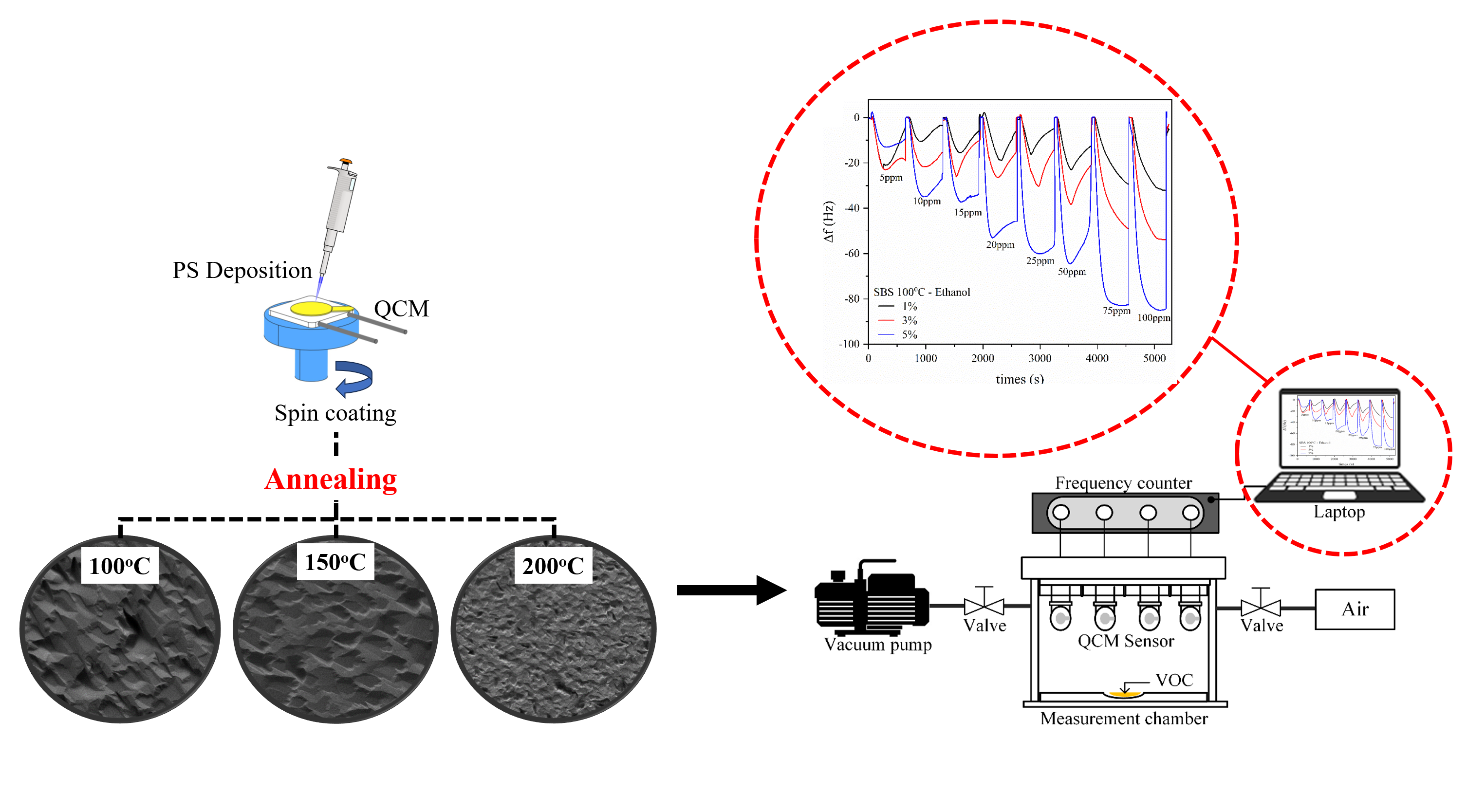
QCM-based alcohol vapor sensors have been widely researched, and various materials have been deposited onto the sensor surface to serve as a functional layer. However, non-conductive polymers such as SBS as a functional layer for alcohol sensors are still minimally reported. In this study, the SBS was deposited on 1 side of the QCM using the spin coating technique. After deposition, the layer was annealed for 1 h. The annealing temperatures are 100, 150 and 200 °C. The concentrations of exposed alcohol vapor were 5, 10, 15, 20, 25, 50, 75 and 100 ppm. This study demonstrated that the SBS layer has the potential to be a functional layer of alcohol sensors. SBS 200 °C is an optimum functional layer for alcohol vapor sensors due to its high ∆f and sensitivity. Meanwhile, SBS 100 °C has poor ∆f and sensitivity. This is due to the morphology of 200 °C SBS, which consists of more valleys that perform as interaction sites for SBS and alcohol molecules. However, one of the limitations of SBS as a functional sensor layer for alcohol sensors is its low selectivity, which is a characteristic of rubbery polymers.
HIGHLIGHTS
- The SBS layer annealed at higher temperatures has more valleys than the SBS layer annealed at low temperatures.
- The valleys in the morphology of the SBS layer act as interaction sites for alcohol molecules, where each site interacts with an alcohol molecule. It is based on the sensor response and proved by fitting the Langmuir model.
- The SBS layer annealed at 200 ᵒC has a high ∆f, sensitivity, and longer response time.
- The selectivity of SBS was relatively low, a characteristic of rubbery polymers.
- The interaction between SBS and methanol is physisorption.
GRAPHICAL ABSTRACT
Downloads
References
JV Ashurst and TM Nappe. Methanol Toxicity, StatPearls, Available at: https://www.ncbi.nlm.nih.gov/books/NBK482121, accessed March 2024.
A Kramer, M Arvand, B Christiansen, S Dancer, M Eggers, M Exner, D Müller, NT Mutters, I Schwebke and D Pittet. Ethanol is indispensable for virucidal hand antisepsis: Memorandum from the alcohol-based hand rub (ABHR) Task Force, WHO Collaborating Centre on Patient Safety, and the Commission for Hospital Hygiene and Infection Prevention (KRINKO), Robert Koch Instit. Antimicrob. Resist. Infect. Control 2022; 11, 93.
P Rayar and S Ratnapalan. Pediatric ingestions of house hold products containing ethanol: A review. Clin. Pediatr. 2013; 52, 203-9.
A Heeley-Hill, S Grange, M Ward, A Lewis, N Owen, C Jordan, G Hodgson and G Adamson. Frequency of use of household products containing VOCs and indoor atmospheric concentrations in homes. Environ. Sci. Process. Impacts 2021; 23, 699-713.
E David and VC Niculescu. Volatile organic compounds (VOCs) as environmental pollutants: Occurrence and mitigation using nanomaterials. Int. J. Environ. Res. Publ. Health 2021; 18, 13147.
S Ramadanoğlu and M Yayla. Alcohol and volatile organic compounds (VOCs) detected in biological, industrial, cosmetic and food samples using an Headspace GC-MS method. In: Proceedings of the 41st FEBS Congress, Molecular and Systems Biology for a Better Life, Ephesus/Kuşadasi, Turkey. 2016.
EKL Hon, A Leung, E Cheung, B Lee, M Tsang and A Torres. An overview of exposure to ethanol-containing substances and ethanol intoxication in children based on three illustrated cases. Drugs Context 2018; 6, 1-5.
AR Chavez, M Sweeney and P Akpunonu. A case of unintentional isopropanol poisoning via transdermal absorption delayed by weekly hemodialysis. Am. J. Case Rep. 2021; 22, e934529.
TY Chang, KH Huang, CS Liu and BY Bao. Exposure to indoor volatile organic compounds and hypertension among thin film transistor liquid crystal display workers. Atmosphere 2020; 11, 718.
X Zhou, X Zhou, C Wang and H Zhou. Environmental and human health impacts of volatile organic compounds: A perspective review. Chemosphere 2023; 313, 137489.
A Korban, S Charapitsa, R Čabala, L Sobolenko, V Egorov and S Sytova. Advanced GC-MS method for quality and safety control of alcoholic products. Food Chem. 2021; 338, 128107.
R Epping and M Koch. On-site detection of volatile organic compounds (VOCs). Molecules 2023; 28, 1598.
SF Memon, R Wang, B Strunz, BS Chowdhry, JT Pembroke and E Lewis. A review of optical fibre ethanol sensors: Current state and future prospects. Sensors 2022; 22, 950.
A Pathak and C Viphavakit. A review on all-optical fiber-based VOC sensors: Heading towards the development of promising technology. Sens. Actuators A 2022; 338, 113455.
D Liu, R Kumar, F Wei, W Han, A Mallik, JH Yuan, S Wan, X He, Z Kang, F Li, C Yu, G Farrell, Y Semenova and Q Wu. High sensitivity optical fiber sensors for simultaneous measurement of methanol and ethanol. Sens. Actuators B 2018; 271, 1-8.
I Constantinoiu and C Viespe. Detection of volatile organic compounds using surface acoustic wave sensor based on nanoparticles incorporated in polymer. Coatings 2019; 9, 373.
A Rianjanu, K Triyana, DB Nugroho, A Kusumaatmaja and R Roto. Electrospun polyvinyl acetate nanofiber modified quartz crystal microbalance for detection of primary alcohol vapor. Sens. Actuators A 2020; 301, 111742.
J Huang and J Wu. Robust and rapid detection of mixed volatile organic compounds in flow through air by a low cost electronic nose. Chemosensors 2020; 8, 73.
X Qiao, X Zhang, Y Tian and Y Meng. Progresses on the theory and application of quartz crystal microbalance. Appl. Phys. Rev. 2016; 3, 031106.
NC Speller, N Siraj, KS Mccarter, S Vaughan and IM Warner. Sensors and actuators B: Chemical QCM virtual sensor array: Vapor identification and molecular weight approximation. Sens. Actuators B 2017; 246, 952-60.
A Aghakhani, F Mohamadi and J Ghadimi. Novel alcohol vapour sensor based on the mixed-ligand modified MOF-199 coated quartz crystal microbalance. Int. J. Environ. Anal. Chem. 2021; 101, 1803-20.
R Sukowati, YM Rohman, BH Agung, DA Hapidin, H Damayanti and K Khairurrijal. An investigation of the influence of nanofibers morphology on the performance of QCM-based ethanol vapor sensor utilising polyvinylpyrrolidone nanofibers active layer. Sens. Actuators B 2023; 386, 133708.
NLL Hekiem, AAM Ralib, MAM Hatta, FB Ahmad and NF Za’Bah. Study of adsorption isotherms in the detection of acetone and isopropyl alcohol using QCM sensor with chitosan sensing layer. In: Proceedings of the IEEE International Conference on Semiconductor Electronics (ICSE), Kuala Lumpur, Malaysia. 2022, p. 29-32.
L Feng, L Feng, Q Li, J Cui and J Guo. Sensitive formaldehyde detection with QCM sensor based on PAAm/MWCNTs and PVAm/MWCNTs. ACS Omega 2021; 6, 14004-14.
MR Eslami and N Alizadeh. Ultrasensitive and selective QCM sensor for detection of trace amounts of nitroexplosive vapors in ambient air based on polypyrrole-Bromophenol blue nanostructure. Sens. Actuators B 2019; 278, 55-63.
X Liu, J Wang and J Hou. Repeatability and sensitivity of quartz crystal microbalance (QCM) sensor array modified with four sensitive materials. Mater. Sci. Semicond. Process. 2022; 147, 106764.
J Völkle, K Kumpf, A Feldner, P Lieberzeit and P Fruhmann. Development of conductive molecularly imprinted polymers (cMIPs) for limonene to improve and interconnect QCM and chemiresistor sensing. Sens. Actuators B 2022, 356, 131293.
SH Hosseini and AA Entezami. Conducting polymer blends of polypyrrole with polyvinyl acetate, polystyrene, and polyvinyl chloride based toxic gas sensors. J. Appl. Polym. Sci. 2003; 90, 49-62.
SW Chiu and KT Tang. Towards a chemiresistive sensor-integrated electronic nose: A review. Sensors 2013; 13, 14214-47.
MO Ansari, SA Ansari, MH Cho, SP Ansari, MS Abdel-wahab and A Alshahrie. Conducting polymer nanocomposites as gas sensors. Functional polymers. Springer, Germany, 2019, p. 911-40.
S Pirsa. Chemiresistive gas sensors based on conducting polymers. In: M Ahmadi, R Ismail and S Anwar (Eds.). Handbook of research on nanoelectronic sensor modeling and applications. IGI Global, Hershey, Pennsylvania, 2017, p. 150-80.
YC Wong, BC Ang, ASMA Haseeb, AA Baharuddin and YH Wong. Review-conducting polymers as chemiresistive gas sensing materials: A review. J. Electrochem. Soc. 2020; 167, 037503.
M Giordano, M Russo, A Cusano, G Mensitieri and G Guerra. Syndiotactic polystyrene thin film as sensitive layer for an optoelectronic chemical sensing device. Sens. Actuators B 2005; 109, 177-84.
B Wang, L Zhou and X Wang. Surface acoustic wave sensor for formaldehyde gas detection using the multi-source spray-deposited graphene/PMMA composite film. Front. Mater. 2023; 9, 1-8.
S Han, X Zhuang, W Shi, X Yang, L Li and J Yu. Poly(3-hexylthiophene)/polystyrene (P3HT/PS) blends based organic field-effect transistor ammonia gas sensor. Sens. Actuators B 2016; 225, 10-5.
K Zhang, H Zhang, W Li, Y Tian, S Li, J Zhao and Y Li. PtOEP/PS composite particles based on fluorescent sensor for dissolved oxygen detection. Mater. Lett. 2016; 172, 112-5.
JK Jeong and DC Lee. Solubility parameter of a SBS triblock copolymer. Korea Polym. J. 1996; 4, 9-15.
W Jia, JY Jeon, L Zhu, S Park, C Bae and H Lin. Gas transport characteristics of fluorinated polystyrene-b-polybutadiene-b-polystyrene (F-SBS). J. Memb. Sci. 2019; 591, 117296.
P Costa, C Silvia, JC Viana and SL Mendez. Extruded thermoplastic elastomers styrene-butadiene-styrene/carbon nanotubes composites for strain sensor applications. Composites Part B 2014; 57, 242-9.
K Kanny and TP Mohan. 5 - Rubber nanocomposites with nanoclay as the filler. In: S Thomas and HJ Maria (Eds.). Progress in rubber nanocomposites. Woodhead Publishing, Cambridge, 2017, p. 153-77.
GD Airey. Rheological properties of styrene butadiene styrene polymer modified road bitumens. Fuel 2003; 82, 1709-19.
B Qin, B Li, J Zhang, X Xie and W Li. Highly sensitive strain sensor based on stretchable sandwich-type composite of carbon nanotube and poly(styrene–butadiene-styrene). Sens. Actuator A 2020; 315, 112357.
Y He, T Zhang, M Zeng, H Duan, B Zhang and J Yu. Effect of acylhydrazone self-healing agents with different structures on the properties of SBS modified asphalt waterproofing membrane. Constr. Build. Mater. 2024; 426, 136238.
Z Liu, P Wang, Z Huang, R Ren and K Liu. Nano-micelle formation and aggregation in SBS-Modified asphalt induced by π-π interaction using molecular dynamics. Mater. Des. 2024; 237, 112571.
K Zhang, W Xie and Y Zhao. Deterioration mechanism of adhesion property for SBS modified asphalt in salt-freeze-thawing environment. Int. J. Adhes. Adhes. 2023; 126, 103441.
J Gou, F Liu, E Shang and J Xin. Enhancing the physical properties of styrene-butadiene-styrene (SBS)-modified asphalt through polyetheramine-functionalized graphene oxide (PEA-GO) composites. Constr. Build. Mater. 2024; 418, 135426.
W Li, Y Zhou, Y Wang, L Jiang, J Ma, S Chen and FL Zhou. Core-sheath fiber-based wearable strain sensor with high stretchability and sensitivity for detecting human motion. Adv. Electron. Mater. 2021; 7, 1-9.
X Wang, S Meng, M Tebyetekerwa, Y Li, J Pionteck, B Sun, Z Qin and M Zhu. Highly sensitive and stretchable piezoresistive strain sensor based on conductive poly(styrene-butadiene-styrene)/few layer graphene composite fiber. Composites Part A 2018, 105, 291-9.
X Wang, S Meng, M Tebyetekerwa, W Weng, J Pionteck, B Sun, Z Qin and M Zhu. Nanostructured polyaniline/poly(styrene-butadiene-styrene) composite fiber for use as highly sensitive and flexible ammonia sensor. Synth. Met. 2017; 233, 86-93.
M Park, J Im, M Shin, Y Min, J Park, H Cho, S Park, MB Shim, S Jeon, DY Chung, J Bae, J Park, U Jeong and K Kim. Highly stretchable electric circuits from a composite material of silver nanoparticles and elastomeric fibres. Nat. Nanotechnol. 2012; 7, 803-9.
MG Buonomenna, G Golemme, CM Tone, MPD Santo, F Ciuchi and E Perrotta. Nanostructured poly(styrene-b-butadiene-b-styrene) (SBS) membranes for the separation of nitrogen from natural gas. Adv. Funct. Mater. 2012; 22, 1759-67.
W Yu, X Wang, X Yin, E Ferraris and J Zhang. The effects of thermal annealing on the performance of material extrusion 3D printed polymer parts. Mater. Des. 2023; 226, 111687.
Z Jiang, P Liu, HJ Sue and T Bremner. Effect of annealing on the viscoelastic behavior of poly(ether-ether-ketone). Polymer 2019; 160, 231-7.
AW Riggins, JH Yu and MD Dadmun. Increasing the isotropy of 3D printed poly(ether ether ketone) using a combination of bimodal polymer blends and post-process thermal annealing. Addit. Manuf. 2024; 84, 104127.
F Servadei, L Zoli, P Galizia, C Melandri, S Failla and D Sciti. Effect of annealing treatments on the mechanical behaviour of UHTCMCs prepared by mild polymer infiltration and pyrolysis. Ceram. Int. 2023; 49, 10032-40.
K Jirakittidul, D Limthin, S Mahithithummathorn and S Phaewchimphlee. Effects of annealing temperature and time on properties of thermoplastic polyurethane based on different soft segments/multi-walled carbon nanotube nanocomposites. Polymers 2023; 15, 364.
MLD Vona. Annealing of polymer membranes BT - encyclopedia of membranes. In: E Drioli, L Giorno (Eds.). Encyclopedia of membranes. Springer Berlin Heidelberg, Germany, 2016.
TN Zafirah, Masruroh, Istiroyah, AO Triqadafi and SP Sakti. Frequency response of the polystyrene films coated on the quartz crystal microbalance to the chloroform vapors. AIP Conf. Proc. 2023; 2818, 90003.
SP Sakti, Masruroh, Istiroyah, DD Kamasi and TN Zafirah. Ultra thick polystyrene coating on quartz crystal microbalance sensor. Mater. Today Proc. 2021; 44, 3217-20.
N Sahu, B Parija and S Panigrahi. Fundamental understanding and modeling of spin coating process: A review. Indian J. Phys. 2009; 83, 493-502.
MD Tyona. A theoritical study on spin coating technique. Adv. Mater. Res. 2013; 2, 195-208.
G Sauerbrey. Verwendung von Schwingquarzen zur Wägung dünner Schichten und zur Mikrowägung. Zeitschrift Für Physik 1959; 155, 206-22.
B Abebe, HCA Murthy and E Amare. Summary on adsorption and photocatalysis for pollutant remediation: Mini review. J. Encapsulation Adsorpt. Sci. 2018; 08, 225-55.
TC Bowen, RD Noble and JL Falconer. Fundamentals and applications of pervaporation through zeolite membranes. J. Memb. Sci. 2004; 245, 1-33.
NT Vinh, VN Phan, MH Nam, AT Le and NV Quy. NO2 gas sensor based on QCM coated with iron oxide nanorods. Vietnam J. Sci. Tech. 2020; 58, 204-11.]
VE Bochenkov and GB Sergeev. Sensitivity, selectivity and stability of gas-sensitive metal-oxide nanostructures. In: A Umar and YB Hahn (Eds.). Metal oxide nanostructures and their applications. American Scientific Publishers, California, 2010, p. 31-52.
Y Dong, W Gao, Q Zhou, Y Zheng and Z You. Characterization of the gas sensors based on polymer-coated resonant microcantilevers for the detection of volatile organic compounds. Anal. Chim. Acta 2010; 671, 85-91.
M Rodríguez-Torres, V Altuzar, C Mendoza-Barrera, G Beltrán-Pérez, J Castillo-Mixcóatl and S Muñoz-Aguirre. Discrimination improvement of a gas sensors’ array using high-frequency quartz crystal microbalance coated with polymeric films. Sensors 2020; 20, 6972.
JW Grate, A Snow, DS Ballantine, H Wohltjen, MH Abraham, RA Mcgill and P Sasson. Determination of partition coefficients from surface acoustic wave vapor sensor responses and correlation with gas-liquid chromatographic partition coefficients. Anal. Chem. 1988; 60, 869-75.
JW Grate, SN Kaganove and VR Bhethanabotla. Comparisons of polymer/gas partition coefficients calculated from responses of thickness shear mode and surface acoustic wave vapor sensors. Anal. Chem. 1998; 70, 199-203.
Y Fu and HO Finklea. Quartz crystal microbalance sensor for organic vapor detection based on molecularly imprinted polymers. Anal. Chem. 2003; 75, 5387-93.
VS Abhisha, VP Swapna and R Stephen. Modern trends and applications of gas transport through various polymers. Elsevier, Netherlands, 2018, p. 363-89.
DSJ Ballantine, SJ Martin, AJ Ricco, GC Frye, H Wohltjen, RM White and ET Zellers. Acoustic wave sensors: Theory, design, and physico-chemical applications. Academic Press, Massachusetts, 1997.
X Li, HF Guo and HM Chen. Determination of the activation energy for desorption by derivative thermogravimetric analysis. Adsorpt. Sci. Tech. 2006; 24, 907-23.
P Pourhakkak, A Taghizadeh, M Taghizadeh, M Ghaedi and S Haghdoust. Fundamentals of adsorption technology. In: M Ghaedi (Ed.). Adsorption: Fundamental processes and applications. Elsevier, Netherlands, 2021.
Downloads
Published
How to Cite
Issue
Section
License
Copyright (c) 2024 Walailak University

This work is licensed under a Creative Commons Attribution-NonCommercial-NoDerivatives 4.0 International License.





