
Roasted-Coffee Aroma Sensing by Using Polymethyl Methacrylate (PMMA) and Polymethyl Methacrylate-Reduced Graphene Oxide (PMMA-rGO) Composite-based Quartz Crystal Microbalance (QCM) Sensor
DOI:
https://doi.org/10.48048/tis.2025.9249Keywords:
QCM sensor, Composites, Reduced graphene oxide, Polymethyl methacrylate, Coffee aroma, Binary solvents, Surface roughnessAbstract
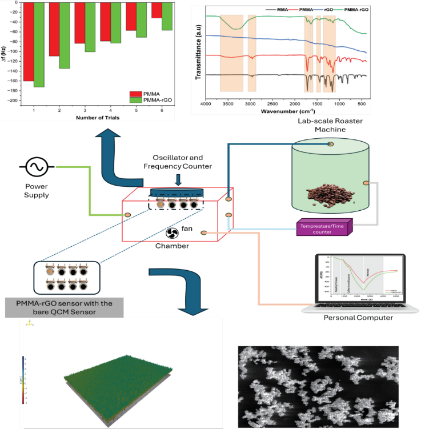
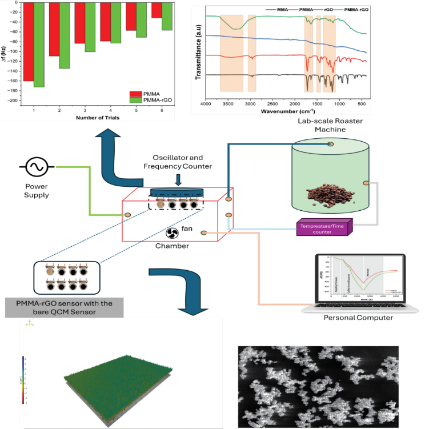
The primary quality of food is often associated with its physical attributes, particularly aroma. Key volatile compounds play a critical role in determining food quality. Coffee as a high-potential commodity in Indonesia and in the world strongly depends on their aroma as a signature for its quality. Several methods have been performed to determine the quality of coffee like cupping methods and chromatography-based technologies. But it depends on the coffee-experts who cannot be replicated by other people because of their subjectivity and still need complex sample processing and lengthy time-analysis. QCM sensor paves the way to solve this problem. By modification of its surface with nanomaterials, QCM sensing performance significantly can be elevated. This study aimed to detect the aroma of roasted coffee using a QCM-based electronic nose sensor. The QCM sensor was coated with aroma-sensitive materials to improve its sensing capabilities, specifically PMMA and PMMA-rGO composites. Both PMMA and PMMA-rGO were synthesized via an in situ polymerization method utilizing a binary solvent system in optimized proportions. The surface roughness of the QCM sensor was slightly higher when coated with PMMA-rGO (Sa = 493.68 ± 74.23 nm) compared to PMMA (Sa = 446.02 ± 26.19 nm) alone. The incorporation of rGO significantly enhanced the sensitivity of the QCM sensor towards the roasted coffee aroma. Based on the Sauerbrey calculation, the value of ∆f for PMMA is –66.05 ± 28.77 Hz while for PMMA-rGO is –74.28 ± 36.40 Hz. These findings suggest that PMMA-rGO composites hold considerable promise as effective sensing materials for improving QCM sensor performance.
HIGHLIGHTS
- PMMA and PMMA-rGO composites were synthesized using modified in situ polymerization in the presence of a binary solvent.
- PMMA and PMMA-rGO were used as sensitive materials on the surface of the QCM sensor.
- The PMMA- and PMMA-rGO-coated QCM sensors detected roasted coffee aroma at 220 °C roasting temperature.
GRAPHICAL ABSTRACT
Downloads
References
JD Barea-Ramos, G Cascos, M Mesías, J Lozano and D Martín-Vertedor. Evaluation of the olfactory quality of roasted coffee beans using a digital nose. Sensors 2022; 22(22), 8654.
CH Lee, I Te Chen, HC Yang and YJ Chen. An AI-powered electronic nose system with fingerprint extraction for aroma recognition of coffee beans. Micromachines (Basel) 2022; 13(8), 1313.
H Purwawangsa, MI Irfany and DA Haq. Indonesian coffee exports’ competitiveness and determinants. Jurnal Manajemen dan Agribisnis 2024; 21(1), 59-71.
F Ashardiono and A Trihartono. Optimizing the potential of Indonesian coffee: A dual market approach. Cogent Social Sciences 2024; 10(1), 2340206.
M Purnomo, Y Yuliati, A Shinta and FD Riana. Developing coffee culture among indonesia’s middle-class: A case study in a coffee-producing country. Cogent Social Sciences 2021; 7(1), 1949808.
BA Suslick, L Feng and KS Suslick. Discrimination of complex mixtures by a colorimetric sensor array: coffee aromas. Anal Chem 2010; 82(5), 2067-2073.
S Sittipod, E Schwartz, L Paravisini and DG Peterson. Identification of flavor modulating compounds that positively impact coffee quality. Food Chemistry 2019; 301, 125250.
L Xu, F Lao, Z Xu, X Wang, F Chen, X Liao, A Chen and S Yang. Use of liquid chromatography quadrupole time-of-flight mass spectrometry and metabolomic approach to discriminate coffee brewed by different methods. Food Chemistry 2019; 286, 106-112.
R Crnjar, P Solari and G Sollai. The human nose as a chemical sensor in the perception of coffee aroma: individual variability. Chemosensors 2023; 11(4), 0248.
F Wei, K Furihata, T Miyakawa and M Tanokura. A pilot study of NMR-based sensory prediction of roasted coffee bean extracts. Food Chem 2014; 152, 363-369.
M Defernez, E Wren, A D Watson, Y Gunning, I J Colquhoun, G Le Gall, D Williamson and E K Kemsley. Low-field ¹H NMR spectroscopy for distinguishing between arabica and robusta ground roast coffees. Food Chemistry 2017; 216, 106-113.
R Consonni, D Polla and L R Cagliani. Organic and conventional coffee differentiation by NMR spectroscopy. Food Control 2018; 94, 284-288.
JCC Freitas, M Ejaz, AT Toci, W Romão and YZ Khimyak. Solid-state NMR spectroscopy of roasted and ground coffee samples: Evidences for phase heterogeneity and prospects of applications in food screening. Food Chemistry 2023; 409, 135317.
K Brudzewski, S Osowski and A Dwulit. Recognition of coffee using differential electronic nose. IEEE Transactions on Instrumentation and Measurement 2012; 61(6), 1803-10.
CG Viejo, E Tongson and S Fuentes. Integrating a low‐cost electronic nose and machine learning modelling to assess coffee aroma profile and intensity. Sensors 2021; 21, 1-15.
Q Zhou, C Zheng, L Zhu and J Wang. A review on rapid detection of modified quartz crystal microbalance sensors for food: Contamination, flavour and adulteration. TrAC Trends in Analytical Chemistry 2022; 157, 116805.
L Katriani, R Aflaha, AH As’ari, P Nurwantoro, R Roto and K Triyana. Nanofiber-coated quartz crystal microbalance with chitosan overlay for highly sensitive room temperature ammonia gas sensor. Microchemical Journal 2024; 206, 111532.
K Triyana, A Sembiring, A Rianjanu, SN Hidayat, R Riowirawan, T Julian, A Kusumaatmaja, I Santoso and R Roto. Chitosan-based quartz crystal microbalance for alcohol sensing. Electronics 2018; 7(9), 181.
A Trajcheva, N Politakos, BT Pérez, Y Joseph, JB Gilev and R Tomovska. QCM nanocomposite gas sensors - Expanding the application of waterborne polymer composites based on graphene nanoribbon. Polymer 2021; 213, 123335.
Y Hu, H Xing, G Li and M Wu. Magnetic imprinted polymer-based quartz crystal microbalance sensor for sensitive label-free detection of methylene blue in groundwater. Sensors 2020; 20(9), 5506.
D Zhang, D Wang, X Zong, G Dong and Y Zhang. High-performance QCM humidity sensor based on graphene oxide/tin oxide/polyaniline ternary nanocomposite prepared by in-situ oxidative polymerization method. Sensors and Actuators B: Chemical 2018; 262, 531-41.
AK Mallik AK, ML Habib, FN Robel, M Shahruzzaman, P Haque, MM Rahman, V Devanath, DJ Martin, AK Nanjundan, Y Yamauchi, M Takafuji and H Ihara. Reduced graphene oxide (rGO) prepared by metal-induced reduction of graphite oxide: Improved conductive behavior of a poly(methyl methacrylate) (PMMA)/rGO composite. ChemistrySelect 2019; 4(27), 7954-7958.
C White, B Pejcic, M Myers and X Qi. Development of a plasticizer-poly(methyl methacrylate) membrane for sensing petroleum hydrocarbons in water. Sensors and Actuators B: Chemical 2014; 193, 70-77.
M Rodríguez-Torres, V Altuzar, C Mendoza-Barrera, G Beltrán-Pérez, J Castillo-Mixcóatl and S Muñoz-Aguirre. Acetone detection and classification as biomarker of diabetes mellitus using a quartz crystal microbalance gas sensor array. Sensors 2023; 23(24), 9823.
A Raza, R Abid, I Murtaza and T Fan. Room temperature NH3 gas sensor based on PMMA/RGO/ZnO nanocomposite films fabricated by in-situ solution polymerization. Ceramics International 2023; 49(16), 27050-27059.
NA Tehrani, IC Esfahani and H Sun. Simultaneous humidity and temperature measurement with micropillar enhanced QCM sensors. Sensors and Actuators A: Physical 2024; 366, 115039.
SS Gaikwad, AS Khune, NN Ingle NN and MD Shirsat. Chemiresistive sensor based on PMMA/rGO composite for detection ammonia. Sensors and Actuators A: Physical 2024; 377, 115665.
S Feizi, A Mehdizadeh, MA Hosseini, SA Jafari and P Ashtari. Reduced graphene oxide/polymethyl methacrylate (rGO/PMMA) nanocomposite for real time gamma radiation detection. Nuclear Instruments and Methods in Physics Research Section A: Accelerators, Spectrometers, Detectors and Associated Equipment 2019; 940, 72-77.
P Sharma, A Ghosh, B Tudu, LP Bhuyan, P Tamuly, N Bhattacharyya, R Bandyopadhyay and A Chatterjee. Detection of linalool in black tea using a quartz crystal microbalance sensor. Sensors and Actuators B: Chemical 2014; 190, 318-325.
B Ghatak, SB Ali, B Tudu, P Pramanik, S Mukherji and R Bandyopadhyay. Detecting ocimene in mango using mustard oil based quartz crystal microbalance sensor. Sensors and Actuators B: Chemical 2019; 284, 514-524.
N Debabhuti, S Neogi, S Mukherjee, A Dhar, P Sharma, RL Vekariya, MP Sarkar, B Tudu B, N Bhattacharyya, R Bandyopadhyay and M Muddassir. Development of QCM sensor to detect α-terpinyl acetate in cardamom. Sensors and Actuators A-physical 2021; 319, 112521.
Z Wang, W Chen, S Gu, J Wang and Y Wang. Discrimination of wood borers infested Platycladus orientalis trunks using quartz crystal microbalance gas sensor array. Sensors and Actuators B: Chemical 2020; 309, 127767.
T Wen, M Sang, M Wang, L Han, Z Gong, X Tang, X Long, H Xiong and H Peng. Rapid detection of d-limonene emanating from citrus infestation by Bactrocera dorsalis (Hendel) using a developed gas-sensing system based on QCM sensors coated with ethyl cellulose. Sensors and Actuators B: Chemical 2021; 328, 129048.
PA Saeed PA and A Sujith. A simple approach to develop conductive poly(methyl methacrylate)-reduced graphene oxide composite with segregated network. Polymer Bulletin 2024; 81, 8917-8931.
D Tumnantong, S Poompradub and P Prasassarakich. Conductive NR/PMMA-RAFT-CNT-rGO composites and their morphological, mechanical, and electrical properties. Journal of Industrial and Engineering Chemistry 2024; 141(12), 501-511.
TL Hsieh, PS Hung, CJ Wang, YS Chou and PW Wu. Controlled synthesis of uniform hollow polypyrrole microcapsules by a cosolvent approach. SN Applied Sciences 2019; 1(4), 319.
X Qiao, X Zhang, Y Tian and Y Meng. Progresses on the theory and application of quartz crystal microbalance. Applied Physics Reviews 2016; 3, 031106.
G Sauerbrey. Verwendung von Schwingquarzen zur Wägung dünner Schichten und zur Mikrowägung. Zeitschrift für Physik 1959; 155, 206-222.
Downloads
Published
How to Cite
Issue
Section
License
Copyright (c) 2024 Walailak University

This work is licensed under a Creative Commons Attribution-NonCommercial-NoDerivatives 4.0 International License.





