
Morphology and Wettability of Polystyrene film on QCM Sensor Caused by Oxygen Plasma with DC Bias
DOI:
https://doi.org/10.48048/tis.2024.8318Keywords:
Oxygen plasma, Negative DC bias, Etching, Polystyrene, Hydrophobicity, ImageJAbstract
Surface wettability and morphology are important aspects of developing QCM sensors for chemical sensors and biosensors. The functionality and morphology of the sensitive coating on the sensor surface affect the sensor sensitivity and selectivity. Various materials and methods to improve the functionality and morphology of the sensor surface have been developed, one of which is plasma. Species and parameters of the generated plasma play an important role in the treatment. One parameter is the DC-bias voltage of RF plasma, which plays an important role in plasma generation and bombardment on the surface being modified. This work shows the effect of the DC bias of the 2 MHz RF plasma with oxygen species. Surface functionality and morphology modification of the polystyrene film on the QCM sensor was done by surface modification using oxygen plasma. Partial etching of the polystyrene film occurred when treated with oxygen plasma generated using 2 MHz with negative DC-bias. CII, CO+, and CO were detected during the exposure of oxygen plasma on polystyrene film, indicating a chemical reaction between the plasma species, oxygen plasma, and the polystyrene. Observation by optical microscope and SEM showed the occurrence of partial etching on the polystyrene film. As there is no masking, the partial etching occurred randomly. The average size of the etched film increased with the DC bias voltage, but the percentage of the etched area was not. The oxygen plasma converts the polystyrene film from hydrophobic to hydrophilic, but hydrophobicity increases with the DC bias voltage.
HIGHLIGHTS
Polystyrene surface treatment using oxygen plasma can be used to alter the surface hydrophobicity. The DC bias plays important role in the surface modification. High DCV bias gives stronger plasma energy which may etched the polystyrene film. Observation using SEM shows part of the polystyrene film was etched as the DC bias voltage increase. The amount of the etched surface can be measured using optical microscope and processed using ImageJ. Increasing the DC bias result in a wider etched film.
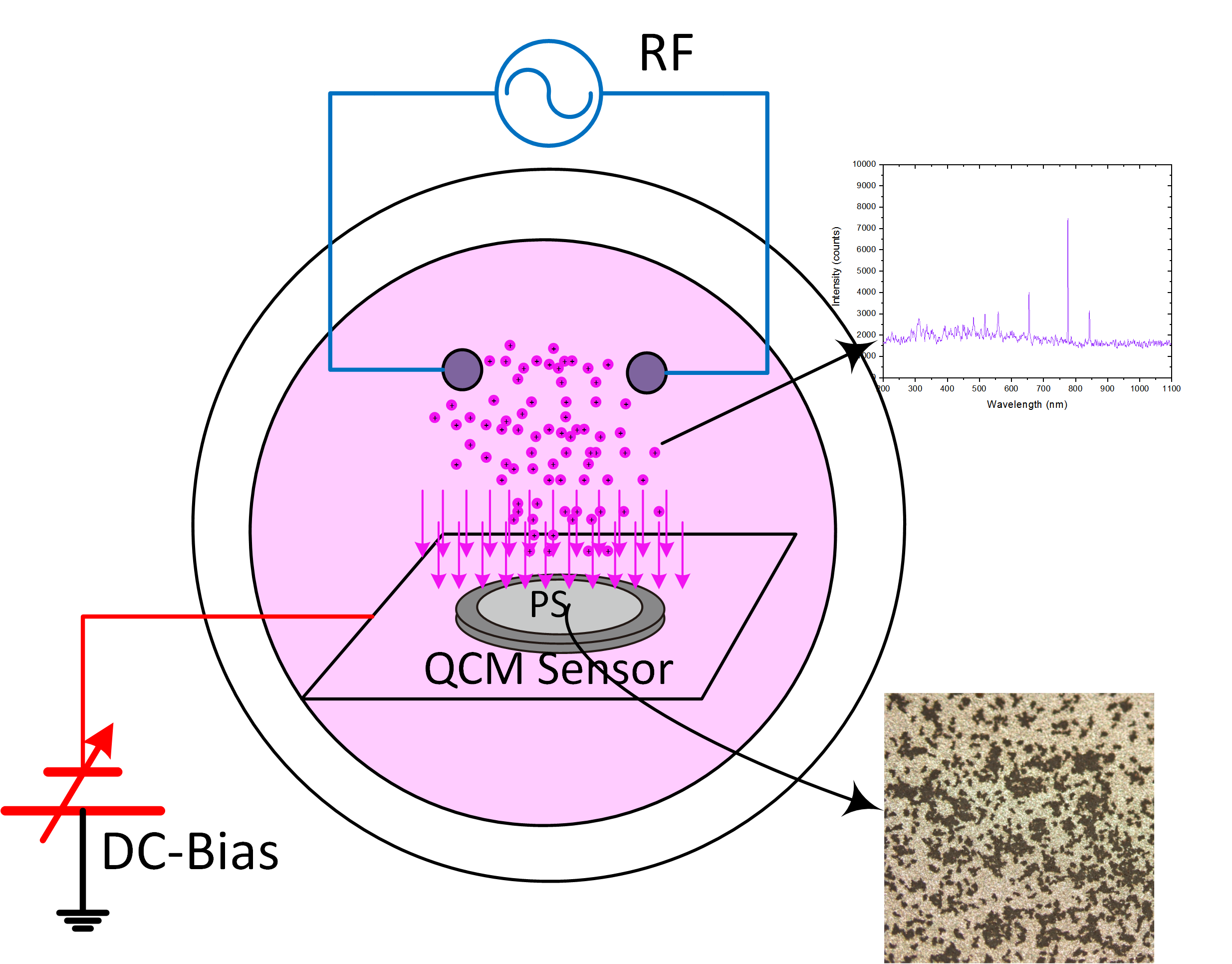
GRAPHICAL ABSTRACT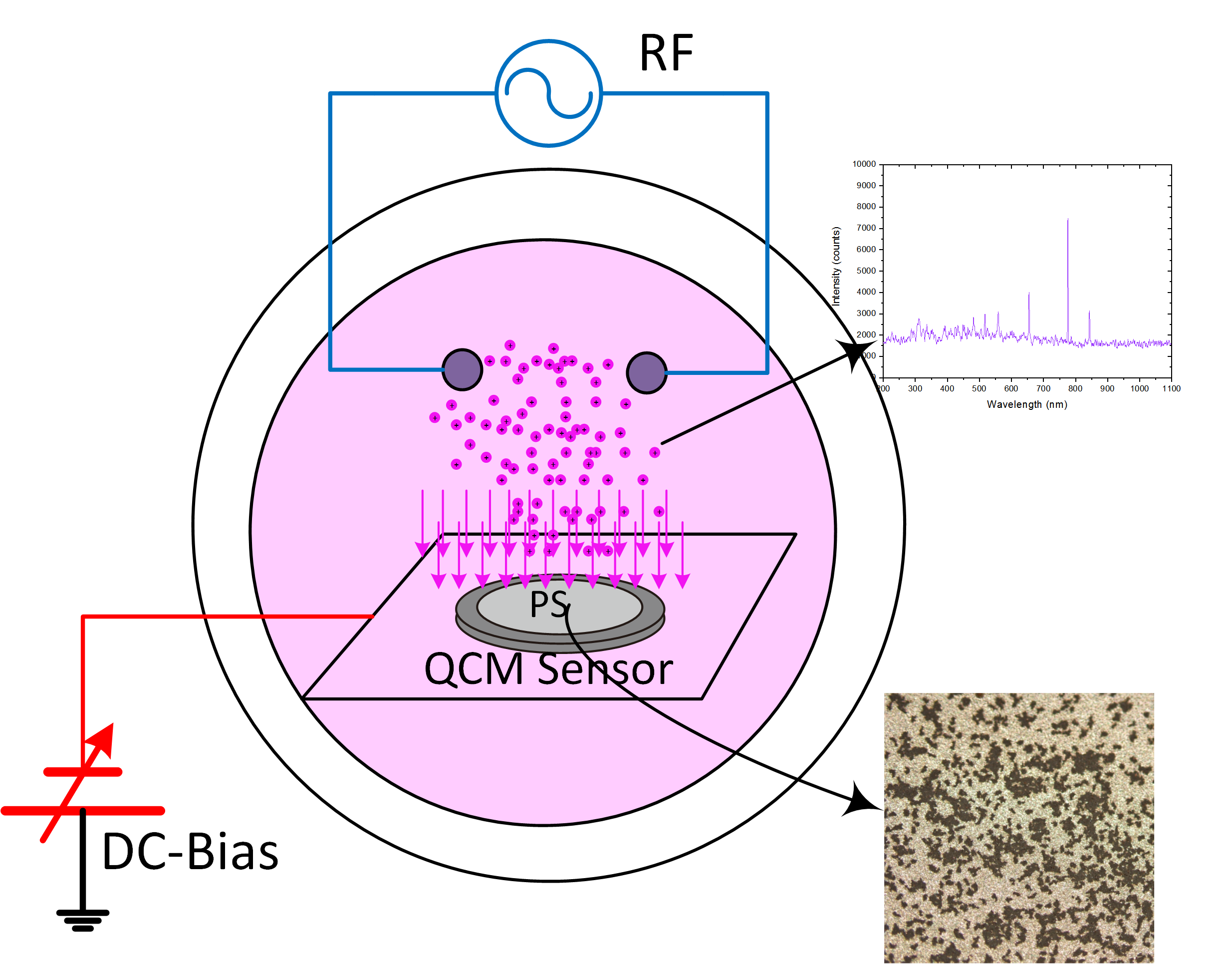
Downloads
References
P Sedlak, J Sikula, J Majzner, M Vrnata, P Fitl, D Kopecky, F Vyslouzil and PH Handel. Adsorption-desorption noise in QCM gas sensors. Sensor. Actuator. B Chem. 2012; 166-167, 264-8.
SP Sakti, N Chabibah, SP Ayu, MC Padaga and A Aulanni’am. Development of QCM biosensor with specific cow milk protein antibody for candidate milk adulteration detection. J. Sensor. 2016; 2016, 1807647.
A Rianjanu, R Roto, T Julian, SN Hidayat, A Kusumaatmaja, EA Suyono and K Triyana. Polyacrylonitrile nanofiber-based quartz crystal microbalance for sensitive detection of safrole. Sensors 2018; 18, 1150.
HY Yoo, M Ju and S Bruckenstein. Increasing QCM sensitivity based on high molecular weight porous polymer films. Sensor. Actuator. B Chem. 2018; 254, 573-7.
Z Pei, J Saint-Guirons, C Käck, B Ingemarsson and T Aastrup. Real-time analysis of the carbohydrates on cell surfaces using a QCM biosensor: A lectin-based approach. Biosens. Bioelectron. 2012; 35, 200-5.
A Erol, S Okur, N Yagmurcukards and MC Arıkan. Humidity-sensing properties of a ZnO nanowire film as measured with a QCM. Sensor. Actuator. B Chem. 2011; 152, 115-20.
D Shim, W Kim, S Chang and JM Kim. Fabrication of periodic nano-porous surface structure for highly sensitive gravimetric quartz crystal applications. Anal. Chim. Acta 2020; 1107, 30-9.
D Zhang, SM Douga and MS Yeganeh. Effects of UV irradiation and plasma treatment on a polystyrene surface studied by IR-visible sum frequency generation spectroscopy. Langmuir 2000; 16, 4528-32.
SP Sakti, L Amaliya, NF Khusnah and M Masruroh. Effect of UV radiation duration and molecular weight to hydrfophobicity and surface roughness of polystyrene coating on QCM sensor. Jurnal Teknologi 2017; 79, 61-7.
SP Sakti, NF Khusnah, DJDH Santjojo and A Sabarudin. Surface modification of polystyrene coating on qcm sensor using ambient air plasma at low pressure. Mater. Today Proc. 2018; 5, 15149-54.
AR Calchera, AD Curtis and JE Patterson. Plasma treatment of polystyrene thin films affects more than the surface. ACS Appl. Mater. Interfaces 2012; 4, 3493-9.
R Landgraf, MK Kaiser, J Posseckardt, B Adolphi and WJ Fischer. Functionalization of polymer sensor surfaces by oxygen plasma treatment. Procedia Chem. 2009; 1, 1015-8.
M Häidopoulos, M Horgnies, F Mirabella and JJ Pireaux. Angle-resolved XPS study of plasma-deposited polystyrene films after oxygen plasma treatment. Plasma Process. Polym. 2008; 5, 67-75.
CC Dupont-Gillain, Y Adriaensen, S Derclaye and PG Rouxhet. Plasma-oxidized polystyrene: Wetting properties and surface reconstruction. Langmuir 2000; 16, 8194-200.
B Guo, S Li, L Song, M Yang, W Zhou, D Tyagi and J Zhu. Plasma-treated polystyrene film that enhances binding efficiency for sensitive and label-free protein biosensing. Appl. Surf. Sci. 2015; 345, 379-86.
Y Xiang, B Dejkoski, P Fulmek and U Schmid. Surface properties of μm and sub-μm polydimethylsiloxane thin films after oxygen plasma treatment. Polymer 2023; 275, 125915.
Y Ting, C Liu, S Park, H Jiang, PF Nealey and AE Wendt. Surface roughening of polystyrene and poly(methyl methacrylate) in Ar/O2 plasma etching. Polymers 2010; 2, 649-63.
E Occhiello, M Morra, P Cinquina and F Garbassi. Hydrophobic recovery of oxygen-plasma-treated polystyrene. Polymer 1992; 33, 3007-15.
S Guruvenket, GM Rao, M Komath and AM Raichur. Plasma surface modification of polystyrene and polyethylene. Appl. Surf. Sci. 2004; 236, 278-84.
PS Arinda, DJDH Santjojo, M Masruroh and SP Sakti. Stability of polystyrene film surface wettability modified using oxygen plasma. Mater. Today Proc. 2019; 13, 24-9.
NF Khusnah, SP Sakti and DJDH Santjojo. Oxygen plasma effect on qcm sensor coated polystyrene film. IOP Conf. Ser. Mater. Sci. Eng. 2018; 367, 012030.
KA Alshaltami and S Daniels. Investigation of etching optimization in capacitively coupled SF6-O2 plasma. AIP Adv. 2019; 9, 035047.
O Kylián, A Choukourov and H Biederman. Nanostructured plasma polymers. Thin Solid Films 2013; 548, 1-17.
R Knizikevičius. Influence of activated polymer on the etching rate of SiO2 in CF4+H2 plasma. Microelectron. Eng. 2009; 86, 55-8.
C Li, T Qiu, G Zhou, M Giersig, X Wang and EM Akinoglu. Oxygen plasma induced solvent resistance of polystyrene particles enables the fabrication of ultra-thin free-standing crosslinked polymer films. Surface. Interfac. 2023; 41, 103164.
H Lee, M Lee and C Chung. Effects of rf-bias power on plasma parameters in a low gas pressure inductively coupled plasma. Appl. Phys. Lett. 2010; 96, 071501.
A Vital, M Vayer, C Sinturel, T Tillocher, P Lefaucheux and R Dussart. Polymer masks for structured surface and plasma etching. Appl. Surf. Sci. 2015; 332, 237-46.
T Shirai, J Reader, AE Kramida, J Sugar and NIST ASD Team. NIST atomic spectra database (ver 5.0). National Institute of Standards and Technology, Maryland, 2012, p. 96-102.
N Krstulovic, I Labazan, S Milosevic, U Cvelbar, A Vesel and M Mozetic. Optical emission spectroscopy characterization of oxygen plasma during treatment of a PET foil. J. Phys. D Appl. Phys. 2006; 39, 3799.
Y Fukunaga, RC Longo, PLG Ventzek, B Lane, A Ranjan, GS Hwang, G Hartmann, T Tsutsumi, K Ishikawa, H Kondo, M Sekine and M Hori. Interaction of oxygen with polystyrene and polyethylene polymer films: A mechanistic study. J. Appl. Phys. 2020; 127, 023303.
D Ray and C Subrahmanyam. CO2 decomposition in a packed DBD plasma reactor: Influence of packing materials. RSC Adv. 2016; 6, 39492-9.
S Kameshima, K Tamura, Y Ishibashi and T Nozaki. Pulsed dry methane reforming in plasma-enhanced catalytic reaction. Catal. Today 2015; 256, 67-75.
D Ray, R Saha and C Subrahmanyam. DBD plasma assisted CO2 decomposition: Influence of diluent gases. Catalysts 2017; 7, 244.
SP Sakti, RY Aji, L Amaliya and Masruroh. Low-cost contact angle measurement system for qcm sensor. Telkomnika 2017; 15, 560-9.
A Vesel, R Zaplotnik, M Mozetic and G Primc. Surface modification of PS polymer by oxygen-atom treatment from remote plasma: Initial kinetics of functional groups formation. Appl. Surf. Sci. 2021; 561, 150058.
G Valette. Hydrophilicity of metal surfaces: Silver, gold and copper electrodes. J. Electroanal. Chem. Interf. Electrochem. 1982; 139, 285-301.
Downloads
Published
How to Cite
Issue
Section
License
Copyright (c) 2024 Walailak University

This work is licensed under a Creative Commons Attribution-NonCommercial-NoDerivatives 4.0 International License.





