
Implications of the Electrodeposition Scan Rate on the Morphology of Polyaniline Layer and the Impedance of a QCM Sensor
DOI:
https://doi.org/10.48048/tis.2023.6411Keywords:
Electrodeposition, Polyaniline, QCM, Resonance parameter, StructuralAbstract
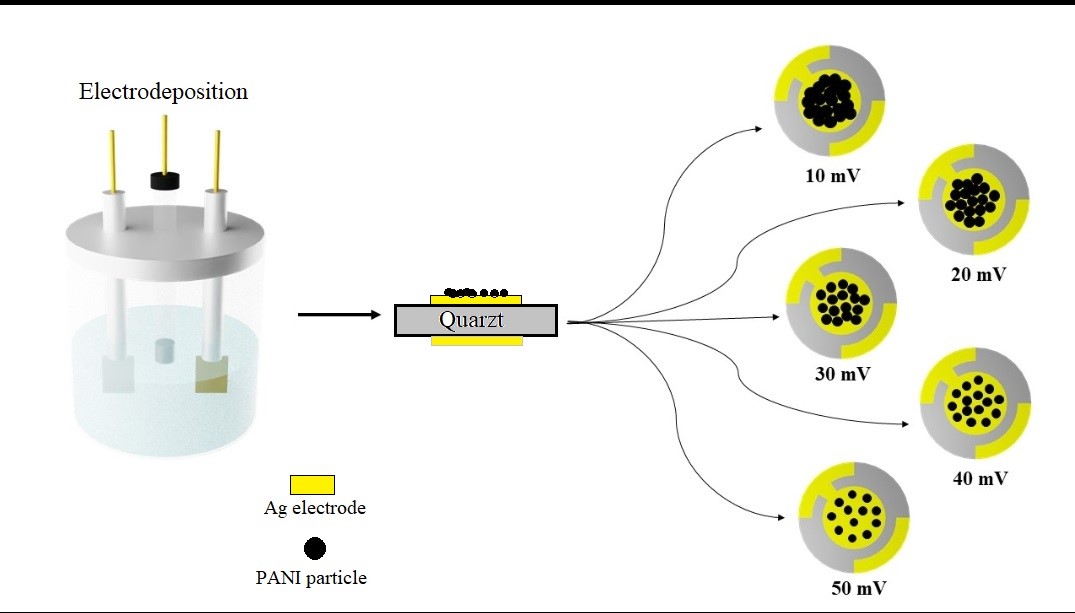
This work aims to determine how the scan rate affects PANI layers' morphology and resonance parameters deposited on quartz crystal microbalance (QCM). The PANI layer was produced using the electrodeposition method with a scan rate variation of 10 to 50 mV/s. The PANI layer deposited at a scan rate of 10 mV/s has an aggregate morphology, whereas the morphology becomes more scattered at a higher scan rate. On the other hand, the homogeneity of the distribution of PANI particles increases due to the increase in the scan rate. The QCM impedance profile also changes with PANI layer deposition at different scan rates. The QCM impedance profile with the PANI layer that is most similar to the uncoated QCM impedance profile is at a scan rate of 10, 40 and 50 mV/s. The resonance parameters, which represent the inertial mass and the dissipative characteristics of the PANI layer, were investigated. The PANI layer with the smallest resonance parameter has a scan rate of 10 and 40 mV/s. Therefore, the 2 scan rates are the best candidates to be applied further.
HIGHLIGHTS
- The electrodeposition scan rate influences the morphology of the PANI layer deposited above QCM
- The amount of carbon distributed across the QCM surface represents how effective the PANI deposition was
- The resulting morphology will impact the PANI layer's impedance characteristic and resonance parameter values
GRAPHICAL ABSTRACT
Downloads
References
X Zhao, X Chen, F Liu, X Ding, X Yu, K Tang and G Li. An ultrafast QCM humidity sensor for respiratory monitoring outside a mask. Sensors Actuators B Chem. 2022; 371, 132396.
A Biadasz, M Kotkowiak, D Łukawski, J Jadwizak, K Rytel and Kędzierski. A versatile gas transmission device with precise humidity control for QCM humidity sensor characterizations. Measurement 2022; 200, 111674.
A Kumar, C Varenne, A L Ndiaye, A Pauly, M Bouvet and J Brunet. Improvement in metrological performances of phthalocyanine-based QCM sensors for BTX detection in air through substituent’s effect. Sensors Actuators B Chem. 2022; 368, 132253.
F Kurniawan, A Nugroho, R A Baskara, L Candle, D Pradini, KA Madurani, RD Sugiarso and H Juwono. Rapid analysis to distinguish porcine and bovine gelatin using PANI/NiO nanoparticles modified Quartz Crystal Microbalance (QCM) sensor. Heliyon 2022; 8, e09401.
F Fauzi, A Rianjanu, I Santoso and K Triyana. Gas and humidity sensing with quartz crystal microbalance (QCM) coated with graphene-based materials - A mini-review. Sensors Actuators A Phys. 2021; 330, 112837.
G Xie, P Sun, X Yan, X Du and Y Jiang. Fabrication of methane gas sensor by layer-by-layer self-assembly of polyaniline/PdO ultra-thin films on quartz crystal microbalance. Sensors Actuators B Chem. 2010; 145, 373-7.
HM Hussien and MH Shinen. Study the sensitivity of quartz crystal microbalance (QCM) sensor coated with different thickness for determination vapors of ethanol, propanol, hexane and benzene. Chem. Mater. Res. 2013; 3, 61-5.
H Xu and J Zhang. Development of quartz crystal microbalance sensor modified by nano-structured polyaniline for detecting the plasticizer in gaseous state. Sensors Transducers 2014; 163, 235-9.
X Yu, X Chen, X Chen, X Zhao, X Yu and X Ding. Digital ammonia gas sensor based on quartz resonator tuned by interdigital electrode coated with polyaniline film. Org. Electr. 2020; 76, 105413.
D Zhang, Z Kang, X Liu, J Guo and Y Yang. Highly sensitive ammonia sensor based on PSS doped ZIF-8-derived porous carbon/polyaniline hybrid film coated on quartz crystal microbalance. Sensors Actuators B Chem. 2022; 357, 131419.
NP Putri, DW Pravitasari, FA Aziz, Maulidiah, DJDH Santjojo, Masruroh and SP Sakti. Solvent effect on viscoelastic behaviour and morphology of polyaniline coating at QCM sensor. J. Phys. Conf. Ser. 2019; 1417, 012002.
EIP Rahayu and NP Putri. The effect of solution concentration and deposition time on viscoelasticity and morphology of polyaniline coating. J. Phys. Conf. Ser. 2020; 1491, 012050.
D Zhang, D Wang, P Li, X Zhou, X Zong and G Dong. Facile fabrication of high performance QCM humidity sensor based on layer-by-layer self-assembled polyaniline/graphene oxide nanocomposite film. Sensors Actuators B Chem. 2018; 255, 1869-77.
NP Putri, E Yulisetiana, DJDH Santjojo, Masruroh and SP Sakti. Effect of evaporation deposition time on thickness and impedance value of polyaniline layers. J. Phys. Conf. Ser. 2021; 1805, 012035.
D Zhang, D Wang, X Zong, G Dong and Y Zhang. High-performance QCM humidity sensor based on graphene oxide/tin oxide/polyaniline ternary nanocomposite prepared by in-situ oxidative polymerization method. Sensors Actuators B Chem. 2018; 262, 531-41.
I Sa’diyah and NP Putri. The effects of potentiostat scan rate variation on impedance value, topography, and morphology of the polyaniline thin film. J. Phys. Sci. Eng. 2021; 6, 46-54.
HJNPD Mello and M Mulato. Influence of galvanostatic electrodeposition parameters on the structure-property relationships of polyaniline thin films and their use as potentiometric and optical pH sensors. Thin Solid Films 2018; 656, 14-21.
L Hou, X Zhi, W Zhang and H Zhou. Boosting the electrochemical properties of polyaniline by one-step co-doped electrodeposition for high performance flexible supercapacitor applications. J. Electroanal. Chem. 2020; 863, 114064.
T Xue, LS Loo, X Wang, SK Kwak and JM Lee. Electrodeposition of mesoporous bilayers of polyaniline supported Cu2O semiconductor films from lyotropic liquid crystalline phase. Chem. Eng. Sci. 2012; 80, 452-9.
AD Jagadale, VS Jamadade, SN Pusawale and CD Lokhande. Effect of scan rate on the morphology of potentiodynamically deposited B-Co(OH)2 and corresponding supercapacitive performance. Electrochimica Acta 2012; 78, 92-7.
A Baba, A Tian, F Stefani, C Xia, Z Wang, RC Advincula, D Johannsmann and W Knoll. Electropolymerization and doping/dedoping properties of polyaniline thin films as studied by electrochemical surface plasmon spectroscopy and by the quartz crystal microbalance. J. Electrochem. Chem. 2004; 562, 95-103.
MA Mohamoud, AR Hillman and I Evimov. Film mechanical resonance phenomenon during electrochemical deposition of polyaniline. Electrochimica Acta 2008; 53, 6235-43.
YA Ismail, JG Martinez and TF Otero. Fibroin/polyaniline microfibrous mat. Preparation and electrochemical characterization as reactive sensor. Electrochimica Acta 2014; 123, 501-10.
J Huang, K Wu, H Bai, H Huang, X Zhang, Y Liu and C Xiong. Facile synthesis of 3D porous polyaniline composite with MnO2-decorated fiber morphology and enhanced electrochemical performance. Polymer 2022; 256, 125235.
K Sahu and A K Kar. Dependency of morphological and optical properties of electropolymerized PANI thin films on different substrate for supercapacitor applications. Mater. Lett. 2021; 302, 130450.
SP Sakti. Quartz crystal resonator parameter calculation based on impedance analyser measurement GRG non-linear solver. J. Nat. A 2014; 1, 82-9.
NP Putri, AA Fahmi, DK Daniel and SP Sakti. Determination of resonance parameters of the PANI thin film fabricated using spin coating method. J. Phys. Conf. Ser. 2021; 2110, 012008.
Masruroh and DJDH Santjojo. The impedance analysis of a viscoelastic petalous structured stearic acid functional layer deposited on a QCM. Sensors 2022; 22, 7504.
SP Sakti, Masruroh, Istiroyah, DD kamasi and TN Zafirah. Ultra thick polystyrene coating on quartz crystal microbalance sensor. Mater. Today Proceed. 2021; 44, 3217-20.
I Burda. Advanced impedance spectroscopy for QCM sensor in liquid medium. Sensors 2022; 22, 2337.
SP Sakti, Masruroh, DD Kamasi and NF Khusnah. Stearic acid coating material loading effect to Quartz Crystal Microbalance sensor. Mater. Today Proc. 2019; 13, 53-8.
E Belarb, VM Blas-Ferrando, M Haro, H Maghraoui-Meherzi and S Gimenez. Electropolymerized polyaniline: A promising hole selesctive contact in organic photoelectrochemical cells. Chem. Eng. Sci. 2016; 154, 143-9.
P Chulkin and M Lapkowski. An insight into ionic conductivity of polyaniline thin films. Materials 2020; 13, 2877.
Downloads
Published
How to Cite
Issue
Section
License
Copyright (c) 2023 Walailak University

This work is licensed under a Creative Commons Attribution-NonCommercial-NoDerivatives 4.0 International License.





