
Zinc Layered Hydroxide 2-methyl-4-chlorophenoxyacetate: Synthesis via ZnO, Characterization and Effect on Seed Germination
DOI:
https://doi.org/10.48048/tis.2023.6943Keywords:
Layered double hydroxide, Herbicide, MCPA, Seed germination, Amino acid, Protein biosynthesisAbstract
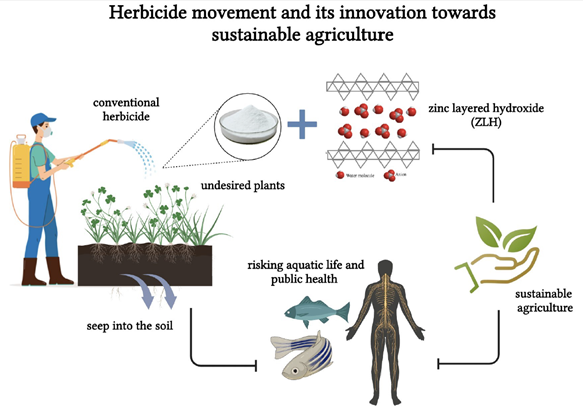
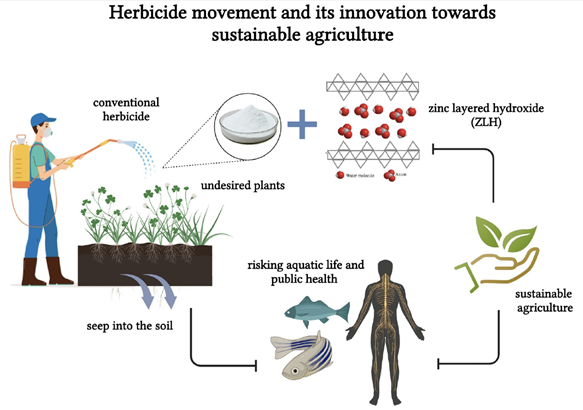
2-methyl-4-chlorophenoxyacetic acid (MCPA) was successfully intercalated into zinc layered hydroxide (ZLH) by anion exchange technique followed by hydrothermal treatment, resulting in the formation of nanoherbicide, zinc-layered hydroxide-2-methyl-4-chlorophenoxyacetic acid (ZMCPA). Fourier-transform infrared spectroscopy (FTIR) and Powder X-ray diffraction (PXRD) was used to confirm the intercalation of herbicide into ZLH, while Ultraviolet-visible spectroscopy (UV-vis) was employed to assess the plant’s protein content and amino acid composition before and after 1 h treatment with ZnO, MCPA and ZMCPA via the foliar technique and direct soil application. The basal spacing of ZMCPA in this study is 21.6 Å at 4.0815°, revealing the triumphant incorporation of MCPA into the ZLH host. The zinc oxide (ZnO) fingerprint from 30° to 60° that certainly vanished in the ZMCPA diffractogram indicates that all ZnO has successfully converted to ZLH matrices. The FTIR spectrum of ZMCPA shows the similarity of most MCPA spectra, but with the COO– peaks at 1610 and 1700 cm–1 replacing the intense C=O band at 1742.21 cm–1, implying that the herbicide has assimilated into the host. The protein level of the plant treated with ZMCPA was discovered to be more significant, which signifies that ZLH has effectively acted as a herbicide carrier. This study has depicted the potential of ZMCPA as a more unassailable agrochemical agent in increasing crop productivity while minimizing environmental consequences.
HIGHLIGHTS
- Successful Intercalation of MCPA into Zinc Layered Hydroxide (ZLH)
- Enhanced Plant Protein Levels with nanocomposite, ZMCPA Treatment
- ZMCPA as a potentially more effective and environmentally friendly agrochemical agent compared to the traditional agrochemical
GRAPHICAL ABSTRACT
Downloads
References
S Kumar, MK Bhowmick and P Ray. Weeds as alternate and alternative hosts of crop pests. Indian J. Weed Sci. 2021; 53, 14-29.
A Syeda, KR Alharby, H Alharby and MI Qureshi. Weed control through herbicide-loaded nanoparticles. In: Nanomaterials and plant potential. Springer Cham, Switzerland, 2019, p. 507-27.
JL Capinera. Symposium relationships between insect pests and weeds: An evolutionary perspective weeds are a food resource for insects. Weed Sci. 2005; 53, 892-901.
W Taye. Effect of weed management on insect pest population on cotton (Gossypium Hirsutum L.) at Werer, Ethiopia. Int. J. Res. Stud. Agric. Sci. 2021; 7, 24-31.
WH Leong, SY Teh, MM Hossain, T Nadarajaw, Z Zabidi-Hussin, SY Chin, KS Lai and SHE Lim. Application, monitoring, and adverse effects in pesticide use: The importance of reinforcement of Good Agricultural Practices (GAPs). J. Environ. Manage. 2020; 260, 109987.
S Xiao, Y Gong, Z Li and P Fantke. Improving pesticide uptake modeling into potatoes: Considering tuber growth dynamics. J. Agric. Food Chem. 2021; 69, 3607-16.
Indu, AS Baghel, A Bhardwaj and W Ibrahim. Optimization of pesticides spray on crops in agriculture using machine learning. Comput. Intell. Neurosci. 2022; 2022, 9408535.
F Peng, X Wang, W Zhang, X Shi, C Cheng, W Hou, X Lin, X Xiao and J Li. Nanopesticide formulation from Pyraclostrobin and graphene oxide as a nanocarrier and application in controlling plant fungal pathogens. Nanomaterials 2022; 12, 1112.
MML Forini, MS Pontes, DR Antunes, PHCD Lima, JS Santos, EF Santiago and R Grillo. Nano-enabled weed management in agriculture: From strategic design to enhanced herbicidal activity. Plant Nano Biol. 2022; 1, 10008.
J Dong, X Liu, Y Chen, W Yang and X Du. User-safe and efficient chitosan-gated porous carbon and nanoherbicides. J. Colloid Interface Sci. 2021; 594, 20-34.
V Takeshita, LB Carvalho, JA Galhardi, GV Munhoz-Garcia, RF Pimpinato, HC Oliveira, VL Tornisielo and LF Fraceto. Development of a preemergent Nanoherbicide: From efficiency evaluation to the assessment of environmental fate and risks to soil microorganisms. ACS Nanosci. Au 2022; 2, 307-23.
G Chugh, KHM Siddique and ZM Solaiman. Nanobiotechnology for agriculture: Smart technology for combating nutrient deficiencies with nanotoxicity challenges. Sustainability 2021; 13, 1781.
C An, C Sun, N Li, B Huang, J Jiang, Y Shen, C Wang, X Zhao, B Cui, C Wang, X Li, S Zhan, F Gao, Z Zeng, H Cui and Y Wang. Nanomaterials, and nanotechnology for the delivery of agrochemicals: Strategies towards sustainable agriculture. J. Nanobiotechnol. 2022; 20, 11.
K Neme, A Nafady, S Uddin and YB Tola. Application of nanotechnology in agriculture, postharvest loss reduction and food processing: Food security implication and challenges. Heliyon 2021; 7, e08539.
M Chaud, EB Souto, A Zielinska, P Severino, F Batain, J Oliveira-Junior and T Alves. Nanopesticides in agriculture: Benefits and challenge in agricultural productivity, toxicological risks to human health and environment. Toxics 2021; 9, 131.
LA Paramo, AA Feregrino-Pérez, R Guevara, S Mendoza and K Esquivel. Nanoparticles in agroindustry: Applications, toxicity, challenges and trends. Nanomaterials 2020; 10, 1654.
V Takeshita, BTD Sousa, AC Preisler, LB Carvalho, ADES Pereira, VL Tornisielo, G Dalazen, HC Oliveira and LF Fraceto. Foliar absorption and field herbicidal studies of atrazine-loaded polymeric nanoparticles. J. Hazard. Mater. 2021; 418, 126350.
SNM Sharif, N Hashim, IM Isa, M Mamat, NM Ali, SA Bakar, MZ Hussein and S Mustafar. The intercalation behaviour and physico-chemical characterisation of novel intercalated nanocomposite from zinc/aluminium layered double hydroxides and broadleaf herbicide clopyralid. Chem. Chem. Tech. 2020; 14, 38-46.
Y Wang, H Cui, C Sun, X Zhao and B Cui. Construction, and evaluation of controlled-release delivery system of Abamectin using porous silica nanoparticles as carriers. Nanoscale Res. Lett. 2014; 9, 655.
J Wu, Y Zhai, FA Monikh, D Arenas-Lago, R Grillo, MG Vijver and WJGM Peijnenburg. The differences between the effects of a nanoformulation and a conventional form of atrazine to lettuce: Physiological responses, defense mechanisms, and nutrient displacement. J. Agr. Food Chem. 2021; 69, 12527-40.
GFM Sousa, DG Gomes, EVR Campos, JL Oliveira, LF Fraceto, R Stolf-Moreira and HC Oliveira. Post-emergence herbicidal activity of nanoatrazine against susceptible weeds. Front. Environ. Sci. 2018; 6, 12.
SMN Mohsin, MZ Hussein, SH Sarijo, S Fakurazi, P Arulselvan and TYY Hin. Synthesis of (cinnamate-zinc layered hydroxide) intercalation compound for sunscreen application. Chem. Cent. J. 2013; 7, 26.
A Gordeeva, YJ Hsu, IZ Jenei, PHBB Carvalho, SI Simak, O Andersson and U Haüssermann. Layered zinc hydroxide dihydrate, Zn5(OH)10·2H2O, from hydrothermal conversion of ϵ-Zn(OH)2 at gigapascal pressures and its transformation to nanocrystalline ZnO. ACS Omega 2020; 5, 17617-27.
NF Khadiran, MZ Hussein, R Ahmad, T Khadiran, Z Zainal, WRWA Kadir and SS Hashim. Preparation and properties of zinc layered hydroxide with nitrate and phosphate as the counter anion, a novel control release fertilizer formulation. J. Porous Mater. 2021; 28, 1797-811.
NSIM Foad, NN Dzulkifli, A Abdullah, ML Jadam and SAISM Ghazali. Synthesis and characterisation of zinc layered hydroxide intercalated with 2-methyl-4-chlorophenoxyacetic acid and its controlled release application. ASM Sci. J. 2021; 15, 1-10.
NM Salleh, SMN Mohsin, SH Sarijo and SAISM Ghazali. Synthesis and physico-chemical properties of zinc layered hydroxide-4-chloro-2-methylphenoxy acetic acid (ZMCPA) nanocomposite. IOP Conf. Ser. Mater. Sci. Eng. 2017; 204, 12012.
SH Sarijo, SAISM Ghazali and MZ Hussein. Synthesis of dual herbicides-intercalated hydrotalcite-like nanohybrid compound with simultaneous controlled release property. J. Porous Mater. 2015; 22, 473-80.
NE Okoronkwo, KC Mba and IC Nnorom. Estimation of protein content and amino acid compositions in selected plant samples using UV-vis spectrophotometeric method. Am. J. Food Sci. Health 2017; 3, 41-6.
SI Sherwani, IA Arif and HA Khan. Modes of action of different classes of herbicides. In: Herbicides, physiology of action, and safety. Intechopen, London, 2015, p. 165-86.
M Rutherford, J Flood and SS Sastroutomo. Roundtable for sustainable palm oil (RSPO): Research project on integrated weed management strategies for oil palm. Integrated Weed Management Strategies for Oil Palm, Kuala Lumpur, Malaysia, 2011, p. 1-189.
I Fatimah, G Purwiandono, I Sahroni, S Sagadevan, W Chun-Oh, SAISM Ghazali and R Doong. Recyclable catalyst of ZnO/SiO2 prepared from salacca leaves ash for sustainable biodiesel conversion. South Afr. J. Chem. Eng. 2022; 40, 134-43.
E Dor, S Galili, E Smirnov, Y Hacham, R Amir and J Hershenhorn. The effects of herbicides targeting aromatic and branched chain amino acid biosynthesis support the presence of functional pathways in broomrape. Front. Plant Sci. 2017; 8, 707.
TM Hildebrandt, AN Nesi, WL Araújo and HP Braun. Amino acid catabolism in plants. Mol. Plant 2015; 8, 1563-79.
GDL Ee, SA Izzaddin, M Rahmani, MA Sukari and HL Lee. γ-Mangostin and rubraxanthone, two potential lead compounds for anti-cancer activity against CEM-SS cell line. Nat. Prod. Sci. 2006; 12, 138-43.
KDA Ghani, S Nayan, SAISM Ghazali, LA Shafie and S Nayan. Critical internal and external factors that affect firms strategic planning. Int. Res. J. Finance Econ. 2010; 51, 50-8.
Downloads
Published
How to Cite
Issue
Section
License
Copyright (c) 2023 Walailak University

This work is licensed under a Creative Commons Attribution-NonCommercial-NoDerivatives 4.0 International License.





