
Effect of Zn Content on Physicochemical Characteristics, Photocatalytic Activity and Antibacterial Activity of Hydrothermally Synthesized Zn-Doped Hydroxyapatite
DOI:
https://doi.org/10.48048/tis.2025.10543Keywords:
Hydroxyapatite, ZnO, Photocatalytic, Antibacterial, TetracyclineAbstract
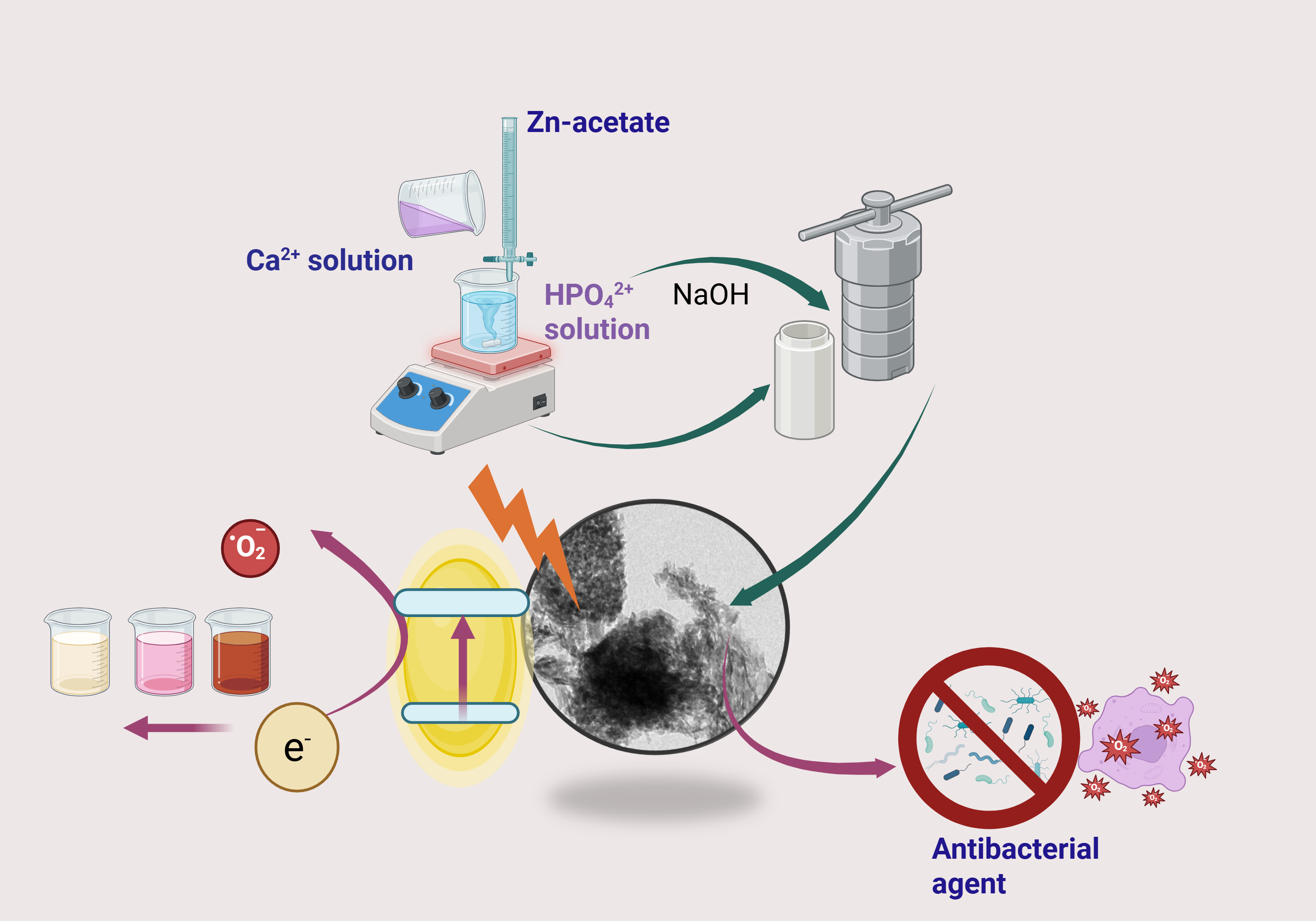
This study explores the effect of zinc (Zn) content on the physicochemical characteristics, photocatalytic activity, and antibacterial activity of hydrothermally synthesized hydroxyapatite (HAp). Zinc doped HAp (Zn-HAp) was synthesized with varying Zn content of 1, 2 and 5 wt%, and characterized using XRD, FTIR, UV-Vis DRS, TEM, and zeta potential analysis. Characterization results showed that Zn was successfully dopped into the HAp structure without forming its own ZnO phase, with a decrease in crystallite size and band gap. Photocatalytic activity test was conducted by degradation of tetracycline (TC) antibiotic using UV light. The results show that Zn-HAp has higher photocatalytic activity than pure HAp, with the highest degradation efficiency of 90.48% obtained at 1Zn-HAp. The photocatalytic activity increased as the band gap decreased, which was facilitated by Zn doping. In addition, antibacterial tests against Escherichia coli and Staphylococcus aureus showed that Zn-HAp had a larger inhibition zone than pure HAp, indicating an increase in antibacterial activity, especially at higher Zn concentrations.
HIGHLIGHTS
- Zinc-doped hydroxyapatite with a varied zinc have been synthesized by hydrothermal method.
- Increasing Zn content in Zn-HAp affects to reduce crystallite size and band gap energies
- The reduced band gap energy leads to the enhanced photocatalytic activity.
- Zn-HAp samples show the higher tetracycline photocatalytic activity compared to HAp at 90.84 %.
- Zn-HAp samples showed good antibacterial activity against Eschericia coli and Staphylococcus aureus.
GRAPHICAL ABSTRACT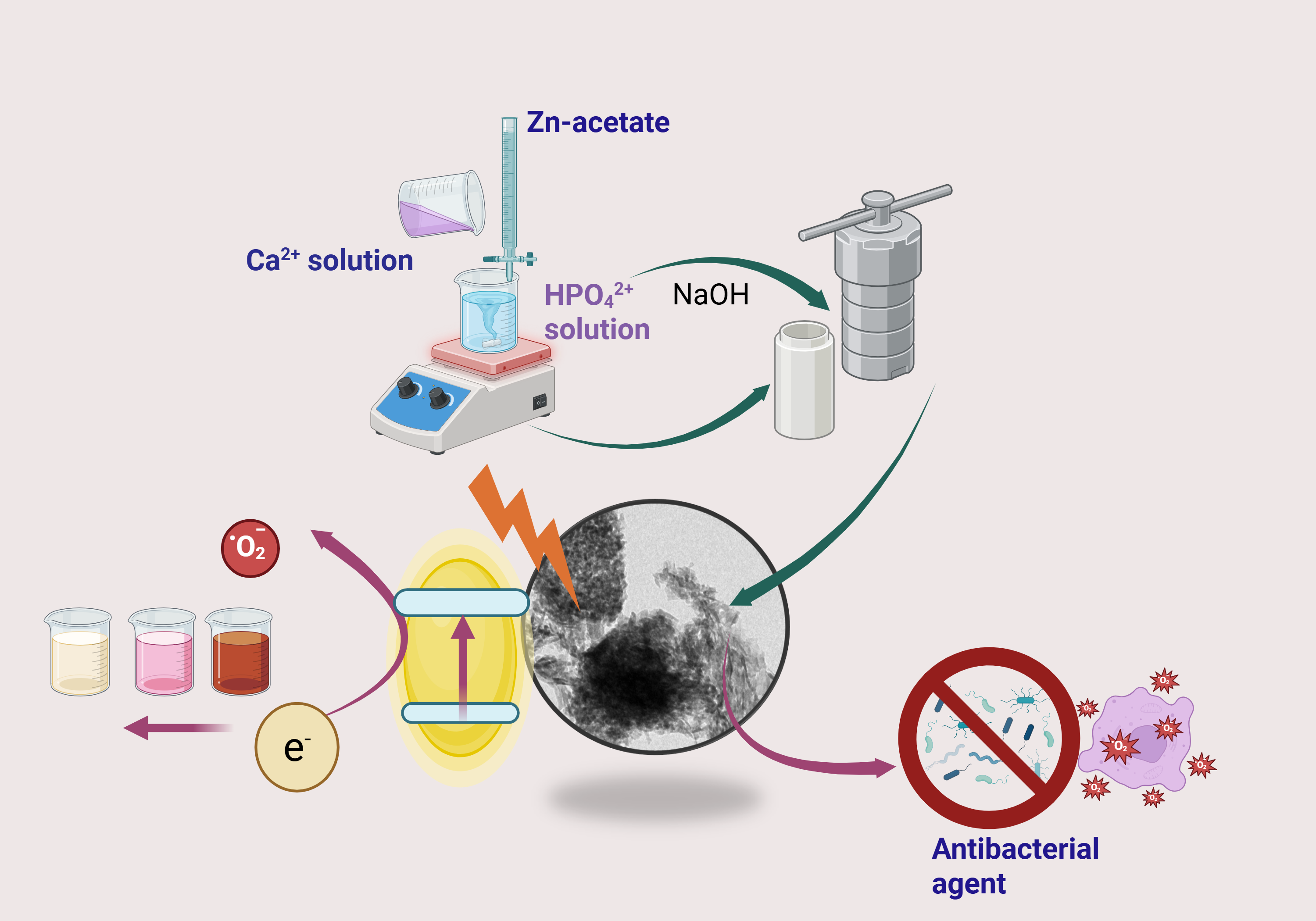
Downloads
References
H Alioui, O Bouras and JC Bollinger. Toward an efficient antibacterial agent: Zn- and Mg-doped hydroxyapatite nanopowders. Journal of Environmental Science and Health - Part A Toxic/Hazardous Substances and Environmental Engineering 2019; 54(4), 315-327.
K Yusuf, V Sampath and S Umar. Bacterial infections and cancer: Exploring this association and its implications for cancer patients. International Journal of Molecular Sciences 2023; 24(4), 3110.
F Ahmad, D Zhu and J Sun. Environmental fate of tetracycline antibiotics: Degradation pathway mechanisms, challenges, and perspectives. Environmental Sciences Europe 2021; 33(1), 64.
J Wang and R Zhuan. Degradation of antibiotics by advanced oxidation processes: An overview. In Science of the Total Environment 2020; 701, 135023.
J Ma, Y Chen, G Zhou, H Ge and H Liu. Recent advances in photocatalytic degradation of tetracycline antibiotics. Catalysts 2024; 14(11), 762.
S Mondal, S Park, J Choi, TTH Vu, VHM Doan, TT Vo, B Lee and J Oh. Hydroxyapatite: A journey from biomaterials to advanced functional materials. Advances in Colloid and Interface Science 2023; 321, 103013.
TCN Nicácio, MAM Castro, MCN Melo, TA Silva, MD Teodoro, MRD Bomio and FV Motta. Zn and Ni doped hydroxyapatite: Study of the influence of the type of energy source on the photocatalytic activity and antimicrobial properties. Ceramics International 2024; 50(15), 27540-27552.
MB Febrian, I Mahendra, A Kurniawan, Y Setiadi, THA Wibawa, R Lesmana and DG Syarif. Zirconium doped hydroxyapatite nanoparticle as a potential design for lung cancer therapy. Ceramics International 2021; 47(19), 27890-27897.
I Fatimah, H Hidayat, PW Citradewi, M Tamyiz, R Doong and S Sagadevan. Hydrothermally synthesized titanium/hydroxyapatite as photoactive and antibacterial biomaterial. Heliyon 2023; 9(3), e14434.
P Porrawatkul, R Pimsen, A Kuyyogsuy, P Rattanaburi and P Nuengmatcha. Morphology-dependent photocatalytic performance of ZnO nanostructures in organic dye and antibiotic degradation. International Journal of Environmental Science and Technology 2024; 21(2), 7397-7414.
P Szterner and M Biernat. The synthesis of hydroxyapatite by hydrothermal process with calcium lactate pentahydrate: The effect of reagent concentrations, pH, temperature, and pressure. Bioinorganic Chemistry and Applications 2022; 2022, 3481677.
M Andrean, M Castro, T Portela, G Sousa, M Moizinho, J Hilton, G Rangel, S Filgueiras, J Manuel and R Mercury. Synthesis of hydroxyapatite by hydrothermal and microwave irradiation methods from biogenic calcium source varying pH and synthesis time. Boletín de la Sociedad Española de Cerámica y Vidrio 2020; 61(1), 35-41.
J Liu, X Ye, H Wang, M Zhu, B Wang and H Yan. The influence of pH and temperature on the morphology of hydroxyapatite synthesized by hydrothermal method. Ceramics International 2003; 29(6), 629-633.
EA Ofudje, AI Adeogun, MA Idowu and SO Kareem. Synthesis and characterization of Zn-Doped hydroxyapatite: Scaffold application, antibacterial and bioactivity studies. Heliyon 2019; 5(5), e01716.
S Kato, S Kagawa, K Saito and M Ogasawara. Incorporation and deposition behaviors of Cu and Ni ions into hydroxyapatite channels by heat treatment. Journal of Physics and Chemistry of Solids 2023; 177, 111287.
M Irfan, SN Sultana, B Venkateswarlu, M Jagannatham, R Dumpala and BR Sunil. Zinc-substituted hydroxyapatite: Synthesis, structural analysis, and antimicrobial behavior. Transactions of the Indian Institute of Metals 2021; 74(9), 2335-2344.
E Andrew, A Idowu, M Abidemi and S Olateju. Heliyon synthesis and characterization of zn-doped hydroxyapatite: Scaffold application , antibacterial and bioactivity studies. Heliyon 2019; 5, e01716.
GS Kumar, A Thamizhavel, Y Yokogawa, SN Kalkura and EK Girija. Synthesis, characterization and in vitro studies of zinc and carbonate co-substituted nano-hydroxyapatite for biomedical applications. Materials Chemistry and Physics 2012; 134(2-3), 1127-1135.
M Hamza, Q Kanwal, Z Ali, S Zargar, AH Alshammari, TA Wani, M Rizwan, K Rohm and MA Mushtaq. Exploring the molecular biology of zinc-doped hydroxyapatite nanocomposites as fillers for dental materials: A self-defensive approach targeting bacterial DNA. Materials Research Express 2024; 11(9), 095401.
M Iafisco, JG Morales, MA Hernández-Hernández, JM García-Ruiz and N Roveri. Biomimetic carbonate-hydroxyapatite nanocrystals prepared by vapor diffusion. Advanced Engineering Materials 2010; 12(7), B218-B223.
J Jia, H Zhou, J Wei, X Jiang, H Hua, F Chen, S Wei, JW Shin and C Liu. Development of magnesium calcium phosphate biocement for bone regeneration. Journal of the Royal Society Interface 2010; 7(49), 1171-1180.
F Ren, RvXin, X Ge and Y Leng. Characterization and structural analysis of zinc-substituted hydroxyapatites. Acta Biomaterialia 2009; 5(8), 3141-3149.
Y Chen, R Zou and Q Wu. Facile synthesis of hollow ZnO/HAp microsphere photocatalysts for efficient removal of tetracycline under full light irradiation. Inorganic Chemistry Communications 2025; 174, 114084.
I El-Habib, H Maatouk, A Lemarchand, S Dine, A Roynette, C Mielcarek, M Traoré and R Azouani. Antibacterial size effect of ZnO nanoparticles and their role as additives in emulsion waterborne paint. Journal of Functional Biomaterials 2024; 15(7), 195.
N Babayevska, Ł Przysiecka, I Iatsunskyi, G Nowaczyk, M Jarek, E Janiszewska and S Jurga. ZnO size and shape effect on antibacterial activity and cytotoxicity profile. Scientific Reports 2022; 12(1), 8148.
V Kalaiselvi, R Mathammal and P Anitha. Sol-gel mediated synthesis of pure hydroxyapatite at different temperatures and silver substituted hydroxyapatite for biomedical applications. Journal of Biotechnology & Biomaterials 2017; 07(4), 1-6.
APS Prasanna and GD Venkatasubbu. Sustained Release of amoxicillin from hydroxyapatite nanocomposite for bone infections. Progress in Biomaterials 2018; 7, 289-296.
X Jiang, Y Zhao, C Wang, R Sun and Y Tang. Effects of physico-chemical properties of ions-doped hydroxyapatite on adsorption and release performance of doxorubicin as a model anticancer drug. Materials Chemistry and Physics 2022; 276, 125440.
GT El-Bassyouni, SH Kenawy, AAAE Aty, EMA Hamzawy and GM Turky. Influence of ZnO doped into hydroxyapatite: Structural, electrical, biocompatibility, and antimicrobial assessment. Journal of Molecular Structure 2022; 1268(1), 133700.
MS Elsayed, IA Ahmed, DMD Bader and AF Hassan. Green synthesis of nano zinc oxide/nanohydroxyapatite composites using date palm pits extract and eggshells: Adsorption and photocatalytic degradation of methylene blue. Nanomaterials 2022; 12(1), 49.
N Qi, P Wang, C Wang and Y Ao. Effect of a typical antibiotic (tetracycline) on the aggregation of TiO2 nanoparticles in an aquatic environment. Journal of Hazardous Materials 2018; 341, 187-197.
N Kanmaz and P Demircivi. Adsorption of tetracycline using one-pot synthesis zirconium metal-organic framework (UiO-66) decorated hydroxyapatite. Journal of Molecular Liquids 2024; 397, 124171.
C Oliveira, ALMD Oliveira, L Chantelle, R Landers, S Medina-Carrasco, MDM Orta, ECS Filho and MG Fonseca. Zinc (II) modified hydroxyapatites for tetracycline removal: Zn (II) doping or ZnO deposition and their influence in the adsorption. Polyhedron 2021; 194, 114879.
I Fatimah, R Audita, G Purwiandono, H Hidayat, S Sagadevan, WC Oh and R Doong. In-situ synthesis of hydroxyapatite-supported Ag3PO4 using cockle (Anadara granosa) shell as photocatalyst in rhodamine B photodegradation and antibacterial agent. Case Studies in Chemical and Environmental Engineering 2024; 10, 100797.
I Fatimah, G Purwiandono, GD Ramanda, N Nurlaela, H Hidayat, S Sagadevan and WC Oh. Zr-doped hydroxyapatite nanorods from cockle shell and study on photocatalyst activity and cytotoxicity. Inorganic Chemistry Communications 2024; 165, 112559.
A Bhattacharjee, A Gupta, M Verma, PA Murugan, P Sengupta, S Matheshwaran, I Manna and K Balani. Site-specific antibacterial efficacy and cyto/hemo-compatibility of zinc substituted hydroxyapatite. Ceramics International 2019; 45(9), 12225-12233.
ML Habib, SA Disha, MS Hossain, MN Uddin and S Ahmed. Enhancement of antimicrobial properties by metals doping in nano-crystalline hydroxyapatite for efficient biomedical applications. Heliyon 2024; 10(1), e23845.
JR Guerra-López, AE Bianchi, MA Ramos, M Ubertino, V Ferraresi-Curotto, JA Güida, K Barbaro, AA Zhukova, VY Grigorieva, JV Rau and GA Echeverría. Preparation of Zinc-doped hydroxyapatite ceramics and evaluation of biocompatibility and antibacterial activity. Journal of Functional Biomaterials 2025; 16(3), 88.
A Anwar, A Sadiqa, A Intisar, AU Rashid, T Razaq, SA Aldossari, MSS Mushab, DY Park and D Choi. Synergistic effect of hydroxyapatite-magnetite nanocomposites in magnetic hyperthermia for bone cancer treatment. Nanotechnology Reviews 2024; 13(1), 20230225.
N Ohtsu, Y Kakuchi and T Ohtsuki. Antibacterial effect of zinc oxide/hydroxyapatite coatings prepared by chemical solution deposition. Applied Surface Science 2018; 445, 596-600.
K Sinulingga, M Sirait, N Siregara and H Abdullah. Synthesis and characterizations of natural limestone-derived nano-hydroxyapatite (HAp): A comparison study of different metals doped HAps on antibacterial activity. RSC Advances 2021; 11(26), 15896-15904.
DAC Ferreira-Ermita, FL Valente, EC Carlo-Reis, FR Araújo, IM Ribeiro, CCV Cintra and APB Borges. Characterization and in vivo biocompatibility analysis of synthetic hydroxyapatite compounds associated with magnetite nanoparticles for a drug delivery system in osteomyelitis treatment. Results in Materials 2020; 5, 100063.
A Nikmah and R Kurniawan. Sintesis Hydroxyapatite Nanoparticle dari Limbah Cangkang Bekicot dan Aktivitas Antibakterinya sebagai Kandidat Material Biomedis. Jurnal Sains dan Edukasi Sains 2024; 7(1), 23-28.
Charlena, IH Suparto and E Kurniawan. Synthesis and characterization of Hydroxyapatite-Zinc Oxide (HAp-ZnO) as antibacterial biomaterial. IOP Conference Series: Materials Science and Engineering 2018; 599, 012011.
M Hassanain, HM Abdel-Ghafar, HI Hamouda, FI El-Hosiny and EMM Ewais. Enhanced antimicrobial efficacy of hydroxyapatite-based composites for healthcare applications. Scientific Reports 2024; 14(1), 26426.
Published
How to Cite
Issue
Section
License
Copyright (c) 2025 Walailak University

This work is licensed under a Creative Commons Attribution-NonCommercial-NoDerivatives 4.0 International License.





