
Photocatalytic Activity of ZnO Nanoparticles from Pineapple Skin for Degradation of Congo Red Dye
DOI:
https://doi.org/10.48048/tis.2025.9042Keywords:
Photocatalytic, Congo Red, ZnO nanoparticles, Pineapple peelAbstract
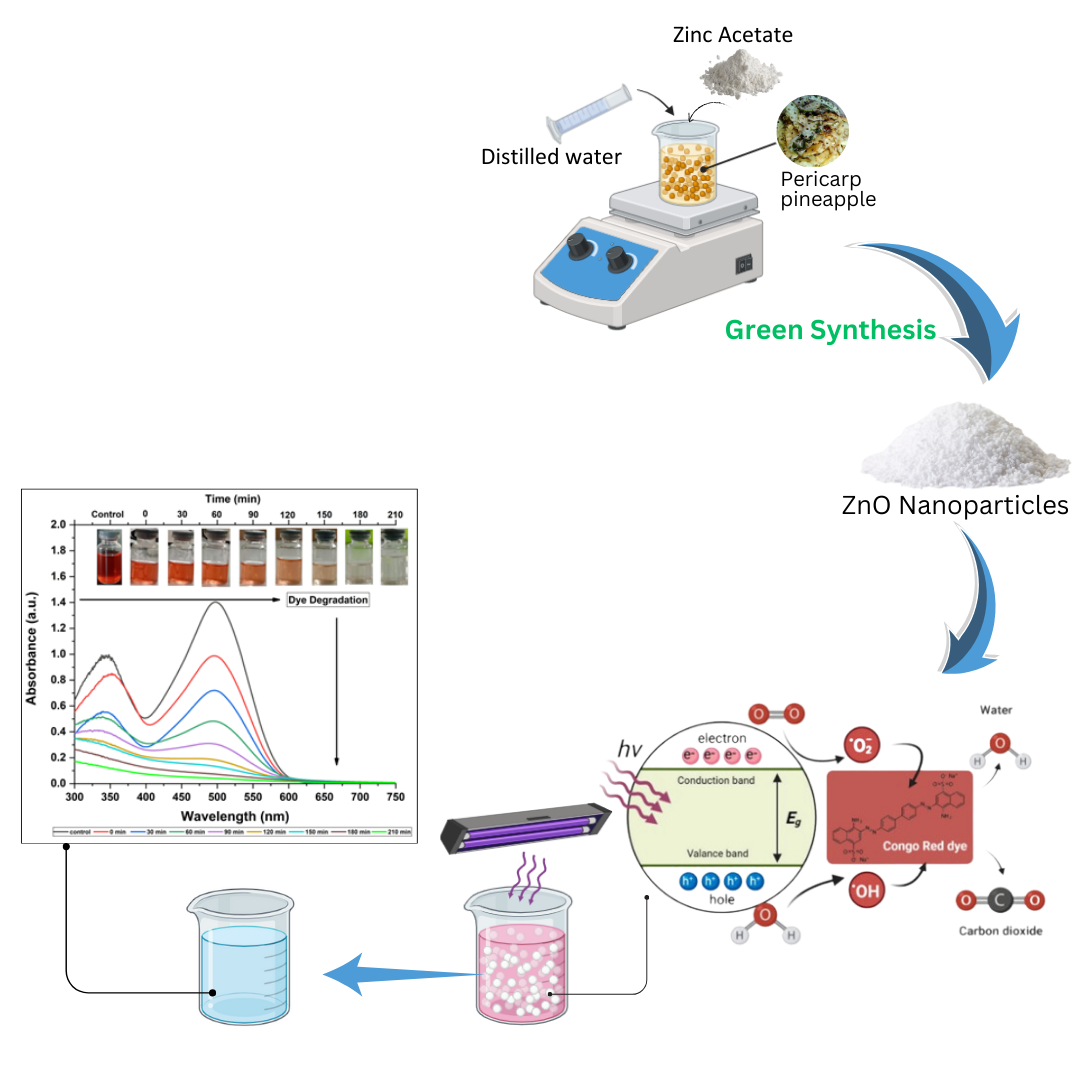
The development of the cloth industry can trigger a large amount of liquid waste to be produced, which, of course, can pollute the environment without proper and effective processing. This fluid waste comes from the dyeing process and usually uses dyes made from azo compounds such as Congo Red (CR), where these compounds cannot be degraded naturally in the environment. For this reason, appropriate waste processing methods are needed that are capable of degrading dye waste produced by the industry, namely with photocatalysis. ZnO nanoparticles are semiconductor materials with the potential to be catalysts because of their high electron mobility, cheapness, and non-toxicity. These nanoparticles can be extracted using the green synthesis method with pineapple peel extract as a bio-reduction. The effectiveness of the photodegradation of the synthesized ZnO nanoparticles is altered by the mass of the catalyst and the duration of UV light irradiation. Catalyst masses of 5, 8, 10, 12, 20, and 30 mg were able to degrade CR dye with a concentration of 30 ppm, respectively 93.51, 93.87, 95.15, 96.15, 97.72, and 97.08 % after irradiation for 210 min. With the large percentage of dye photodegradation, the ZnO nanoparticles resulting from the research showed good photocatalytic activity, which could later be used to process liquid waste from the textile industry.
HIGHLIGHTS
- The textile industry produces large amounts of liquid waste from the dyeing process, especially from azo compounds such as Congo Red (CR), which are difficult to degrade naturally in the environment.
- ZnO nanoparticles extracted using the green synthesis method with pineapple peel extract as a bio-reduction offer an environmentally friendly solution for processing liquid waste in the textile industry with a photocatalyst system.
- ZnO nanoparticles have good photocatalytic activity, especially in degrading Congo Red dye up to 97.72 % at a concentration of 30 ppm after 210 minutes of irradiation, depending on the mass of the catalyst.
GRAPHICAL ABSTRACT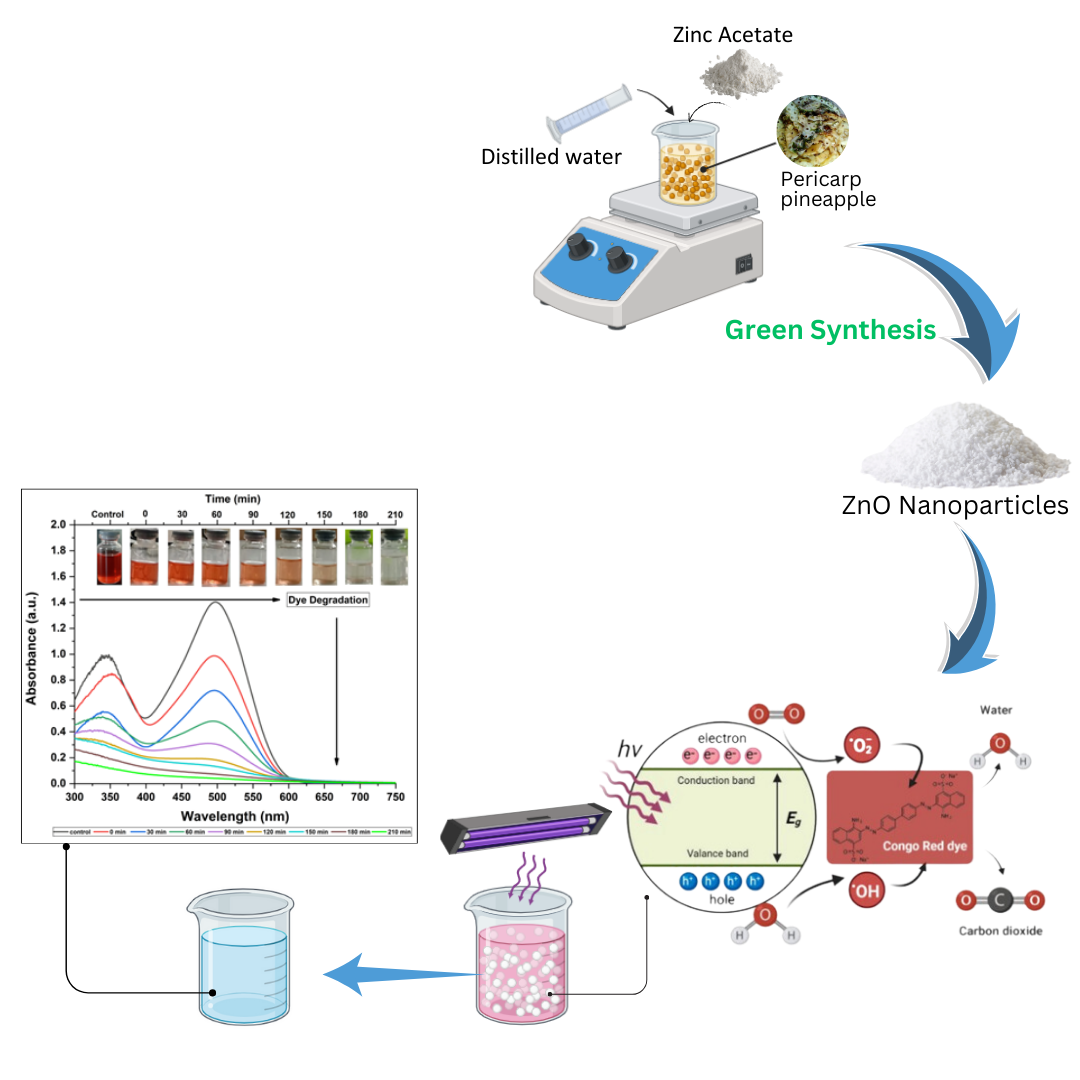
Downloads
References
RMA Putri, T Yuanita and M Roelianto. Antibacterial potency of pineapple peel extract (Ananas comosus) on Enterococcus faecalis growth. Conservative Dentistry Journal 2016; 6(2), 61-65.
NA Mirgane, VS Shivankar, SB Kotwal, GC Wadhawa and MC Sonawale. Waste pericarp of Ananas comosus in green synthesis zinc oxide nanoparticles and their application in waste water treatment. Materials Today: Proceedings 2021; 37(2), 886-889.
A Klinbumrung, T Thongtem, A Phuruangrat and S Thongtem. Optical and ammonia-sensing properties of SnO2 nanoparticles synthesized using a 900 W microwave. Japanese Journal of Applied Physics 2016; 55(8), 85001.
H Al-Hasani, J Al-Sabahi, B Al-Ghafri, R Al-Hajri and M Al-Abri. Effect of water quality in photocatalytic degradation of phenol using zinc oxide nanorods under visible light irradiation. Journal of Water Process Engineering 2022; 49, 103121.
TS Aldeen, HEA Mohamed and M Maaza. ZnO nanoparticles prepared via a green synthesis approach: Physical properties, photocatalytic and antibacterial activity. Journal of Physics and Chemistry of Solids 2022; 160, 110313.
L Li, X Guo, X Lu, J Ren and P La. Electronic and photocatalytic properties of ZnO/GaTe heterostructure from first principles calculations. Materials Science in Semiconductor Processing 2023; 154, 107189.
J Gaur, K Vikrant, KH Kim, S Kumar, M Pal, R Badru, S Masand and J Momoh. Photocatalytic degradation of Congo red dye using zinc oxide nanoparticles prepared using Carica papaya leaf extract. Materials Today Sustainability 2023; 22, 100339.
SMA Rao, S Kotteeswaran and AM Visagamani. Green synthesis of zinc oxide nanoparticles from camellia sinensis: Organic dye degradation and antibacterial activity. Inorganic Chemistry Communications 2021; 134, 108956.
S Benkhaya, S M’rabet and AE Harfi. Classifications, properties, recent synthesis and applications of azo dyes. Heliyon 2020; 6(1), e03271.
V Vignesh and G Shanmugam. Removal and recovery of hazardous Congo red from aqueous environment by selective natural amino acids in simple processes. Process Biochemistry 2023; 127, 99-111.
S Zafar, DA Bukhari and A Rehman. Azo dyes degradation by microorganisms - An efficient and sustainable approach. Saudi Journal of Biological Sciences 2022; 29(12), 103437.
FH Abdullah, NHHA Bakar and MA Bakar. Current advancements on the fabrication, modification, and industrial application of zinc oxide as photocatalyst in the removal of organic and inorganic contaminants in aquatic systems. Journal of Hazardous Materials 2022; 424, 127416.
T Chen, J Xie and P Gao. Ultraviolet photocatalytic degradation of perovskite solar cells: Progress, challenges, and strategies. Advanced Energy and Sustainability Research 2022; 3(6), 2100218.
L Sawunyama, O Oyewo, DC Onwudiwe and SS Makgato. Photocatalytic degradation of tetracycline using surface defective black TiO2-ZnO heterojunction photocatalyst under visible light. Heliyon 2023; 9(11), e21423.
BC Nwaiwu, EE Oguzie and CC Ejiogu. Photocatalytic degradation of Congo red using doped zinc oxide nanoparticles. EQA-International Journal of Environmental Quality 2024; 60, 18-26.
S Arul and T Senthilnathan. Photodegradation of congored dye using heterogeneous photocatalysis under ultraviolet irradiation. RASAYAN Journal of Chemistry 2019; 12(2), 891-897.
L Rohmawati, LR Lailia, NP Putri, M Nasir and D Darminto. Characterization of ZnO nanoparticles pineapple skin extract (Ananas comosus L.) as photocatalytic activity. Journal Water Environmental Nanotechnology 2024; 9(1), 112-123.
RSP Dewi and L Rohmawati. Analysis of crystalline phase and functional groups of ZnO from pineapple peel extract. Indonesian Physics Review 2022; 5, 148-156.
H Hameed, A Waheed, MS Sharif, M Saleem, A Afreen, M Tariq, A Kamal, WA Al-Onazi, DA Al Farraj, S Ahmad and RM Mahmoud. Green synthesis of zinc oxide (ZnO) nanoparticles from green algae and their assessment in various biological applications. Micromachines 2023; 14(5), 928.
A Bagabas, A Alshammari, MF Aboud and H Kosslick. Room-temperature synthesis of zinc oxide nanoparticles in different media and their application in cyanide photodegradation. Nanoscale Research Letters 2013; 8(1), 516.
MA Al-Ghouti and DA Da’ana. Guidelines for the use and interpretation of adsorption isotherm models: A review. Journal of Hazardous Materials 2020; 393, 122383.
Z Shaghaghi, S Mollaei, AR Amani-Ghadim and Z Abedini. Green synthesis of ZnO Nanoparticles using the aqueous extract of Platanus orientalis: Structural characterization and photocatalytic activity. Materials Chemistry and Physics 2023; 305, 127900.
SM Abegunde, EF Olasehinde and MA Adebayo. Green synthesis of ZnO nanoparticles using Nauclea latifolia fruit extract for adsorption of Congo red. Hybrid Advances 2024; 5, 100164.
X Wang, J Hou, L Dou, S Song, Q Kang and D Wang. Insight into the nanoscale pore structure of organic-rich shales in the Bakken Formation, USA. Journal of Petroleum Science and Engineering 2020; 191, 107182.
L Xu, J Zhang, J Ding, T Liu, G Shi, X Li, W Dang, Y Cheng and R Guo. Pore structure and fractal characteristics of different shale lithofacies in the Dalong Formation in the western area of the Lower Yangtze platform. Minerals 2020; 10(1), 72.
M Thommes, K Kaneko, AV Neimark, JP Olivier, F Rodriguez-Reinoso, J Rouquerol and KSW Sing. Physisorption of gases, with special reference to the evaluation of surface area and pore size distribution (IUPAC Technical Report). Pure and Applied Chemistry 2015; 87(9-10), 1051-1069.
S Pai, H Sridevi, T Varadavenkatesan, R Vinayagam and R Selvaraj. Photocatalytic zinc oxide nanoparticles synthesis using Peltophorum pterocarpum leaf extract and their characterization. Optik 2019; 185, 248-255.
FN Alharbi, ZM Abaker and SZA Makawi. Phytochemical substances - Mediated synthesis of zinc oxide nanoparticles (ZnO NPS). Inorganics 2023; 11(8), 328.
KK Supin, PMP Namboothiri and M Vasundhara. Enhanced photocatalytic activity in ZnO nanoparticles developed using novel Lepidagathis ananthapuramensis leaf extract. RSC Advances 2023; 13(3), 1497-1515.
V Manikandan, G Palanisamy, J Lee, MF Albeshr, AF Alrefaei, LA Pragasan, F Zhang and X Liu. Development of silver oxide-loaded reduced graphene oxide nanohybrids for enhanced photocatalytic activity under visible light in aqueous solutions. Chemosphere 2023; 336, 139227.
A Chitgar, SR Shabanian, G Dashtpeyma and M Nikzad. Optimizing photocatalytic oxidative desulfurization using novel BiOI/B4C heterojunction in the presence of air and visible-light irradiation through response surface methodology (RSM). Journal of Industrial and Engineering Chemistry 2024; 132, 182-200.
JM Gao, Z Li, S Ma, Y Zhang and F Cheng. Novel process for facile preparation of mesoporous silica-based materials with controllable pore structure from coal fly ash. Particuology 2024; 91, 128-137.
L Kong, A Rau, N Yang and K Lu. Flexible ZnO nanoparticle-poly(methyl methacrylate) hybrid films and their ultraviolet shielding behaviors. The Journal of the Minerals, Metals & Materials Society 2021; 73, 432-440.
T Das, X Rocquefelte and S Jobic. Ab initio positioning of the valence and conduction bands of bulk photocatalysts: Proposition of absolute reference energy. The Journal of Physical Chemistry 2020; 124(36), 19426-19434.
KA Sultana, MT Islam, JA Silva, RS Turley, JA Hernadez-Viezcas, JL Gardea-Torresdey and JC Noveron. Sustainable synthesis of zinc oxide nanoparticles for photocatalytic degradation of organic pollutant and generation of hydroxyl radical. Journal of Molecular Liquids 2020; 307, 112931.
G Rajesh, PS Kumar, S Akilandeswari, G Rangasamy, A Mandal, VU Shankar, M Ramya, K Nirmala and K Thirumalai. A synergistic consequence of catalyst dosage, pH solution and reactive species of Fe-doped CdAl2O4 nanoparticles on the degradation of toxic environmental pollutants. Chemosphere 2023; 318, 137919.
FA Aisien, NA Amenaghawon and EF Ekpenisi. Photocatalytic decolourisation of industrial wastewater from a soft drink company. Journal of Engineering and Applied Sciences 2013; 9, 11-16.
Elaziouti, N Laouedj and B Ahmed. ZnO-assisted photocatalytic degradation of Congo red and Benzopurpurine 4B in aqueous solution. Journal of Chemical Engineering & Process Technology 2011; 2(2), 1000106.
RS Brishti, MA Habib, MH Ara, KMR Karim, MK Islam, J Naime, MMH Rumon and MAR Khan. Green synthesis of ZnO NPs using aqueous extract of Epipremnum aureum leave: Photocatalytic degradation of Congo red. Result in Chemistry 2024; 7, 101441.
N Güy and M Özacar. The influence of noble metals on photocatalytic activity of ZnO for Congo red degradation. International Journal of Hydrogen Energy 2016; 41(44), 20100-20112.
Downloads
Published
How to Cite
Issue
Section
License
Copyright (c) 2024 Walailak University

This work is licensed under a Creative Commons Attribution-NonCommercial-NoDerivatives 4.0 International License.





