
The Role of Coconut Milk Ratio and Cooling-Reheating Cycle in Resistant Starch Type 5 of Buras as Indonesian Traditional Rice Cake
DOI:
https://doi.org/10.48048/tis.2025.9449Keywords:
Resistant starch, Coconut milk ratio, Cooling-reheating, Starch digestibility, BurasAbstract
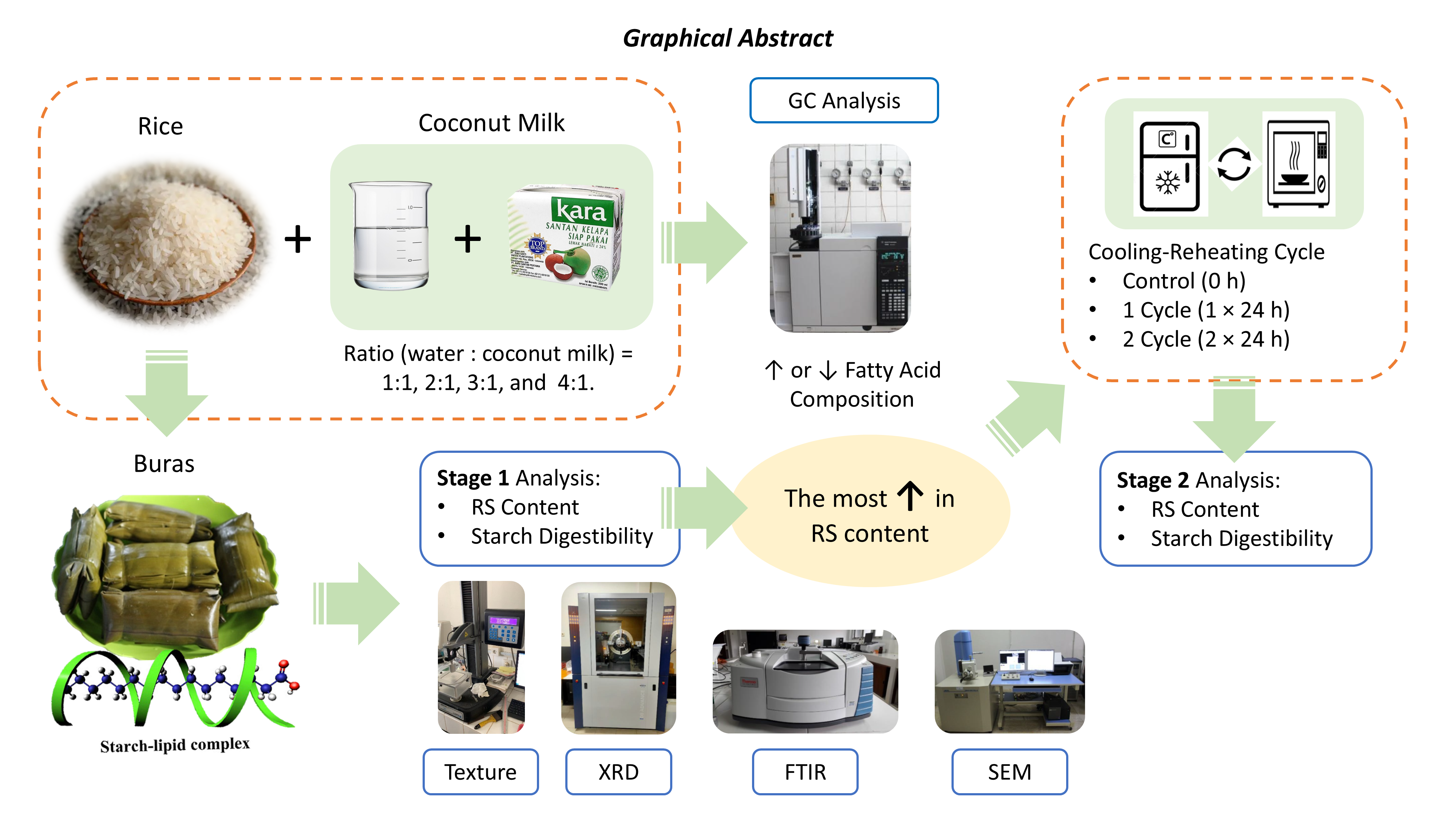
Some traditional carbohydrate-based foods in various Southeast Asian countries use coconut milk as one of their ingredients. One is a typical Indonesian rice cake called Buras. The presence of coconut milk can increase the resistant starch (RS) type 5 content in Buras because coconut milk contains fat. Another influential factor besides fat is cooling-reheating. This study aims to determine the effect of coconut milk ratio and cooling reheating on RS Buras. Four different ratios of coconut milk (Water: Coconut milk) were used for making Buras: 1:1, 2:1, 3:1 and 4:1. Increasing the ratio increased the RS content. The results showed that coconut milk ratio factors significantly increased the RS content (p<0.05). Buras R1 or Buras with a coconut milk ratio of 1:1 (100 mL water: 100 mL coconut milk) produced the highest RS content (30.55 %). Two cycles of cooling-reheating resulted in higher RS. Two cycles (S2) of cooling-reheating increased the RS content of the R1 Buras sample by 9.57 % and had the lowest digestibility at 180 min (18.94 %). The best-treated sample was R1 with two cooling-reheating cycles (R1S2). The coconut milk ratio also decreases starch digestibility. The best-treated sample was also R1S2 because it had the lowest digestibility. The low digestibility and high RS are due to the crystalline phase and the presence of an amylose-lipid complex, as shown by XRD and FTIR analysis. SEM analysis of the Buras with the best ratio (R1) showed a smooth, luminous granule surface surrounded by fat.
HIGHLIGHTS
- Amylose-lipid complex or RS5 is formed during rice-coconut milk gelatinization and retrogradation.
- One of the high-RS5 products can be found in Buras, a traditional food from Indonesia.
- Coconut milk ratio affects the increase of resistant starch content to 30.55 %.
- Two cycles of cooling-reheating increased the resistant starch content of the Buras without and with coconut milk addition by 11.44 and 9.57 %.
- Amylose-lipid complex presence confirmed by XRD with diffraction peaks of 17, 20 and 21 °, and FTIR analysis with absorption bands at 2,925 and 2,585 cm−1.
- The SEM analysis shows that the Buras granule surface tends to be altered due to gelatinization, and the presence of fat makes it smooth and shiny.
GRAPHICAL ABSTRACT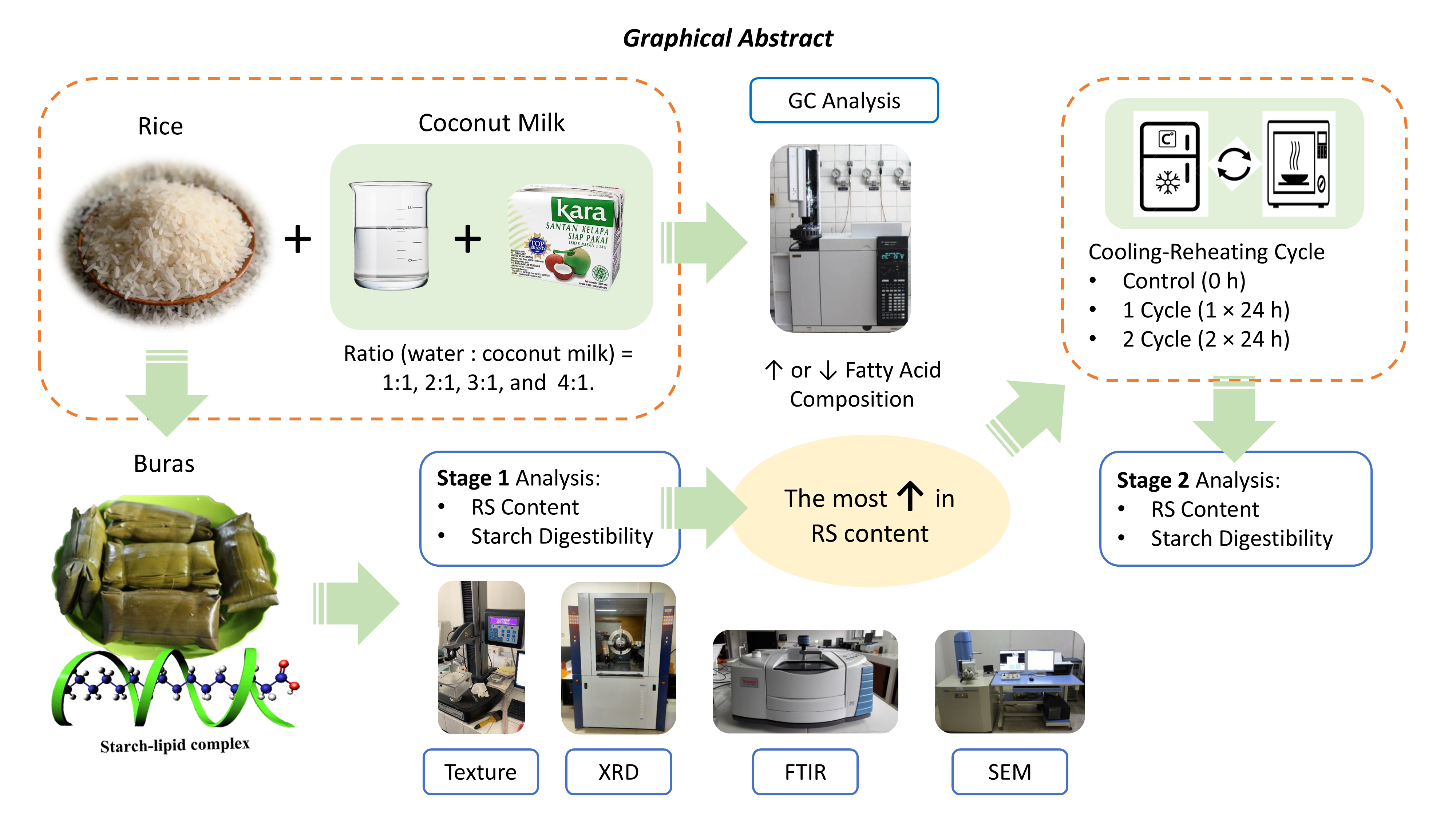
Downloads
References
J Park, SK Oh, HJ Chung and HJ Park. Structural and physicochemical properties of native starches and nondigestible starch residues from Korean rice cultivars with different amylose contents. Food Hydrocolloids 2020; 102, 105544.
N Aini, S Dewi, SN Asyifa and A Sofyan. Review the utilization of resistant starch in aking rice flour as anti-diabetic food ingredients. In: Proceedings of the International Summit on Science, Technology, and Humanity, Jakarta, Indonesia. 2020, p. 27-34.
CK Reddy, DJ Lee, ST Lim and EY Park. Enzymatic debranching of starches from different botanical sources for complex formation with stearic acid. Food Hydrocolloids 2019; 89, 856-863.
BN Okumus, Z Tacer-Caba, K Kahraman and D Nilufer-Erdil. Resistant starch type V formation in brown lentil (Lens culinaris Medikus) starch with different lipids/fatty acids. Food Chemistry 2018; 240, 550-558.
S Alyaqoubi, A Abdullah, M Samudi, N Abdullah, ZR Addai and KH Musa. Study of antioxidant activity and physicochemical properties of coconut milk (Pati santan) in Malaysia. Journal of Chemical and Pharmaceutical Research 2015; 7(4), 967-973.
NA Anugrahati, Y Pranoto, Y Marsono and DW Marseno. In vitro digestibility of Indonesian cooked rice treated with cooling- reheating process and coconut milk addition. International Research Journal of Biological Sciences 2015; 4(12), 34-39.
HA Pangastuti and L Permana. Pengukuran pati resisten tipe 5 secara in vitro pada nasi uduk (in Indonesian). Jurnal Pengolahan Pangan 2021; 6(2), 42-48.
I Goñi, L Garcia-Diz, E Mañas and F Saura-Calixto. Analysis of resistant starch: A method for foods and food products. Food Chemistry 1996; 56(4), 445-449.
DN Faridah, I Andriani, ZA Talitha and FS Budi. Physicochemical characterization of resistant starch type V (RS5) from manggu cassava starch (Manihot esculenta). Food Research 2021; 5(2), 228-234.
S Sonia, F Witjaksono and R Ridwan. Effect of cooling of cooked white rice on resistant starch content and glycemic response. Asia Pacific Journal of Clinical Nutrition 2015; 24(4), 620-625.
TK Kim, JH Lee, HI Yong, MC Kang, JY Cha, JY Chun and YS Choi. Effects of defatting methods on the physicochemical properties of proteins extracted from Hermetia illucens larvae. Foods 2022; 11(10), 1400.
I Goñi, A Garcia-Alonso and F Saura-Calixto. A starch hydrolysis procedure to estimate glycemic index. Nutrition Research 1997; 17(3), 427-437.
AOAC International. Official methods of analysis of AOAC International. AOAC International, Maryland, United States, 2012.
S Side, SE Putri and MI Musa. Analysis of the chemical content of virgin coconut oil (VCO) with raw material of coconut from Walennae Village, Sabbangparu District, Sengkang Regency. Indonesian Journal of Fundamental Sciences 2023; 9(1), 1-6.
AN Karunasiri, M Gunawardane, CM Senanayake, N Jayathilaka and KN Seneviratne. Antioxidant and nutritional properties of domestic and commercial coconut milk preparations. International Journal of Food Science 2020; 2020(1), 3489605.
Q Liu, H Guan, Y Guo, D Wang, Y Yang, H Ji, A Jiao and Z Jin. Structure and in vitro digestibility of amylose-lipid complexes formed by an extrusion-debranching-complexing strategy. Food Chemistry 2024; 437, 137950.
P Chumsri, W Panpipat, LZ Cheong and M Chaijan. Formation of intermediate amylose rice starch-lipid complex assisted by ultrasonication. Foods 2022; 11(16), 2430.
I Chakraborty, I Govindaraju, S Kunnel, V Managuli and N Mazumder. Effect of storage time and temperature on digestibility, thermal, and rheological properties of retrograded rice. Gels 2023; 9(2), 142.
MR Toutounji, VM Butardo Jr, W Zou, A Farahnaky, L Pallas, P Oli and CL Blanchard. A high-throughput in vitro assay for screening rice starch digestibility. Foods 2019; 8(12), 601.
M Tamura, K Hoshi, T Saito and Y Sasahara. In vitro starch digestion of cooked rice grain following the addition of various vegetable oils. Japan Agricultural Research Quarterly 2022; 56(3), 261-267.
R Vaitkeviciene, J Bendoraitiene, R Degutyte, M Svazas and D Zadeike. Optimization of the sustainable production of resistant starch in rice bran and evaluation of its physicochemical and technological properties. Polymers 2022; 14(17), 3662.
W Xia, Y Lin, F Wang, Y Liu and RH Liu. Preparation and physicochemical properties: A new extruded rice using cassava starch and broken rice flour. Frontiers in Sustainable Food Systems 2024; 8, 1383012.
M Kaláb. A bowl of rice and SEM. Infocus 2018; 5, 12-37.
M Thakur, AK Rai and SP Singh. Structural characteristics, physicochemical properties, and digestibility analysis of resistant starch type-V prepared from debranched corn starch and fatty acid complexation. ACS Omega 2023; 8(29), 25799-25807.
Ijaz, M Uddin, NM Khan, F Ali, ZU Khan, N Muhammad, J Iqbal, N Rehman, AK Jan and S Ahmad. Green production and structural evaluation of maize starch-fatty acid complexes through high speed homogenization. Journal of Polymers and the Environment 2020; 28, 3110-3115.
XD Shi, JY Yin, SW Cui, Q Wang, SY Wang and SP Nie. Plant-derived glucomannans: Sources, preparation methods, structural features, and biological properties. Trends in Food Science & Technology 2020; 99, 101-116.
GF Tansman, PS Kindstedt and JM Hughes. Powder X-ray diffraction can differentiate between enantiomeric variants of calcium lactate pentahydrate crystal in cheese. Journal of Dairy Science 2014; 97(12), 7354-7362.
S Luo, Z Zeng, Y Mei, K Huang, J Wu, C Liu and X Hu. Improving ordered arrangement of the short-chain amylose-lipid complex by narrowing molecular weight distribution of short-chain amylose. Carbohydrate Polymers 2020; 240, 116359.
S Shi, Y Dong, Q Li, T Liu and X Yu. Morphology, structural, thermal and rheological properties of wheat starch-palmitic acid complexes prepared during steam cooking. RSC Advances 2020; 10(50), 30087-30093.
A Shah, FA Masoodi, A Gani and BA Ashwar. In-vitro digestibility, rheology, structure, and functionality of RS3 from oat starch. Food Chemistry 2016; 212, 749-758.
A Khatun, DLE Waters and L Liu. The impact of rice lipid on in vitro rice starch digestibility. Foods 2022; 11(10), 1528.
X Lian, K Cheng, D Wang, W Zhu and X Wang. Analysis of crystals of retrograded starch with sharp X-ray diffraction peaks made by recrystallization of amylose and amylopectin. International Journal of Food Properties 2017; 20(S3), S3224-S3236.
H Wang, Y Wu, N Wang, L Yang and Y Zhou. Effect of water content of high-amylose corn starch and glutinous rice starch combined with lipids on formation of starch-lipid complexes during deep-fat frying. Food Chemistry 2019; 278, 515-522.
R Photinam, A Moongngarm, P Detchewa and YJ Wang. Improvement of amylose-lipid complex and starch digestibility profiles of corn starch added with rice bran oil or linoleic acid using ultrasonic and microwave treatment. Journal of Food Science and Technology 2024; 61, 2287-2298.
A Pourfarzad, MB Habibi Najafi, MH Haddad Khodaparast and MH Khayyat. Serish inulin and wheat biopolymers interactions in model systems as a basis for understanding the impact of inulin on bread properties: A FTIR investigation. Journal of Food Science and Technology 2015; 52, 7964-7973.
P Wiruch, S Naruenartwongsakul and Y Chalermchart. Textural properties, resistant starch, and in vitro starch digestibility as affected by parboiling of brown glutinous rice in a retort pouch. Current Research in Nutrition and Food Science Journal 2019; 7(2), 555-567.
N Ratnaningsih, E Harmayani and Y Marsono. Physicochemical properties, in vitro starch digestibility, and estimated glycemic index of resistant starch from cowpea (Vigna unguiculata) starch by autoclaving-cooling cycles. International Journal of Biological Macromolecules 2020; 142, 191-200.
Published
How to Cite
Issue
Section
License
Copyright (c) 2025 Walailak University

This work is licensed under a Creative Commons Attribution-NonCommercial-NoDerivatives 4.0 International License.





