
Physicochemical and Structural Properties of Resistant Starch Prepared from Tacca Tuber Starch using Autoclaving-Cooling and Acid Hydrolysis Treatments
DOI:
https://doi.org/10.48048/tis.2025.8822Keywords:
Tacca tuber starch, Resistant starch, Autoclaving-cooling, Acid hydrolysis, Citric acid, Physicochemical properties, Structural propertiesAbstract
Tacca tuber (Tacca leontopetaloides) is a neglected and underutilized plant species. Recently, tacca tuber has been studied as a food plant source of high-amylose starch, so it has the potential to be developed into resistant starch (RS), especially type-3 RS (RS3). RS3 can be prepared through the autoclave-cooling (AC) process, but the RS produced is not optimal. Further increase in RS can be obtained through hydrolysis of citric acid (AH). Until now, systematic knowledge about the preparation method and characterization of RS3 produced from tacca tuber starch through the AC-AH process remains unavailable. This study aims to determine the physicochemical properties and structure of RS3 from tacca tuber starch made through the AC-AH process. Tacca tubers were obtained from the Garut coast, Indonesia. They were first extracted to obtain starch and then processed using the AC process to make RS3. The acquired RS3 was hydrolyzed using AH at various concentrations and hydrolysis times. The results showed that all treatments did not affect the proximate composition, except for water content. Significant effects were observed on amylose and RS levels. The swelling power, solubility, water holding capacity, oil holding capacity and color profile of RS3 also significantly changed. The morphology of RS3 was deformed, accompanied by a change in its crystal structure to a combination of B and V types. This alteration was followed by an increase in the relative crystallinity and thermal profile, while the paste profile decreased significantly. In conclusion, all preparation methods affected the physicochemical properties and structure of RS3 from yam starch, except for the proximate composition. AC-AH treatment with 0.3 M citric acid for 4 h is recommended for preparing RS3 because it produces the highest RS content. The acquired RS3 has the potential to be applied in products that require good paste stability, and have health benefits.
HIGHLIGHTS
- Tacca tuber is a neglected and underutilized plant species, a potential source of high amylose starch to be developed into resistant starch type-3 (RS3).
- Autoclaving-cooling (AC) and citric acid hydrolysis (AH) treatments produced 32.40 % RS3.
- RS3 has an irregular, rough and agglomerate morphological structure.
- The crystal structure of RS3 is a combination of types B and V, with a relative crystallinity of 24.38 - 45.94 %.
- AC-AH treatment with 0.3 M citric acid for 4 h is recommended in preparing RS3 because it results in the highest RS content.
GRAPHICAL ABSTRACT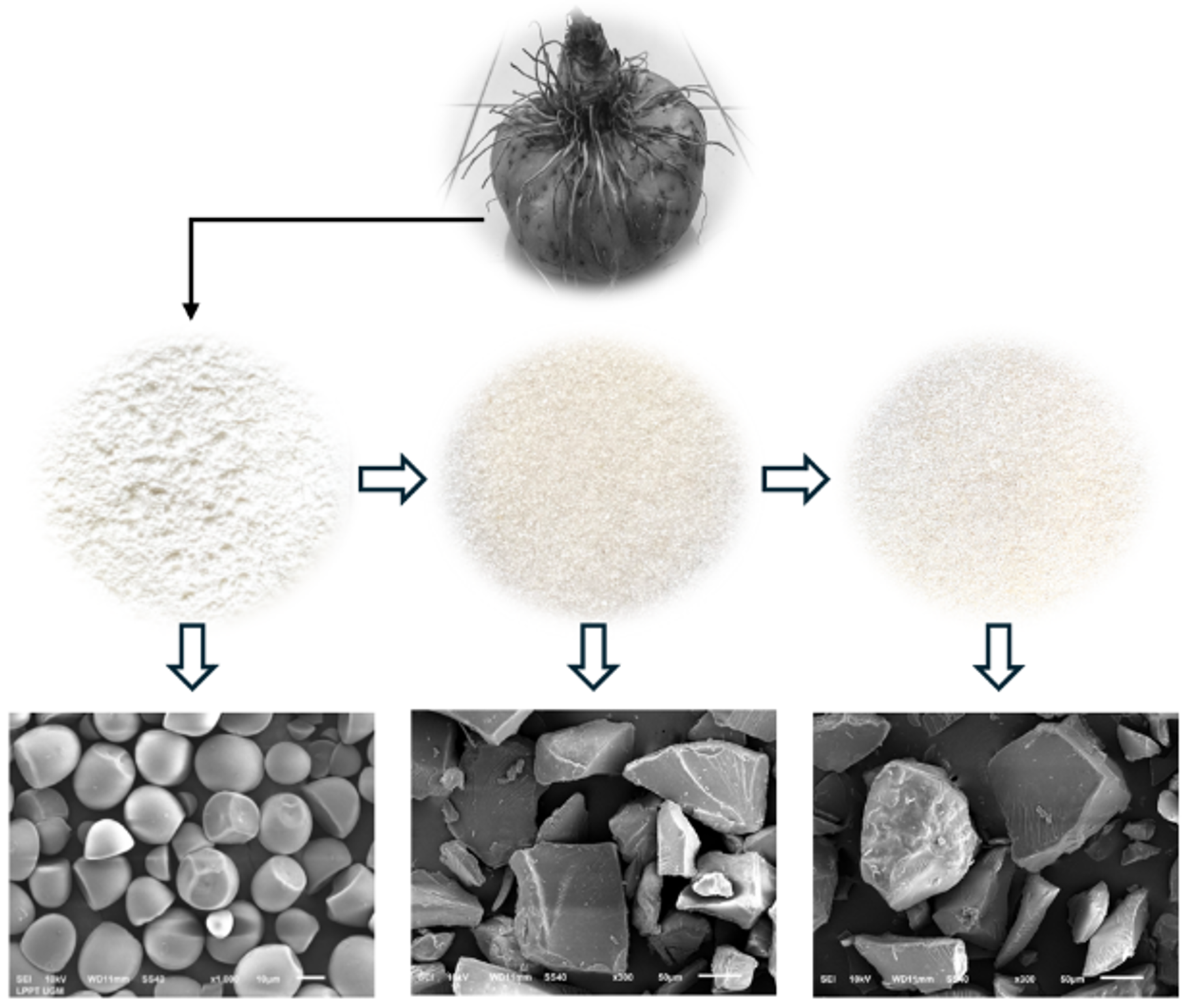
Downloads
References
TK Lim. Tacca leontopetaloides. In: TK Lim (Ed.). Edible medicinal and non-medicinal plants. Springer, Netherlands, 2016, p. 301-307.
D Yonata, B Pranata and Nurhidajah. Potential of neglected and underutilized tacca tuber (Tacca leontopetaloides) for sustainable food system in Indonesia. Journal of Global Innovations in Agricultural Sciences 2024; 12(3), 770-778.
D Yonata, P Triwitono, LA Lestari and Y Pranoto. Physicochemical, structure and functional characteristics of Tacca leontopetaloides starches grown in Indonesia. Biodiversitas Journal of Biological Diversity 2023; 24(11), 6396-6406.
L Zhang, L Zhao, X Bian, K Guo, L Zhou and C Wei. Characterization and comparative study of starches from seven purple sweet potatoes. Food Hydrocolloids 2018; 80, 168-176.
Q Chang, B Zheng, Y Zhang and H Zeng. A comprehensive review of the factors influencing the formation of retrograded starch. International Journal of Biological Macromolecules 2021; 186, 163-173.
Q Liu, J Shi, Z Jin and A Jiao. Development and characterization of resistant starch produced by an extrusion - debranching strategy with a high starch concentration. Food Hydrocolloids 2023; 136, 108276.
M Meenu and B Xu. A critical review on anti-diabetic and anti-obesity effects of dietary resistant starch. Critical Reviews in Food Science and Nutrition 2019; 59(18), 3019-3031.
Y Pranoto. Starch and its derivatives as potential source of prebiotics. In: PS Panesar and AK Anal (Eds.). Probiotics, prebiotics and synbiotics: Technological advancements toward safety and industrial applications. Wiley, England, 2022. p. 378-406.
Z Ma, X Hu and JI Boye. Research advances on the formation mechanism of resistant starch type III: A review. Critical Reviews in Food Science and Nutrition 2020; 60(2), 276-297.
Y Zhang, W Liu, C Liu, S Luo, T Li, Y Liu, D Wu and Y Zuo. Retrogradation behaviour of high-amylose rice starch prepared by improved extrusion cooking technology. Food Chemistry 2014; 158, 255-261.
VF Abioye, IA Adeyemi, BA Akinwande, P Kulakow and B Maziya-Dixon. Effect of autoclaving on the formation of resistant starch from two Nigeria Cassava (Manihot esculenta) varieties. Food Research 2018; 2(5), 468-473.
G Giuberti, A Marti, A Gallo, S Grassi and G Spigno. Resistant starch from isolated white sorghum starch: Functional and physicochemical properties and resistant starch retention after cooking. A comparative study. Starch 2019; 71(7-8), 1800194.
F Zheng, Q Xu, S Zeng, Z Zhao, Y Xing, J Chen and P Zhang. Multi-scale structural characteristics of black Tartary buckwheat resistant starch by autoclaving combined with debranching modification. International Journal of Biological Macromolecules 2023; 249, 126102.
ERN Herawati, D Ariani, R Nurhayati, M Miftakhussolikhah, H Na’imah and Y Marsono. Effect of autoclaving-cooling treatments on chemical characteristic and structure of Tacca (Tacca leontopetaloides) starch. In: Proceedings of the 5th International Conference on Food, Agriculture and Natural Resources, Paris, France. 2020, p. 169-172.
S Ozturk, H Koksel and PKW Ng. Production of resistant starch from acid-modified amylotype starches with enhanced functional properties. Journal of Food Engineering 2011; 103(2), 156-164.
RM Astuti, Widaningrum, N Asiah, A Setyowati and R Fitriawati. Effect of physical modification on granule morphology, pasting behavior, and functional properties of arrowroot (Marantha arundinacea L) starch. Food Hydrocolloids 2018; 81, 23-30.
TAA Nasrin and AK Anal. Resistant starch III from culled banana and its functional properties in fish oil emulsion. Food Hydrocolloids 2014; 35, 403-409.
S Raungrusmee and AK Anal. Effects of lintnerization, autoclaving, and freeze-thaw treatments on resistant starch formation and functional properties of Pathumthani 80 rice starch. Foods 2019; 8(11), 558.
S Raungrusmee, S Koirala and AK Anal. Effect of physicochemical modification on granule morphology, pasting behavior, and functional properties of Riceberry rice (Oryza Sativa L.) starch. Food Chemistry Advances 2022; 1, 100116.
P Triwitono, Y Marsono, A Murdiati and DW Marseno. The effect of two cycles autoclaving and citric acid hydrolysis combination to chemical and physical characteristics of mung beans (Vigna radiata L.) starch RS-3. Agritech 2018; 37(3), 312-318.
F Fan, X Huxi, L Qinlu, Z Qian, W Suyan, L Feijun and Y Ya. Ultrasound-damp heat method combined with acid hydrolysis in preparation of rice resistant starch and its physico-chemical properties. Journal of the Chinese Cereals and Oils Association 2018; 33(7), 43-50.
XH Zhao and Y Lin. Resistant starch prepared from high-amylose maize starch with citric acid hydrolysis and its simulated fermentation in vitro. European Food Research and Technology 2009; 228(6), 1015-1021.
XH Zhao and Y Lin. The impact of coupled acid or pullulanase debranching on the formation of resistant starch from maize starch with autoclaving-cooling cycles. European Food Research and Technology 2009; 230, 179-184.
WSW Pratiwi, AK Anal and SR Putra. Production by lintnerization-autoclaving and physicochemical characterization of resistant starch III from sago palm (Metroxylon sagu rottb). Indonesian Journal of Chemistry 2015; 15(3), 295-304.
Q Yang, L Liu, X Li, J Li, W Zhang, M Shi and B Feng. Physicochemical characteristics of resistant starch prepared from Job’s tears starch using autoclaving-cooling treatment. CyTA - Journal of Food 2021; 19(1), 316-325.
R Nurhayati, AN Suryadi, D Ariani, ERN Herawati, Miftakhussolikhah and Y Marsono. Resistant starch in native Tacca (Tacca leontopetaloides) starch and its various modified starches. International Food Research Journal 2022; 29(3), 667-675.
AOAC International. Official methods of analysis. AOAC International, Washington DC, 1995.
MA Zailani, H Kamilah, A Husaini, AZRA Seruji and SR Sarbini. Functional and digestibility properties of sago (Metroxylon sagu) starch modified by microwave heat treatment. Food Hydrocolloids 2022; 122, 107042.
Y Zhou, S Meng, D Chen, X Zhu and H Yuan. Structure characterization and hypoglycemic effects of dual modified resistant starch from indica rice starch. Carbohydrate Polymers 2014; 103, 81-86.
M Wang, G Liu, J Li, W Wang, A Hu and J Zheng. Structural and physicochemical properties of resistant starch under combined treatments of ultrasound, microwave, and enzyme. International Journal of Biological Macromolecules 2023; 232, 123331.
YC Koh and HJ Liao. Preparation and physicochemical characterization of debranched rice starch nanoparticles from mono- and dual-modification by hydrothermal treatments. Food Bioscience 2023; 55, 103004.
JB Hutchings. Food colour and appearance. Springer, Boston, 1999.
K Zhu, PJ Kanu, IP Claver, K Zhu, H Qian and H Zhou. A method for evaluating Hunter whiteness of mixed powders. Advanced Powder Technology 2009; 20(2), 123-126.
WS Mokrzycki and M Tatol. Color difference delta E - A survey. Machine Graphics and Vision 2011; 20(4), 383-411.
H Marta, Y Cahyana, S Bintang, GP Soeherman and M Djali. Physicochemical and pasting properties of corn starch as affected by hydrothermal modification by various methods. International Journal of Food Properties 2022; 25(1), 792-812.
I Isah, AA Oshodi and VN Atasie. Physicochemical properties of cross linked acha (Digitaria exilis) starch with citric acid. Chemistry International 2017; 3(2), 150-157.
MA Zailani, H Kamilah, A Husaini and SR Sarbini. Physicochemical properties of microwave heated sago (Metroxylon sagu) starch. CyTA - Journal of Food 2021; 19(1), 596-605.
W Sangwongchai, N Sa-ingthong, S Phothiset, C Saenubon and M Thitisaksakul. Resistant starch formation and changes in physicochemical properties of waxy and non-waxy rice starches by autoclaving-cooling treatment. International Journal of Food Properties 2024; 27(1), 532-548.
N Ratnaningsih, Suparmo, E Harmayani and Y Marsono. Physicochemical properties, in vitro starch digestibility, and estimated glycemic index of resistant starch from cowpea (Vigna unguiculata) starch by autoclaving-cooling cycles. International Journal of Biological Macromolecules 2020; 142, 191-200.
RSA Rashid, AMD Mohamed, SN Achudan and P Mittis. Physicochemical properties of resistant starch type III from sago starch at different palm stages. Materials Today: Proceedings 2020; 31, 150-154.
AS Babu, R Parimalavalli, K Jagannadham and JS Rao. Chemical and structural properties of sweet potato starch treated with organic and inorganic acid. Journal of Food Science and Technology 2015; 52(9), 5745-5753.
AS Babu, R Parimalavalli and SG Rudra. Effect of citric acid concentration and hydrolysis time on physicochemical properties of sweet potato starches. International Journal of Biological Macromolecules 2015; 80, 557-565.
NH Kim, JH Kim, S Lee, H Lee, JW Yoon, R Wang and SH Yoo. Combined effect of autoclaving‐cooling and cross‐linking treatments of normal corn starch on the resistant starch formation and physicochemical properties. Starch 2010; 62(7), 358-363.
AN Dundar and D Gocmen. Effects of autoclaving temperature and storing time on resistant starch formation and its functional and physicochemical properties. Carbohydrate Polymers 2013; 97(2), 764-771.
BA Ashwar, A Gani, IA Wani, A Shah, FA Masoodi and DC Saxena. Production of resistant starch from rice by dual autoclaving-retrogradation treatment: In vitro digestibility, thermal and structural characterization. Food Hydrocolloids 2016; 56, 108-117.
H Li, Y Gui, J Li, Y Zhu, B Cui and L Guo. Modification of rice starch using a combination of autoclaving and triple enzyme treatment: Structural, physicochemical and digestibility properties. International Journal of Biological Macromolecules 2020; 144, 500-508.
Q Xu, F Zheng, P Yang, P Tu, Y Xing, P Zhang, H Liu, X Liu and X Bi. Effect of autoclave–cooling cycles combined pullulanase on the physicochemical and structural properties of resistant starch from black Tartary buckwheat. Journal of Food Science 2023; 88(1), 315-327.
H Kim, KH Lee, JY Kim, WJ Lim and ST Lim. Characterization of nanoparticles prepared by acid hydrolysis of various starches. Starch 2012; 64(5), 367-373.
Y Pranoto, Rahmayuni, Haryadi and SK Rakshit. Physicochemical properties of heat moisture treated sweet potato starches of selected Indonesian varieties. International Food Research Journal 2014; 21(5), 2031-2038.
X Li, X Zhang, W Yang, L Guo, L Huang, X Li and W Gao. Preparation and characterization of native and autoclaving-cooling treated Pinellia ternate starch and its impact on gut microbiota. International Journal of Biological Macromolecules 2021; 182, 1351-1361.
BA Alimi and TS Workneh. Structural and physicochemical properties of heat moisture treated and citric acid modified acha and iburu starches. Food Hydrocolloids 2018; 81, 449-455.
H Gu, H Yao and F Wang. Structural and physicochemical properties of resistant starch from Chinese chestnut (Castanea mollissima) prepared by autoclaving treatment and pullulanase hydrolysis. Journal of Food Processing and Preservation 2018; 42(1), e13364.
H Li, R Wang, J Liu, Q Zhang, G Li, Y Shan and S Ding. Effects of heat-moisture and acid treatments on the structural, physicochemical, and in vitro digestibility properties of lily starch. International Journal of Biological Macromolecules 2020; 148, 956-968.
SI Rafiq, S Singh and DC Saxena. Effect of heat-moisture and acid treatment on physicochemical, pasting, thermal and morphological properties of horse chestnut (Aesculus indica) starch. Food Hydrocolloids 2016; 57, 103-113.
RHB Setiarto, HD Kusumaningrum, BSL Jenie, T Khusniati, N Widhyastuti and I Ramadhani. Microstructure and physicochemical characteristics of modified taro starch after annealing, autoclaving-cooling and heat moisture treatment. Food Research 2020; 4(4), 1226-1233.
C Zhang, M Qiu, T Wang, L Luo, W Xu, J Wu, F Zhao, K Liu, Y Zhang and X Wang. Preparation, structure characterization, and specific gut microbiota properties related to anti-hyperlipidemic action of type 3 resistant starch from Canna edulis. Food Chemistry 2021; 351, 129340.
A Chakravarty, M Tandon, S Attri, D Sharma, P Raigond and G Goel. Structural characteristics and prebiotic activities of resistant starch from Solanum tuberosum: Kufri Bahar, a popular Indian tuber variety. LWT 2021; 145, 111445.
KO Falade and OE Ayetigbo. Effects of annealing, acid hydrolysis and citric acid modifications on physical and functional properties of starches from four yam (Dioscorea spp.) cultivars. Food Hydrocolloids 2015; 43, 529-539.
PC Martins, LC Gutkoski and VG Martins. Impact of acid hydrolysis and esterification process in rice and potato starch properties. International Journal of Biological Macromolecules 2018; 120, 959-965.
D Qiao, L Yu, H Liu, W Zou, F Xie, G Simon, E Petinakis, Z Shen and L Chen. Insights into the hierarchical structure and digestion rate of alkali-modulated starches with different amylose contents. Carbohydrate Polymers 2016; 144, 271-281.
X Wang, CK Reddy and B Xu. A systematic comparative study on morphological, crystallinity, pasting, thermal and functional characteristics of starches resources utilized in China. Food Chemistry 2018; 259, 81-88.
D Zhou, Z Ma, J Xu, X Li and X Hu. Resistant starch isolated from enzymatic, physical, and acid treated pea starch: Preparation, structural characteristics, and in vitro bile acid capacity. LWT 2019; 116, 108541.
Y Ding, J Huang, N Zhang, SK Rasmussen, D Wu and X Shu. Physiochemical properties of rice with contrasting resistant starch content. Journal of Cereal Science 2019; 89, 102815.
SY Lee, KY Lee and HG Lee. Effect of different pH conditions on the in vitro digestibility and physicochemical properties of citric acid-treated potato starch. International Journal of Biological Macromolecules 2018; 107, 1235-1241.
Z Ma, X Yin, X Hu, X Li, L Liu and JI Boye. Structural characterization of resistant starch isolated from Laird lentils (Lens culinaris) seeds subjected to different processing treatments. Food Chemistry 2018; 263, 163-170.
W Gao, P Liu, J Zhu, H Hou, X Li and B Cui. Physicochemical properties of corn starch affected by the separation of granule shells. International Journal of Biological Macromolecules 2020; 164, 242-252.
Z Ma, X Yin, D Chang, X Hu and JI Boye. Long- and short-range structural characteristics of pea starch modified by autoclaving, α-amylolysis, and pullulanase debranching. International Journal of Biological Macromolecules 2018; 120, 650-656.
CK Reddy, S Haripriya, AN Mohamed and M Suriya. Preparation and characterization of resistant starch III from elephant foot yam (Amorphophallus paeonifolius) starch. Food Chemistry 2014; 155, 38-44.
BA Acevedo, M Villanueva, MG Chaves, MV Avanza and F Ronda. Starch enzymatic hydrolysis, structural, thermal and rheological properties of pigeon pea (Cajanus cajan) and dolichos bean (Dolichos lab‐lab) legume starches. International Journal of Food Science & Technology 2020; 55(2), 712-719.
Y Huo, B Zhang, M Niu, C Jia, S Zhao, Q Huang and H Du. An insight into the multi-scale structures and pasting behaviors of starch following citric acid treatment. International Journal of Biological Macromolecules 2018; 116, 793-800.
C Wu, R Sun, Q Zhang and G Zhong. Synthesis and characterization of citric acid esterified canna starch (RS4) by semi-dry method using vacuum-microwave-infrared assistance. Carbohydrate Polymers 2020; 250, 116985.
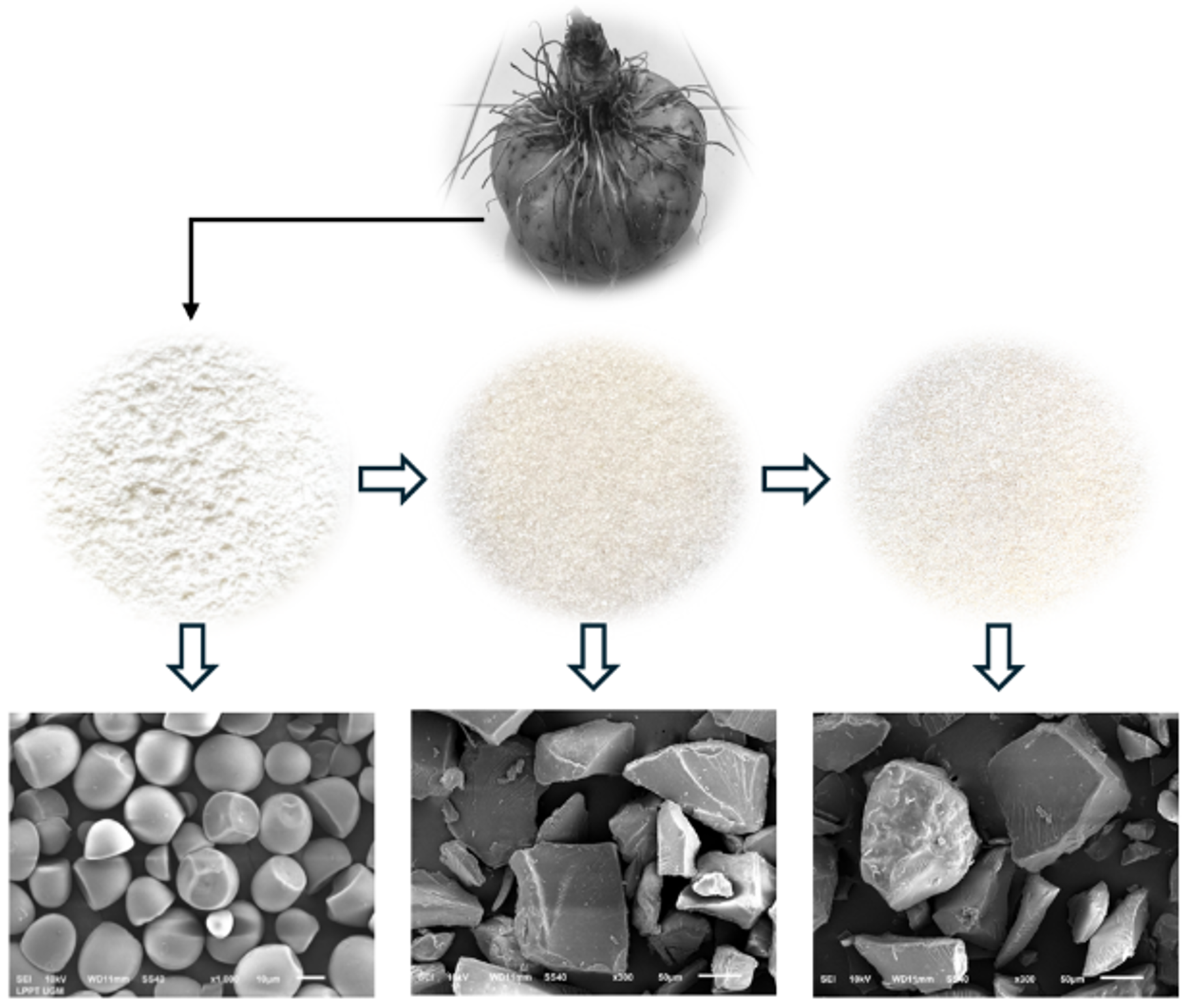
Downloads
Published
How to Cite
Issue
Section
License
Copyright (c) 2024 Walailak University

This work is licensed under a Creative Commons Attribution-NonCommercial-NoDerivatives 4.0 International License.





