
Synergistic Antibacterial Effect of Quercetin and Cefotaxime on Extended-Spectrum β-Lactamase-Producing Acinetobacter baumannii
DOI:
https://doi.org/10.48048/tis.2026.14206Keywords:
Acinetobacter baumannii, β-lactam-resistant, Biofilm inhibition, Cefotaxime, Multidrug resistance, Quercetin, Synergistic activityAbstract
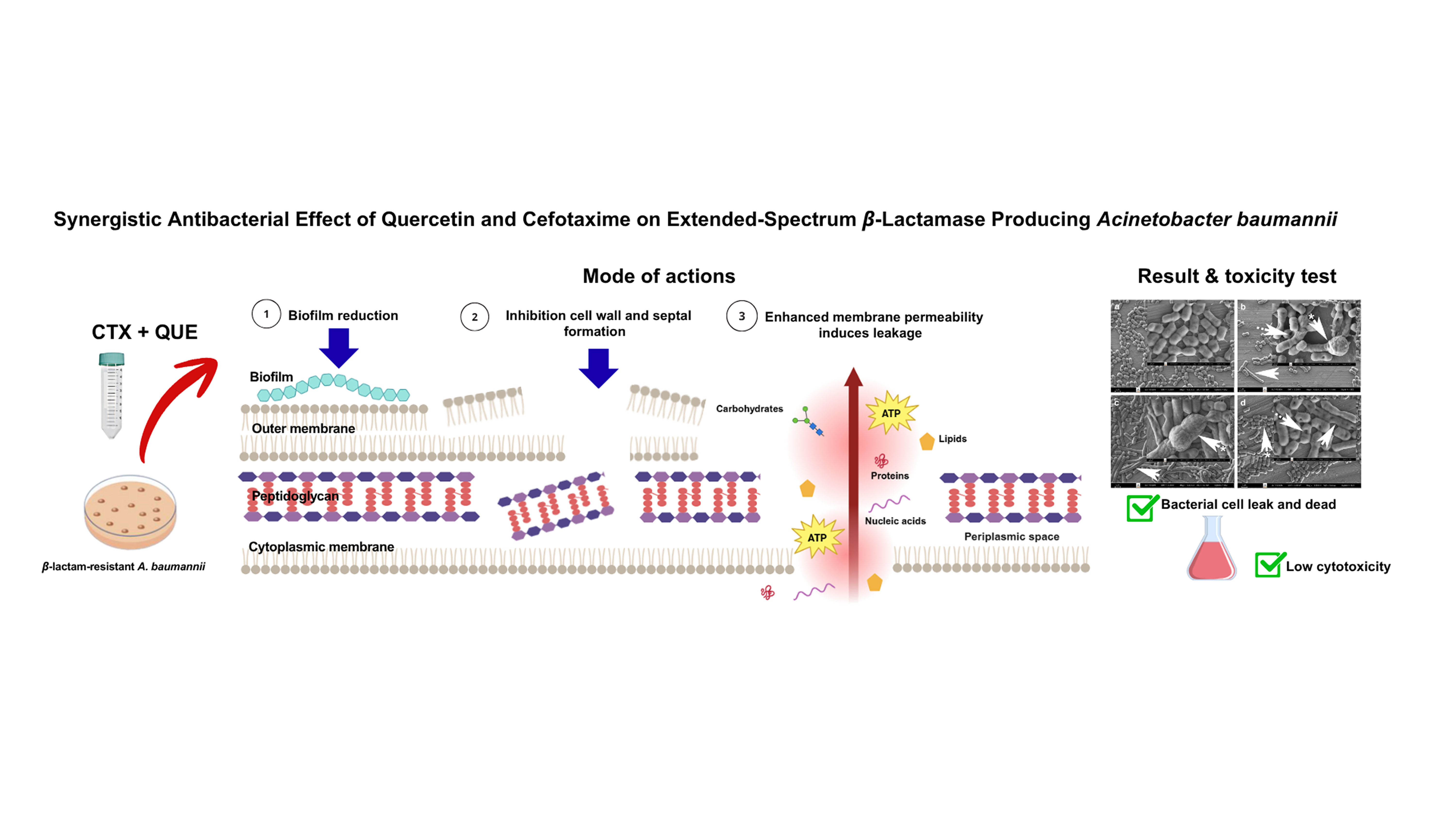
Acinetobacter baumannii (A. baumannii) is a critical multidrug-resistant pathogen designated by the WHO as a major global health threat, with rising resistance to third-generation cephalosporins and carbapenems severely restricting therapeutic options. This study explores the novel potential of combining conventional antibiotics with plant-derived compounds, focusing on quercetin (QUE), a bioactive flavonoid. We evaluated the synergistic antibacterial activity and mechanisms of cefotaxime (CTX)–QUE combinations against 3 β-lactam-resistant A. baumannii strains (DMST 43250, DMST 44689, DMST 45378). All strains exhibited high CTX resistance (MIC 1,024 µg/mL) and harbored the blaTEM gene, consistent with β-lactamase-mediated resistance. Notably, CTX–QUE demonstrated strong synergy (FICI 0.31) against strain DMST 45378, with time kill assays confirming sustained antibacterial activity (≥ 2 log10 CFU/mL reduction compared with QUE alone). Mechanistic analyses revealed significant cytoplasmic membrane disruption, leakage of intracellular DNA/RNA, and marked morphological damage. In addition, QUE inhibited biofilm formation and altered biomolecular profiles, while exhibiting appreciable cytotoxicity in human keratinocytes under in vitro conditions. Collectively, these findings highlight the novelty of employing a natural flavonoid to potentiate β-lactam activity and support the promise of plant-derived compounds as adjunctive strategies against WHO critical priority pathogens. Further studies are warranted to validate this combination before clinical application against β-lactam-resistant A. baumannii.
HIGHLIGHTS
- Quercetin-cefotaxime shows potent synergy against β-lactam-resistant baumannii.
- Synergy involves disruption of the cell wall and septal formation.
- Synergy-driven membrane permeabilization induces DNA, RNA, and enzyme leakage.
- Synergy inhibits biofilm formation and could limit cefotaxime-resistant strains.
- Low cytotoxicity supports adjunct therapeutic potential.
GRAPHICAL ABSTRACT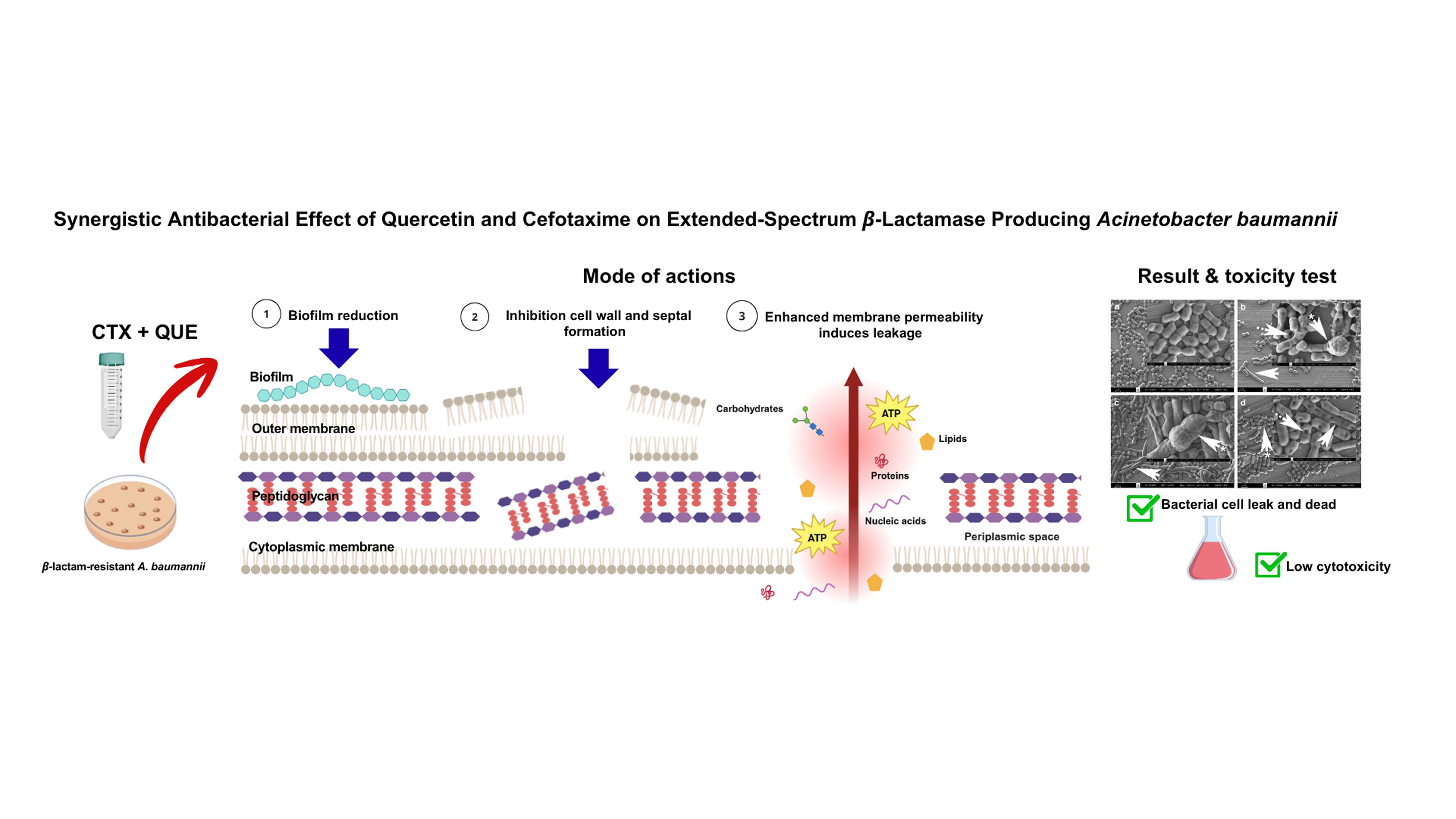
Downloads
References
MR De Blasiis, A Sciurti, V Baccolini, C Isonne, M Ceparano, J Iera, C De Vito, C Marzuillo, P Villari and G Migliara. Impact of antibiotic exposure on antibiotic-resistant Acinetobacter baumannii isolation in intensive care unit patients: A systematic review and meta-analysis. Journal of Hospital Infection 2024; 143, 123-139.
GJ Da Silva and S Domingues. Insights on the horizontal gene transfer of carbapenemase determinants in the opportunistic pathogen Acinetobacter baumannii. Microorganisms 2016; 4(3), 29.
C Dallenne, A Da Costa, D Decré, C Favier and G Arlet. Development of a set of multiplex PCR assays for the detection of genes encoding important β-lactamases in Enterobacteriaceae. Journal of Antimicrobial Chemotherapy 2010; 65(3), 490-495.
S Singh, S Singh, M Trivedi and M Dwivedi. An insight into MDR Acinetobacter baumannii infection and its pathogenesis: Potential therapeutic targets and challenges. Microbial Pathogenesis 2024; 192, 106674.
World Health Organization. WHO bacterial priority pathogens list, 2024: Bacterial pathogens of public health importance to guide research, development and strategies to prevent and control antimicrobial resistance. 2024, Available at: https://www.who.int/news/item/17-05-2024-who-updates-list-of-drug-resistant-bacteria-most-threatening-to-human-health, accessed April 2026.
CR Lee, JH Lee, M Park, KS Park, IK Bae, YB Kim, CJ Cha, BC Jeong and SH Lee. Biology of Acinetobacter baumannii: Pathogenesis, antibiotic resistance mechanisms, and prospective treatment options. Frontiers in Cellular and Infection Microbiology 2017; 7, 55.
G Eumkeb, S Siriwong, S Phitaktim, N Rojtinnakorn and S Sakdarat. Synergistic activity and mode of action of flavonoids isolated from smaller galangal and amoxicillin combinations against amoxicillin-resistant Escherichia coli. Journal of Applied Microbiology 2012; 112(1), 55-64.
S Phitaktim, M Chomnawang, K Sirichaiwetchakoon, B Dunkhunthod, G Hobbs and G Eumkeb. Synergism and the mechanism of action of the combination of α-mangostin isolated from Garcinia mangostana L. and oxacillin against an oxacillin-resistant Staphylococcus saprophyticus. BMC Microbiology 2016; 16(1), 195.
SE Weinberg, A Villedieu, N Bagdasarian, N Karah, L Teare and WF Elamin. Control and management of multidrug resistant Acinetobacter baumannii: A review of the evidence and proposal of novel approaches. Infection Prevention in Practice 2020; 2(3), 100077.
ED Wilkie, JO Alao and TA Akinmolayan. Host-pathogen interactions in acinetobacter baumannii infections: Mechanisms of immune evasion and potential therapeutic targets. In: K Rangel and S De Simone (Eds.). Acinetobacter baumannii - the rise of a resistant pathogen: The rise of a resistant pathogen. IntechOpen, London, 2024, p. 65-67.
S Roy, G Chowdhury, AK Mukhopadhyay, S Dutta and S Basu. Convergence of biofilm formation and antibiotic resistance in Acinetobacter baumannii infection. Frontiers in Medicine 2022; 9, 793615.
TD Gootz. The global problem of antibiotic resistance. Critical Reviews™ in Immunology 2010; 30(1), 79-93.
K Kengkla, K Kongpakwattana, S Saokaew, A Apisarnthanarak and N Chaiyakunapruk. Comparative efficacy and safety of treatment options for MDR and XDR Acinetobacter baumannii infections: A systematic review and network meta-analysis. Journal of Antimicrobial Chemotherapy 2018; 73(1), 22-32.
PA Todd and RN Brogden. Cefotaxime: An update of its pharmacology and therapeutic use. Drugs 1990; 40(4), 608-651.
National Drug Information. National list of essential medicines, Available at: https://ndi.fda.moph.go.th/drug_national, accessed April 2026.
National Antimicrobial Resistant Surveillance Center. Antimicrobial resistance antibiogram, Available at: https://narst.dmsc.moph.go.th/antibiogram, accessed April 2026.
K Bush and JF Fisher. Epidemiological expansion, structural studies, and clinical challenges of new β-lactamases from gram-negative bacteria. Annual Review of Microbiology 2011; 65, 455-478.
PJ Shah and MT Williamson. Evaluation of synergism between cefotaxime and Allium sativum against extended spectrum beta-lactamase and Ambler class C co-producers. Journal of Applied Pharmaceutical Science 2019; 9(03), 098-104.
EM Halawani, AM Hassan and SMG El-Rab. Nanoformulation of biogenic cefotaxime-conjugated-silver nanoparticles for enhanced antibacterial efficacy against multidrug-resistant bacteria and anticancer studies. International Journal of Nanomedicine 2020; 15, 1889.
X Liu, L Ma, F Chen, J Liu, H Yang and Z Lu. Synergistic antibacterial mechanism of Bi2Te3 nanoparticles combined with the ineffective β-lactam antibiotic cefotaxime against methicillin-resistant Staphylococcus aureus. Journal of Inorganic Biochemistry 2019; 196, 110687.
B Muchtaromah, AM Firdaus, AN Ansori, MR Duhita, EB Minarno, A Hayati, M Ahmad and I Analisa. Effect of pegagan (Centella asiatica) nanoparticle coated with chitosan on the cytokine profile of chronic diabetic mice. Narra J 2024; 4(1), e697.
H Padmi, VD Kharisma, ANM Ansori, MT Sibero, MH Widyananda, ME Ullah, O Gumenyuk, S Chylichcova, N Bratishko and ES Prasedya. Macroalgae bioactive compounds for the potential antiviral of SARS-CoV-2: An in silico study. Journal of Pure and Applied Microbiology 2022; 16(2), 1018-1027.
MH Widyananda, SK Pratama, ANM Ansori, Y Antonius, VD Kharisma, AAA Murtadlo, V Jakhmola, M Rebezov, M Khayrullin and M Derkho. Quercetin as an anticancer candidate for glioblastoma multiforme by targeting AKT1, MMP9, ABCB1, and VEGFA: An in silico study. Karbala International Journal of Modern Science 2023; 9(3), 10.
WC Rizky, MC Jihwaprani, A Kindi, ANM Ansori and M Mushtaq. The pharmacological mechanism of quercetin as adjuvant therapy of COVID-19. Life Research 2022; 5(3), 1-9.
AM Hossion, Y Zamami, RK Kandahary, T Tsuchiya, W Ogawa, A Iwado and K Sasaki. Quercetin diacylglycoside analogues showing dual inhibition of DNA gyrase and topoisomerase IV as novel antibacterial agents. Journal of Medicinal Chemistry 2011; 54(11), 3686-3703.
D Wu, Y Kong, C Han, J Chen, L Hu, H Jiang and X Shen. D-Alanine: D-alanine ligase as a new target for the flavonoids quercetin and apigenin. International Journal of Antimicrobial Agents 2008; 32(5), 421-426.
K Ganesan and B Xu. A critical review on polyphenols and health benefits of black soybeans. Nutrients 2017; 9(5), 455.
M Alvarez, N Debattista and N Pappano. Antimicrobial activity and synergism of some substituted flavonoids. Folia Microbiologica 2008; 53(1), 23-28.
W Hertel, G Peschel, JH Ozegowski and PJ Müller. Inhibitory effects of triterpenes and flavonoids on the enzymatic
activity of hyaluronic acid-splitting enzymes. Archiv der Pharmazie: An International Journal Pharmaceutical and
Medicinal Chemistry 2006; 339(6), 313-318.
S Siriwong, Y Teethaisong, K Thumanu, B Dunkhunthod and G Eumkeb. The synergy and mode of action of quercetin plus amoxicillin against amoxicillin-resistant Staphylococcus epidermidis. BMC Pharmacology and Toxicology 2016; 17(1), 39.
F Geoghegan, R Wong and A Rabie. Inhibitory effect of quercetin on periodontal pathogens in vitro. Phytotherapy Research 2010; 24(6), 817-820.
O Ustün, B Ozçelik, Y Akyön, U Abbasoglu and E Yesilada. Flavonoids with anti-Helicobacter pylori activity from Cistus laurifolius leaves. Journal of Ethnopharmacology 2006; 108(3), 457-461.
Clinical Laboratory Standards Institute. CLSI document M100: Performance standards for antimicrobial susceptibility testing. 32nd ed. Clinical Laboratory Standards Institute, Philadelphia, United States, 2022.
IX Liu, DG Durham and RME Richards. Baicalin synergy with β-lactam antibiotics against methicillin-resistant Staphylococcus aureus and other β-lactam-resistant strains of S. aureus. Journal of Pharmacy and Pharmacology 2000; 52(3), 361-366.
FJ Pérez-Pérez and ND Hanson. Detection of plasmid-mediated AmpC β-lactamase genes in clinical isolates by using multiplex PCR. Journal of Clinical Microbiology 2002; 40(6), 2153-2162.
Y Teethaisong, G Eumkeb, S Chumnarnsilpa, N Autarkool, J Hobson, I Nakouti, G Hobbs and K Evans. Phenotypic detection of AmpC β-lactamases, extended-spectrum β-lactamases and metallo-β-lactamases in Enterobacteriaceae using a resazurin microtitre assay with inhibitor-based methods. Journal of Medical Microbiology 2016; 65(10), 1079-1087.
CR Bonapace, JA Bosso, LV Friedrich and RL White. Comparison of methods of interpretation of checkerboard synergy testing. Diagnostic Microbiology and Infectious Disease 2002; 44(4), 363-366.
MB Marques, ES Brookings, SA Moser, PB Sonke and KB Waites. Comparative in vitro antimicrobial susceptibilities of nosocomial isolates of Acinetobacter baumannii and synergistic activities of nine antimicrobial combinations. Antimicrobial Agents and Chemotherapy 1997; 41(5), 881-885.
R Michael, E Richards and DK Xing. In vitro evaluation of the antimicrobial activities of selected lozenges. Journal of Pharmaceutical Sciences 1993; 82(12), 1218-1220.
Y Teethaisong, N Autarkool, K Sirichaiwetchakoon, P Krubphachaya, S Kupittayanant and G Eumkeb. Synergistic activity and mechanism of action of Stephania suberosa Forman extract and ampicillin combination against ampicillin-resistant Staphylococcus aureus. Journal of Biomedical Science 2014; 21(1), 90.
R Gopal, YG Kim, JH Lee, SK Lee, JD Chae, BK Son, CH Seo and Y Park. Synergistic effects and antibiofilm properties of chimeric peptides against multidrug-resistant Acinetobacter baumannii strains. Antimicrobial Agents and Chemotherapy 2014; 58(3), 1622-1629.
Y Teethaisong, T Pimchan, R Srisawat, G Hobbs and G Eumkeb. Boesenbergia rotunda (L.) Mansf. extract potentiates the antibacterial activity of some β-lactams against β-lactam-resistant staphylococci. Journal of Global Antimicrobial Resistance 2018; 12, 207-213.
HM Al-Qadiri, NI Al-Alami, MA Al-Holy and BA Rasco. Using Fourier transform infrared (FT-IR) absorbance spectroscopy and multivariate analysis to study the effect of chlorine-induced bacterial injury in water. Journal of Agricultural and Food Chemistry 2008; 56(19), 8992-8997.
KP Devi, SA Nisha, R Sakthivel and SK Pandian. Eugenol (an essential oil of clove) acts as an antibacterial agent against Salmonella typhi by disrupting the cellular membrane. Journal of Ethnopharmacology 2010; 130(1), 107-115.
B Dunkhunthod, C Talabnin, M Murphy, K Thumanu, P Sittisart and G Eumkeb. Gymnema inodorum (Lour.) Decne. extract alleviates oxidative stress and inflammatory mediators produced by RAW264. 7 macrophages. Oxidative Medicine and Cellular Longevity 2021; 2021(1), 8658314.
LC Antunes, P Visca and KJ Towner. Acinetobacter baumannii: Evolution of a global pathogen. Pathogens and Disease 2014; 71(3), 292-301.
GS Kogilathota Jagirdhar, K Rama, ST Reddy, H Pattnaik, RK Qasba, PR Elmati, R Kashyap, M Schito and N Gupta. Efficacy of cefoperazone sulbactam in patients with Acinetobacter infections: a systematic review of the literature. Antibiotics 2023; 12(3), 582.
BA Evans and SG Amyes. OXA β-lactamases. Clinical Microbiology Reviews 2014; 27(2), 241-263.
A Pal and A Tripathi. Quercetin potentiates meropenem activity among pathogenic carbapenem-resistant Pseudomonas aeruginosa and Acinetobacter baumannii. Journal of Applied Microbiology 2019; 127(4), 1038-1047.
S Ghafourian, N Sadeghifard, S Soheili and Z Sekawi. Extended spectrum beta-lactamases: definition, classification and epidemiology. Current Issues in Molecular Biology 2015; 17(1), 11-22.
DL Paterson and RA Bonomo. Extended-spectrum β-lactamases: A clinical update. Clinical Microbiology Reviews 2005; 18(4), 657-686.
AY Peleg, H Seifert and DL Paterson. Acinetobacter baumannii: Emergence of a successful pathogen. Clinical Microbiology Reviews 2008; 21(3), 538-582.
MJ Trimble, P Mlynárčik, M Kolář and RE Hancock. Polymyxin: alternative mechanisms of action and resistance. Cold Spring Harbor Perspectives in Medicine 2016; 6(10), a025288.
TT Cushnie and AJ Lamb. Recent advances in understanding the antibacterial properties of flavonoids. International Journal of Antimicrobial Agents 2011; 38(2), 99-107.
CW Hall and TF Mah. Molecular mechanisms of biofilm-based antibiotic resistance and tolerance in pathogenic bacteria. FEMS Microbiology Reviews 2017; 41(3), 276-301.
IASV Packiavathy, P Sasikumar, SK Pandian and A Veera Ravi. Prevention of quorum-sensing-mediated biofilm development and virulence factors production in Vibrio spp. by curcumin. Applied Microbiology and Biotechnology 2013; 97, 10177-10187.
LB Chibane, V Forquet, P Lantéri, Y Clément, LL Akkari, N Oulahal, P Degraeve and C Bordes. Antibacterial properties of polyphenols: Characterization and QSAR (Quantitative structure-activity relationship) models. Frontiers in Microbiology 2019; 10, 829.
T Guo, M Li, X Sun, Y Wang, L Yang, H Jiao and G Li. Synergistic activity of capsaicin and colistin against colistin-resistant Acinetobacter baumannii: In vitro/vivo efficacy and mode of action. Frontiers in Pharmacology 2021; 12, 744494.
D Naumann. Infrared spectroscopy in microbiology. Encyclopedia of Analytical Chemistry 2000; 102, 131.
 Novais, AR Freitas, C Rodrigues and L Peixe. Fourier transform infrared spectroscopy: Unlocking fundamentals and prospects for bacterial strain typing. European Journal of Clinical Microbiology & Infectious Diseases 2019; 38, 427-448.
TLA Nguyen and D Bhattacharya. Antimicrobial activity of quercetin: An approach to its mechanistic principle. Molecules 2022; 27(8), 2494.
S Qayyum, D Sharma, D Bisht and AU Khan. Identification of factors involved in Enterococcus faecalis biofilm under quercetin stress. Microbial Pathogenesis 2019; 126, 205-211.
K Maquelin, LPC Smith, C Kirschner, NN Thi, D Naumann and G Puppels. Vibrational spectroscopic studies of microorganisms.In: P Griffiths and JM Chalmers (Eds.). Handbook of vibrational spectroscopy. John Wiley & Sons, New Jersey, United States, 2006.
M Kalinowska, H Lewandowska, M Pruszyński, G Świderski, E Gołębiewska, K Gryko, J Braun, M Borkowska, M Konieczna and W Lewandowski. Co (II) complex of quercetin-spectral, anti-/pro-oxidant and cytotoxic activity in HaCaT cell lines. Applied Sciences 2021; 11(19), 9244.
SY Seo, WS Ju, K Kim, J Kim, JO Yu, JS Ryu, JS Kim, HA Lee, DB Koo and YK Choo. Quercetin induces mitochondrial apoptosis and downregulates ganglioside GD3 expression in melanoma cells. International Journal of Molecular Sciences 2024; 25(10), 5146.
Downloads
Published
How to Cite
Issue
Section
License
Copyright (c) 2026 Walailak University

This work is licensed under a Creative Commons Attribution-NonCommercial-NoDerivatives 4.0 International License.