
A Randomized Controlled Trial on the Moisturizing Effects of Amomum schmidtii (K. Schum.) in Working-Age Adults and its Effects on Gene Expression in HaCaT Keratinocytes
DOI:
https://doi.org/10.48048/tis.2026.10869Keywords:
Amomum schmidtii (K. Schum.), Skin oiliness, Skin moisture, Skin creases, Gene expression, Working-age adultsAbstract
Allergic contact dermatitis commonly affects working-age adults due to repeated allergen exposure, leading to skin barrier damage, water loss, and oxidative stress. Amomum schmidtii (K. Schum.) (A. schmidtii) is traditionally used in Thai medicine to improve skin hydration. This study aimed to compare the effects of A. schmidtii, coconut, and cold creams on skin moisture, oiliness, and skin creases in working-age adults. Moreover, antioxidant activity and potential mechanisms were investigated by analyzing skin moisture-related gene expression in keratinocyte cells. A double-blind, randomized controlled trial involving 45 volunteers was conducted. Participants applied A. schmidtii, coconut, and cold creams to the dorsal hands. Skin moisture, oiliness, and creases were assessed using the Corneometer® CM820/CM825, Sebumeter® SM815, and stereomicroscopic image analysis, respectively. The results exhibited that skin moisture and oiliness of A. schmidtii cream-treated groups significantly increased compared to bare skin (p < 0.05). In addition, the distance between skin creases of A. schmidtii cream-treated group was significantly decreased after application compared to bare skin (p < 0.05). Interestingly, the effects of A. schmidtii cream-treated group on these skin test parameters were practically similar to coconut and cold cream. Additionally, A. schmidtii oil demonstrated antioxidant activity as assessed by the 2,2-diphenyl-1-picrylhydrazyl (DPPH) assay. The oil showed a notable antioxidant capacity, with an IC₅₀ value of 7.26 compared to 1.56 µg/mL for the standard antioxidant, Trolox. Moreover, after treating human keratinocyte (HaCaT) cells with A. schmidtii oil for 24 h, there was an increase in the synthesis of hyaluronic acid by upregulating the HAS2 gene, along with an increase in the expression of genes encoding tight junction proteins (TJP1 gene) and filaggrin (FLG gene). These results provide evidence that A. schmidtii could be used as a moisturizing agent to prevent dry skin in working adults and could upregulate the gene-related skin moisture expression.
HIGHLIGHTS
- Amomum schmidtii (K. Schum.) significantly increased skin moisture after topical application.
- Topical use of Amomum schmidtii (K. Schum.) enhanced skin oiliness, potentially supporting barrier function.
- The distance between skin creases was significantly decreased after applied schmidtii cream.
- Amomum schmidtii (K. Schum.) upregulated the expression of HAS2, FLG, and TJP1 genes in HaCaT keratinocytes.
- Amomum schmidtii (K. Schum.) demonstrated free radical scavenging activity, suggesting antioxidant potential.
GRAPHICAL ABSTRACT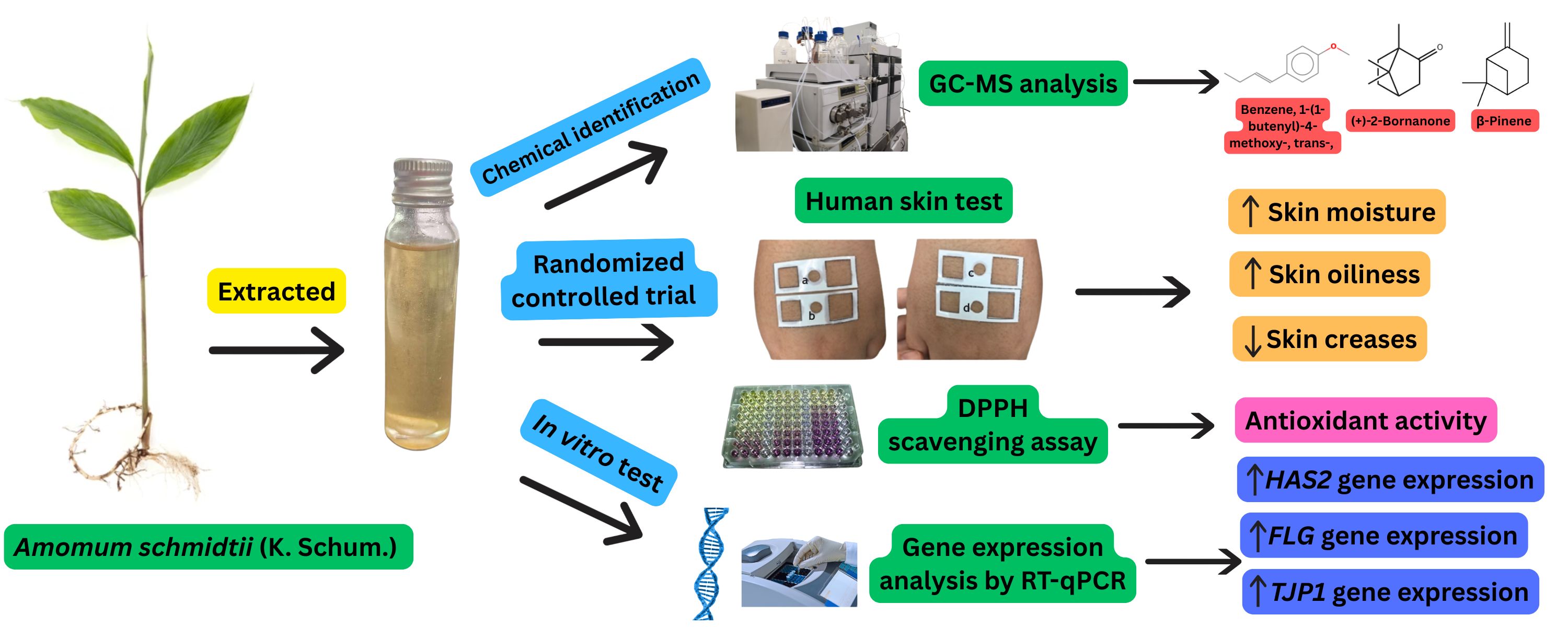
Downloads
References
Ministry of Public Health, Health Data Center. Occupational and environmental disease annual report. Ministry of Public Health, Health Data Center, 2020.
TL Diepgen. Occupational skin diseases. Journal der Deutschen Dermatologischen Gesellschaft 2012; 10(5), 297-315.
ZC Chiesa Fuxench, JK Block, M Boguniewicz, J Boyle, L Fonacier, JM Gelfand, MH Grayson, DJ Margolis, L Mitchell, JI Silverberg, L Schwartz, EL Simpson and PY Ong. Atopic dermatitis in america study: A cross-sectional study examining the prevalence and disease burden of atopic dermatitis in the US adult population. Journal of Investigative Dermatology 2019; 139(3), 583-590.
J Rajkumar, N Chandan, P Lio and V Shi. The skin barrier and moisturization: Function, disruption, and mechanisms of repair. Skin Pharmacology and Physiology 2023; 36(4), 174-185.
S Saensouk, P Saensouk, P Pasorn and P Chantaranothai. Diversity and uses of Zingiberaceae in nam nao national park, Chaiyaphum and Phetchabun provinces, Thailand, with a new record for Thailand. Agriculture and Natural Resources 2016; 50(6), 445-453.
FI Rahman, PO Zulfa, A Beočanin, IM Faisal, N Louca, MI Carstoiu and H Zufry. Targeting phosphoglycerate dehydrogenase enzyme using ginger compounds to suppress thyroid cancer progression. Narra X 2024; 2(1), e112-e112.
C Singtothong, MJ Gagnon and J Legault. Chemical composition and biological activity of the essential oil of Amomum biflorum. Natural Product Communications 2013; 8(2), 265-267.
B Bravo, P Correia, JE Gonçalves Junior, B Sant’Anna and D Kerob. Benefits of topical hyaluronic acid for skin quality and signs of skin aging: From literature review to clinical evidence. Dermatology and Therapy 2022; 35(12), e15903.
K Bäsler, S Bergmann, M Heisig, A Naegel, M Zorn-Kruppa and JM Brandner. The role of tight junctions in skin barrier function and dermal absorption. Journal of Controlled Release 2016; 242, 105-118.
JO Lee, SH Hwang, T Shen, JH Kim, L You, W Hu and JY Cho. Enhancement of skin barrier and hydration-related molecules by protopanaxatriol in human keratinocytes. Journal of Ginseng Research 2021; 45(2), 354-360.
SD Noveir, U Biba, J Galamgam and CE Cheng. A review of topical oils on the skin. JAAD Reviews 2024; 2, 36-40.
A Sharma, M Banyal, J Gupta and S Joshi. Formulation and evaluation of herbal cold cream. International Journal of Advance Research and Innovative Ideas in Education 2023; 9(3), 2578-2585.
H Lindley-Hatcher, A Hernandez-Serrano, J Wang, J Cebrian, J Hardwicke and E Pickwell-MacPherson. Evaluation of in vivo THz sensing for assessing human skin hydration. Journal of Physics: Photonics 2020; 3(1), 014001.
L Cheng, J Guo and Y Lu. Inhibition of lipogenesis and sebum secretion for Lotus corniculatus seed extract in vitro and in vivo. International Journal of Cosmetic Science 2022; 45(1), 62-72.
S Bielfeldt, J Blaak, S Laing, M Schleißinger, C Theiss, KP Wilhelm and P Staib. Deposition of plant lipids after single application of a lip care product determined by confocal raman spectroscopy, corneometry and transepidermal water‐loss. International Journal of Cosmetic Science 2019; 41(3), 281-291.
K Srisook, P Salee, Y Charoensuk and E Srisook. In vitro anti-oxidant and anti-tyrosinase activities of the rhizomal extracts from Amomum biflorum Jack. Thai Journal of Botany 2010; 2, 143-150.
S Jin, M Xu, X Gao, S Jiang, Y Xiong, W Zhang, H Qiao, Y Wu and H Fu. Effects of alkalinity exposure on antioxidant status, metabolic function, and immune response in the hepatopancreas of Macrobrachium nipponense. Antioxidants 2024; 13(1), 129.
T Keereekoch, T Srisuwan, P Kaewpitak, S Dangnam and S Subhaddhirasakul. Formulation of Amomum biflorum Jack air freshener gel. Thaksin University Journal 2019; 22(2), 15-21.
C Sagayap, P Chuysinuan, N Chutiwitoonchai, P Pripdeevech, W Kaewsri, S Sureram, N Chantratita, K Lirdprapamongkol, J Svasti, S Techasakul, C Mahidol, S Ruchirawat and P Kittakoop. An anisole derivative in the essential oil of Wurfbainia schmidtii with virucidal activity against SARS-CoV-2 and anti-inflammatory properties. Natural Product Communications 2025; 20(3), 1-10.
S Zaman and N Akhtar. Effect of turmeric (Curcuma longa Zingiberaceae) extract cream on human skin sebum secretion. Tropical Journal of Pharmaceutical Research 2013; 12(5), 665-669.
YY Lin, SH Lu, R Gao, CH Kuo, WH Chung, WC Lien, CC Wu, Y Diao and HMD Wang. A novel biocompatible herbal extract‐loaded hydrogel for acne treatment and repair. Oxidative Medicine and Cellular Longevity 2021; 2021(1), 5598291.
V Mazzarello, E Gavini, G Rassu, MG Donadu, D Usai, G Piu, V Pomponi, F Sucato, S Zanetti and MA Montesu. Clinical assessment of new topical cream containing 2 essential oils combined with tretinoin in the treatment of acne. Clinical Cosmetic and Investigational Dermatology 2020; 13, 233-239.
S Rahman, MA Rivai, D Dasrul and O Ayu. Effect of hemp seed oil on accelerating wound healing: Evaluation of wound size reduction, epithelialization, granulation tissue formation, and vascularization in murine models. Narra J 2025; 5(1), e1878.
L Shang, M Li, A Xu and F Zhuo. Recent applications and molecular mechanisms of hyaluronic acid in skin aging and wound healing. Medicine in Novel Technology and Devices 2024; 23, 100320.
YH Choi, YS Tak, S Rho and E Hwang. Skin feature extraction and processing model for statistical skin age estimation. Multimedia Tools and Applications 2013; 64(2), 227-247.
K Chekanov, D Danko, T Tlyachev, K Kiselev, R Hagens and A Georgievskaya. State-of-the-art in skin fluorescent photography for cosmetic and skincare research: from molecular spectra to AI image analysis. Life 2024; 14(10), 1271.
SS Skandalis, T Karalis and P Heldin. Intracellular hyaluronan: Importance for cellular functions. Seminars in Cancer Biology 2020; 62, 20-30.
M Armengot-Carbo, Á Hernández-Martín and A Torrelo. The role of filaggrin in the skin barrier and disease development. Actas Dermo-Sifiliográficas 2015; 106(2), 86-95.
Published
How to Cite
Issue
Section
License
Copyright (c) 2025 Walailak University

This work is licensed under a Creative Commons Attribution-NonCommercial-NoDerivatives 4.0 International License.





