
Physicochemical, Phytochemical, and Antioxidant Properties of Spent Hops from Craft Beer Brewing
DOI:
https://doi.org/10.48048/tis.2025.10320Keywords:
Antioxidant activity, Brewing byproducts, Phytochemical properties, Spent hops, Spray drying, Antioxidant activity, Brewing byproducts, Phytochemical properties, Spent hops, Spray dryingAbstract
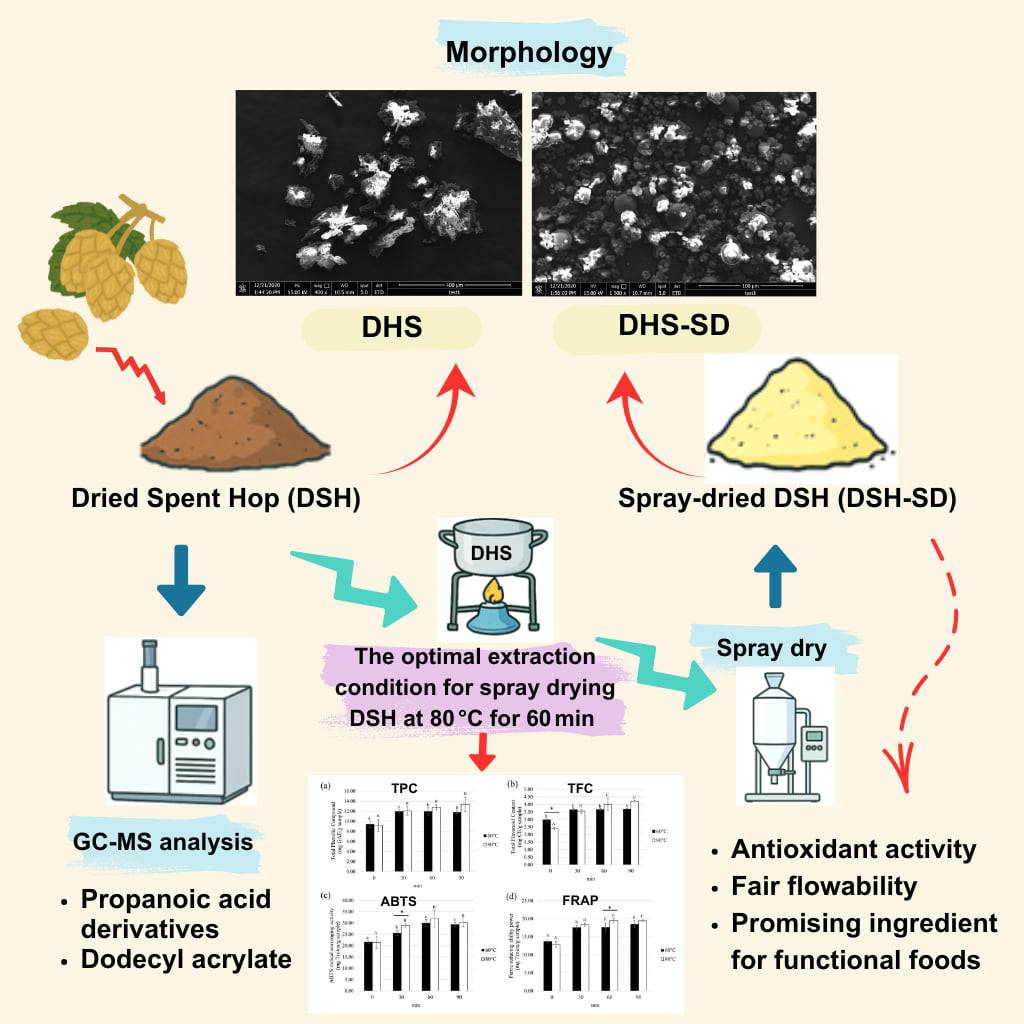
Spent hops, a byproduct of brewing exhibit interesting functional qualities and antioxidant potential. This study aimed to determine the physicochemical, phytochemical, and antioxidant characteristics of dried spent hop (DSH) obtained from Weizen craft beer brewing. Additionally, spray-dried spent hop powder (DSH-SD) was examined. GC-MS analysis revealed that the major components of DSH powder were propanoic acid, 3,3'-thiobis-, didodecyl ester (19.64%), and dodecyl acrylate (15.95%). The DSH exhibited a moisture content of 5.85 ± 0.05%, ash content of 4.53 ± 0.01%, protein content of 14.81 ± 0.60%, and water activity (aw) of 0.3182 ± 0.01. Based on phenolic and flavonoid contents, as well as antioxidant activities evaluated through the ABTS and FRAP assays, the optimal extraction condition for spray drying was determined to be 80 °C for 60 min. After spray drying, DSH-SD exhibited a moisture content of 8.39 ± 0.10%, ash content of 2.52 ± 0.23%, protein content of 3.88 ± 0.17%, and aw of 0.4460 ± 0.01. DSH-SD had a total phenolic content of 13.17 ± 0.62 mg GAE/g and a total flavonoid content of 4.10 ± 0.14 mg CE/g. The antioxidant activity was 20.17 ± 0.77 mg TE/g (ABTS assay) and 19.09 ± 1.46 mg TE/g (FRAP assay). DSH-SD showed fair flowability with a Carr index of 17.09 ± 1.48%, tapped density of 0.31 ± 0.00 g/cm³, and bulk density of 0.26 ± 0.00 g/cm³. These findings suggest that DSH-SD is a promising, sustainable ingredient for functional food applications with potential health benefits.
HIGHLIGHTS
- Dried spent hops (DSH) were analyzed for their physicochemical, phytochemical, and antioxidant properties.
- GC-MS of DSH revealed key bioactive compounds, including propanoic acid derivatives and dodecyl acrylates.
- The optimal extraction condition for spray drying DSH at 80 °C for 60 min enhanced the highest phenolic and flavonoid contents, with strong antioxidant activity.
- Spray-dried DSH (DSH-SD) exhibited antioxidant activity and fair flowability, making it a viable functional food ingredient.
GRAPHICAL ABSTRACT
Downloads
References
SR Jaeger, T Worch, T Phelps, D Jin and AV Cardello. Preference segments among declared craft beer drinkers: Perceptual, attitudinal and behavioral responses underlying craft-style vs. traditional-style flavor preferences. Food Quality and Preference 2020; 82, 103884.
B Aquilani, T Laureti, S Poponi and L Secondi. Beer choice and consumption determinants when craft beers are tasted: An exploratory study of consumer preferences. Food Quality and Preference 2015; 41, 214-224.
R Censi, D Vargas Peregrina, MR Gigliobianco, G Lupidi, C Angeloni, L Pruccoli, A Tarozzi and PD Martino. New antioxidant ingredients from brewery byproducts for cosmetic formulations. Cosmetics 2021; 8(4), 96.
J Kleban and I Nickerson. To brew, or not to brew-that is the question: An analysis of competitive forces in the craft brew industry. Journal of the International Academy of Case Studies 2012; 18, 59-82.
HE Anderson, IC Santos, ZL Hildenbrand and KA Schug. A review of the analytical methods used for beer ingredient and finished product analysis and quality control. Analytica Chimica Acta 2019; 1085, 1-20.
G Donadini and S Porretta. Uncovering patterns of consumers’ interest for beer: A case study with craft beers. Food Research International 2017; 91, 183-198.
A Faltermaier, D Waters, T Becker, E Arendt and M Gastl. Common wheat (Triticum aestivum L.) and its use in brewing cereal: A review. Journal of the Institute of Brewing 2014; 120(1), 1-15.
PR Shewry, Y Wan, MJ Hawkesford and P Tosi. Spatial distribution of functional components in the starchy endosperm of wheat grains. Journal of Cereal Science 2020; 91, 102869.
R Meusinger. Solution to wheat beer challenge. Analytical and Bioanalytical Chemistry 2020; 412(1), 5.
T Kao. Health potential for beer brewing byproducts. IntechOpen, London, 2018.
E Bravi, GD Francesco, V Sileoni, G Perretti, F Galgano and O Marconi. Brewing by-product upcycling potential: Nutritionally valuable compounds and antioxidant activity evaluation. Antioxidants 2021; 10(2), 165.
S Olivares-Galvan, ML Marina and MC Garcia. Extraction of valuable compounds from brewing residues: Malt rootlets, spent hops, and spent yeast. Trends in Food Science and Technology 2022; 127, 181-197.
AW Sahin, K Hardiman, JJ Atzler, M Vogelsang-O’Dwyer, D Valdeperez, S Munch, G Cattaneo, P O’Riordan and EK Arendt. Rejuvenated brewer’s spent grain: The impact of two BSG-derived ingredients on techno-functional and nutritional characteristics of fibre-enriched pasta. Innovative Food Science and Emerging Technologies 2021; 68, 102633.
NG Heredia-Sandoval, MDC Granados-Nevarez, AMCDL Barca, F Vasquez-Lara, LN Malunga, FB Apea-Bah, T Beta and AR Islas-Rubio. Phenolic acids, antioxidant capacity, and estimated glycemic index of cookies added with brewer’s spent grain. Plant Foods for Human Nutrition 2020; 75(1), 41-47.
JDS Guedes, TC Pimentel, HT Diniz-Silva, ETDC Almeida, JF Tavares, ELD Souza, EF Garcia and M Magnani. Protective effects of β-glucan extracted from spent brewer yeast during freeze-drying, storage, and exposure to simulated gastrointestinal conditions of probiotic lactobacilli. LWT 2019; 116, 108496.
R Rakowska, A Sadowska, E Dybkowska and F Swiderski. Spent yeast as a natural source of functional food additives. Roczniki Panstwowego Zakladu Higieny 2017; 68(2), 115-121.
G Astray, P Gullon, B Gullon, PES Munekata and JM Lorenzo. Humulus lupulus L. as a natural source of functional biomolecules. Applied Sciences 2020; 10(15), 5074.
TR Arruda, PF Pinheiro, PI Silva and PC Bernardes. A new perspective of a well-recognized raw material: Phenolic content, antioxidant and antimicrobial activities and α- and β-acids profile of Brazilian hop (Humulus lupulus L.) extracts. LWT 2021; 141, 110905.
O Vergun, O Shymanska, E Ivanisova and V Fishchenko. Antioxidant activity of extracts of wild Humulus lupulus L. Agrobiodiversity for Improving Nutrition Health and Life Quality 2021; 5(1), 47-54.
JI Lyu, J Ryu, KS Seo, KY Kang, SH Park, TH Ha, JW Ahn and SY Kang. Comparative study on phenolic compounds and antioxidant activities of hop (Humulus lupulus L.) strobile extracts. Plants 2022; 11(1), 135.
Z Kolenc, T Hribernik, T Langerholc, M Pintaric, MP Povse and U Bren. Antioxidant activity of different hop (Humulus lupulus L.) genotypes. Plants 2023; 12(19), 3436.
A Karlovic, A Juric, N Coric, K Habschied, V Krstanovic and K Mastanjevic. By-products in the malting and brewing industries–re-usage possibilities. Fermentation 2020; 6(3), 82.
K Rachwal, A Wasko, K Gustaw and M Polak-Berecka. Utilization of brewery wastes in food industry. PeerJ 2020; 8, e9427.
M Karabin, T Hudcova, L Jelinek and P Dostalek. Biologically active compounds from hops and prospects for their use. Comprehensive Reviews in Food Science and Food Safety 2016; 15(3), 542-567.
A Bartmanska, E Walecka-Zacharska, T Tronina, J Popłonski, S Sordon, E Brzezowska, J Bania and E Huszcza. Antimicrobial properties of spent hops extracts, flavonoids isolated therefrom, and their derivatives. Molecules 2018; 23(8), 2059.
FSF Costa, TR Amparo, JB Seibert, BM Silveira, RGD Silva, DI Pereira, RGG Barbosa, ODHD Santos, GC Brandao, LFDM Teixeira, PMDA Vieira and GHBD Souza. Reuse of hot trub as an active ingredient with antioxidant and antimicrobial potential. Waste Biomass Valorization 2021; 12(4), 2037-2047.
J Poplonski, E Turlej, S Sordon, T Tronina, A Bartmanska, J Wietrzyk and E Huszcza. Synthesis and antiproliferative activity of minor hops prenylflavonoids and new insights on prenyl group cyclization. Molecules 2018; 23(4), 776-792.
M Caban, K Chojnacka, K Owczarek, J Laskowska, J Fichna, A Podsedek, D Sosnowska and U Lewandowska. Spent hops (Humulus Lupulus L.) extract as modulator of the inflammatory response in lipopolysaccharide stimulated RAW 264.7 macrophages. Journal of Physiology and Pharmacology 2020; 71(1), 67-78.
B Luzak, J Golanski, T Przygodzki, M Boncler, D Sosnowska, J Oszmianski, C Watala and M Rozalski. Extract from spent hop (Humulus lupulus L.) reduces blood platelet aggregation and improves anticoagulant activity of human endothelial cells in vitro. Journal of Functional Foods 2016; 22, 257-269.
A Wilkowska, W Ambroziak, A Czyzowska and J Adamiec. Effect of microencapsulation by spray-drying and freeze-drying technique on the antioxidant properties of blueberry (Vaccinium myrtillus) juice polyphenolic compounds. Polish Journal of Food and Nutrition Sciences 2016; 66(1), 11-16.
E Drozlowska, M Starowicz, N Smietana, U Krupa-Kozak and L Lopusiewicz. Spray-drying impact on the physicochemical properties and formation of Maillard reaction products contributing to antioxidant activity of camelina press cake extract. Antioxidants, 2023; 12(4), 919.
AOAC. Official methods of analysis. The Association of Official Chemists, Maryland, 2000.
C Khongla, P Yuwang, T Yuwang and S Musika. Physicochemical, phytochemical and antioxidant properties of organic sweet potato flour and its application in breadstick. Trends in Sciences 2024; 21(10), 8162.
C Khongla, J Chuaingan, T Siadkhunthod, P Somnam, S Musika and P Sangsawad. Physicochemical properties of rice bran hydrolysate prepared in a pilot scale process and its application in milk tablets. Trends in Sciences 2022; 19(23), 2316.
IFF Benzie and JJ Strain. The ferric reducing ability of plasma as a measure of “antioxidant power” The FRAP assay. Analytical Biochemistry 1996; 239(1), 70-76.
M Saifullah, YA Yusof, NL Chin and MG Aziz. Physicochemical and flow properties of fruit powder and their effect on the dissolution of fast dissolving fruit powder tablets. Powder Technology 2016; 301, 396-404.
B Steenackers, LD Cooman and DD Vos. Chemical transformations of characteristic hop secondary metabolites in relation to beer properties and the brewing process: A review. Food Chemistry 2015; 172, 742-756.
O Kemp, S Hofmann, I Braumann, S Jensen, A Fenton and O Oladokun. Changes in key hop-derived compounds and their impact on perceived dry-hop flavour in beers after storage at cold and ambient temperature. Journal of the Institute of Brewing 2021; 127(4), 367-384.
J Luo, Q Pan, Y Chen, W Huang, Q Chen, T Zhao, Z Guo, Y Liu and B Lu. Storage stability and degradation mechanism of xanthohumol in Humulus lupulus L. and beer. Food Chemistry 2024; 437(1), 137778.
R ElGamal, C Song, AM Rayan, C Liu, S Al-Rejaie and G ElMasry. Thermal degradation of bioactive compounds during drying process of horticultural and agronomic products: A comprehensive overview. Agronomy 2023; 13(6), 1580.
K Goscinna, J Poberezny, E Wszelaczynska, W Szulc and B Rutkowska. Effects of drying and extraction methods on bioactive properties of plums. Food Control 2021; 122, 107771.
M Iannone, E Ovidi, S Vitalini, V Laghezza Masci, A Marianelli, M Iriti, A Tiezzi and S Garzoli. From hops to craft beers: Production process, VOCs profile characterization, total polyphenol and flavonoid content determination and antioxidant activity evaluation. Processes 2022; 10(3), 517.
S Bedini, G Flamini, J Girardi, F Cosci and B Conti. Not just for beer: Evaluation of spent hops (Humulus lupulus L.) as a source of eco-friendly repellents for insect pests of stored foods. Journal of Pest Science 2015; 88(3), 583-592.
DG Hauser, SR Lafontaine and TH Shellhammer. Extraction efficiency of dry-hopping. Journal of the American Society of Brewing Chemists 2019; 77(3), 188-198.
DD Tengse, B Priya and PAR Kumar. Optimization for encapsulation of green tea (Camellia sinensis L.) extract by spray drying technology. Journal of Food Measurement and Characterization 2017; 11(1), 85-92.
I Codina-Torrella, L Rodero and MP Almajano. Brewing by-products as a source of natural antioxidants for food preservation. Antioxidants 2021; 10(10), 1512.
OD Ogundele, SO Thompson, SK Lawal and BF Demehin. Effects of drying temperature on proximate composition and functional properties of Colocasia esculenta (cocoyam) flour. International Journal of Recent Innovation in Food Science and Nutrition 2019; 2(1), 24-33.
NE Haddad, H Choukri, ME Ghanem, A Smouni, R Mentag, K Rajendran, K Hejjaoui, F Maalouf and S Kumar. High-temperature and drought stress effects on growth, yield and nutritional quality with transpiration response to vapor pressure deficit in lentil. Plants 2021; 11(1), 95.
C Anandharamakrishnan, CD Rielly and AGF Stapley. Effects of process variables on the denaturation of whey proteins during spray drying. Drying Technology 2007; 25(5), 799-807.
FDC Siacor, KJA Lim, AA Cabajar, CFY Lobarbio, DJ Lacks and EB Taboada. Physicochemical properties of spray-dried mango phenolic compounds extracts. Journal of Agriculture and Food Research 2020; 2, 100048.
R Censi, D Vargas Peregrina, MR Gigliobianco, G Lupidi, C Angeloni, L Pruccoli, A Tarozzi and PD Martino. New antioxidant ingredients from brewery by-products for cosmetic formulations. Cosmetics 2021; 8(4), 96.
MJ Petron, AI Andres, G Esteban and ML Timon. Study of antioxidant activity and phenolic compounds of extracts obtained from different craft beer by-products. Journal of Cereal Science 2021; 98, 103162.
T Tronina, J Poplonski and A Bartmanska. Flavonoids as phytoestrogenic components of hops and beer. Molecules 2020; 25(18), 4201.
JW Lee, J Lee, K Kim, Y Shin, J Kim, H Kim, H Kim, S Min, P Kim, K Choi and K Park. n-Butyl acrylate-induced antioxidant system alteration through two generations in Oryzias latipes. Fish Physiology and Biochemistry 2019; 45, 873-883.
S Sudan and HV Rupasinghe. Antiproliferative activity of long chain acylated esters of quercetin-3-O-glucoside in hepatocellular carcinoma HepG2 cells. Experimental Biology and Medicine 2015; 240(11), 1452-1464.
F Blasi, C Chiesi, R Spogli, L Cossignani and M Nocchetti. Oxidative stability of long-chain fatty acids with different unsaturation degrees into layered double hydroxides. Applied Sciences 2021; 11(15), 7035.
J Nishad, CJ Selvan, SA Mir and SJD Bosco. Effect of spray drying on physical properties of sugarcane juice powder (Saccharum officinarum L.). Journal of Food Science and Technology 2017; 54(3), 687-697.
A Shrivastava, AD Tripathi, V Paul and DC Rai. Optimization of spray drying parameters for custard apple (Annona squamosa L.) pulp powder development using response surface methodology (RSM) with improved physicochemical attributes and phytonutrients. LWT 2021; 151, 112091.
L Gallo, JM Llabot, D Allemandi, V Bucala and J Pina. Influence of spray-drying operating conditions on Rhamnus purshiana (Cascara sagrada) extract powder physical properties. Powder Technology 2011; 208(1), 205-214.
K Sarabandi, SH Peighambardoust, AS Mahoonak and SP Samaei. Effect of carrier types and compositions on the production yield, microstructure and physical characteristics of spray dried sour cherry juice concentrate. Journal of Food Measurement and Characterization 2017; 11(4), 1602-1612.
S Tatasciore, V Santarelli, L Neri, CD Di Mattia, A Di Michele, D Mastrocola and P Pittia. Microencapsulation of hop bioactive compounds by spray drying: Role of inlet temperature and wall material. Current Research in Food Science 2014; 8, 100769.
Published
How to Cite
Issue
Section
License
Copyright (c) 2025 Walailak University

This work is licensed under a Creative Commons Attribution-NonCommercial-NoDerivatives 4.0 International License.





