
Biocontrol Efficacy of Trichoderma spp. Isolated from Volcanic Durian Orchard Soils Against Curvularia Species Associated with Rubber Leaf Fall Disease
DOI:
https://doi.org/10.48048/tis.2027.14112Keywords:
Biological control, Curvularia, Rubber leaf fall disease, Trichoderma, Volcanic durian orchard soilsAbstract
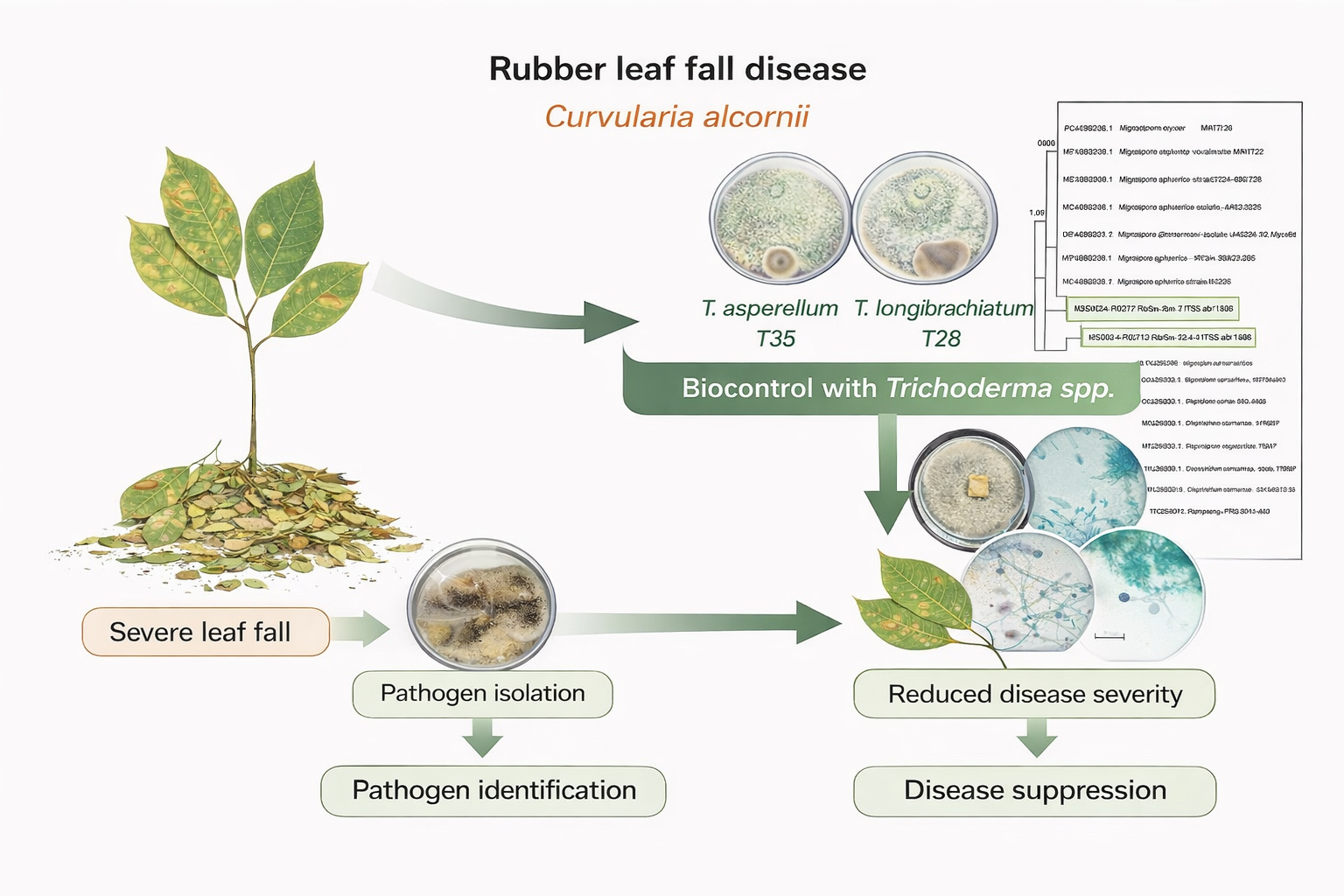
Rubber leaf fall disease is an important constraint affecting rubber production and is associated with several fungal pathogens that reduce leaf area, photosynthetic capacity, and overall plant vigor. Volcanic durian orchard soils are recognized as a potential reservoir of beneficial microorganisms with biocontrol activity. Therefore, this study aimed to isolate and identify fungal pathogens associated with rubber leaf fall symptoms and to evaluate the biocontrol efficacy of Trichoderma spp. isolated from volcanic durian orchard soils in Sisaket Province, Thailand, against the most virulent pathogen. A total of 13 fungal isolates were obtained from symptomatic rubber leaves collected in Sakon Nakhon Province, Thailand. Based on morphological characteristics and ITS sequence analysis, the isolates were preliminarily assigned to the genera, including Colletotrichum, Curvularia, Diaporthe, Nigrospora, and Neodeightonia. Pathogenicity tests revealed that the Curvularia isolate RbSn212-3 was the most virulent, producing the largest lesion diameter (33.53 ± 3.29 mm) at 7 days post-inoculation. A total of 21 Trichoderma isolates obtained from volcanic durian orchard soils were evaluated for antagonistic activity using dual culture assays. Trichoderma longibrachiatum T19, T28, and Trichoderma harzianum T47 exhibited strong inhibition against Curvularia isolates RbSn212-3, with inhibition rates of 78.58%, 77.15%, and 75.72%, respectively. Trichoderma asperellum T33 showed the highest overgrowth capacity (187.5%), indicating strong mycoparasitic potential. However, culture filtrates of selected isolates did not suppress pathogen growth under the tested conditions. Detached leaf assays demonstrated that T. asperellum T33, T. harzianum T20, and T. harzianum KU completely suppressed lesion development, achieving up to 100% disease inhibition depending on the inoculation sequence. These findings indicate that selected Trichoderma isolates possess promising potential as biological control agents against rubber leaf fall disease caused by Curvularia spp. Further studies incorporating multilocus phylogenetic analyses, as well as greenhouse and field evaluations, are required to confirm pathogen identity and validate the efficacy of these biocontrol agents under practical cultivation conditions.
HIGHLIGHTS
- Curvularia was identified as a major pathogen associated with rubber leaf fall.
- Selected Trichoderma effectively suppressed Curvulariagrowth and infection.
- Preventive Trichodermaapplication provided stronger disease suppression than curative treatment.
- asperellumT33, T. longibrachiatum T28, and T. harzianum KU showed high biocontrol potential.
GRAPHICAL ABSTRACT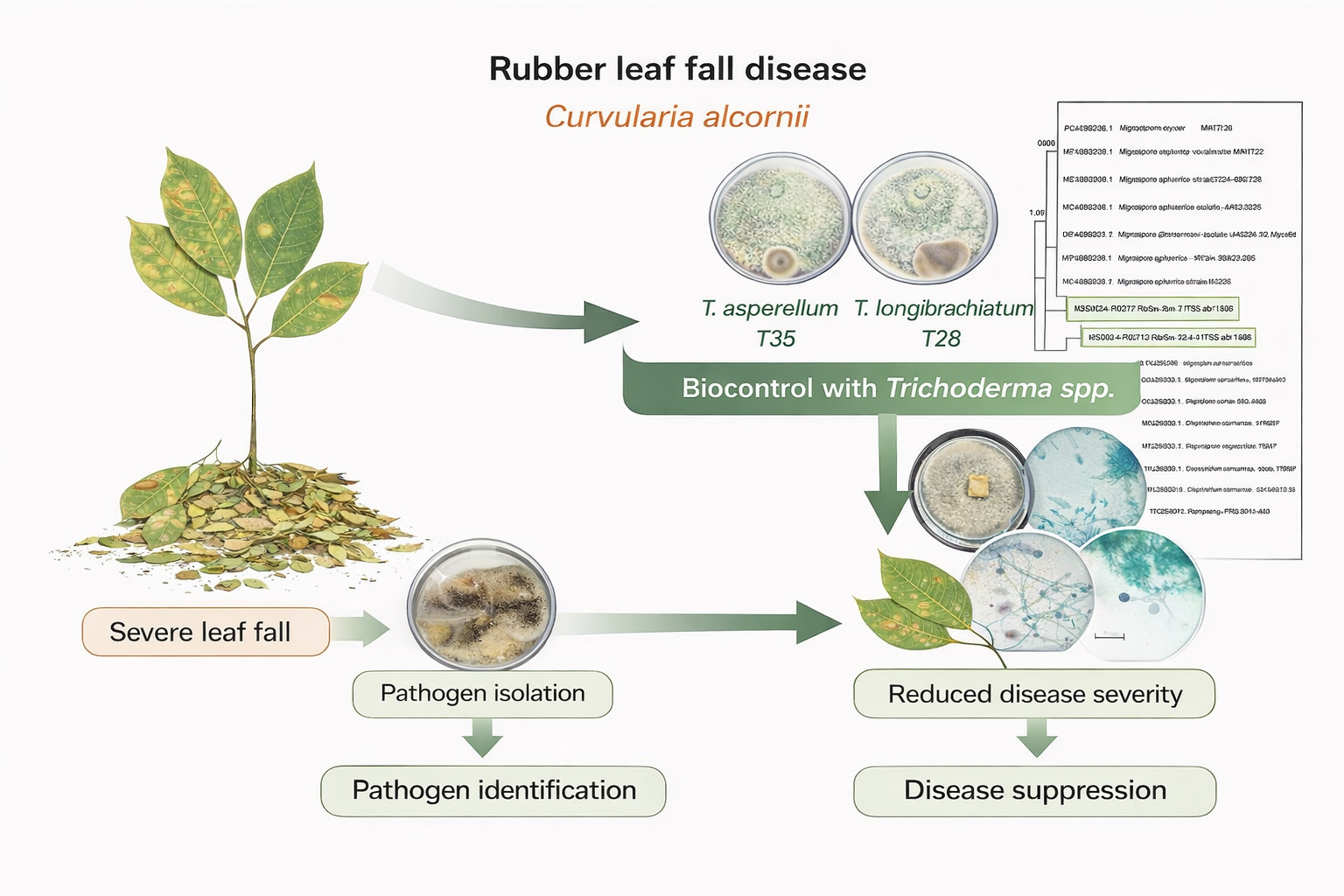
Downloads
References
JN Simon, N Nuthammachot, K Techato, KE Okpara, S Channumsin, R Kaewthongrach and MSK Sarkar. Para rubber (Hevea brasiliensis) feedstock for livelihoods opportunities in Southern Thailand: Analysis of socioeconomic productivity potentials and security. Sustainability 2022; 14(16), 10142.
N Thaochan, C Pornsuriya, T Chairin, P Chomnunti and A Sunpapao. Morphological and molecular characterization of Calonectria foliicola associated with leaf blight on rubber tree (Hevea brasiliensis) in Thailand. Journal of Fungi 2022; 8(10), 986.
FA Azizan, IS Astuti, A Young and AA Aziz. Rubber leaf fall phenomenon linked to increased temperature. Agriculture, Ecosystems & Environment 2023; 352, 108531.
S Kaewchai, P Paopradit, C Pornsuriya, RS Jayawardena and KD Hyde. Pathogenicity and molecular phylogenetic analysis reveal Colletotrichum siamense as causal agent of leaf fall disease in rubber trees (Hevea brasiliensis) in Southern Thailand. Agriculture and Natural Resources 2024; 58(1), 49-58.
T Sirikamonsathien, M Kenji and T Dethoup. Potential of endophytic Trichoderma in controlling Phytophthora leaf fall disease in rubber (Hevea brasiliensis). Biological Control 2023; 179, 105175.
HA Contreras-Cornejo, M Schmoll, BA Esquivel-Ayala, CE González-Esquivel, V Rocha-Ramírez and J Larsen. Mechanisms for plant growth promotion activated by Trichoderma in natural and managed terrestrial ecosystems. Microbiological Research 2024; 281, 127621.
L Kredics, R Büchner, D Balázs, H Allaga, O Kedves, G Racić, A Varga, VD Nagy, C Vágvölgyi and G Sipos. Recent advances in the use of Trichoderma-containing multicomponent microbial inoculants for pathogen control and plant growth promotion. World Journal of Microbiology and Biotechnology, 2024. 40, 162.
N Seekham, N Kaewsalong, A Jantasorn and T Dethoup. Biological control of Corynespora leaf fall disease in rubber by endophytic Trichoderma spp. under field conditions. Europian Journal of Plant Pathology 2024; 170, 207-218.
W Sutthisa, W Hompana and R Yutthasin. Enhancing biocontrol potential: Development and efficacy assessment of a liquid formulation of Trichoderma asperellum MSU007 against Sclerotium rolfsii. Trends in Sciences 2024; 21(4), 7550.
W Sutthisa, J Srilawong, N Kliangros, S Khankhum and P Charirak. Development and application of a Trichoderma-PGPR bioformulation to enhance rice growth. Journal of Pure and Applied Microbiology 2025; 19(1), 296-306.
S Pandey, R Kumar and K Giri. In vitro antagonism of Trichoderma isolates against Curvularia andropogonis causing leaf blight of Java citronella. National Academy Science Letters 2019; 42(3), 259-263.
W Sutthisa, B Kunseekhaw, S Khankhum, P Pimvichai and R Yutthasin. Assessment of Trichoderma species Isolated from volcanic soil of a durian field in Sisaket province, Thailand for plant growth promotion and biocontrol potential. Trends in Sciences 2024; 21(11), 8452.
TJ White, T Bruns, S Lee and K Taylor. Amplification and direct sequencing of fungal ribosomal RNA genes for phylogenetics. Academic Press, New York, 1990, p. 315-322.
K Saravanakumar and W Myeong-Hyeon. Isolation and molecular identification of Trichoderma species from wetland soil and their antagonistic activity against phytopathogens. Physiological and Molecular Plant Pathology 2020; 109, 101458.
CL Schoch, KA Seifert, S Huhndorf, V Robert, JL Spouge, CA Levesque and W Chen. Nuclear ribosomal internal transcribed spacer (ITS) region as a universal DNA barcode marker for Fungi. Proceedings of the National Academy of Sciences of the United States of America 2012; 109(16), 6241-6246.
AT Hoang, TT Lam, HTP Thi, HN Thi, HP Pham, LD Thi, DD Ngo and AD Do. Identification of Nigrospora sphaerica and Curvularia lunata as causal agents of leaf spot disease in cantaloupe (Cucumis melo L.) in Southern Vietnam. Australasian Plant Pathology 2025; 54, 177-186.
X Liu, B Li, J Cai, X Zheng, Y Feng and G Huang. Colletotrichum species causing anthracnose of rubber trees in China. Scientific Reports 2018; 8, 10435.
Y Liu,Y Shi, D Zhuo, T Yang, L Dai, L Li, H Zhao, X Liu and Z Cai. Characterization of Colletotrichum causing anthracnose on rubber trees in Yunnan: Two new records and two new species from China. Plant Disease 2023; 107(10), 3037-3050.
M Wang, F Liu, PW Crous and L Cai. Phylogenetic reassessment of Nigrospora: Ubiquitous endophytes, plant and human pathogens. Persoonia 2017; 39, 118-142.
V Guarnaccia and PW Crous. Emerging citrus diseases in Europe caused by species of Diaporthe. IMA Fungus 2017; 8(2), 317-334.
A Alves, PW Crous, A Correia and AJL Phillips. Morphological and molecular data reveal cryptic speciation in Lasiodiplodia theobromae. Fungal Diversity 2008; 28, 1-13.
KD Hyde, P Baldrian, Y Chen, KWT Chethana, SD Hoog, M Doilom, ARG de Farias, MFM Gonçalves, D Gonkhom, H Gui, S Hilário, Y Hu, RS Jayawardena, S Khyaju, PM Kirk, P Kohout, T Luangharn, SSN Maharachchikumbura, IS Manawasinghe, PE Mortimer, ..., A Walker. Current trends, limitations and future research in the fungi. Fungal Diversity 2024; 125, 1-71.
GE Harman, CR Howell, A Viterbo, I Chet and M Lorito. Trichoderma species - opportunistic, avirulent plant symbionts. Nature Reviews Microbiology 2024; 2, 43-56.
E Becker, N Rajakulendran and SF Shamoun. Biocontrol potential of Trichoderma spp. against Phytophthora ramorum. Pathogens 2025; 14(2), 136.
F Vinale, K Sivasithamparam, EL Ghisalberti, GR Marra, SL Woo and M Lorito. Trichoderma–plant–pathogen interactions. Soil Biology and Biochemistry 2008; 40(1), 1-10.
C Stracquadanio, JM Quiles, G Meca and SO Cacciola. Antifungal activity of bioactive metabolites produced by Trichoderma asperellum and Trichoderma atroviride in iiquid medium. Journal of Fungi 2020; 6(4), 263.
Downloads
Published
How to Cite
Issue
Section
License
Copyright (c) 2026 Walailak University

This work is licensed under a Creative Commons Attribution-NonCommercial-NoDerivatives 4.0 International License.