
Development of Alginate-Based Bacillus subtilis Biopellets for Tomato Bacterial Wilt Control
DOI:
https://doi.org/10.48048/tis.2025.10332Keywords:
Alginate encapsulation, Bacillus subtilis, Biocontrol, Biopellets, Seed treatment, Tomato bacterial wiltAbstract
Tomato bacterial wilt, caused by Ralstonia solanacearum, poses a significant challenge to crop production. This study screened 101 bacterial isolates from soil samples collected in Maha Sarakham Province, Thailand, for their antagonistic activity against R. solanacearum. The selection process involved initial screening based on visual inhibition zones using the paper disc diffusion method, followed by quantitative assessment of bacterial growth inhibition. Among the isolates, SK3-24 exhibited the highest inhibitory effect, forming an inhibition zone of 40.00 ± 17.32 mm, as measured using the standard zone of inhibition method, followed by SK3-20 (18.17 ± 1.50 mm). Morphological, biochemical, and molecular analyses (16S rRNA gene sequencing) identified SK3-24 as Bacillus subtilis. To enhance its application, SK3-24 was formulated into alginate-based biopellets, which maintained high bacterial viability (1.20 × 10⁸ CFU/g) after nine months of storage at 4 °C. Greenhouse trials demonstrated that these biopellets effectively suppressed disease incidence and severity in tomato seedlings and seeds. At 21 days post-inoculation, treated plants showed no disease symptoms and exhibited enhanced growth, with plant height (16.14 ± 1.32 cm) and leaf number (19.40 ± 1.34) comparable to healthy controls. These findings underscore the potential of SK3-24 biopellets as a sustainable and effective biocontrol strategy for managing tomato bacterial wilt while promoting plant health.
HIGHLIGHTS
This study explores the identification of effective antagonistic bacterial strains against R. solanacearum through 16S rDNA sequencing and aims to develop a bioformulation for sustainable management of tomato bacterial wilt. By integrating strain characterization, screening, and bioformulation development, this research seeks to deliver an environmentally friendly alternative to chemical pesticides, ensuring enhanced tomato production while safeguarding environmental and human health.
GRAPHICAL ABSTRACT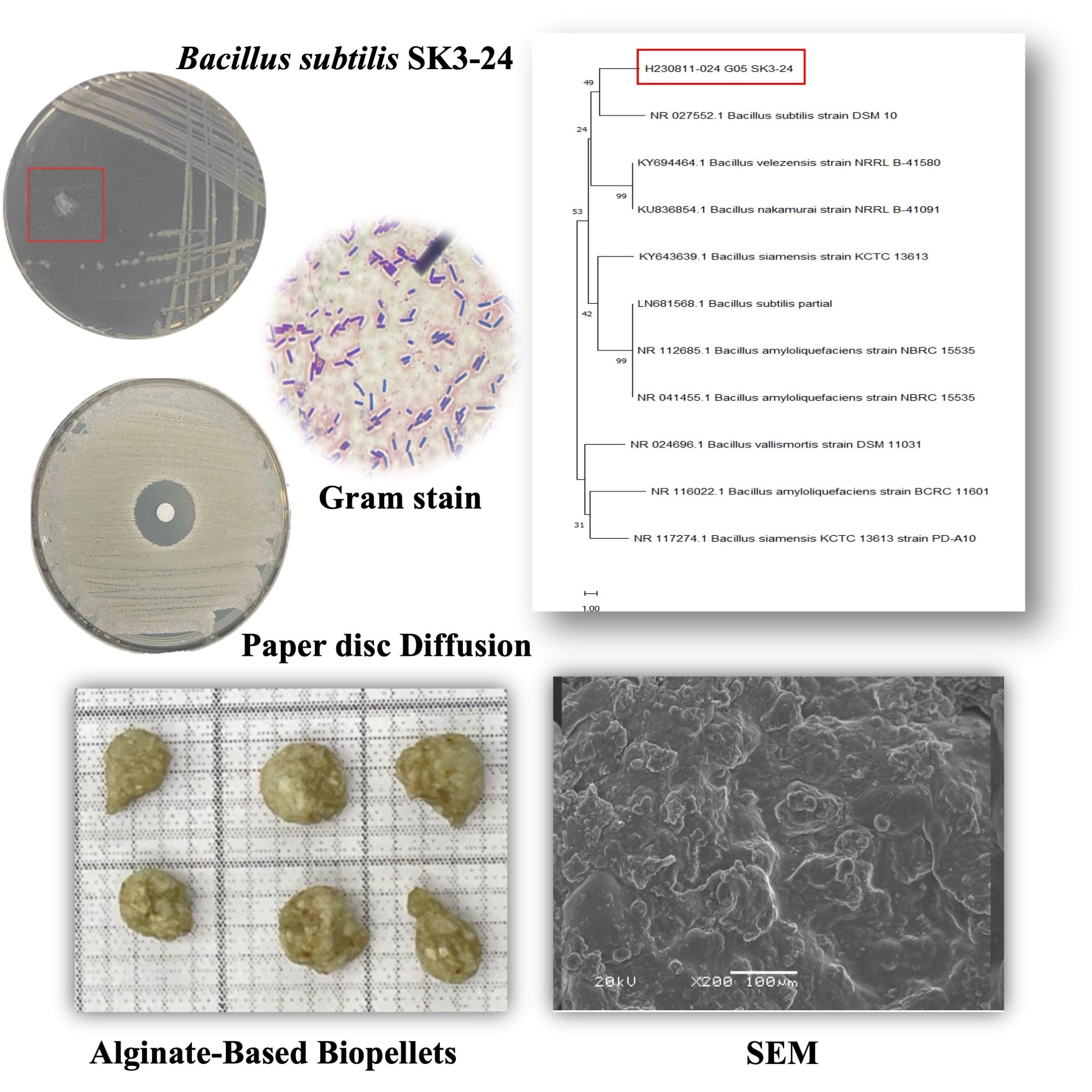
Downloads
References
DM Gatahi. Challenges and opportunities in tomato production chain and sustainable standards. International Journal of Horticulture Science and Technology 2020; 7(3), 235-262.
IB Chabi, O Zannou, SCAD Emmanuelle, BP Ayegnon, B Oloude, O Odouaro, S Maqsood, CM Galanakis and APP Kayode. Tomato pomace as a source of valuable functional ingredients for improving physicochemical and sensory properties and extending the shelf life of foods. Heliyon 2024; 10(3), e25261.
EJ Collins, C Bowyer, A Tsouza and M Chopra. Tomatoes: An extensive review of the associated health impacts of tomatoes and factors that can affect their cultivation. Biology (Basel) 2022; 11(2), 239.
MO Shafe, NM Gumede, TT Nyakudya and E Chivandi. Lycopene: A potent antioxidant with multiple health benefits. Journal of Nutrition and Metabolism 2024; 17, 6252426.
Y He, Y Chen, Y Zhang , X Qin, X Wei, D Zheng, W Lin, Q Li and G Yuan. Genetic diversity of Ralstonia solanacearum species complex strains obtained from Guangxi, China and their pathogenicity on plant in the Cucurbitaceae family and other botanical families. Plant Pathology 2021; 70(6), 1261-1532.
A Balla, A Silini, H Cherif-Silini, BA Chenari, WK Moser, JA Nowakowska, T Oszako, F Benia and L Belbahri. The threat of pests and pathogens and the potential for biological control in forest rcosystems. Forests 2021; 12(11), 1579.
TM Phiri, G Bhattarai, KE Chiwina, Q Fan, H Xiong, I Alatawi, R Dickson, NK Joshi, A Rojas, KS Ling and A Shi. An evaluation of bacterial wilt (Ralstonia solanacearum) resistance in a set of tomato germplasm from the United States department of Agriculture. Agronomy 2024; 14(2), 350.
P Finger, J Sok, E Ahovi, S Akter, J Bremmer, S Dachbrodt-Saaydeh, C de Lauwere, C Kreft, P Kudsk, F Lambarraa-Lehnhardt, C McCallum, AO Lansink, E Wauters and N Mohring. Towards sustainable crop protection in agriculture: A framework for research and policy. Agricultural Systems 2024; 219, 104037.
A Dadrasnia, MM Usman, R Omar, S Ismail and R Abdullah. Potential use of Bacillus genus to control of bananas diseases: Approaches toward high yield production and sustainable management. Journal of King Saud University - Science 2020; 32(4), 2336-2342.
CKF Wong, NB Saidi, G Vadamalai, CY Teh and D Zulperi. Effect of bioformulations on the biocontrol efficacy, microbial viability and storage stability of a consortium of biocontrol agents against Fusarium wilt of banana. Journal of Applied Microbiology 2019; 127(2), 544-555.
W Sutthisa and S Anujakkawan. Antibacterial potential of oyster mushroom (Pleurotus ostreatus (Jacq. Ex Fr.) P. Kumm.) extract against pathogenic bacteria. Journal of Pure and Applied Microbiology 2023; 17(3), 1907-1915.
Q Chen, Y Song, Y An, Y Lu and G Zhong. Soil microorganisms: Their role in enhancing crop nutrition and health. Diversity 2024; 16(12), 734.
S Jayaraman, AK Naorem, R Lal, RC Dalal, NK Sinha, AK Patra and SK Chaudhari. Disease-suppressive soils-beyond food production: A critical Review. Journal of Soil Science and Plant Nutrition 2021; 21, 1437-1465.
Y Jia, H Niu, P Zhao, X Li, F Yan, C Wang and Z Qiu. Synergistic biocontrol of Bacillus subtilis and Pseudomonas fluorescens against early blight disease in tomato. Applird Microbiology and Biotechnology 2023; 107(19), 6071-6083.
CP Serrao, JCG Ortega, PC Rodrigues and CRB de Souza. Bacillus species as tools for biocontrol of plant diseases: A meta-analysis of twenty-two years of research, 2000-2021. World Journal of Microbiology and Biotechnology 2024; 40(4), 110.
JM Liu, SS Wang, X Zheng, N Jin, J Lu, YT Huang, B Fan and FZ Wang. Antimicrobial activity against phytopathogens and inhibitory activity on solanine in potatoes of the endophytic bacteria isolated from potato tubers. Frontiers Microbiology 2020; 11, 570926.
J Shafi, H Tian and M Ji. Bacillus species as versatile weapons for plant pathogens: A review. Biotechnol & Biotechnological Equipment 2017; 31(3), 446-459.
Y Wang, Y Pei, X Wang, X Dai and M Zhu. Antimicrobial metabolites produced by the plant growth-promoting rhizobacteria (PGPR): Bacillus and Pseudomonas. Advanced Agrochem 2024; 3(3), 206-221.
DR Boone, RW Castenholz and GM Garrity. Bergey’s manual of systematic bacteriology. Vol I. Springer, New York, 2001, p. 1-722.
R Franco-Duarte, L Cernakova, S Kadam, KA Kaushik, B Salehi, A Bevilacqua, MR Corbo, H Antolak, K Dybka-Stępien, M Leszczewicz, TS Relison, AVC de Souza, J Sharifi-Rad, HDM Coutinho, N Martins and CF Rodrigues. Advances in chemical and biological methods to identify microorganisms-from past to present. Microorganisms 2019; 7(5), 130.
CR Harwood, JM Mouillon, S Pohl and J Arnau. Secondary metabolite production and the safety of industrially important members of the Bacillus subtilis group. FEMS Microbiology Reviews 2018; 42(6), 721-738.
S Boulahouat, H Cherif-Silini, A Silini, AC Bouket, L Luptakova, FN Alenezi and L Belbahri. Biocontrol efficiency of rhizospheric Bacillus against the plant pathogen Fusarium oxysporum: A promising approach for sustainable agriculture. Microbiology Research 2023; 14(3), 892-908.
D Zadeike, Z Gaizauskaite, L Basinskiene, R Zvirdauskiene and D Cizeikiene. Exploring calcium alginate-based gels for encapsulation of Lacticaseibacillus paracasei to enhance stability in functional breadmaking. Gels 2024; 10(10), 641.
RS Riseh, YA Skorik, VK Thakur, MM Pour, E Tamanadar and SS Noghabi. Encapsulation of plant biocontrol bacteria with alginate as a main polymer material. International Journal of Molecular Sciences 2021; 22(20), 11165.
M Ali, J Cybulska, M Frac and A Zdunek. Application of polysaccharides for the encapsulation of beneficial microorganisms for agricultural purposes. International Journal of Biological Macromolecules 2023; 244, 125366.
E Lotfalinezhad, A Taheri, SE Razavi and SJ Sanei. Preparation and assessment of alginate-microencapsulated Trichoderma harzianum for controlling Sclerotinia sclerotiorum and Rhizoctonia solani on tomato. International Journal of Biological Macromolecules 2024; 259(2), 129278.
AM Diaz-Rodriguez, FI Parra, LAC Chavez, LFG Ortega, MIE Alvarado,G Santoyo and S de los Santos-Villalobos. Microbial Inoculants in sustainable agriculture: Advancements, challenges, and future directions. Plants 2025; 14(2), 191.
Z Minchev, O Kostenko, R Soler and MJ Pozo. Microbial consortia for effective biocontrol of root and foliar diseases in tomato. Frontiers in Plant Science 2021; 12, 756368.
S Singh and DJH Shyu. Perspective on utilization of Bacillus species as plant probiotics for different crops in adverse conditions. AIMS Microbiology 2024; 10(1), 220-238.

Published
How to Cite
Issue
Section
License
Copyright (c) 2025 Walailak University

This work is licensed under a Creative Commons Attribution-NonCommercial-NoDerivatives 4.0 International License.





