
Chemical Composition and Antifungal Properties of Guava Leaf Extract (Psidium guajava L.) Against Pythium aphanidermatum, Chinese Kale Damping-Off Disease Pathogen
DOI:
https://doi.org/10.48048/tis.2024.8134Keywords:
Damping-off disease, GC-MS, Guava, Plant extracts, Seeds coatingAbstract
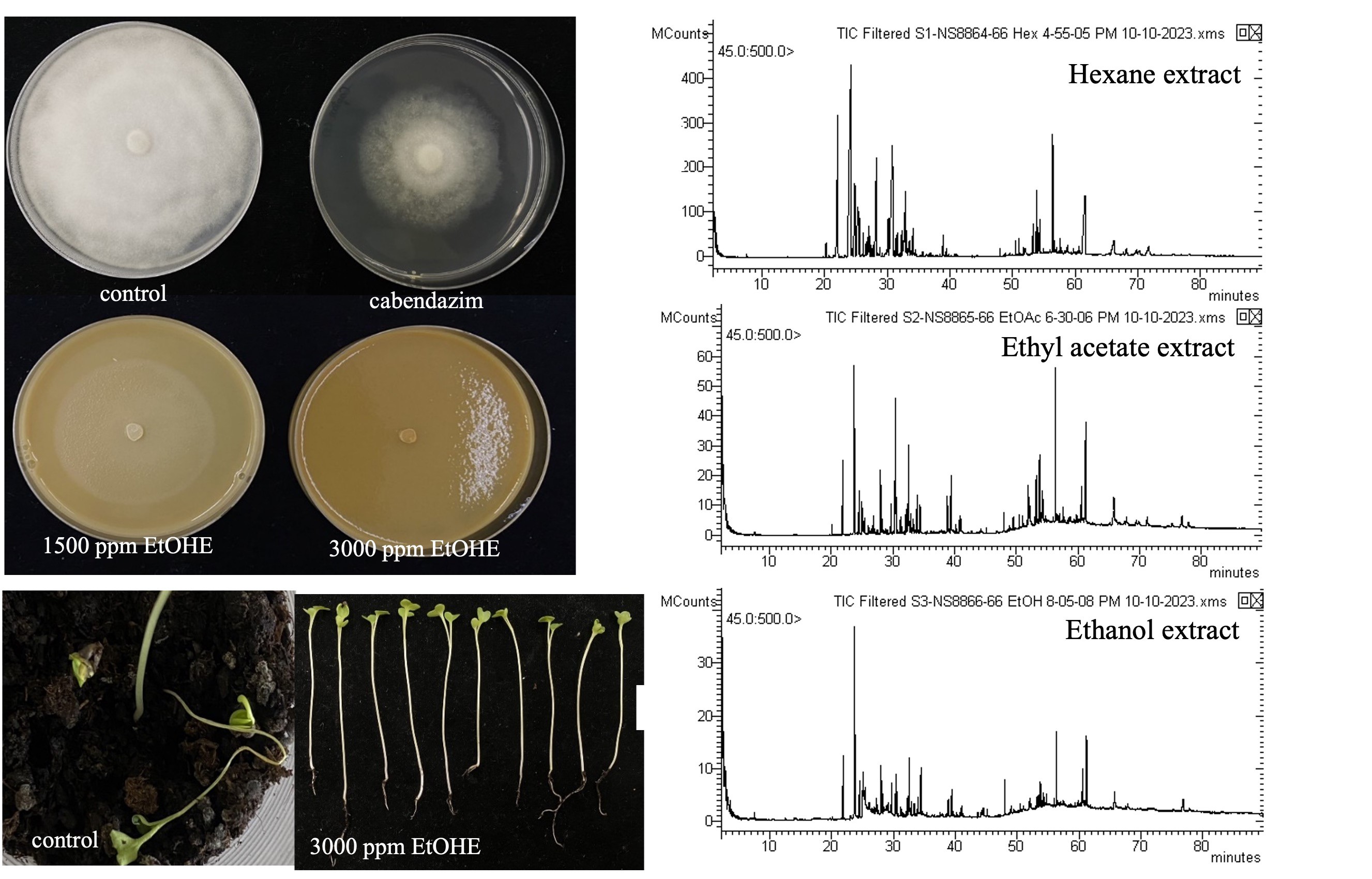
Damping-off disease represents a considerable hazard to the cultivation of Chinese kale (Brassica oleracea var. alboglabra), leading to seedling death and notable economic repercussions. This study explores the efficacy of guava leaf extracts, obtained through different extraction solvents, against Pythium aphanidermatum, a significant pathogen causing damping-off disease in Chinese kale (Pak Kha-naa) cultivation in Thailand. Guava leaf extract was obtained using different solvents: hexane, ethyl acetate and ethanol. Subsequently, the extract was diluted to concentrations of 1,000, 1,500 and 3,000 ppm to assessment the inhibitory effects on P. aphanidermatum utilizing the poisoned plate technique. Results revealed that only ethanol-extracted guava leaf extract at 3,000 ppm exhibited significant inhibition of P. aphanidermatum, achieving complete inhibition. At 1,500 ppm, ethanol-extracted guava leaf extract demonstrated inhibition comparable to carbendazim. Greenhouse trials further confirmed the efficacy of pre-planting seeds coating with ethanolic guava leaf extract at concentrations of 1,500 and 3,000 ppm in reducing damping-off disease incidence in Chinese kale. Chemical analysis of guava extract with GC-MS revealed the presence of 58 compounds in the hexane extract, with copaene, β-caryophyllene, calamenene and caryophyllene oxide being major constituents. The ethyl acetate extract contained 53 compounds, including β-caryophyllene and squalene, while caryophyllene was a predominant component among the 40 chemicals identified in the ethanol extract. Methylparaben was exclusively present in the ethanol extract, showcasing inhibitory effects on the fungus. This research sheds light on the potential of guava leaf extracts as a sustainable solution for disease management in Chinese kale cultivation.
HIGHLIGHTS
Ethanolic extract of guava leaf at 3,000 ppm completely inhibits the pathogen Pythium aphanidermatum. Seed coated with ethanol-extracted guava leaf extract at concentrations of 1,500 and 3,000 ppm reduced damping-off disease incidence in Chinese kale in greenhouse trials. Chemical analysis via GC-MS revealed diverse compounds in guava leaf extracts, with notable constituents such as copaene, β-caryophyllene, calamenene and caryophyllene oxide in the hexane extract, β-caryophyllene and squalene in the ethyl acetate extract and caryophyllene predominance in the ethanol extract. Identification of methylparaben exclusively in the ethanol extract suggests its potential inhibitory effects on the fungus. This study underscores the promising potential of guava leaf extracts as a sustainable solution for disease management in Chinese kale cultivation, offering insights into alternative methods for controlling damping-off disease.
GRAPHICAL ABSTRACT
Downloads
References
JR Lamichhane, C Dürr, AA. Schwanck, MH Robin, JP Sarthou, V Cellier, A Messéan and JN Aubertot. Integrated management of damping-off diseases. A review. Agron. Sustain. Dev. 2017; 37, 10.
RK Horst. Westcott’s plant disease handbook. Springer, Dordrecht, the Netherlands, 2013, p. 177.
M Babadoost and SZ Islam. Fungicide seed treatment effects on seed- ling damping-off of pumpkin caused by Phytophthora capsici. Plant Dis. 2003; 87, 63-8.
C Bacharis, A Gouziotis, P Kalogeropoulou, O Koutita, K Tzavella- Klonari and GS Karaoglanidis. Characterization of Rhizoctonia spp. isolates associated with damping-off disease in cotton and tobacco seedlings in Greece. Plant Dis. 2010; 94, 1314-22.
MA Fajardo-Mejía, JG Morales-Osorio1, GA Correa-Londoño and JD León-Peláez. Effect of plant extracts and growth substrates on controlling damping-off in Pinus tecunumanii seedlings. Cerne 2016; 22, 317-324.
MK Al-shemmary, AA El-Zaawely, AH Al-Taie and NI Elsheery. Antifungal activity of some plant extracts and Trichoderma spp. against cucumber damping off caused by Pythium aphanidermatum. J. Biodiversity Environ. Sci.2018; 12, 195-203.
MT Fauzi and RD Sari. Effectiveness of several plant extracts as botanical fungicides to control damping-off disease caused by Sclerotium rolfsii on soybean. IOP Conf. Ser. Earth Environ. Sci. 2022; 1107, 012035.
NASM Hamidi, WMIWM Kamaruzzaman, NAM Nasir, MS Shaifudin and MSM Ghazali. Potential application of plant-based derivatives as green components in functional coatings: A review. Cleaner Mater. 2022; 4, 100097.
MF Abdel-Monaim, KAM Abo-Elyousr and KM Morsy. Effectiveness of plant extracts on suppression of damping-off and wilt diseases of lupine (Lupinus termis Forsik). Crop Prot. 2011; 30, 185-91.
M Kumar, M Tomar, R Amarowicz, V Saurabh, MS Nair, C Maheshwari, M Sasi, U Prajapati, M Hasan, S Singh, S Changan, RK Prajapat, MK Berwal and V Satankar. Guava (Psidium guajava L.) leaves: Nutritional composition, phytochemical profile, and health-promoting bioactivities. Foods 2021; 10, 752.
PG Daswani, MS Gholkar and TJ Birdi. Psidium guajava: A single plant for multiple health problems of rural Indian population. Pharmacogn. Rev. 2017; 11, 167-74.
MT Islam and AN Faruq. Effect of some medicinal plant extracts on damping-off disease of winter vegetable. World Appl. Sci. J. 2012; 17, 1498-503.
S Shaheena, AD Chintagunta, VR Dirisala and NSS Kumar. Extraction of bioactive compounds from Psidium guajava and their application in dentistry. AMB Express 2019; 9, 208.
RB Devi, TN Barkath, P Vijayaraghavan and TS Rejiniemon. GC-MS analysis of phytochemical from Psidium guajava Linn leaf extract and their invitro antimicrobial activities. Int. J. Pharm Biol. Sci. 2018; 8, 583-9.
W Sutthisa and P Chaiyacham. Antibacterial activity of ethanolic extracts of Lentinus squarrosulus Mont. against human pathogenic bacteria. J. Pure Appl. Microbiol. 2022; 16, 441-7.
S Bahraminejad, R Amiri, S Ghasemi and N Fathi. Inhibitory effect of some Iranian plant species against three plant pathogenic fungi. Int. J. Agr. Crop Sci. 2013; 5, 1002-8.
W Sutthisa, A Popranom, A Taddeetrakool and S Khankhum. Development of Trichoderma formulation and application to control durian anthracnose disease. Trend. Sci. 2024; 21, 7276.
K Kumari, S Bhargava and R Singh. GC-MS Analysis of methanol extracts of five toxic plant seed for detection of bioactive compounds. Indian J. Forensic Med. Toxicol. 2020; 14, 395-401.
S Tachakittirungrod, S Okonogi and S Chowwanapoonpohn. Study on antioxidant activity of certain plants in Thailand: Mechanism of antioxidant action of guava leaf extract. Food Chem. 2007; 103, 381-8.
N Vukovic, T Milosevic, S Sukdolak and S Solujic. Antimicrobial activities of essential oil and methanol extract of Teucrium montanum. Evid. Based Complement Altern. Med. 2007; 4, 17-20.
B Biswas, K Rogers, F McLaughlin, D Daniels and A Yadav. Antimicrobial activities of leaf extracts of Guava (Psidium guajava L.) on two gram-negative and gram-positive bacteria. Int. J. Microbiol. 2013; 2013, 746165.
AK Blanco-Ríos, LÁ Medina-Juárez, GA González-Aguilar and N Gámez-Meza. Antioxidant activity of the phenolic and oily fractions of different sweet bell peppers. J. Mex. Chem. Soc. 2013; 57, 137-43.
SS Dahham, YM Tabana, MA Iqbal, MBK Ahamed, MO Ezzat, ASA Majid and AMSA Majid. The anticancer, antioxidant and antimicrobial properties of the sesquiterpene β-Caryophyllene from the essential oil of Aquilaria crassna. Molecules 2015; 20, 11808-29.
RCS Sá, LN Andrade and DPD Sousa. Sesquiterpenes from essential oils and anti-Inflammatory activity. Nat. Prod. Commun. 2015; 10, 1767-74.
LI Paula-Freire, ML Andersen, VS Gama, GR Molska and EL Carlini. The oral administration of trans-caryophyllene attenuates acute and chronic pain in mice. Phytomedicine 2014; 21, 356-62.
A Alam, T Jawaid, SM Alsanad, M Kamal and MF Balaha. Composition, antibacterial efficacy, and anticancer activity of essential oil extracted from Psidium guajava (L.) leaves. Plants 2023; 12, 246.
ER Neves, S Schäfer, A Phillips, J Canejo and MF Macedo. Antifungal effect of different methyl and propyl paraben mixtures on the treatment of paper biodeterioration. Int. Biodeterior. Biodegrad. 2009; 63, 267-72.
Downloads
Published
How to Cite
Issue
Section
License
Copyright (c) 2024 Walailak University

This work is licensed under a Creative Commons Attribution-NonCommercial-NoDerivatives 4.0 International License.





