
Effect of Hydroxyl–Carboxyl Positional Isomerism in Hydroxybenzoic Acids on Gold Nanoparticle Capping and Paraquat Binding
DOI:
https://doi.org/10.48048/tis.2026.14111Keywords:
Gold nanoparticles, Hydroxybenzoic acid isomers, Paraquat, π-π interaction, Positional isomerismAbstract
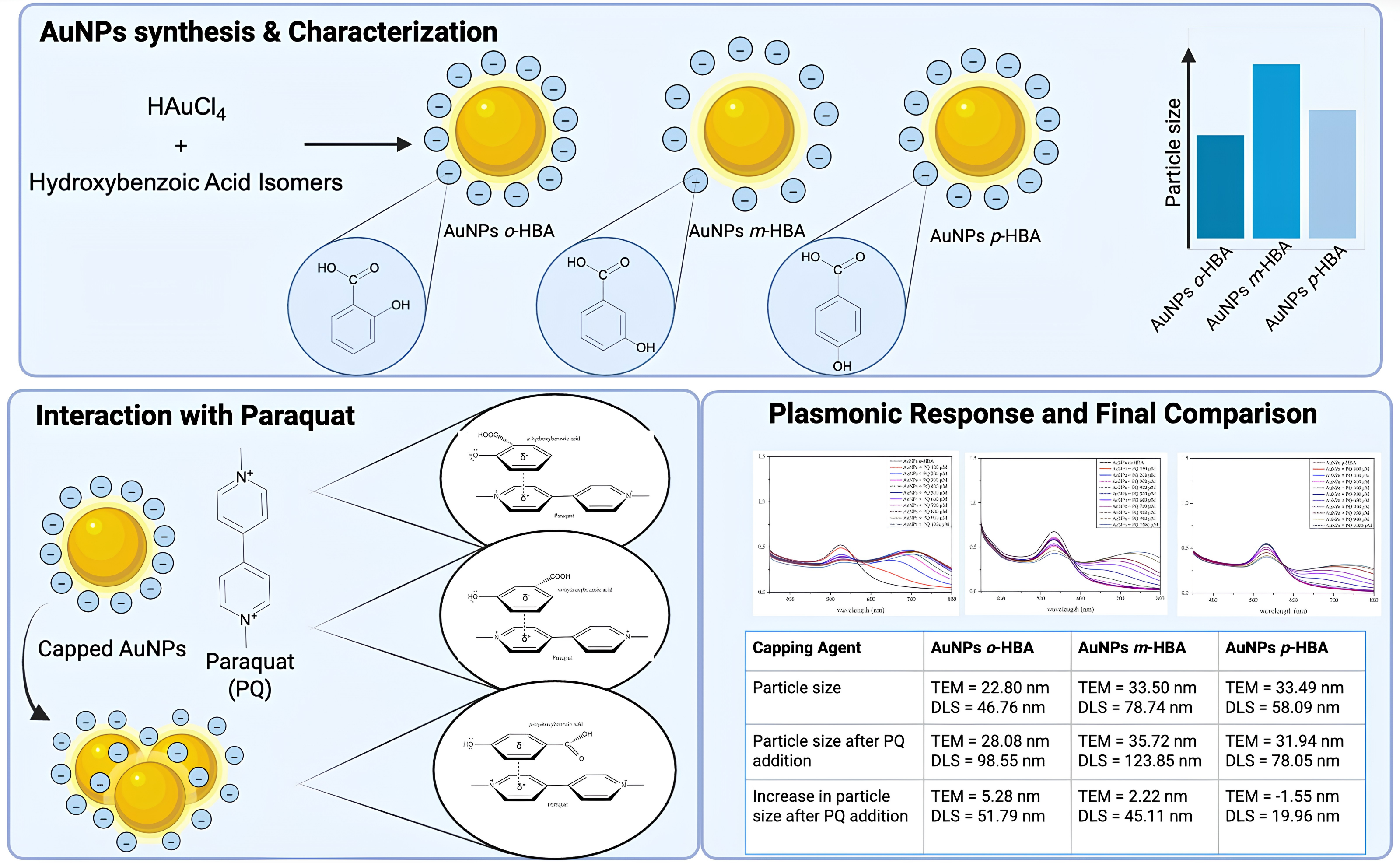
The positions of hydroxyl and carboxyl groups in hydroxybenzoic acid (HBA) isomers strongly influence their molecular properties; however, their roles in nanoparticle capping and analyte interactions remain insufficiently understood. This study aims to investigate how the positional isomerism of o–, m–, and p–hydroxybenzoic acid affects the synthesis, colloidal stability, and paraquat binding properties of gold nanoparticles (AuNPs). AuNPs were synthesized using each hydroxybenzoic acid isomer as a dual reducing and capping agent. UV–Vis spectroscopy, TEM, DLS, zeta potential, FTIR, and XRD characterized the resulting nanoparticles. Paraquat interactions were evaluated through SPR, hydrodynamic size, and aggregation changes at 1×10˗4 M to 1×10˗3 M. o–hydroxybenzoic acid produces the smallest (22.28 nm) and most uniform AuNPs with the highest negative zeta potential (˗52.8 mV), which may be related to intramolecular hydrogen bonding. Upon paraquat exposure, o-hydroxybenzoic acid-capped AuNPs showed the most pronounced SPR red shift and the largest increase in hydrodynamic diameter (46.76 to 92.55 nm). m–hydroxybenzoic acid-capped AuNPs exhibited intermediate responses, while p–hydroxybenzoic acid–capped AuNPs showed the weakest plasmonic response. Positional isomerism of hydroxybenzoic acids governs AuNPs formation, and paraquat induces aggregation. Despite their higher intrinsic stability, o–hydroxybenzoic acid-capped AuNPs are the most responsive to paraquat, which is proposed to involve π-π donor–acceptor interactions. These findings provide insight into the role of positional isomerism for designing isomer-selective capping layers in nanoparticle-based detection systems.
HIGHLIGHTS
- Gold nanoparticles (AuNPs) were successfully synthesized using o-, m-, and p-hydroxybenzoic acids as dual-function reducing and capping agents.
- The positional isomerism of the hydroxyl and carboxyl groups appears to influenced nanoparticle size, uniformity, and colloidal stability.
- The negatively charged hydroxybenzoic acids capped AuNPs were further utilized to study p-p interactions with positively charged paraquat.
- Paraquat induced concentration-dependent surface plasmon resonance (SPR) perturbations, nanoparticle aggregation, and increased hydrodynamic diameter, which are consistent with p donor-acceptor interactions.
GRAPHICAL ABSTRACT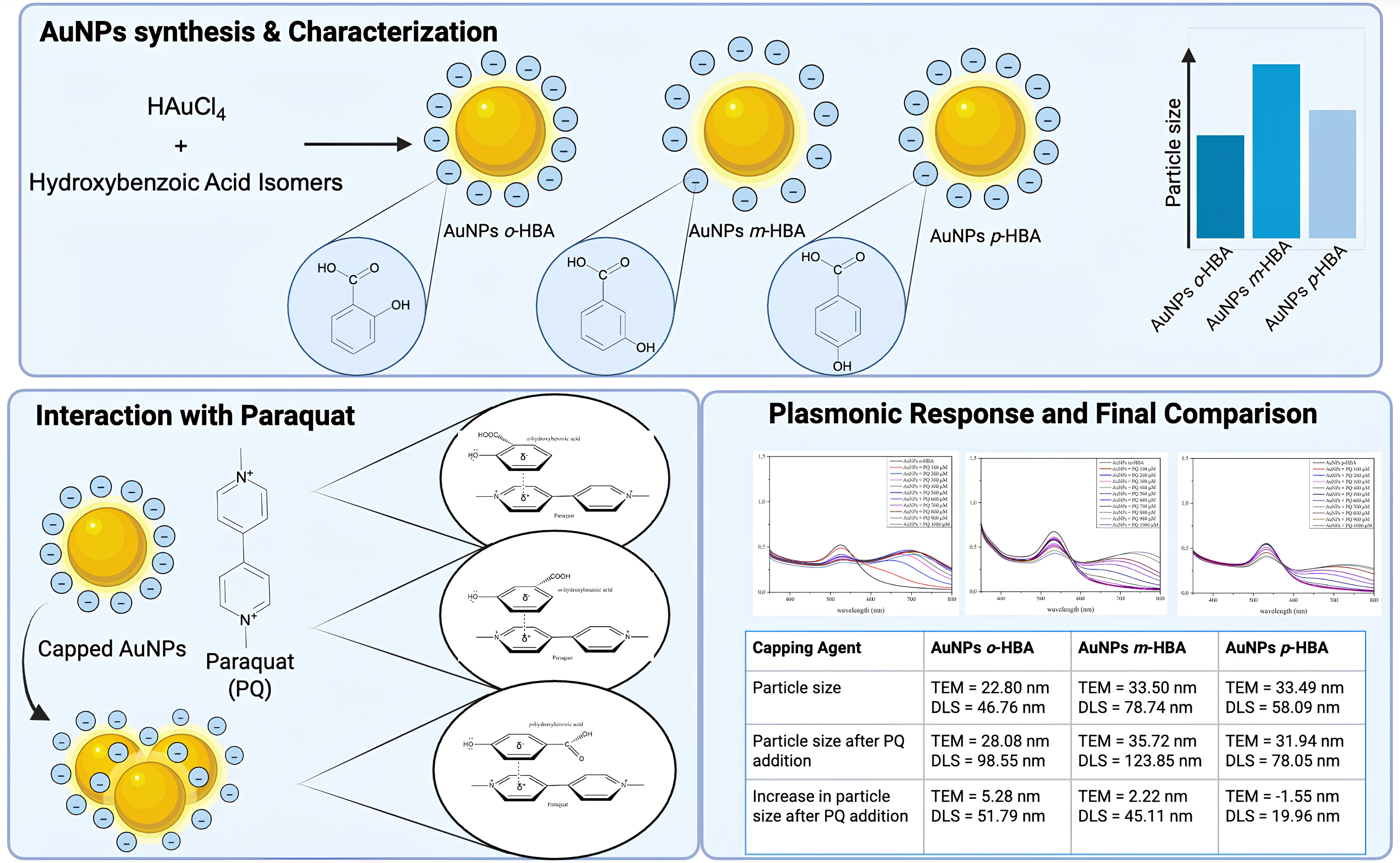
Downloads
References
MR Kumalasari, R Alfanaar and AS Andreani. Gold Nanoparticles (AuNPs): A versatile material for biosensor application. Talanta Open 2024; 9, 100327.
SAF Kusuma, JA Harmonis, R Pratiwi and AN Hasanah. Gold nanoparticle-Based colorimetric sensors: Properties and application in detection of heavy metals and biological molecules. Sensors 2023; 23(19), 8172.
S Palani, JP Kenison, S Sabuncu, T Huang, F Civitci, S Esener and X Nan. Multispectral localized surface plasmon resonance (msLSPR) reveals and overcomes spectral and sensing heterogeneities of single gold nanoparticles. ACS Nano 2023; 17(3), 2266.
DPS Negi. Recent developments in the colorimetric sensing of biological molecules using gold nanoparticles-based probes. Talanta Open 2022; 6, 100122.
H Kim, M Park, J Hwang, JH Kim, DR Chung, KS Lee and M Kang. Development of Label-free colorimetric assay for MERS-CoV using gold nanoparticles. ACS Sensor 2019; 4(5), 1306-1312.
H Yuan, W Ji, S Chu, Q Liu, J Guang, G Sun, Y Zang, X Han, J Masson and W Peng. Au nanoparticles as label-free competitive reporters for sensitivity enhanced fiber-optic spr heparin sensor. Biosensor and Bioelectronic 2020; 154, 112039.
R D’Agata and G Spoto. Surface plasmon resonance imaging for nucleic acid detection. Analytical and Bioanalytical Chemistry 2013; 405, 573-584.
H Chen, S Cai, J Luo, X Liu, L Ou, Q Zhang, B Liedberg and Y Wang. Colorimetric biosensing assays based on gold nanoparticles functionalized/combined with non-antibody recognition elements. Trends in Analytical Chemistry 2024; 173, 117654.
SM Amini and A Akbari. Metal nanoparticles synthesis through natural phenolic acids. IET Nanobiotechnology 2019; 13(8), 771-777.
AS Andreani, ES Kunarti and SJ Santosa. Synthesis of gold nanoparticles capped-benzoic acid derivative compounds (o-, m-, and p-Hydroxybenzoic Acid). Indonesian Journal of Chemistry 2019; 19(2), 376.
AM Figat, B Bartosewicz, M Liszewska, B Budner, M Norek and BJ Jankiewicz. α-Amino Acids as Reducing and Capping Agents in Gold Nanoparticles Synthesis Using the Turkevich Method. Langmuir 2023; 39(25), 8646-8657.
A Hill, H Sa’Adeh, D Cameron, F Wang, AB Trofimov, EY Larionova, R Richter and K Prince. Positional and conformational isomerism in hydroxybenzoic acid: A Core-level study and comparison with phenol and benzoic acid. Journal of Physical Chemistry A 2021; 125(45), 9877-9891.
K Aarset, EM Page and DA Rice. Molecular structures of benzoic acid and 2-Hydroxybenzoic acid, obtained by gas-phase electron diffraction and theoretical calculations. Journal of Physical Chemistry A 2006; 112(40), 10040-10045.
K Aarset, EM Page and DA Rice. Molecular structures of 3-hydroxybenzoic acid and 4-hydroxybenzoic acid, obtained by gas-phase electron diffraction and theoretical calculations. Journal of Physical Chemistry A 2008; 112(40), 10040.
P Kongpreecha and S Siri. Simple colorimetric screening of paraquat residue in vegetables evaluated by localized surface plasmon resonance of gold nanoparticles. Biotechnology and Applied Biochemistry 2022; 69(3), 1148-1158.
H Liu, Q Wu, T Chu, Y Mo, S Cai, M Chen and G Zhu. High-dose acute exposure of paraquat induces injuries of swim bladder, gastrointestinal tract and liver via neutrophil-mediated ROS in zebrafish and their relevance for human health risk assessment. Chemosphere 2018; 205, 662-673.
M Abbaszadeh, MH Sayadi and J Kharkan. Impact of polyvinyl chloride microplastic and paraquat herbicide on the blood cells, biochemical parameters, liver enzymes and morphological changes of aqueduct fish. Chemosphere 2024; 362, 142643.
P Sharma and P Mittal. Parkinsonism and related disorders paraquat (herbicide) as a cause of Parkinson’s Disease. Parkinsonism and Related Disorders 2024; 119, 105932.
J Wu, W Shao, X Liu, F Zheng, Y Wang, P Cai, Z Guo, H Hu, G Yu, J Guo, L Yao, S Wu and H Li. Microglial exosomes in Paraquat-Induced Parkinson’s disease: Neuroprotection and biomarker clues. Environmental Pollution 2024; 352, 124035.
J Turkevich, PC Stevenson and J Hillier. A study of the nucleation and growth processes in the synthesis of colloidal gold. Discussion of the Faraday Society 1951; 11, 55-75.
W Haiss, NTK Thanh, J Aveyard and DG Fernig. Determination of size and concentration of gold nanoparticles from UV-Vis spectra. Analytical Chemistry 2007; 79(11), 4215-4221.
G Gusrizal, SJ Santosa, ES Kunarti and B Rusdiarso. Dual function of p-Hydroxy benzoic acid as reducing and capping agent in rapid and simple formation of stable silver nanoparticles. International Journal of Chemtech Research 2016; 9(09), 472-482.
G Gusrizal, SJ Santosa, ES Kunarti and B Rusdiarso. Synthesis of silver nanoparticles by reduction of silver ion with m-hydroxybenzoic acid. Asian Journal of Chemistry 2017; 29(7), 1417-1422.
P Kongpreecha and S Siri. A new colorimetric aptasensor for paraquat detection based on the designed aptamer with multiple paraquat binding sites in combination with gold nanoparticles. Analytical Methods 2024; 16(15), 2340-2348.
R Fujiki, T Matsui, Y Shigeta, H Nakano and N Yoshida. Recent developments of computational methods for pKa prediction based on electronic structure theory with solvation models. J 2021; 4(4), 849-864.
J Stetefeld, SA McKenna and TR Patel. Dynamic light scattering: A practical guide and applications in biomedical sciences. Biophysical Reviews 2016; 8(4), 409-427.
S Mourdikoudis, RM Pallares and NTK Thanh. Characterization techniques for nanoparticles: Comparison and complementarity upon studying nanoparticle properties. Nanoscale 2018; 10(27), 12871.
X Jiang, W Zhang, S Zhao, S Zhou, Y Shi and Z Xin. Effect of benzoic acid surface modified alumina nanoparticles on the mechanical properties and crystallization behaviour of isotactic polypropylene nanocomposites. RSC Advances 2018; 8(37), 20790-20800.
P Wulandari, T Nagahiro, K Michioka, K Tamada, KI Ishibashi, Y Kimura and M Niwano. Coordination of carboxylate on metal nanoparticles characterized by fourier transform infrared spectroscopy. Chemistry Letter 2008; 37(8), 888-889.
P Wulandari, T Nagahiro, N Fukada, Y Kimura, M Niwano and K Tamada. Characterization of citrates on gold and silver nanoparticles. Journal of Colloid and Interface Science 2015; 438, 244-248.
I Sathisaran and SV Dalvi. Crystal engineering of curcumin with salicylic acid and hydroxyquinol as coformers. Crystal Growth and Desain 2017; 17(7), 3974-3988.
M Stec and PM Synowiec. Precipitation of salicylic acid with and without US-assistance. study on supersaturation discharge, cconversion, and yield. Chemical Engineering and Processing - Process Intensification 2026; 226, 110847.
TN Caio, N Gonçalves, F Wypych and LMF Lona. Enhancement of mechanical and thermal properties of poly(L-lactide) nanocomposites filled with synthetic layered compounds. International Journal of Polymer Science 2017. https://doi.org/10.1155/2017/1985078.
G Lanza, D Betancourth, A Avila, H Riascos and JA Perez-Taborda. Control of the size distribution of AuNPs for colorimetric sensing by pulsed laser ablation in liquids. Kuwait Journal of Science 2025; 52(1), 100294.
S Bhattacharjee. DLS and zeta potential – What they are and what they are not? Journal of Controlled Release 2016; 235, 337-351.
HS Kim, YS Seo, K Kim, JW Han, Y Park and S Cho. Concentration effect of reducing agents on green synthesis of gold nanoparticles: Size, morphology, and growth mechanism. Nanoscale Research Letter 2016; 11, 230.
ECBA Alegria, APC Ribeiro, M Mendes, AM Ferraria, AMBD Rego and AJL Pombeiro. Effect of phenolic compounds on the synthesis of gold nanoparticles and its catalytic activity in the reduction of nitro compounds. Nanomaterials 2018; 8(5), 320.
Y Xiong, T Ma, H Zhang, L Qiu, S Chang, Y Yang and F Liang. Gold nanoparticle functionalized nanopipette sensors for electrochemical paraquat detection. Microchimica Acta 2022; 189, 251.
H Li, DX Chen, YL Sun, YB Zheng, LL Tan, PS Weiss and YW Yang. Viologen-mediated assembly of and sensing with carboxylatopillar[5]arene-modified gold nanoparticles. Journal of the American Chemical Society 2013; 135(4), 1570-1576.
KJM Bishop, CE Wilmer, S Soh and BA Grzybowski. Nanoscale forces and their uses in self-assembly. Small 2009; 5(14), 1600-1630.
C Kuitio, S Klangprapan, N Chingkitti, S Boonthavivudhi and K Choowongkomon. Aptasensor for paraquat detection by gold nanoparticle colorimetric method. Journal of Environmental Science and Health B 2021; 56(4), 370-377.
K Haas. CHEM 431: Inorganic chemistry (Haas). The LibreTexts libraries, Davis, California, 2020.
Downloads
Published
How to Cite
Issue
Section
License
Copyright (c) 2026 Walailak University

This work is licensed under a Creative Commons Attribution-NonCommercial-NoDerivatives 4.0 International License.