
Ultrasonic-Assisted Extraction of Bee Pollen as Antioxidant Activity for Develop to Nanoemulsion in Topical Formulation by Box-Behnken Design
DOI:
https://doi.org/10.48048/tis.2026.13729Keywords:
Bee pollen extract, Antioxidant activity, Cytotoxicity, Nanoemulsion, Box-Behnken design, Response Surface MethodologyAbstract
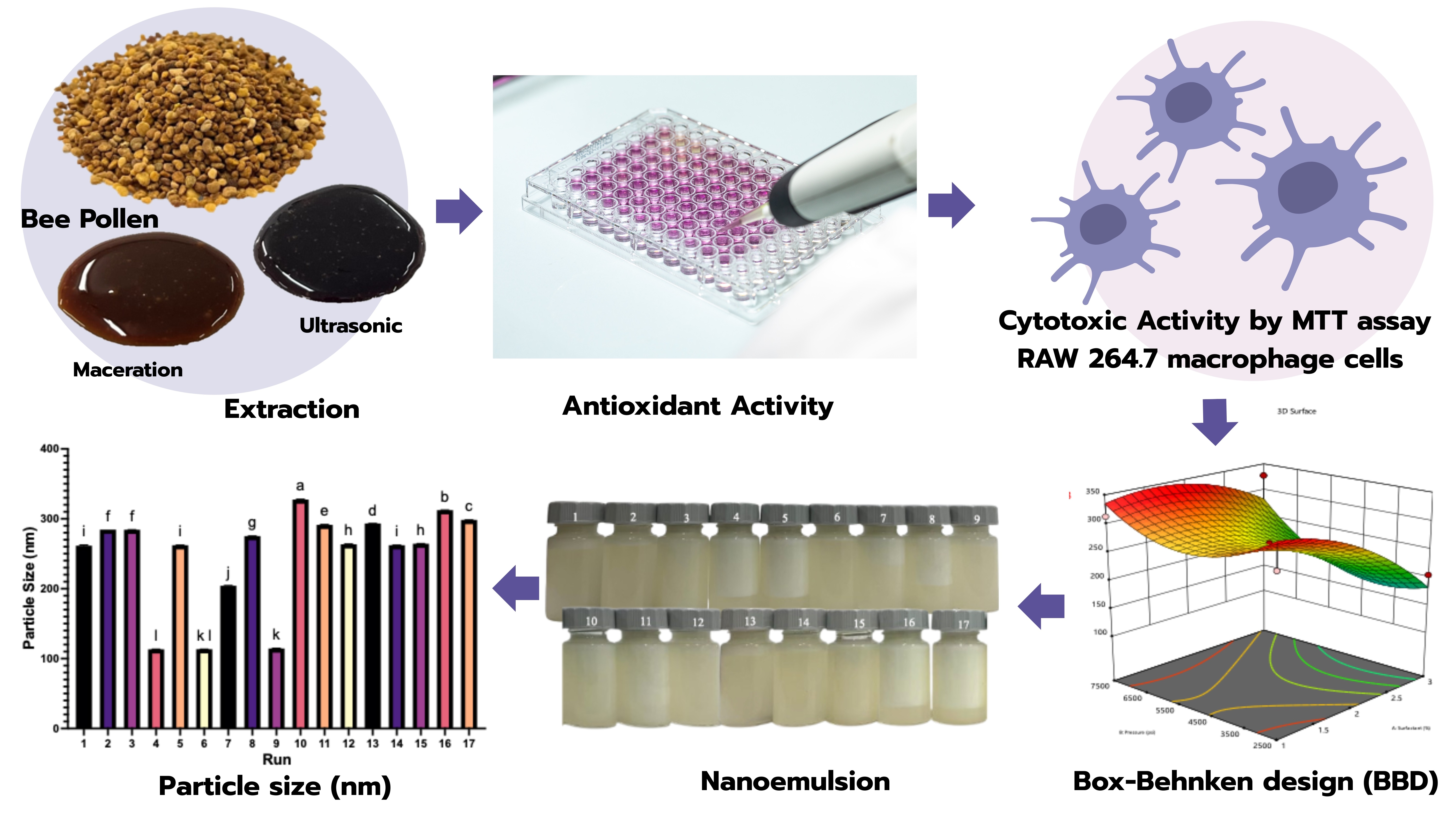
Bee pollen is a natural supplement composed of flower pollen, nectar and the secretions of bees. This research analyzed the composition of bee pollen using FTIR-ATR, which showed that bee pollen contains components that enhance antioxidant activity such as protein. The antioxidant potential of bee pollen extract was evaluated. Analyses on bee-pollen from ultrasonic extraction exhibited impressive radical scavenging properties in DPPH, ABTS and NO assay, without being a cell-toxic, and own potential for the investigations into gene expression and inflammatory cytokine modulation. For developing nanoemulsion in formulation, Box-Behnken Design using Response Surface Methodology (RSM) was used to determine the significant stability variables of particle size (PS), viscosity, and type of surfactant Tween. Phase separation was observed in 8 of 17 experimental trials, where higher pressure (7,000 psi) increased particle size and higher surfactant concentrations slightly enlarged particles but reduced zeta potential. Time exhibited a negligible impact. A combination of 2% surfactant and 5,000 psi pressure applied for 30 min was the optimal process condition, producing nanoparticles of 140.46 nm with a corresponding ZP of −24.46 mV, as corroborated by triplicate measurements. Formulations 1 - 3, 6, 9, 12 - 15, and 17 passed all stability tests. Conversely, formulations 4 - 5, 7 - 8, 10 - 11, and 16 showed phase separation and need further modification. These results are in accordance with known stiffness stabilization mechanisms in nanoemulsion systems, evidencing a surfactant assisted particle dispersion enhancement. This 2-dimensional strategy further promotes the functional possibility of bee pollen through powerful antioxidant profiling and rationally designed delivery systems.
HIGHLIGHTS
- Antioxidant Properties and Safety: The ultrafiltration-extracted bee pollen expressed significant antioxidant capacity in DPPH, ABTS, and NO scavenging assays as well as no cytotoxicity, providing scope for investigating a cellular level for gene expression and inflammatory cytokines.
- Factors influencing stability of nanoemulsions: Box-Behnken design (BBD) optimization identified that the particle size, viscosity, and surfactant type (i.e., Tween) were associated with the phase separation among 8 of the 17 nanoemulsions formulated. The higher surfactant concentration slightly increased the particle size and decreased the zeta potential, and pressure (3,000 - 7,000 psi) changes inversely affected particle size.
- Optimal Formulation Parameters: RSM study resulted in surfactant level of 2%, pressure of 5,000 psi and processing time of 30 min for enhanced predicted and validated particle size (140.46 nm) and zeta potential (−24.46 mV) The combined optimized formulation parameters were validated experimentally with least deviation.
GRAPHICAL ABSTRACT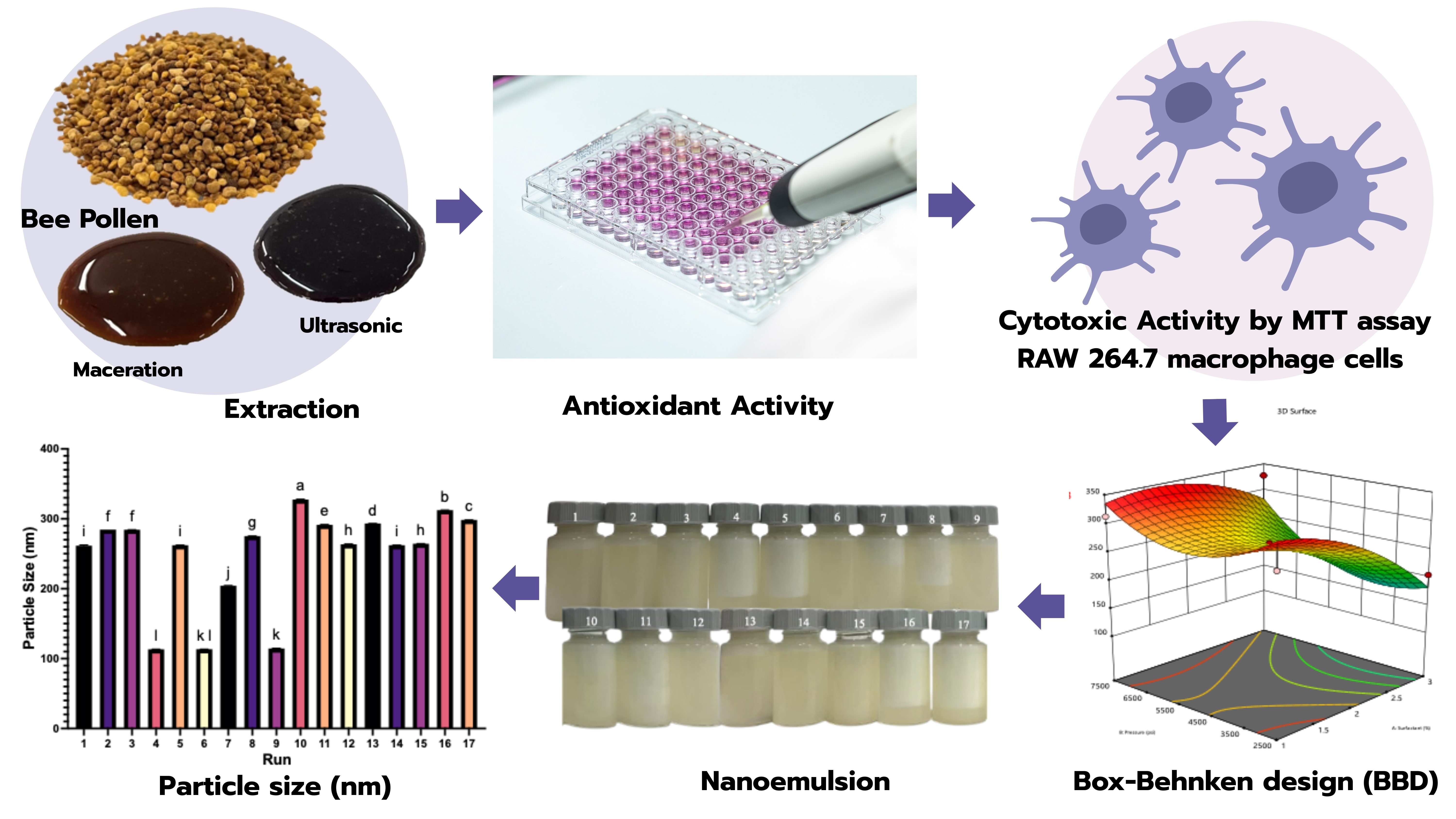
Downloads
References
AE Ghouizi, M Bakour, H Laaroussi, D Ousaaid, NE Menyiy, C Hano and B Lyoussi. Bee pollen as functional food: Insights into its composition and therapeutic properties. Antioxidants 2023; 12(3), 557.
SI Anjum, A Ullah, F Gohar, G Raza, MI Khan, M Hameed, A Ali, CC Chen and IT Gajger. Bee pollen as a food and feed supplement and a therapeutic remedy: Recent trends in nanotechnology. Frontiers in Nutrition 2024; 11, 1371672.
A Rzepecka-Stojko, J Stojko, A Kurek-Górecka, M Górecki, A Kabała-Dzik, R Kubina, A Moździerz and E Buszman. Polyphenols from bee pollen: Structure, absorption, metabolism and biological activity. Molecules 2015; 20(12), 21732- 21749.
A Cavallero, F Vidotto, C Sbrana, L Peres Fabbri, G Petroni and M Gabriele. Antioxidant-rich polyfloral bee pollen exerts antimicrobial activity and anti-inflammatory effect in A549 lung epithelial cells by modulating the NF-κB pathway. Foods 2025; 14(5), 802.
SI Anjum, A Ullah, F Gohar, G Raza, MI Khan, M Hameed, A Ali, CC Chen and IT Gajger. Bee pollen as a food and feed supplement and a therapeutic remedy: Recent trends in nanotechnology. Frontiers in Nutrition 2024; 11, 1371672.
HR El-Seedi, N Zhao, Y Al-Naggar, SM Alsharif, HE Tahir, B Xu, K Wang, SAEid, AAA El-Wahed, ME Rateb, HS Afifi, AF Algethami and CM Khalifa. Honey bee products: Preclinical and clinical studies of their anti-inflammatory and immunomodulatory properties. Frontiers in Nutrition 2022; 8, 761267.
NM Naibaho, W Fatriasari, IW Kusuma and ET Arung. Phytochemical screening, antioxidant and anti-inflammatory properties of several stingless bee pollens processed using different drying methods. Uludağ Bee Journal 2023; 23(2), 153-166.
M Oroian, F Dranca and F Ursachi. Comparative evaluation of maceration, microwave and ultrasonic-assisted extraction of phenolic compounds from propolis. Journal of Food Science and Technology 2020; 57(1), 70-78.
CI Ilie, E Oprea, EI Geana, A Spoiala, M Buleandra, GG Pircalabioru, IA Badea, D Ficai, E Andronescu, A Ficai and LM Ditu. Bee pollen extracts: Chemical composition, antioxidant properties, and effect on the growth of selected probiotic and pathogenic bacteria. Antioxidants 2022; 11(5), 959.
T Eteraf-Oskouei, A Shafiee-Khamneh, F Heshmati-Afshar and A Delazar. Anti-inflammatory and anti-angiogenesis effect of bee pollen methanolic extract using air pouch model of inflammation. Research in Pharmaceutical Sciences 2020; 15(1), 66-75.
J Kocot, M Kiełczykowska, D Luchowska-Kocot, J Kurzepa and I Musik. Antioxidant Potential of Propolis, Bee Pollen, and Royal Jelly: Possible Medical Application. Oxidative Medicine and Cellular Longevity 2018; 2018, 7074209.
Y Yang, JL Zhang, Q Zhou, L Wang, W Huang and RD Wang. Effect of ultrasonic and ball-milling treatment on cell wall, nutrients, and antioxidant capacity of rose (Rosa rugosa) bee pollen, and identification of bioactive components. Journal of the Science of Food and Agriculture 2019; 99(12), 5350-5357.
Y Bi, S Luo, J Ni, S Miao, Z Ning, Z Zhang, S Xu, W Tian, W Peng and X Fang. Effect of ultrasonic treatment on the microstructure, antioxidant activities and metabolites of camellia bee pollen. Ultrasonics Sonochemistry 2025; 118, 107359.
AS Rozman, N Hashim, B Maringgal and K Abdan. Optimisation of stingless bee honey nanoemulsions using response surface methodology. Foods 2021; 10(9), 2133.
Preeti, S Sambhakar, R Malik S Bhatia, A Al Harrasi, C Rani, R Saharan, S Kumar, Geeta and R Sehrawat. Nanoemulsion: An emerging novel technology for improving the bioavailability of drugs. Scientifica 2023; 2023, 6640103.
B Iskandar, TW Liu, HC Mei, IC Kuo, MDC Surboyo, HM Lin and CK Lee. Herbal nanoemulsions in cosmetic science: A comprehensive review of design, preparation, formulation, and characterization. Journal of Food and Drug Analysis 2024; 32(4), 4.
RY Valdivia-Olivares, EA Martinez-González, G Montenegro, R Bridi, MJ Alvarez-Figueroa and JV González-Aramundiz. Innovative multiple nanoemulsion (W/O/W) based on Chilean honeybee pollen improves their permeability, antioxidant and antibacterial activity. Food Research International 2023; 168, 112767.
M Jaiswal, R Dudhe and PK Sharma. Nanoemulsion: An advanced mode of drug delivery system. 3 Biotech 2015; 5(2), 123-127.
RY Valdivia-Olivares, EA Martinez-González, G Montenegro, R Bridi, MJ Alvarez-Figueroa and JV González-Aramundiz. Innovative multiple nanoemulsion (W/O/W) based on Chilean honeybee pollen improves their permeability, antioxidant and antibacterial activity. Food Research International 2023; 168, 112767.
P Lertkaeo, J Yansakol, K Yoothit, S Kongputorn and T Promma. Comparison of traditional and ultrasonic-assisted extraction methods on anthocyanin, total phenolic compounds and antioxidant activity of Homdaeng st.1 and Homdum st.2 brown rice. PSRU Journal of Science and Technology 2021; 6(1), 109-122.
AJO Lopes, CC Vasconcelos, JBS Garcia, MS Dória Pinheiro, FAN Pereira, DS Camelo, SV Morais, JRB Freitas, CQD Rocha, MN de Sousa Ribeiro and MS do Socorro de Sousa Cartágenes. Anti-Inflammatory and antioxidant activity of pollen extract collected by Scaptotrigona affinis postica: In silico, in vitro, and in vivo studies. Antioxidants 2020; 9(2), 103.
J Deng, W Cheng and G Yang. A novel antioxidant activity index (AAU) for natural products using the DPPH assay. Food Chemistry 2011; 125(4), 1430-1435.
R Re, N Pellegrini, A Proteggente, A Pannala, M Yang and C Rice-Evans. Antioxidant activity applying an improved ABTS radical cation decolorization assay. Free Radical Biology and Medicine 1999; 26(9-10), 1231-1237.
IR Ilyasov, VL Beloborodov, IA Selivanova and RP Terekhov. ABTS/PP decolorization assay of antioxidant capacity reaction pathways. International Journal of Molecular Sciences 2020; 21(3), 1131.
Y Cai, Q Luo, M Sun and H Corke. Antioxidant activity and phenolic compounds of 112 traditional Chinese medicinal plants associated with anticancer. Life Sciences 2004; 74(17), 2157-2184.
R Govindarajan, S Rastogi, M Vijayakumar, A Shirwaikar, AKS Rawat, S Mehrotra and P Pushpangadan. Studies on the antioxidant activities of Desmodium gangeticum. Biological and pharmaceutical Bulletin 2003; 26(10), 1424-1427.
T Saisavoey, P Sangtanoo, C Chanchao, O Reamtong and A Karnchanatat. Identification of novel anti-inflammatory peptides from bee pollen (Apis mellifera) hydrolysate in lipopolysaccharide-stimulated RAW264.7 macrophages. Journal of Apicultural Research 2021; 60(2), 280-289.
E Moita, A Gil-Izquierdo, C Sousa, F Ferreres and LR Silva. Integrated analysis of COX-2 and iNOS derived inflammatory mediators in LPS-stimulated RAW macrophages pre-exposed to Echium plantagineum L. bee pollen extract. PLoS One 2013; 8(3), 59131.
JE Kwak, JY Lee, JY Baek, SW Kim and MR Ahn. The antioxidant and anti-inflammatory properties of bee pollen from acorn (Quercus acutissima Carr.) and Darae (Actinidia arguta). Antioxidants 2024; 13(8), 981.
P Srikoon, R Kariya, E Kudo, H Goto, K Vaeteewoottacharn, M Taura, S Wongkham and S Okada. Diethyldithiocarbamate suppresses an NF-κB dependent metastatic pathway in cholangiocarcinoma cells. Asian Pacific Journal of Cancer Prevention 2013; 14(7), 4441-4446.
S Prđun, L Svečnjak, M Valentić, Z Marijanović and I Jerković. Characterization of bee pollen: physico-chemical properties, headspace composition and FTIR spectral profiles. Foods 2021; 10(9), 2103.
SNA S Azhar, SE Ashari and N Salim. Development of a kojic monooleate-enriched oil-in-water nanoemulsion as a potential carrier for hyperpigmentation treatment. International Journal of Nanomedicine 2018; 13, 646.
R Raviadaran, D Chandran, LH Shin and S Manickam. Optimization of palm oil in water nano-emulsion with curcumin using microfluidizer and response surface methodology. LWT 2018; 96, 58-65.
V Piazzini, E Monteforte, C Luceri, E Bigagli, AR Bilia and MC Bergonzi. Nanoemulsion for improving solubility and permeability of Vitex agnus-castus extract: Formulation and in vitro evaluation using PAMPA and Caco-2 approaches. Drug Delivery 2017; 24(1), 380-390.
S Shafiq-Un-Nabi, F Shakeel, S Talegaonkar, J Ali, S Baboota, A Ahuja, RK Khar and M Ali. Formulation development and optimization using nanoemulsion technique: A technical note. Journal of the American Association of Pharmaceutical Scientists 2007; 8(2), 28.
S Zeghoud, A Rebiai, H Hemmami, B Ben Seghir, N Elboughdiri, S Ghareba, D Ghernaout and N Abbas. ATR-FTIR spectroscopy, HPLC chromatography, and multivariate analysis for controlling bee pollen quality in some Algerian regions. ACS Omega 2021; 6(7), 4878-4887.
A Kenđel and B Zimmermann. Chemical analysis of pollen by FT-Raman and FTIR spectroscopies. Frontiers in Plant Science 2020; 11, 352.
SAM Khalifa, MH Elashal, N Yosri, M Du, SG Musharraf, L Nahar, S Sarker, Z Guo, W Cao, X Zou, AA El-Wahed, J Xiao, HA Omar, MF Hegazy and HR El-Seedi. Bee pollen: Current status and therapeutic potential. Nutrients 2021; 13(6), 1876.
S Castiglioni, P Astolfi, C Conti, E Monaci, M Stefano and P Carloni. Morphological, physicochemical and FTIR Spectroscopic properties of bee pollen loads from different botanical origin. Molecules 2019; 24(21), 3974.
R Bleha, TV Shevtsova, M Živčáková, A Korbářová, M Ježková, I Saloň, J Brindza and A Synytsya. Spectroscopic discrimination of bee pollen by composition, color, and botanical origin. Foods 2021; 10(8), 1682.
OW Lyric, MC Jozlyn and EM Elmer-Rico. Comparative study of the extraction methods for the instrumental analysis of bee propolis. Journal of Teaching & Research 2021; 1, 51-60.
P Shiqin, ZZ Meifei, LL Shanshan, M Xiaobin and H Fuliang. Ultrasound-assisted extraction of polyphenols from Chinese propolis. Frontiers in Sustainable Food System 2023; 7, 1131959.
S Çelik, N Kutlu, YC Gerçek, S Bayram, R Pandiselvam and NE Bayram. Optimization of ultrasonic extraction of nutraceutical and pharmaceutical compounds from bee pollen with deep eutectic solvents using response surface methodology. Foods 2022; 11(22), 3652.
M Oroian, F Ursachi and F Dranca. Ultrasound-assisted extraction of polyphenols from crude pollen. Antioxidants 2020; 9(10), 982.
P Momchev, P Ciganović, M Jug, E Marguí, J Jablan and MZ Končić. Comparison of maceration and ultrasonication for green extraction of phenolic acids from Echinacea purpurea aerial parts. Molecules 2020; 25(21), 5142.
GAKD Puspawati, Y Marsono, Supriyadi and R Armunanto. Comparison of sonication with maceration on antioxidant potency of anthocyanin and Karotenoid of Tamarillo (Solanum betaceaum Cav.). Agritech 2019; 38(3), 304-312.
IR Ilyasov, VL Beloborodov, IA Selivanova and RP Terekhov. ABTS/PP decolorization assay of antioxidant capacity reaction pathways. International Journal of Molecular Sciences 2020; 21(3), 1131.
JW Dong, L Cai, Y Xing, J Yu and ZT Ding. Re-evaluation of ABTS assay for total antioxidant capacity of natural products. Natural Product Communications 2015; 10(12), 2169-2172.
HL Chen, XZ Lan, YY Wu, YW Ou, TC Chen and WT Wu. The antioxidant activity and nitric oxide production of extracts obtained from the leaves of Chenopodium quinoa Willd. Biomedicine 2017; 7(4), 24.
Y Chung, JY Park, JE Lee, KT Kim and HD Paik. Antioxidant activity and inhibitory effect on nitric oxide production of hydroponic ginseng fermented with lactococcus lactis KC24. Antioxidants 2021; 10(10), 1614.
OE Etim, SE Ekanem and SM Sam. In vitro antioxidant activity and nitric oxide scavenging activity of Citrullus lanatus seeds. Journal of Natural Sciences Research 2013; 3(12), 126-132.
M Oroian, F Ursachi and F Dranca. Ultrasound-assisted extraction of polyphenols from crude pollen. Antioxidants 2020; 9(4), 322.
S Peng, M Zhu, S Li, X Ma and F Hu. Ultrasound-assisted extraction of polyphenols from Chinese propolis. Frontiers in Sustainable Food Systems 2023; 7, 1131959.
A Untea, A Lupu, M Saracila and T Panaite. Comparison of ABTS, DPPH, phosphomolybdenum assays for estimating antioxidant activity and phenolic compounds in five different plant extracts. Bulletin UASVM Animal Science and Biotechnologies 2018; 75(2), 110.
A Łepecka and D Kołożyn-Krajewska. Antioxidant properties of food-derived lactic acid bacteria: A review. Microbial Biotechnology 2025; 18(9), 70229.
N Chaves, A Santiago and JC Alías. Quantification of the antioxidant activity of plant extracts: Analysis of sensitivity and hierarchization based on the method used. Antioxidants 2020; 9(1), 76.
M Platzer, S Kiese, T Herfellner, U Schweiggert-Weisz, O Miesbauer and P Eisner. Common trends and differences in antioxidant activity analysis of phenolic substances using single electron transfer based assays. Molecules 2021; 26(5), 1244.
M Sirirak and M Saowanee. Selection of appropriate methods analysis of cytotoxicity. PSU Medical Journal 2023; 3(2), 85-91.
D Karakas, F Ari and E Ulukaya. The MTT viability assay yields strikingly false positive viabilities although the cells are killed by some plant extracts. Turkish Journal of Biology 2017; 41, 919-925.
P Supattar, P Intira and S Kasem. Cytotoxicity Activity of beauvericin and crude extracts from Beauveria sp. Rajabhat Phranakhon Research Journal 2012; 7(1), 35-43.
C Rodríguez-Pólit, R Gonzalez-Pastor, J Heredia-Moya, SE Carrera-Pacheco, F Castillo-Solis, R Vallejo-Imbaquingo, C Barba-Ostria and LP Guamán. Chemical properties and biological activity of bee pollen. Molecules 2023; 28(23), 7768.
A El-Ghouizi, M Bakour, H Laaroussi, D Ousaaid, N-El Menyiy, C Hano and B Lyoussi. Bee pollen as functional food: Insights into its composition and therapeutic properties. Antioxidants 2023; 12(3), 557.
B Longsri, N Kanpipit, P Puthongking, P Mahakunakorn, S Tiyaworanant, BSB Sungthong and S Thapphasaraphong. Determination of a chemical marker in dipterocarpus alatus oleoresin samples and bioactivity screening via antioxidants, nitric oxide inhibition on murine RAW 264.7 cells, and collagen production on normal human dermal fibroblasts. Tropical Journal of Natural Product Research 2021; 5(5), 850-856.
AD Gadhave. Nanoemulsions: Formation, stability and applications. International Journal for Research in Science and Advanced Technologies 2014; 2(3), 38-43.
J Park, U Scheler and RJ Messinger. Molecular-level understanding of phase stability in phase-change nanoemulsions for thermal energy storage by NMR spectroscopy. ACS Journal of Surfaces and Colloids 2024; 40(41), 21814-21823.
Q Liu, H Huang, H Chen, J Lin and Q Wang. Food-grade nanoemulsions: Preparation, stability and application in encapsulation of bioactive compounds. Molecules 2019; 24, 4242.
A Gawin-Mikołajewicz, U Nawrot, KH Malec, K Krajewska, KP Nartowski and BL Karolewicz. The effect of high-pressure homogenization conditions on the physicochemical properties and stability of designed fluconazole-loaded ocular nanoemulsions. Pharmaceutics 2023; 16(1), 11.
SS Galooyak and B Dabir. Three-factor response surface optimization of nano-emulsion formation using a microfluidizer. Journal of Food Science and Technology 2015; 52(5), 2558-2571.
A Kumar, A Dhiman, R Suhag, R Sehrawat, A Upadhyay and DJ McClements. Comprehensive review on potential applications of microfluidization in food processing. Food Science and Biotechnology 2021; 31(1), 17-36.
S Zhao, Z Wang, X Wang, B Kong, Q Liu, X Xia and H Liu. Characterization of nanoemulsions stabilized with different emulsifiers and their encapsulation efficiency for oregano essential oil: Tween 80, soybean protein isolate, tea saponin, and soy lecithin. Foods 2023; 12, 3183.
T Chuacharoen, S Prasongsuk and CM Sabliov. Effect of surfactant concentrations on physicochemical properties and functionality of curcumin nanoemulsions under conditions relevant to commercial utilization. Molecules 2019; 24(15), 2744.
A Yagmur and MG Zeynep. Effects of surfactants on albumin nanoparticles. Journal of Research in Pharmacy 2022; 26(5), 1177-1189.
KJ Tristan, A S Ian, D Benjamin, HC Victor, G Thomas, DP Nestor and T Fangyuan. Zeta potential and size analysis of zeolitic imidazolate framework-8 nanocrystals prepared by surfactant-assisted synthesis. Langmuir 2024; 40(12), 6138-6148.
TR Smith, Y Watanabe and Q Chen. Advances in dynamic light scattering for nanomaterial characterization. Analytical Chemistry Reviews 2021; 94(7), 3215-3228.
LP Johnson and SH Lee. Zeta potential thresholds for nanoparticle stabilization. Langmuir 2023; 39(12), 4451-4460.
R Garcia, K Tanaka and A Müller. Colloidal stability optimization through coupled DLS-ELS analysis. Journal of Nanomaterials 2022; 15(4), 112-128.
V Iyer, C Cayatte, B Guzman, K Schneider-Ohrum, R Matuszak, A Snell, GM Rajani, MP McCarthy and B Muralidhara. Impact of formulation and particle size on stability and immunogenicity of oil-in-water emulsion adjuvants. Human Vaccines & Immunotherapeutics 2015; 11(7), 1853-1864.
MBZ Maryam and P Akram. Effect of surfactant concentration on the particle size, stability and potential zeta of beta carotene nano lipid carrier. International Journal of Current Microbiology and Applied Sciences 2015; 4(9), 924-932.
P Riangjanapatee and S Okonogi. Effect of surfactant on lycopene-loaded nanostructured lipid carriers. Drug Discoveries & Therapeutics 2012; 6(3), 163-168.
MN Nur Afiqah, BM Helal Uddin, IS Zaidul, YL Chew and KB Liew. Effect of concentration of lipid with surfactant and ultrasonification power on the formation of naringenin-loaded solid lipid nanoparticles. Journal of Pharmaceutical Negative Results 2022; 13(7), 104-108.
S Gupta, R Kesarla, N Chotai, A Misra and A Omri. Systematic approach for the formulation and optimization of solid lipid nanoparticles of efavirenz by high pressure homogenization using design of experiments for brain targeting and enhanced bioavailability. BioMed Research International 2017; 2017, 5984014.
W Jiang, BYS Kim, JT Rutka and WCW Chan. Nanoparticle-mediated cellular response is size-dependent. Nature Nanotechnology 2020; 5(3), 146-150.
WK Restu, Y Sampora, Y Meliana and A Haryono. Effect of accelerated stability test on characteristics of emulsion systems with chitosan as a stabilizer. Procedia Chemistry 2015; 16, 171-176.
TB Schreiner, A Santamaria-Echart, A Ribeiro, AM Peres, MM Dias, SP Pinho and MF Barreiro. Formulation and optimization of nanoemulsions using the natural surfactant saponin from Quillaja Bark. Molecules 2020; 25(7), 1538.
Y Guo, X Zhang, X Wang, L Zhang, Z Xu and D Sun. Nanoemulsions stable against Ostwald ripening. Langmuir 2024; 40(2), 1364-1372.
E Bouyer, G Mekhloufi, V Rosilio, JL Grossiord and F Agnely. Proteins, polysaccharides, and their complexes used as stabilizers for emulsions: Alternatives to synthetic surfactants in the pharmaceutical field. International Journal of Pharmaceutics 2012; 436, 359-378.
NK Mohammed, BJ Muhialdin and ASM Hussin. Characterization of nanoemulsion of Nigella sativa oil and its application in ice cream. Food Science and Nutrition 2020; 8(6), 2608-2618.
Y Zhao, F Peng and Y Ke. Design and characterization of oil-in-water nanoemulsion for enhanced oil recovery stabilized by amphiphilic copolymer, nonionic surfactant, and LAPONITE® RD. RSC Advances 2021; 11(4), 1952-1959.
Downloads
Published
How to Cite
Issue
Section
License
Copyright (c) 2026 Walailak University

This work is licensed under a Creative Commons Attribution-NonCommercial-NoDerivatives 4.0 International License.





