
Development of Kraft Paper Type of Liner Board from Pineapple Leaves to Suitable for Printing of Packaging
DOI:
https://doi.org/10.48048/tis.2026.11968Keywords:
Pineapple leaf pulp, Mechanical properties, AKD: Cationic polymeric blend ratio, PrintabilityAbstract
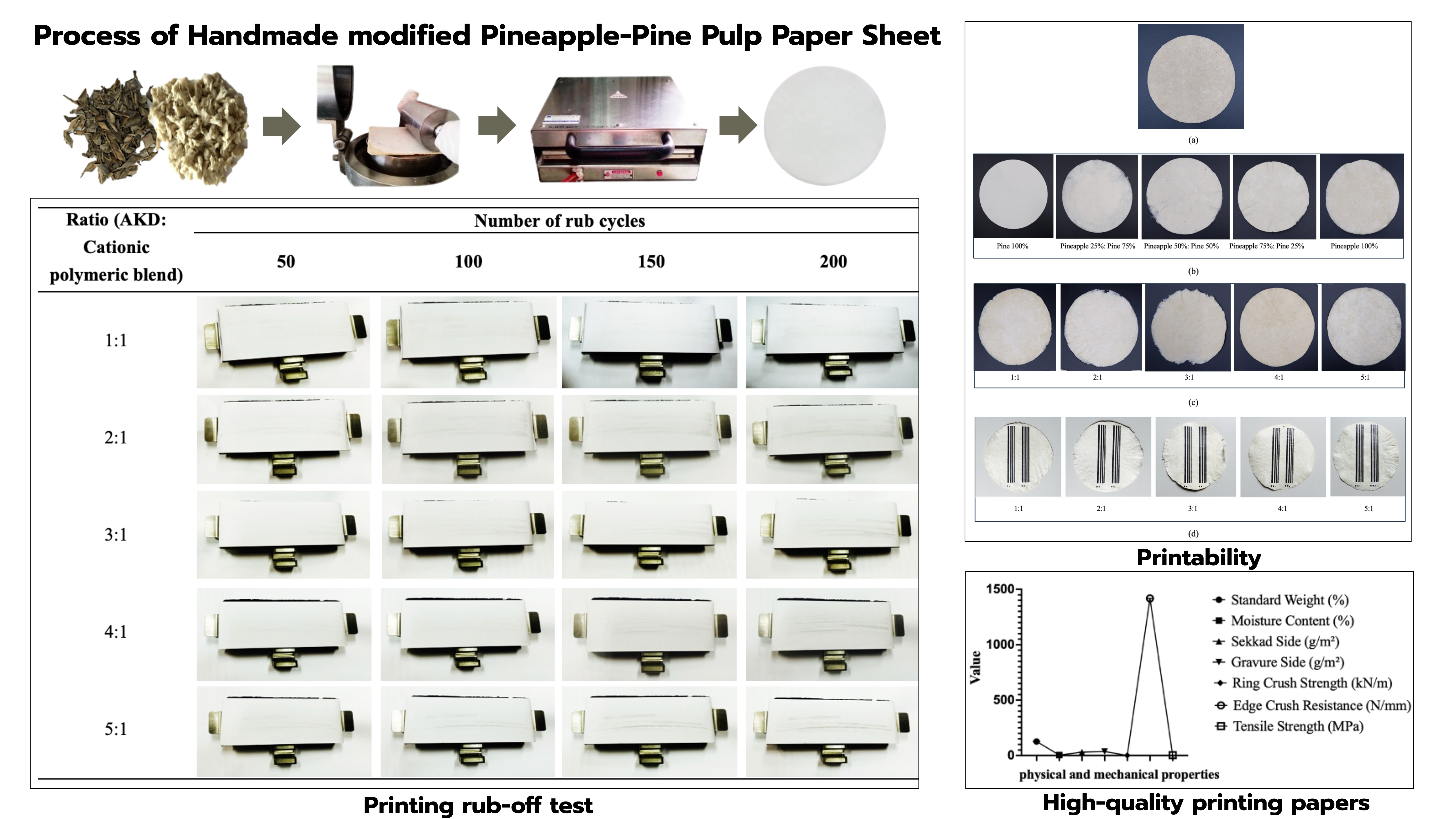
Handmade modified Pineapple-Pine pulp paper hand sheets were prepared by combining pine pulp with pineapple pulp in different proportions, such as 100:0, 75:25, 50:50, 25:75 and 0:100. The physical and mechanical properties, such as tensile index, burst index and brightness of the paper made have been tested under laboratory conditions. It is observed that the best blending percentage is 50:50 having a tensile index of 21.34 ± 0.07 MPa, a burst index of 2.18 ± 0.01 Nm/g, water absorption index 185.13 ± 0.05 g/m2, brightness 66.60 ± 0.04 °Elrepho. This ratio exhibits the most suitable compromise for mechanical strength, absorbency and visual level needed for paper use. For printing suitable coating materials, five formulations were tested by adjusting the AKD: Cationic polymeric blend ratio from about 1:1 to 5:1 and holding silica constant at 2.5 mL. The best formulation according to TIS 170-2550 was found in a ratio of AKD:Cationic polymer blend is 3:1 with standard weight equals 127.31 ± 0.06%, moisture of value 4.40 ± 0.1% and lowest water absorption (Sekkad side = 30.20 ± 0.08 g/m2; gravure side = 36.42 ± 0.21 g/m2). Further, the ring crush strength and edge crush strength were 1.53 ± 0.02 kN/m and 1,417.61 ± 0.53 N/mm and tensile strength was 3.82 ± 0.17 MPa for this new formulation respectively. These properties balance water resistance, printability and mechanical properties together and it is fit for high quality packaging and printing paper.
HIGHLIGHTS
- The best pineapple fiber extraction result was obtained by using 4% sodium hydroxide decoction for 1 h with pulp efficiency of 95.58 ± 0.63% cellulose-rich fibers in cosmetic packaging applications.
- Sample made up of 50:50 pineapple and pine pulp were observed to give optimum tensile strength (21.34 ± 0.07 MPa), burst index (2.18 ± 0.01 Nm/g) water absorption (185.13 ± 0.05 g/m2), brightness (66.6 ± 0.04 °Elrepho).
- Optimum ratio of AKD to cationic polymer for print quality was 3:1 leading to good GSM with low Moisture and uniform Strength values for Printing and packaging.
- In the case of rub-off printability, the best ink adhesion was obtained at an AKD: Cationic polymer ratio range between 1:1 and 4:1, particularly below 200 rub cycles with a 5:1 ratio showing rapid degradation in print quality.
GRAPHICAL ABSTRACT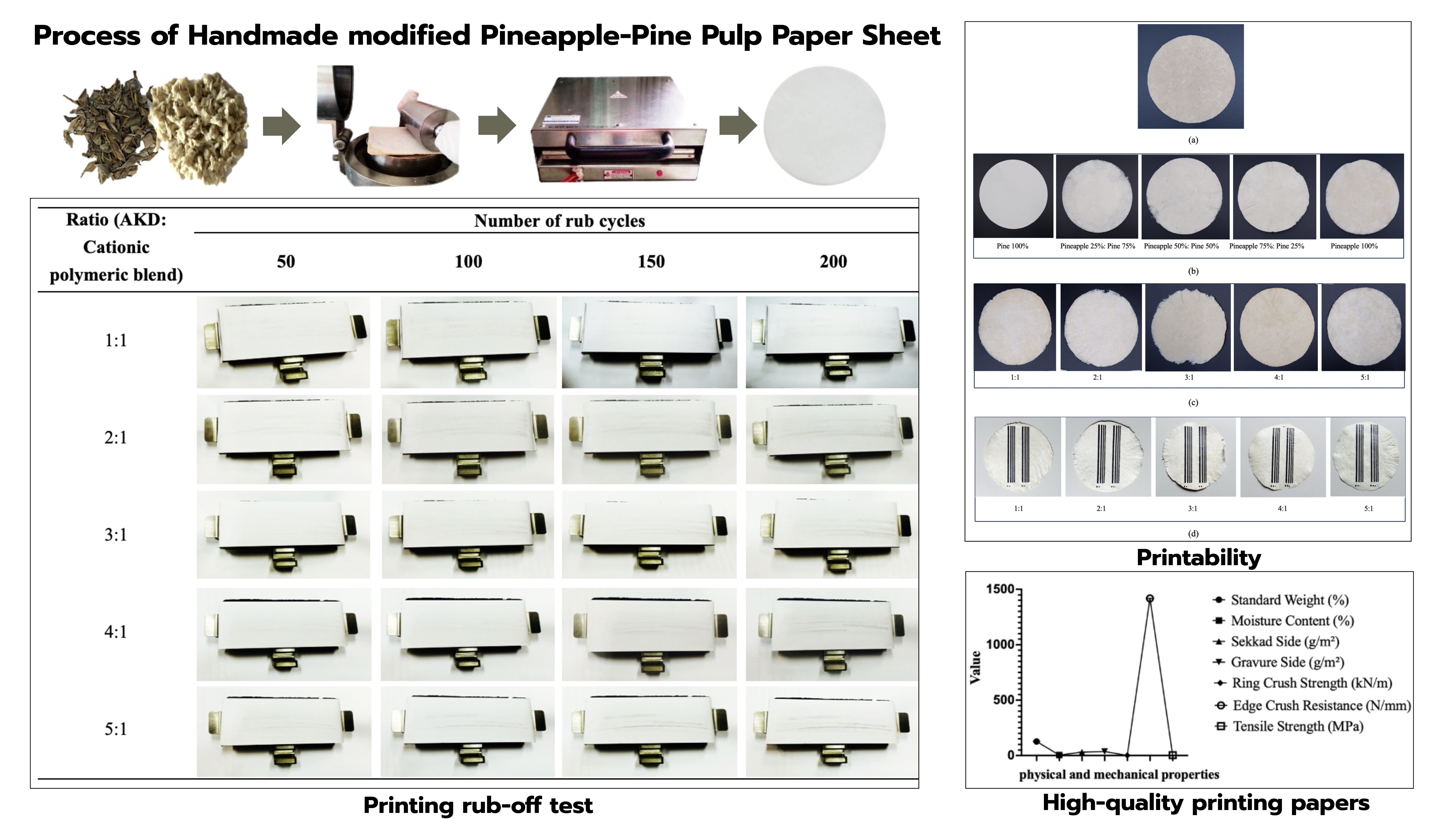
Downloads
References
J Shen and M Zhang. Disassembly, refinement, and reassembly: From ancient papermaking to modern materials processing. Journal of Bioresources and Bioproducts 2025; 10(1), 7-13.
TT Hailemariam and B Woldeyes. Production and characterization of pulp and paper from flax straw. Scientific Reports 2024; 14, 24300.
M Sethupathi, MV Khumalo, SJ Skosana and S Muniyasamy. Recent developments of Pineapple Leaf Fiber (PALF) utilization in the polymer composites - a review. Separations 2024; 11(8), 245.
MFF Pego and ML Bianchi. Blended paper: Physical, optical, structural, and interfiber bonding analysis. Cerne 2021; 27, 2944.
P Srichola, J Boonyarit, W Kongtud and R Chollakup. Utilization of pineapple leaf fiber mixed with banana or cattail stem fibers and their paper physical properties for application in packaging. Agriculture and Natural Resources 2022; 56(6), 1103-1112.
Y Li, Y Luo, J Han and Q Lin. Recent progress in functional paper-based coatings for advanced printing. Progress in Organic Coatings 2021; 154, 106198.
J Saikia, T K Maji and P Das. Nanomaterials and coatings for paper-based printing: Recent developments and perspectives. Industrial & Engineering Chemistry Research 2019; 58(18), 7650-7664.
T Apipatpapha, P Ongkunarak and R Chollaku. Pineapple leaf fiber supply chain analysis for the sustainability of community enterprise: A case study in Thailand. IOP Conference Series: Earth and Environmental Science 2022; 1074, 012032.
M Asim, K Abdan, M Jawaid, M Nasir, Z Dashtizadeh, MR Ishak and E Hoque. A review on pineapple leaves fibre and its composites. International Journal of Polymer Science 2015; 2015(6), 50567.
DM Chaves, JC Araújo, CV Gomes, SP Gonçalves, R Fangueiro and DP Ferreira. Extraction, characterization and properties evaluation of pineapple leaf fibers from Azores pineapple. Heliyon 2024; 10(4), e26698.
L Mathew and K Joseph. Investigation of physical, chemical and mechanical properties of pineapple leaf fibers. Journal of Applied Polymer Science 2005; 96(5), 1911-1915.
H Salem, RW Gooding, DM Martinez and JA Olson. Some fundamental aspects of pulp screen capacity. Advances in Pulp and Paper Research 2013; 1, 261-299.
P Aryanpour, RW Gooding and JA Olson. Pulp screen plugging characteristics. BioResources 2025; 20(1), 1820-1837.
S Mukhopadhyay, HPSA Khalil and MN Islam. Extraction of cellulose microfibrils from lignocellulosic fibers: A review. Carbohydrate Polymers 2013; 93(1), 95-105.
V Saravanakumar, S Kumaravel, S Nagarajan, S Dharmalingam, FSSA Coimbra and N Mariappan. Characterization of cellulose fibers from the reed plant Phragmites karka. Carbohydrate Polymers 2013; 112, 301-308.
M Jawaid and HPSA Khalil. Cellulosic/synthetic fibre reinforced polymer hybrid composites: A review. Carbohydrate Polymers 2011; 86(1), 1-18.
Thai Industrial Standards Institute. Kraft paper (TIS 170-2550). Thai Industrial Standards Institute, Bangkok, Thailand, 2007.
KZMA Motaleb, MS Islam and MB Hoque. Improvement of physicomechanical properties of pineapple leaf fiber reinforced composite. International Journal of Biomaterials 2018; 2018, 7384360.
S Tanpichai, A Boonmahitthisud and S Witayakran. Use of steam explosion as a green alternative method to prepare pulp from pineapple leaves. Journal of Metals, Materials and Minerals 2019; 29(2), 104-114.
PHF Pereira, HL Ornaghi, V Arantes and MOH Cioffi. Effect of chemical treatment of pineapple crown fiber in the production, chemical composition, crystalline structure, thermal stability and thermal degradation kinetic properties of cellulosic materials. Carbohydrate Research 2021; 499, 108227.
Y Tian, L Teng, H Yang, H Jin, H Guo and C Wu. Characterization of pineapple leaf fiber following enzymatic degumming. Cellulose Chemistry and Technology 2023; 58(1-2), 125-132.
MN Solanki, KM Attur, KA Vachhani, NA Patel, MA Shah and DM Doshi. Phytochemicals in vital tooth bleaching: Spectrophotometric evaluation of efficacy with papaya, pineapple, or kiwi extracts and 30% hydrogen peroxide. Journal of Conservative Dentistry and Endodontics 2024; 27(7), 760-764.
V Vekaash, CJK Reddy and KV Venkatesh. Effect of vital bleaching with solutions containing different concentrations of hydrogen peroxide and pineapple extract as an additive on human enamel using reflectance spectrophotometer: An in vitro study. Journal of Conservative Dentistry 2017; 20(5), 337-340.
H Onggo and JT Astuti. The effect of sodium hydroxide and hydrogen peroxide on the yield and color of pulp from pineapple leaf fiber. Jurnal Ilmu dan Teknologi Kayu Tropis 2015; 13(2), 37-43.
NI Nashiruddin, AF Mansor, RA Rahman, RM Ilias and HW Yussof. Process parameter optimization of pretreated pineapple leaves fiber for enhancement of sugar recovery. Industrial Crops and Products 2020; 152, 112514.
P Sricholsa, J Boonyarit, W Kongtdru and R Cholakup. Utilization of pineapple leaf fiber mixed with banana or cattail stem fibers and their paper physical properties for application in packaging. Agriculture and Natural Resources 2022; 56(6), 1103-1112.
NHN Do, BY Truong, PTX Nguyen, KA Le, HM Duong and PK Le. Composite aerogels of TEMPO-oxidized pineapple leaf pulp and chitosan for dyes removal. Separation and Purification Technology 2022; 283, 120200.
A Li, Y Shi, J Zhang and Y Zhang. Comparative analysis of the physical and mechanical properties of kraft paper and watercolor paper. Maderas Ciencia y Tecnología 2021; 23(45), 1-12.
P Rattanawongwuk, N Kunfong, S Klaysri, T Chotimarn, S Dungsrihet, N Tiwaichai, U Inthatha and N Soykeabkaew. Comparison of molded pulps from rice straw, pineapple leaf and banana stem pulps. ScienceAsia 2020; 46, 79-84.
MDA Chowdhury, E Uddin, MM Uddin, R Hasanin, SMA Rieje, MS Rusdi, MR Rahman, SMMA Saleem, YAH Jehan and MM Mohammaid. Pulp production from pineapple leaf waste for sustainable paper manufacturing. BioResources 2025; 20(4), 9390-9405.
S Sibaly and P Jeetah. Production of paper from pineapple leaves. Journal of Environmental Chemical Engineering 2017; 5(6), 5978-5986.
S Adamopoulos, E Martinez and D Ramirez. Characterization of packaging grade papers from recycled raw materials through the study of fibre morphology and composition. Global NEST Journal 2007; 9(1), 20-29.
AAM Khalid and SR Masrol. Characteristics of pulp and paper made from MD2 pineapple leaf via soda-anthraquinone (AQ) pulping method. Progress in Engineering Application and Technology 2023; 4(2), 540-549.
L Abenghal, J Bley, B Tolnai, G Njamen and B Chabot. Development of a new sustainable packaging paper based on cellulose filaments and refined kraft pulp. Future Foods 2025; 11, 100540.
JMS Matos, DV Evtuguin, APM de Sousa and MGVS Carvalho. Xylanase treatment of eucalypt kraft pulps: Effect of carryover. Applied Microbiology and Biotechnology 2024; 108(1), 210.
M Çiçekler. Effects of different ratios of starch-containing AKD on paper properties in internal sizing of various pulp types. Cellulose Chemistry and Technology 2022; 56(9-10), 1031-1047.
H Rochesani, C Irawan, M Nurfitiani, JP Sestari and U Rosdiana. The influence and the analysis of alkyl ketene dimers (AKD) to paper resistance in water absorption and chemical solution penetration. Atlantis Highlights in Engineering 2018; 1, 267-271.
Z Tian, R Zhang, Y Liu, J Xu, X Zhu, T Lei and K Li. Hemicellulose-based nanocomposites coating delays lignification of green asparagus by introducing AKD as a hydrophobic modifier. Renewable Energy 2021; 178, 1097-1105.
A Korpela, AK Jaiswal and J Asikainen. Effects of hydrophobic sizing on paper dry and wet-strength properties: A comparative study between AKD sizing of NBSK handsheets and rosin sizing of CTMP handsheets. BioResources 2021; 16(3), 5350-5360.
PA Parvathy and SK Sahoo. Hydrophobic, moisture resistant and biorenewable paper coating derived from castor oil based epoxy methyl ricinoleate with repulpable potential. Progress in Organic Coatings 2021; 158, 106347.
T Garbowski, A Knitter-Piątkowska and P Winiarski. Simplified modelling of the edge crush resistance of multi-layered corrugated board: Experimental and computational study. Materials 2023; 16(1), 458.
K Salminen, J Katja-aho, H Lindqvist, E Retulainen, T Rantanen and A Sundberg. The effects of certain polymers on tensile strength and tension relaxation of wet web. In: Proceedings of the Paper Conference and Trade Show, Kentucky, United States. 2011, p. 825-832.
T Garbowski, J Pozorska and Z Pozorski. Mechanical characterization of corrugated board: Sensitivity analysis in design of experiments. Thin-Walled Structures 2025; 216, 113671.
Published
How to Cite
Issue
Section
License
Copyright (c) 2025 Walailak University

This work is licensed under a Creative Commons Attribution-NonCommercial-NoDerivatives 4.0 International License.





