
Stable Nanoemulsion System Development Enabling the Topical Delivery of Synechococcus-Derived Peptides
DOI:
https://doi.org/10.48048/tis.2026.11601Keywords:
Colloidal stability, Cosmetic formulation, High-pressure homogenization, Nanoemulsion, Peptide delivery, SynechococcusAbstract
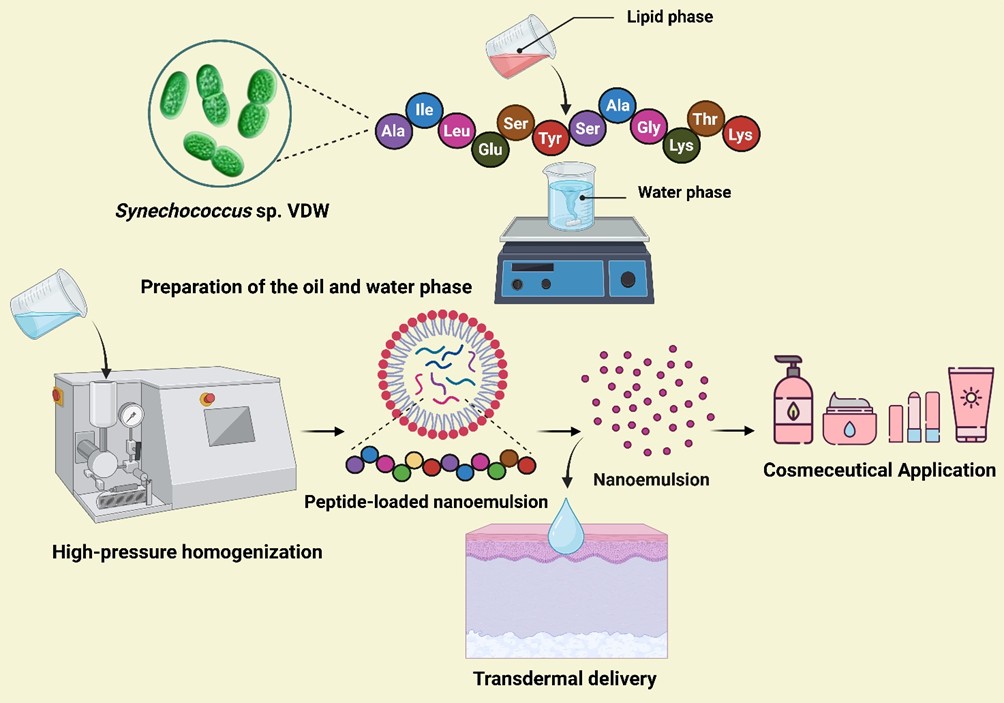
Marine microalgae including Synechococcus sp. VDW offer the potential to serve as a source of bioactive peptides offering valuable antioxidant and antimelanogenic qualities for use in the pharmaceutical and cosmetics industries. At present, however, the use of such peptides is challenging due to their poor physicochemical stability. This research therefore sought to achieve the production and characterization of a stable nanoemulsion system based upon the use of synthetic Synechococcus-derived peptides through the process of high-pressure homogenization (HPH). Preparation of the nanoemulsions involved the use of Tween-80 and caprylic/capric triglyceride at a pressure of 7,500 psi to perform homogenization for varying durations of 15, 30 and 45 min. Using the optimized formulation with 0.1% w/w peptide for a time of 45 min resulted in 122.16 nm droplets while the zeta potential was −80.09 mV and the PDI (polydispersity index) value was 0.13. Colloidal stability could be considered high, while physical stability under thermal cycling, centrifugation and freeze-thaw cycles was very good, with no phase separation. For all testing intervals, the viscosity and refractive index were stable. It can thus be argues that the HPH approach is suitable to produce peptide-loaded nanoemulsions offering good stability and useful physicochemical characteristics. The developed nanoemulsion system has been optimized to offer potential for applications involving the transdermal delivery of marine peptides in the cosmeceutical sector and for a range of dermal therapies.
HIGHLIGHTS
- Developed a stable peptide-loaded nanoemulsion using high-pressure homogenization (HPH) at 7,500 psi for 45 min.
- Achieved small, uniform droplet size (122.16 nm), high zeta potential (−80.09 mV) and low PDI (0.13), indicating strong colloidal stability.
- Nanoemulsion exhibited excellent physical stability under centrifugation, freeze–thaw and heating–cooling cycles.
- Increased peptide concentration led to decreased pH and viscosity, optimizing flow and emulsification properties.
- Potential application in transdermal delivery systems for cosmeceuticals and dermatological formulations.
GRAPHICAL ABSTRACT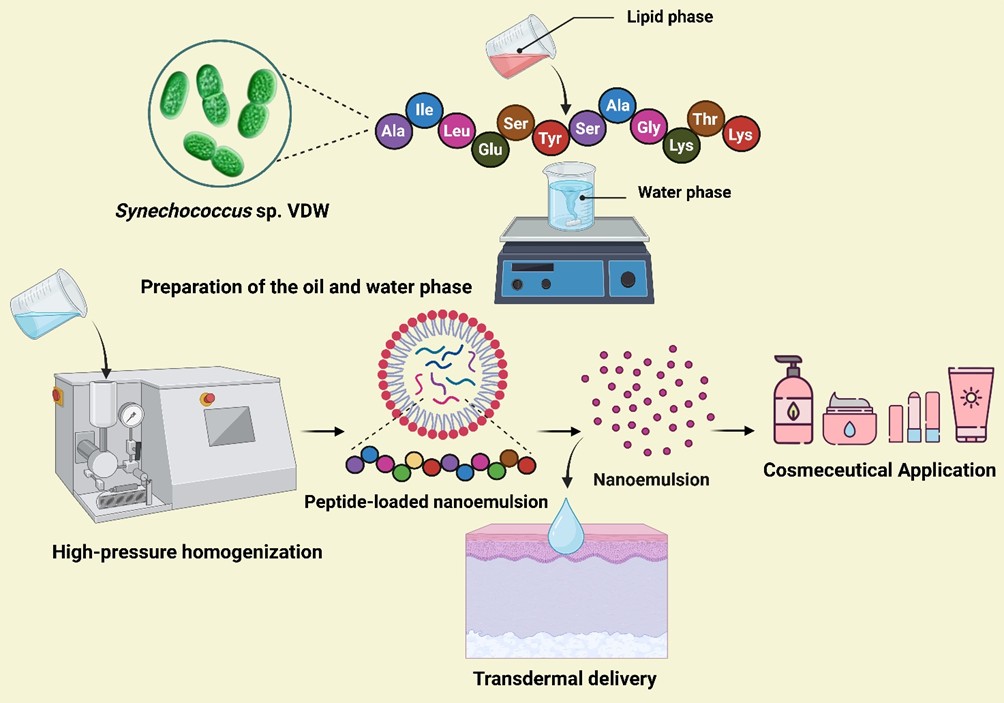
Downloads
References
CN Eze, CK Onyejiaka, SA Ihim, TO Ayoka, CC Aduba, JK Ndukwe, O Nwaiwu and H Onyeaka. Bioactive compounds by microalgae and potentials for the management of some human disease conditions. AIMS Microbiology 2023, 9(1), 55-74.
SAM Khalifa, ES Shedid, EM Saied, AR Jassbi, FH Jamebozorgi, ME Rateb, M Du, MM Abdel-Daim, GY Kai, MAM Al-Hammady, J Xiao, Z Guo and HR El-Seedi. Cyanobacteria—from the oceans to the potential biotechnological and biomedical applications. Marine Drugs 2021; 19(5), 241.
R Suttisuwan, S Phunpruch, T Saisavoey, P Sangtanoo, N Thongchul and A Karnchanatat. Free radical scavenging properties and induction of apoptotic effects of Fa fraction obtained after proteolysis of bioactive peptides from microalgae Synechococcus sp. VDW. Food Technol Biotechnol 2019, 57(3), 358-368.
P Srimongkol, P Sangtanoo, T Saisavoey, S Puthong, A Buakeaw, A Karnchanatat, K Kuptawach, S Phunpruch, W Keawbankrud and R Suttisuwan. Synechococcus marine microalgae peptide: Melanogenesis inhibition in cellular and zebrafish models. Algal Research 2024, 82, 103601.
C Berraquero-García, R Pérez-Gálvez, FJ Espejo-Carpio, A Guadix, EM Guadix and PJ García-Moreno. Encapsulation of bioactive peptides by spray-drying and electrospraying. Foods 2023, 12(10), 2005.
V Pérez-Pérez, C Jiménez-Martínez, JL González-Escobar and LJ Corzo-Ríos. Exploring the impact of encapsulation on the stability and bioactivity of peptides extracted from botanical sources: Trends and opportunities. Frontiers in Chemistry 2024; 12, 1423500.
HH Tayeb, R Felimban, S Almaghrabi and N Hasaballah. Nanoemulsions: Formulation, characterization, biological fate, and potential role against COVID-19 and other viral outbreaks. Colloid and Interface Science Communications 2021; 45, 100533.
Q Liu, H Huang, H Chen, J Lin and Q Wang. Food-grade nanoemulsions: Preparation, stability and application in encapsulation of bioactive compounds. Molecules 2019; 24(23), 4242.
M Kumar, RS Bishnoi, AK Shukla and CP Jain. Techniques for formulation of nanoemulsion drug delivery system: A review. Preventive Nutrition and Food Science2019; 24(3), 225-234.
S Jacob, FS Kather, SHS Boddu, J Shah and AB Nair. Innovations in nanoemulsion technology: Enhancing drug delivery for oral, parenteral, and ophthalmic applications. Pharmaceutics 2024; 16(10), 1333.
YH Park, T Kong, JR Roede, DP Jones and K Lee. A biplot correlation range for group-wise metabolite selection in mass spectrometry. BioData Mining 2019; 12, 4.
Y Shi, M Zhang, K Chen and M Wang. Nano-emulsion prepared by high pressure homogenization method as a good carrier for Sichuan pepper essential oil: Preparation, stability, and bioactivity. LWT 2022; 154, 112779.
R Charoenjittichai, D Charnvanich and V Panapisal. Effects of surfactant mixture ratio and concentration on nanoemulsion physical stability. Thai Journal of Pharmaceutical Sciences 2016, 40, 45-48.
TMR Lotfy, SMS Shawir and MEI Badawy. The impacts of chitosan-essential oil nanoemulsions on the microbial diversity and chemical composition of refrigerated minced meat. International Journal of Biological Macromolecules 2023; 239, 124237.
T Hong, K Iwashita and K Shiraki. Viscosity control of protein solution by small solutes: A review. Current protein & peptide science 2018; 19(8), 746-758.
YN Ashagrie, MG Tadesse, RK Bachheti, G Nijhawan, S Tyagi and A Bachheti. Formulation and characterization of Caesalpinia decapetala seed oil nanoemulsion: Physicochemical properties, stability, and antibacterial activity. Scientific Reports 2025; 15, 14598.
S Shafiq-un-Nabi, F Shakeel, S Talegaonkar, J Ali, S Baboota, A Ahuja, RK Khar and M Ali. Formulation development and optimization using nanoemulsion technique: A technical note. AAPS PharmSciTech 2007, 8(2), E12-E28.
M Rezaee, M Basri, RNZRA Rahman, AB Salleh, N Chaibakhsh and R Karjiban. Formulation development and optimization of palm kernel oil esters-based nanoemulsions containing sodium diclofenac. International Journal of Nanomedicine 2014; 9(1), 539-548.
K Han, S Li, C Li, M Li, X Zhang, Z Xie, Y Liu, C An and J Wang. Oil-in-water nanoemulsion adhesive system: Preparation by ultrasonic homogenization and its application in 3D direct writing composite energetic materials. Journal of Materials Research and Technology 2024; 30, 1582-1593.
S Harimurti, D Febriyani, DP Sukamdi, H Widadi and A Amjad. Development of moringa leave extract nanoemulsions: Effect of ethanol concentration and sonication toward the stability. BIO Web of Conferences 2024; 135, 03004.
S Vauthey, S Santoso, H Gong, N Watson, N Watson and S Zhang. Molecular self-assembly of surfactant-like peptides to form nanotubes and nanovesicles. Proceedings of the National Academy of Sciences of the United States of America 2002; 99(8), 5355-5360.
DK Chou, R Krishnamurthy, TW Randolph, JF Carpenter and MC Manning. Effects of Tween 20 and Tween 80 on the stability of Albutropin during agitation. Journal of Pharmaceutical Sciences 2005; 94(6), 1368-1381.
TA Khan, HC Mahler and RSK Kishore. Key interactions of surfactants in therapeutic protein formulations: A review. European Journal of Pharmaceutics and Biopharmaceutics 2015; 97(A), 60-67.
R Adjonu, G Doran, P Torley and S Agboola. Stability of whey protein bioactive peptide-stabilised nanoemulsions: Effect of pH, ions, heating and freeze–thawing. International Journal of Food Science and Technology 2023; 58(4), 1787-1794.
SJ Traving, MRJ Clokie and M Middelboe. Increased acidification has a profound effect on the interactions between the cyanobacterium Synechococcus sp. WH7803 and its viruses. FEMS Microbiology Ecology 2014; 87(1), 133-141.
MC Alfaro-Rodríguez, P Prieto, MC García, MJ Martín-Piñero and J Muñoz. Influence of nanoemulsion/gum ratio on droplet size distribution, rheology and physical stability of nanoemulgels containing inulin and omega-3 fatty acids. Journal of the Science of Food and Agriculture 2022; 102(14), 6397-6403.
S Gohtani and W Prasert. Nano-emulsions; Emulsification using low energy methods. Japan Journal of Food Engineering 2014; 15(3), 119-130.
C Solans, P Izquierdo, J Nolla, N Azemar and MJ Garcia-Celma. Nano-emulsions. Current Opinion in Colloid & Interface Science 2005; 10(3-4), 102-110.
DJ McClements. Nanoemulsions versus microemulsions: Terminology, differences, and similarities. Soft Matter 2012; 8(6), 1719-1729.
N Anton and TF Vandamme. Nano-emulsions and micro-emulsions: Clarifications of the critical differences. Pharmaceutical Research 2011; 28, 978-985.
T Tadros, P Izquierdo, J Esquena and C Solans. Formation and stability of nano-emulsions. Advances in Colloid and Interface Science 2004; 108-109, 303-318.
SM Jafari, Y He and B Bhandari. Production of sub-micron emulsions by ultrasound and microfluidization techniques. Journal of Food Engineering 2018; 82(4), 478-488.
SY Tang, P Shridharan and M Sivakumar. Impact of process parameters in the generation of novel aspirin nanoemulsions—Comparative studies between ultrasound cavitation and microfluidizer. Ultrasonics Sonochemistry 2021; 20(1), 485-497.
Z Németh, I Csóka, RS Jazani, B Sipos, H Haspel, G Kozma, Z Kónya and DG Dobó. Quality by design-driven zeta potential optimisation study of liposomes with charge imparting membrane additives. Pharmaceutics 2022; 14(9), 1798.
DDS Alvares, IBS Martins, TG Viegas, MS Palma, ASD Araujo, SJD Carvalho and JR Neto. Modulatory effects of acidic pH and membrane potential on the adsorption of pH-sensitive peptides to anionic lipid membrane. Membranes 2021; 11(5), 307.
S Shiyan, Zubaidah and G Pratiwi. Chemometric approach to assess response correlation and its classification in simplex centroid design for pre-optimization stage of catechin-SNEDDS. Research Journal of Pharmacy and Technology 2021; 14(11), 5863-5870.
K Haładyn, A Wojdyło and P Nowicka. Shaping the bioactive potential, health-promoting properties, and bioavailability of o/w nanoemulsions by modulating the dose of a carotenoid preparation isolated from Calendula officinalis L. Food Chemistry 2024; 456, 139990.
CM Asensio, PR Quiroga, Q Huang, V Nepote and NR Grosso. Fatty acids, volatile compounds and microbial quality preservation with an oregano nanoemulsion to extend the shelf life of hake (Merluccius hubbsi) burgers. International Journal of Food Science and Technology 2019; 54(1), 149-160.
Published
How to Cite
Issue
Section
License
Copyright (c) 2025 Walailak University

This work is licensed under a Creative Commons Attribution-NonCommercial-NoDerivatives 4.0 International License.





