
Physicochemical and Pharmacokinetic Fatty Acid Profiles from 3 Beans Drive Superior Lamellar Liquid Crystal Hair Treatment Cream Functionality with Lipomulse Luxe MB Emulsifier
DOI:
https://doi.org/10.48048/tis.2026.12145Keywords:
Bean oil, Physicochemical properties, Lipomulse Luxe MB, Lamella CrystalAbstract
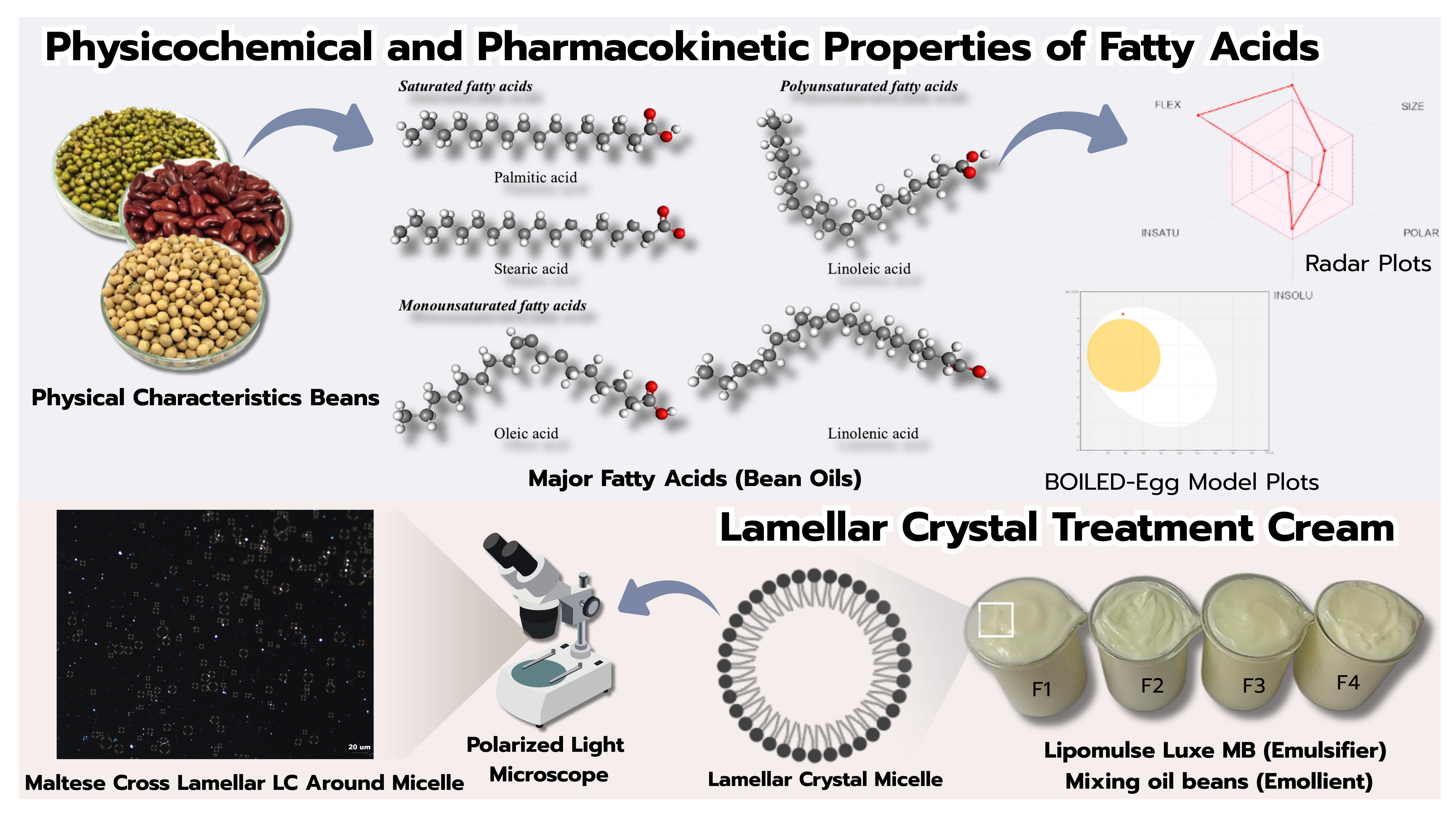
The green bean (Vigna radiate L.), red bean (Phaseolus vulgaris L.) and soybean (Glycine max L.) oils were studied and significant differences in appearance and yield of these oils were found. Soybean oil yielded the highest oil recovery (20.10 ± 0.55%) followed by green bean oil (2.36 ± 0.32%) and red bean oil (1.92 ± 0.04%). The major composition of the rich fatty acid profile was palmitic, stearic, oleic, linoleic and linolenic acids with its own unique physicochemical characteristics. Such as stearic acid of consensus log Po/w 5.93 and log S (ESOL) ‒5.73, and linoleic acid, consensus log Po/w 5.61 and log S (ESOL) ‒4.32 consensuses for these values were calculated based on some determinations results 76 - 77 being those with higher number of attempts). ADME analysis indicated that the absorption of all major FAs in GI was significantly high whereas, only limited penetration through skin and blood-brain barrier (BBB) were observed with synthetic accessibility score ranging from 2.31 - 4.91, respectively. While preparing the topical cream formulations, a composition containing green bean oil: red bean oil: soybean oil in 1:1:1 ratio stabilized with Lipomulse Luxe MB was identified to provide an optimal balance of softness, gloss, stability and hair-conditioning performance. The optimized base cream (F4) exhibited a viscosity of 48,442.33 ± 12.90 cP and maintained phase stability with no separation observed after seven heat-cool cycles. Notably, the formulation containing a 1:1:1 ratio of green bean, red bean, and soybean oils achieved significantly greater hair smoothness and glossiness, as determined by texture analysis and microscopic evaluation, thereby outperforming the other tested formulations. These findings support the suitability of bean oil-based formulations as novel cosmetic carriers.
HIGHLIGHTS
- In particular, the saturated and unsaturated long chain fatty acids palmitic, stearic, oleic, linoleic and linolenic showed a very good agreement among them with consensus log Po/w values ranging from 5.20 to 5.93 for saturated and whose corresponding range spanned from 5.21 to 5.65 for monounsaturated ones. Moreover, their moderate-to-low solubility in water (ESOL logS between –4.02 and –5.73) highlights their emollient and cosmetic roles.
- Modeled SwissADME led to high levels of GI absorption for all the main fatty acids, with saturated forms showing favorable skin permeation (Log Kp values per–2.19 and –2.77 cm/s) and selective ability to cross the blood-brain barrier thus supporting their optimal PK profiles compared with unsaturated counterparts.
- Lamellar crystal creams containing either Lipomulse Luxe MB or 1:1:1, mixing bean oils resulted in an ideal balance between texture, stability and hair conditioning efficacy. This was confirmed by constant pH value (5.71 ± 0.51), excellent viscosity (48,442 ± 12.90 to 48,670 ± 15.82 cP) and no phase separation following seven heating–cooling cycles.
GRAPHICAL ABSTRACT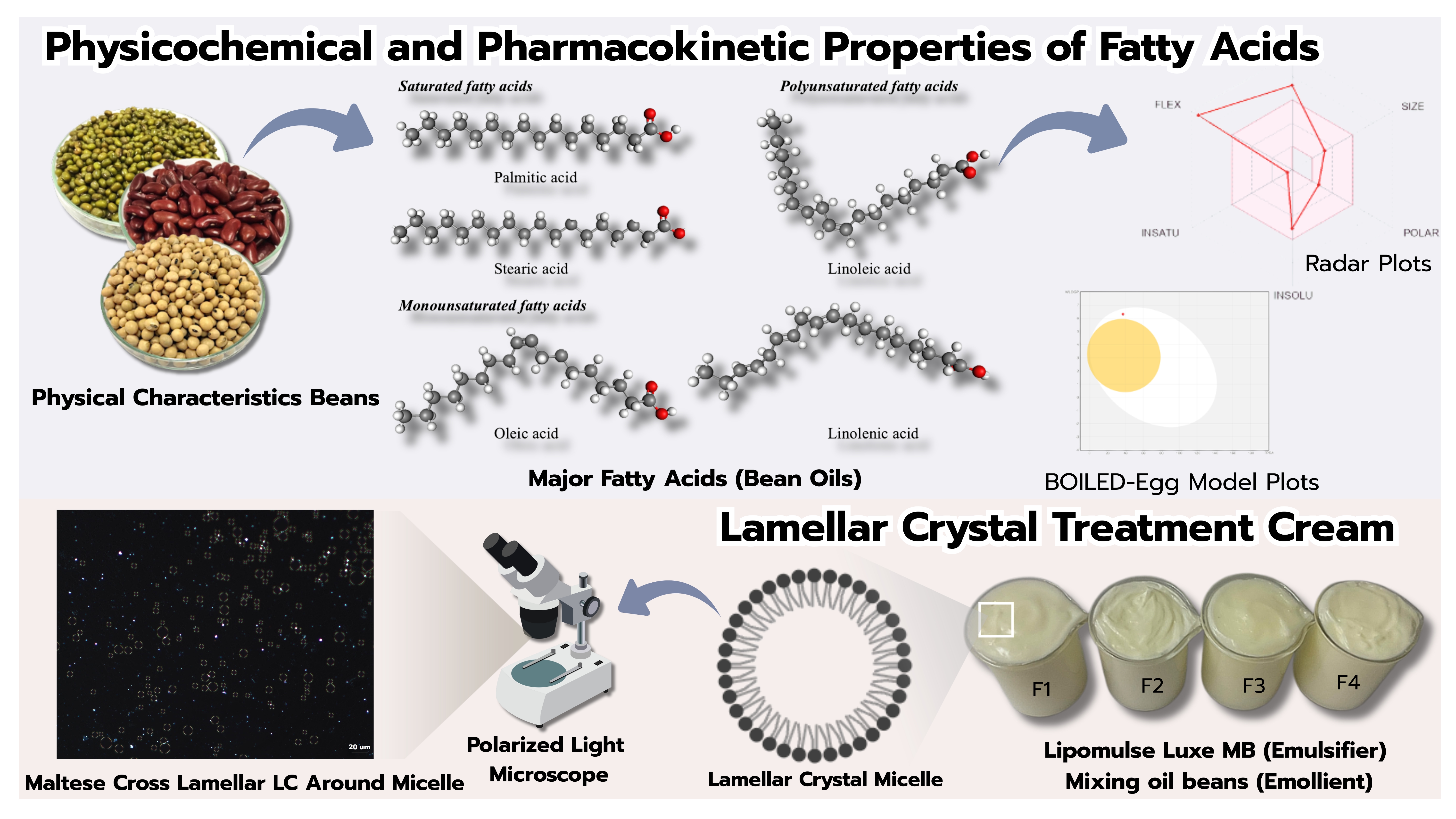
Downloads
References
WC Byrdwell and RJ Goldschmidt. Fatty Acids of Ten Commonly Consumed Pulses. Molecules 2022; 27(21), 7260.
R Rodríguez Madrera, A Campa Negrillo and JJ Ferreira Fernández. Fatty acids in dry beans (Phaseolus vulgaris L.): A contribution to their analysis and the characterization of a diversity panel. Foods 2024; 13(13), 2023.
Y Sahasakul, A Aursalung, S Thangsiri, P Wongchang, P Sangkasa-Ad, A Wongpia, A Polpanit, W Inthachat, P Temviriyanukul and U Suttisansanee. Nutritional compositions, phenolic contents, and antioxidant potentials of ten original lineage beans in Thailand. Foods 2022; 11(14), 2062.
S Wang, M Wu, Q Hu, C Jiang, S Wang, Y Yao and L Wang. Nutritional component analysis of mung bean (Vigna radiata L.). SABRAO Journal of Breeding and Genetics 2025; 57(3), 1050-1059.
AB Özyiğit. Seed inoculation with Rhizobium japonicum bacteria improved fatty acid composition of different soybean (Glycine max L.) genotypes. Journal of King Saud University - Science 2024; 36(11), 103492.
E Adewole, A Ojo, O Oludoro and I Osasona. Fatty acid profiles of Phaseolus species. Food Research 2021; 5(5), 131-135.
A Singh, T Umeda and I Kobayashi. Formulation and characterization of soybean oil-in-water emulsions stabilized using gelatinized starch dispersions from plant sources. Molecules 2024; 29(9), 1923.
MO Aremun, H Ibrahim and TO Bamidele. Physicochemical characteristics of the oils extracted from some Nigerian plant foods - a review. Chemical and Process Engineering Research 2015; 32, 36-52.
FC Yang, Y Zhang and MC Rheinstädter. The structure of peopleʼs hair. PeerJ 2014; 2, 619.
V Mysore and A Arghya. Hair oils: Indigenous knowledge revisited. International Journal of Trichology 2022; 14(3), 84-90.
NH Lai, THN Dang, TT Nguyen and DTQ Phan. Utilizing lipid bond technology with molecular lipid complex to provide lipid treatment for damaged hair. Dermatology Research and Practice 2025; 2025, 5385312.
SH Song, JH Lim, SK Son, J Choi, NG Kang and SM Lee. Prevention of lipid loss from hair by surface and internal modification. Scientific Reports 2019; 9(1), 9834.
S Abdalla, MK Aroua and LT Gew. A comprehensive review of plant-based cosmetic Oils (Virgin Coconut oil, Olive oil, Argan oil, and Jojoba oil): Chemical and biological properties and their cosmeceutical applications. ACS Omega 2024; 9(44), 44019-44032.
W Rattanabun, W Nakyai, N Phungsara, T Neamchuchuen and W Keawbankrud. Comparative antioxidant and anti-fungal (Malassezia furfur) activities of Glycine max L., Vigna radiata L., and Phaseolus vulgaris L.: Optimal active for anti-irritation efficacy and nanoemulsion-based formulation development. International Journal of Environmental Science 2025; 11(7), 603-615.
Y Yamamoto, M Kumetani, Y Onuki, T Koide, T Suzuki and T Fukami. Analysis of the stability of external-application dermatologic preparations: Consideration from rheological measurements. Chemical & Pharmaceutical Bulletin 2016; 64(7), 1047-1055.
MA Wazed, S Yasmin, P Basak, A Hossain, MM Rahman, MR Hassan, MM Khair and MN Khatun. Evaluation of physicochemical parameters of edible oils at room temperature and after heating at high temperature. Food Research 2023; 7(4), 91-100.
H-Y Sung and KH Kim. Hair growth promotion with black soybean extracts: Case series. Journal of Pharmacopuncture 2022; 25(1), 63-67.
D Sowdhanya, J Singh, P Rasane, S Kaur, J Kaur, S Ercisli and H Verma. Nutritional significance of velvet bean (Mucuna pruriens) and opportunities for its processing into value-added products. Journal of Agriculture and Food Research 2024; 15, 100921.
MA van Rooijen and RP Mensink. Palmitic acid versus stearic acid: Effects of interesterification and intakes on cardiometabolic risk markers - a systematic review. Nutrients 2020; 12(3), 615.
N Salih, J Salimon and E Yousif. The physicochemical and tribological properties of oleic acid based triester biolubricants. Industrial Crops and Products 2011; 34(1), 1089-1096.
NB Patil, RS Adnaik and TT Shaikh. Swiss ADME predictions of pharmacokinetics and drug-likeness characteristics of secondary metabolites found in Glycyrrhiza glabra. International Journal of Science and Research Methodology 2025; 28(1), 16-24.
DL Roman, M Roman, C Soni, M Schmutz, E Hernandez, P Wick, T Cassaniti, G Cavalli, V Ostafe and A Ivansari. Computational assessment of the pharmacological profiles of degradation products of chitosan. Frontiers in Bioengineering and Biotechnology 2019; 7, 00214.
AS Pirzada, H Khan, W Alam, HW Darwish, AA Elhenawy, A Kuznetsov and M Daglia. Physicochemical properties, pharmacokinetic studies, DFT approach, and antioxidant activity of nitro and chloro indolinone derivatives. Frontiers in Chemistry 2024; 12, 1360719.
PA Chimane, RS Adnaik and SN Ghule. Swiss ADME prediction of pharmacokinetics and drug-likeness properties of secondary metabolism present in Buchanania lanzan. Journal of Current Pharma Research 2025; 21(1), 1-9.
TM Obuotor, AO Kolawole, OE Apalowo and AJ Akamo. Metabolic profiling, ADME pharmacokinetics, molecular docking studies and antibacterial potential of Phyllantus muellerianus leaves. Advances in Traditional Medicine 2023; 23(2), 427-442.
A Rauf, H Khan, M Khan, A Abusharha, G Serdaroğlu and M Daglia. In silico, SwissADME, and DFT studies of newly synthesized oxindole derivatives followed by antioxidant studies. Journal of Chemistry 2023; 2023(1), 5553913.
CJ Ononamadu and A Ibrahim. Molecular docking and prediction of ADME/drug-likeness properties of potentially active antidiabetic compounds isolated from aqueous-methanol extracts of Gymnema sylvestre and Combretum micranthum. Bio Technologia (Pozn) 2021; 102(1), 85-99.
Y Staneva, I Iliev, S Georgieva and A Merdjanova. In silico prediction of physicochemical properties and drug-likeness of omega-3 fatty acids. Ovidius University Annals of Chemistry 2024; 35(2), 118-125.
L Di, P Artursson, A Avdeef, GF Ecker, B Faller, H Fischer, JB Houston, M Kansy, EH Kerns, SD Krämer, H Lennernäs and K Sugano. Evidence-based approach to assess passive diffusion and carrier-mediated drug transport. Drug Discovery Today 2012; 17(15-16), 905-912.
M Hanifah, M Jurfi. Formulation and stability testing of nanoemulsion lotion containing Centella asiatica extract. Journal of Young Pharmacists 2018; 10(4), 404-408.
G Hemalatha, P Abhiram, P Tejeswari, M Pooja, Sravani and Shailaja. Nano-emulsion approach to enhance skin hydration: Formulation and evaluation of a hyaluronic acid moisturizing cream. International Research Journal of Modernization in Engineering Technology and Science 2025; 7(8), 2462-2467.
B Iskandar, TW Liu, HC Mei, IC Kuo, MDC Surboyo, HM Lin and CK Lee. Herbal nanoemulsions in cosmetic science: A comprehensive review of design, preparation, formulation, and characterization. Journal of Food and Drug Analysis 2024; 32(4), 428-458.
A Andonova, V Gugleva, Y Sotirova, K Nikolova, M Marcheva, Z Petkova and V Andonova. Influence of natural oils on the textural and rheological properties of cosmetic creams. Pharmacia 2024; 71, 138613.
J Stabrauskiene, A Mazurkevičiūtė, D Majiene, R Balanaskiene and J Bernatoniene. Development and evaluation of an anti-inflammatory emulsion: Skin penetration, physicochemical properties, and fibroblast viability assessment. Pharmaceutics 2025; 17(7), 933.
S Jiamphun and W Chaiyana. Enhancing skin delivery and stability of vanillic and ferulic acids in aqueous enzymatically extracted glutinous rice husk by nanostructured lipid carriers. Pharmaceutics 2023; 15(7), 1961.
YM Navarro-Pérez, E Cedeño-Linares, O Norman-Montenegro, V Rau-Sanjuan, Y Mondeja-Rivera, AM Hernández-Monzón and MM González-Bedía. Prediction of the physical stability and quality of O/W cosmetic emulsions using full factorial design. Journal of Pharmacy & Pharmacognosy Research 2021; 9(1), 98-112.
T Xiao, X Ma, H Hu, F Xiang, X Zhang, Y Zheng, H Dong, B Adhikari, Q Wang and A Shi. Advances in emulsion stability: A review on mechanisms, role of emulsifiers, and applications in food. Food Chemistry: X 2025; 29, 102792.
M Estanqueiro, J Conceição, MH Amaral, D Santos, JB Silva and JMS Lobo. Characterization and stability studies of emulsion systems containing pumice. Brazilian Journal of Pharmaceutical Sciences 2014; 50(2), 361-370.
M Shafiei, Y Kazemzadeh, DA Martyushev, Z Dai and M Riazi. Effect of chemicals on the phase and viscosity behavior of water in oil emulsions. Scientific Reports 2023; 13, 4100.
Y Yang, S Yan, B Yu, C Gao, K Chang and J Wang. Lamellar gel containing emulsions as an effective carrier for stabilization and transdermal delivery of retinyl propionate. Colloids and Surfaces A: Physicochemical and Engineering Aspects 2023; 674, 131834.
Z Hua, C Zhang, J He, Y Chen, S Zhang, J Sun, N Wang, J Zhang, X Yang, J Chen and X Wei. Ultra-micro liquid crystal in cosmetic emulsion with excellent moisture retention and delivery selectivity. ACS Omega 2024; 9(47), 47194-47202.
V Teeranachaideekul, S Soontaranon, S Sukasem, D Chantasart and A Wongrakpanich. Influence of the emulsifier on nanostructure and clinical application of liquid crystalline emulsions. Scientific Reports 2023; 13(1), 4185.
W Zhang and L Liu. Study on the formation and properties of liquid crystal emulsion in cosmetic. Journal of Cosmetics, Dermatological Sciences and Applications 2013; 3(2), 139-144.
W Gu, L Gu, N Tao, X Wang and C Xu. Composite fish collagen peptide-based biopolymer emulsion for keratin structure stabilization and hair fiber repair. Polymers 2025; 17(7), 907.
F Zamiri, H Rakhshandeh, B Kiafar, SM Naqvi, M Emadzadeh, S Fakhraei and M Maleki. Assessment of the effects of bean extract on axillary hair reduction. Avicenna Journal of Phytomedicine 2024; 14(2), 268-277.
C Fernandes, B Medronho, L Alves and MG Rasteiro. On hair care physicochemistry: From structure and degradation to novel biobased conditioning agents. Polymers 2023; 15(3), 608.
MFRG Dias. Hair cosmetics: An overview. International Journal of Trichology 2015; 7(1), 2-15.
Published
How to Cite
Issue
Section
License
Copyright (c) 2025 Walailak University

This work is licensed under a Creative Commons Attribution-NonCommercial-NoDerivatives 4.0 International License.





