
Mimusops elengi Flower Hydroethanolic Extract as A Safe Antioxidant Ingredient for Cosmeceutical Applications
DOI:
https://doi.org/10.48048/tis.2025.9261Keywords:
Mimusops elengi, Phenolics, Free radical scavenging, Skin cells, Cytotoxicity, Cosmeceuticals, Stability testAbstract
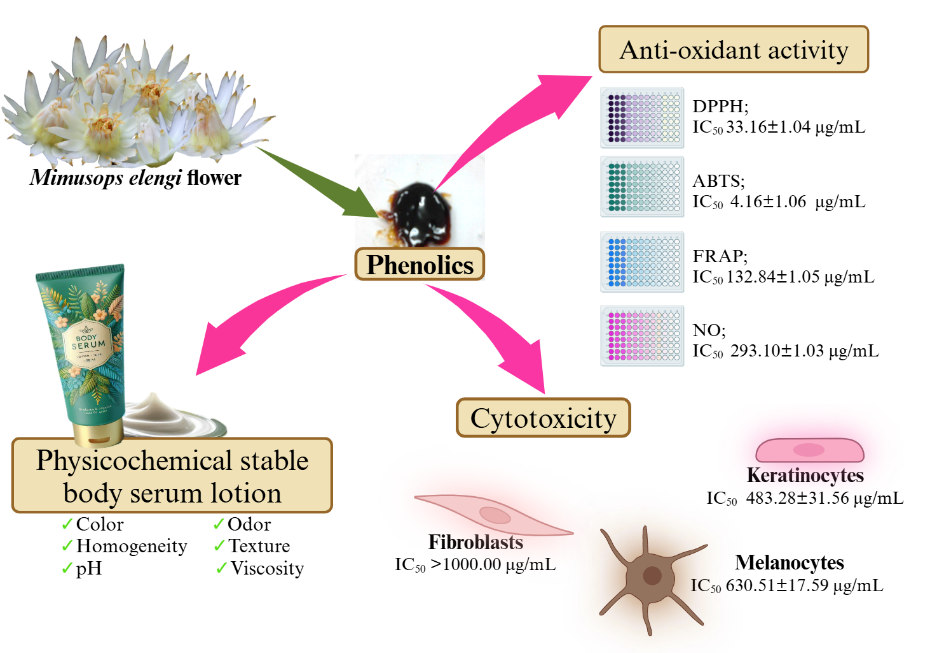
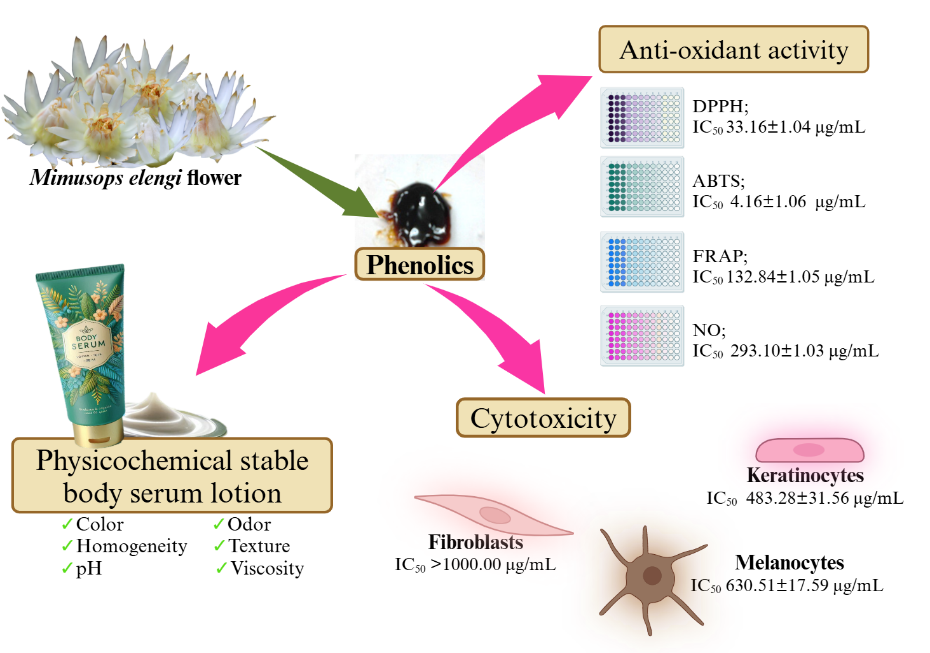
Natural phenolic antioxidants have gained increasing attention for their safety and effectiveness in cosmeceutical products. Among these, the flowers of Mimusops elengi (M. elengi), traditionally used in Thai medicine, are known for their rich content of phenolic and terpene compounds, which contribute to their therapeutic potential. This study investigates the antioxidant activity and skin safety of M. elengi flower hydroethanolic extract (MEFE) for cosmeceutical applications. The MEFE was prepared through maceration, and the total phenolic content was measured using the Folin-Ciocalteu method. FT-IR and UV-VIS absorption spectroscopy were employed to confirm the presence of phenolic functional groups. Antioxidant activities were tested using DPPH, FRAP, ABTS, and NO assays to assess the MEFE’s radical scavenging efficiency. In addition, cytotoxicity assays on human skin cells, including keratinocytes (HaCaT), fibroblasts, and melanocytes (B16F1), were conducted to ensure safety. A body serum lotion containing the 2.00 % w/w MEFE was formulated and evaluated for stability. Results showed that the extract contained phenolics 77.02 ± 0.01 mg GAE/g and exhibited strong antioxidant activities with IC50 values of 33.16 ± 1.04, 4.16 ± 1.06, 132.84 ± 1.05, and 293.10 ± 1.03 µg/mL for DPPH, FRAP, ABTS, and NO assays, respectively. Cytotoxicity testing confirmed low toxicity, with IC50 values of 483.28 ± 31.56 µg/mL for keratinocytes, >1,000.00 µg/mL for fibroblasts, and 630.51 ± 17.59 µg/mL for melanocytes. The 2.00 % MEFE body serum lotion demonstrated good physical stability, suggesting that the MEFE is a promising ingredient for skincare products. Therefore, further studies are needed to identify the phytoconstituents in the MEFE, and explore the molecular mechanisms by which the MEFE inhibits skin aging from oxidative stress. Additionally, clinical trials are needed to evaluate its overall safety through a skin irritation test and to assess its efficacy in the 2.00 % MEFE body serum lotion.
HIGHLIGHTS
- The ethanolic extract of Mimusops elengi flowers (MEFE) serves as a potent natural source of phenolic antioxidants, evaluated through DPPH, ABTS, FRAP, and NO scavenging assays.
- The effective antioxidant dose of the MEFE does not exhibit toxicity to skin cells, indicating its safety for cosmeceutical applications.
- The body serum lotion formulated with the 2.00 % w/w MEFE was developed, exhibiting good stability in physicochemical properties.
GRAPHICAL ABSTRACT
Downloads
References
N Leerach, S Yakaew, P Phimnuan, W Soimee, W Nakyai, W Luangbudnark and J Viyoch. Effect of Thai banana (Musa AA group) in reducing the accumulation of oxidation end products in UVB-irradiated mouse skin. Journal of Photochemistry and Photobiology B: Biology 2017; 168, 50-58.
A Merecz-Sadowska, P Sitarek, E Kucharska, T Kowalczyk, K Zajdel, T Cegliński and R Zajdel. Antioxidant properties of plant-derived phenolic compounds and their effect on skin fibroblast cells. Antioxidants 2021; 10(5), 726.
RU Nisa, AU Nisa, AY Tantray, AH Shah, AT Jan, AA Shah and IA Wani. Plant phenolics with promising therapeutic applications against skin disorders: A mechanistic review. Journal of Agricultural and Food Research 2024; 16, 101090.
KC Wu, YC Hseu, YC Shih, G Sivakumar, JT Syu, GL Chen, MT Lu and PC Chu. Calycosin, a common dietary isoflavonoid, suppresses melanogenesis through the downregulation of PKA/CREB and p38 MAPK signaling pathways. International Journal of Molecular Sciences 2022; 23(3), 1358.
P Nagakannan, BD Shivasharan, BS Thippeswamy and VP Veerapur. Restoration of brain antioxidant status by hydroalcoholic extract of Mimusops elengi flowers in rats treated with monosodium glutamate. Journal of Environmental Pathology, Toxicology and Oncology 2012; 31(3), 213-221.
P Nagakannan, BD Shivasharan, BS Thippeswamy, VP Veerapur and P Bansal. Protective effect of hydroalcoholic extract of Mimusops elengi Linn. flowers against middle cerebral artery occlusion induced brain injury in rats. Journal of Ethnopharmacology 2012; 140(2), 247-254.
S Shailajan and D Gurjar. Wound healing efficacy of Mimusops elengi L. flowers in albino Wistar rats using excision wound model. Pharmacognosy Communications 2016; 6(2), 72-79.
RV Hadaginhal, VP Tikare, KS Patil, MD Bhanushali, NS Desai and A Karigar. Evaluation of cognitive enhancing activity of Mimusops elengi Linn on albino rats. International Journal of Research in Ayurveda and Pharmacy 2010; 1(2), 484-492.
N Narayanaswamy, S Rohini, A Duraisamy and KP Balakrishnan. Antityrosinase and antioxidant activities of various parts of Mimusops elengi: A comparative study. International Journal of Research in Cosmetic Science 2011; 1(1), 17-22.
W Nakyai, W Pabuprapap, W Sroimee, V Ajavakom, B Yingyongnarongkul and A Suksamrarn. Anti-acne vulgaris potential of the ethanolic extract of Mesua ferrea L. flowers. Cosmetics 2021; 8(4), 107.
S Yakaew, P Phimnuan, K Tiensomjitr, W Nakyai, N Nuengchamnong, G Ross, M Ungsurungsei and J Viyoch. Hom-Kularb-Dang rice bran extract for the prevention of UVB-damage against human skin fibroblast. Chiang Mai University Journal of Natural Sciences 2020; 19(1), 34-51.
L Kirkbride, L Humphries, P Kozielska and H Curtis. Designing a suitable stability protocol in the face of a changing retail landscape. Cosmetics 2021; 8(3), 64.
F Chemat, MA Vian and G Cravotto. Green extraction of natural products: Concept and principles. International Journal of Molecular Sciences 2012; 13(7), 8615-8627.
F Papaccio, AD Arino, S Caputo and B Bellei. Focus on the contribution of oxidative stress in skin aging. Antioxidants 2022; 11(6), 1121.
C Li, L Kuai, R Cui and X Miao. Melanogenesis and the targeted therapy of melanoma. Biomolecules 2022; 12(12), 1874.
IG Munteanu and C Apetrei. Analytical methods used in determining antioxidant activity: A review. International Journal of Molecular Sciences 2021; 22(7), 3380.
R Radi. Oxygen radicals, nitric oxide, and peroxynitrite: Redox pathways in molecular medicine. Proceedings of the National Academy of Sciences of the United States of America 2018; 115(23), 5839-5848.
CV Suschek, T Schewe, H Sies and KD Kröncke. Nitrite a naturally occurring precursor of nitric oxide that acts like a ‘prodrug’. Biological Chemistry 2006; 387(5), 499-506.
S Shailajan and D Gurjar. Evaluation of Mimusops elengi L. flowers using pharmacognostic approach. Pharmacognosy Communications 2015; 5(1), 83-92.
T Morikawa, Y Manse, M Koda, S Chaipech, Y Pongpiriyadacha, O Muraoka and K Ninomiya. Two new aromatic glycosides, elengiosides A and B, from the flowers of Mimusops elengi. Journal of Natural Medicines 2018; 72(2), 542-550.
PK Rout, D Sahoo and LN Misra. Comparison of extraction methods of Mimusops elengi L. flowers. Industrial Crops and Products 2010; 32(3), 678-680.
J Rumpf, R Burger and M Schulze. Statistical evaluation of DPPH, ABTS, FRAP, and Folin-Ciocalteu assays to assess the antioxidant capacity of lignins. International Journal of Biological Macromolecules 2023; 233, 123470.
JH Hsu, CS Yang and JJ Chen. Antioxidant, anti-α-glucosidase, antityrosinase, and anti-inflammatory activities of bioactive components from Morus alba. Antioxidants 2022; 11(11), 2222.
A Kandasamy, K Aruchamy, P Rangasamy, D Varadhaiyan, C Gowri, TH Oh, S Ramasundaram and B Athinarayanan. Phytochemical analysis and antioxidant activity of Centella asiatica extracts: An experimental and theoretical investigation of flavonoids. Plants 2023; 12(20), 3547.
N Bai, K He, M Roller, CS Lai, X Shao, MH Pan and CT Ho. Flavonoids and phenolic compounds from Rosmarinus officinalis. Journal of Agricultural and Food Chemistry 2010; 58(9), 5363-5367.
P Pimton, P Ratphibun, N Tassaneesuwan, R Chiangnoon and P Uttayarat. Cytotoxicity evaluation of hydrogel sheet dressings fabricated by gamma irradiation: Extract and semi-direct contact tests. Trends in Sciences 2022; 19(13), 4583.
B Kietthanakorn, W Ruksiriwanich, W Manosroi, J Manosroi and A Manosroi. Biological activities of supercritical carbon dioxide fluid (scCO2) extracts from medicinal flowers. Chiang Mai Journal of Science 2012; 39(1), 84-96.
K Natungnuy and S Poeaim. Antioxidant and cytotoxic activities of methanolic extracts from Mimusops elengi flowers. International Journal of Agricultural Technology 2018; 14(5), 731-740.
A Merecz-Sadowska, P Sitarek, K Zajdel, E Kucharska, T Kowalczyk and R Zajdel. The modulatory influence of plant-derived compounds on human keratinocyte function. International Journal of Molecular Sciences 2021; 22(22), 12488.
J Zhang, H Yu, MQ Man and L Hu. Aging in the dermis: Fibroblast senescence and its significance. Aging Cell 2024; 23(2), e14054.
SH Naikoo, H Rashid, S Kumar, S Archoo, UA Sheikh, NA Lone, PP Singh and SA Tasduq. Inhibition of melanogenesis by 3-(1′-methyltetrahydropyridinyl)-2,4-6-trihydroxy acetophenone via suppressing the activity of cAMP response element-binding protein (CREB) and nuclear exclusion of CREB-regulated transcription coactivator 1 (CRTC1). European Journal of Pharmacology 2023; 952, 175734.
A Manosroi, B Kietthanakorn, C Chankhampan, N Khositsuntiwo and W Manosroi. Physical characteristics and biological activities of Thai flower extracts loaded in niosomes. Chiang Mai Journal of Science 2013; 40(4), 603-617.
SK Bhavikatti, MI Karobari, SLA Zainuddin, A Marya, SJ Nadaf, VJ Sawant, SB Patil, A Venugopal, P Messina and GA Scardina. Investigating the antioxidant and cytocompatibility of Mimusops elengi Linn extract over human gingival fibroblast cells. International Journal of Environmental Research and Public Health 2021; 18(13), 7162.
B Arifin, R Nasution, N Desrianti, M Marianne and H Helwati. Antimicrobial activity of hand lotion of flower Mimusops elengi. Open Access Macedonian Journal of Medical Sciences 2019; 7(22), 3748-3756.
A Choudhary, CN Smitha, DK Suresh and SK Basu. Clinical evaluation of efficacy of Quercus infectoria and Mimusops elengi Linn. herbal preparation in inhibition of gingivitis. Advances in Human Biology 2015; 5(3), 68-76.
AS Udhya, G Vivekanandan, GP Elangovan, S Saranya, D Surya and KK Munagala. Efficacy of locally delivered herbal chip containing (8 % Mimusops elengi) as an adjunct to scaling and root planing in chronic periodontitis: A randomised split-mouth clinical study. Advances in Human Biology 2024; 14(4), 357-361.
R Nasution, AI Azwar, H Helwati and Marianne. Antibacterial activities of perfume: Combination flower Magnolia alba, Cananga odorata and Mimusops elengi L, fixed with Pogostemon cablin oil. Indonesian Journal of Pharmaceutical and Clinical Research 2019; 2(1), 19-23.
N Koomklang, P Tangsombatvichit, S Tumthong, K Kongsong, T Nawatnatee and J Khongdetch. Antioxidant and tyrosinase inhibition activities from ethanolic extracts of Mimusops elengi and Hibiscus sabdariffa flowers and Dillenia indica and Abelmoschus esculentus fruits. Advanced Science Journal 2024; 24(1), 127-142.
U Bernauer, L Bodin, Q Chaudhry, P Coenraads, M Dusinska, J Ezendam, E Gaffet, CL Galli, B Granum, E Panteri, V Rogiers, C Rousselle, M Stepnik, T Vanhaecke, S Wijnhoven, A Koutsodimou, W Uter and NV Goetz. The SCCS Notes of Guidance for the testing of cosmetic ingredients and their safety evaluation, 11th revision, 30 - 31 March 2021, SCCS/1628/21. Regulatory Toxicology and Pharmacology 2021; 127, 105052.
C Alonso, R Lucas, C Barba, M Marti, L Rubio, F Comelles, JC Morales, L Coderch and JL Parra. Skin delivery of antioxidant surfactants based on gallic acid and hydroxytyrosol. Journal of Pharmacy and Pharmacology 2015; 67(7), 900-908.
RK Harwansh, R Deshmukh, VP Shukla, D Khunt, BG Prajapati, S Rashid, N Ali, GM Elossaily, VK Suryawanshi and A Kumar. Recent advancements in gallic acid-based drug delivery: Applications, clinical trials, and future directions. Pharmaceutics 2024; 16(9), 1202.
A Butkeviciute, K Ramanauskiene, V Kurapkiene and V Janulis. Dermal penetration studies of potential phenolic compounds ex vivo and their antioxidant activity in vitro. Plants 2022; 11(15), 1901.
CM Kavali, TQ Nguyen, AS Zahr, LI Jiang and T Kononov. A randomized, a randomized, double-blind, split-body, placebo-controlled clinical study to evaluate the efficacy and tolerability of a topical body firming moisturizer for upper arm rejuvenation. Aesthetic Surgery Journal 2021; 41(6), NP472-NP483.
HS Kwon, JH Lee, GM Kim and JM Bae. Efficacy and safety of retinaldehyde 0.1 % and 0.05 % creams used to treat photoaged skin: A randomized double-blind controlled trial. Journal of Cosmetic Dermatology 2018; 17(3), 471-476.
Downloads
Published
How to Cite
Issue
Section
License
Copyright (c) 2024 Walailak University

This work is licensed under a Creative Commons Attribution-NonCommercial-NoDerivatives 4.0 International License.





