
A Holistic In-Silico Characterization of Mortalin (HSPA9) Inhibitors from Murraya koenigii and Pogostemon cablin for TP53 Reactivation in Breast Cancer
DOI:
https://doi.org/10.48048/tis.2026.13664Keywords:
Breast cancer, Mortalin, TP53, Murraya koenigii, Pogostemon cablin, 8,8’’-Biskoenigine, Apigenin derivativeAbstract
Breast cancer, a leading cause of cancer-related deaths, is characterized by therapeutic challenges, including side effects and drug resistance. The interaction between mortalin (HSPA9) and p53, a tumor suppressor, is known to play a crucial role in cancer progression, as mortalin sequesters p53 and inhibits its tumor-suppressive functions. This study evaluated the potential of bioactive compounds from Murraya koenigii and Pogostemon cablin as novel therapeutic agents for breast cancer through targeting the mortalin-p53 interaction. An in silico approach combining network pharmacology, molecular docking, and molecular dynamics was employed to identify potential inhibitors of this interaction. The study identified two promising candidates: 8,8’’-biskoenigine (CID: 12967046) from M. koenigii and apigenin 7-(6’’-p-coumarylglucoside) (CID: 44257826) from P. cablin. These compounds were screened for drug-likeness, pharmacokinetics, and binding affinity to mortalin. Molecular docking and dynamics simulations demonstrated stable binding interactions with mortalin, particularly with 8,8’’-biskoenigine (‒7,9 kcal/mol), which showed the strongest binding affinity and stability among the candidates. These findings highlight the potential of phytochemicals from M. koenigii and P. cablin as targeted breast cancer treatments by modulating the mortalin-p53 signaling axis. Further experimental validation is needed to confirm their efficacy in vitro and in vivo. This research offers a promising direction for the development of plant-based compounds as effective cancer therapeutics.
HIGHLIGHTS
- The first comprehensive in silico validation establishes that koenigii and P. cablin are potent mortalin inhibitors, unlocking p53-mediated breast cancer therapy.
- 8,8-Biskoenigine (CID 12967046) from Murraya koenigiishowed superior -7.9 kcal/mol affinity and 50-ns MD stability versus controls (mortaparib plus and embelin).
- Apigenin 7-(6”-p-coumarylglucoside (CID 44257826) from Pogostemon cablin emerged as a secondary lead with favorable interactions at key residues (Phe262, Asn221) and drug-like ADMET properties.
GRAPHICAL ABSTRACT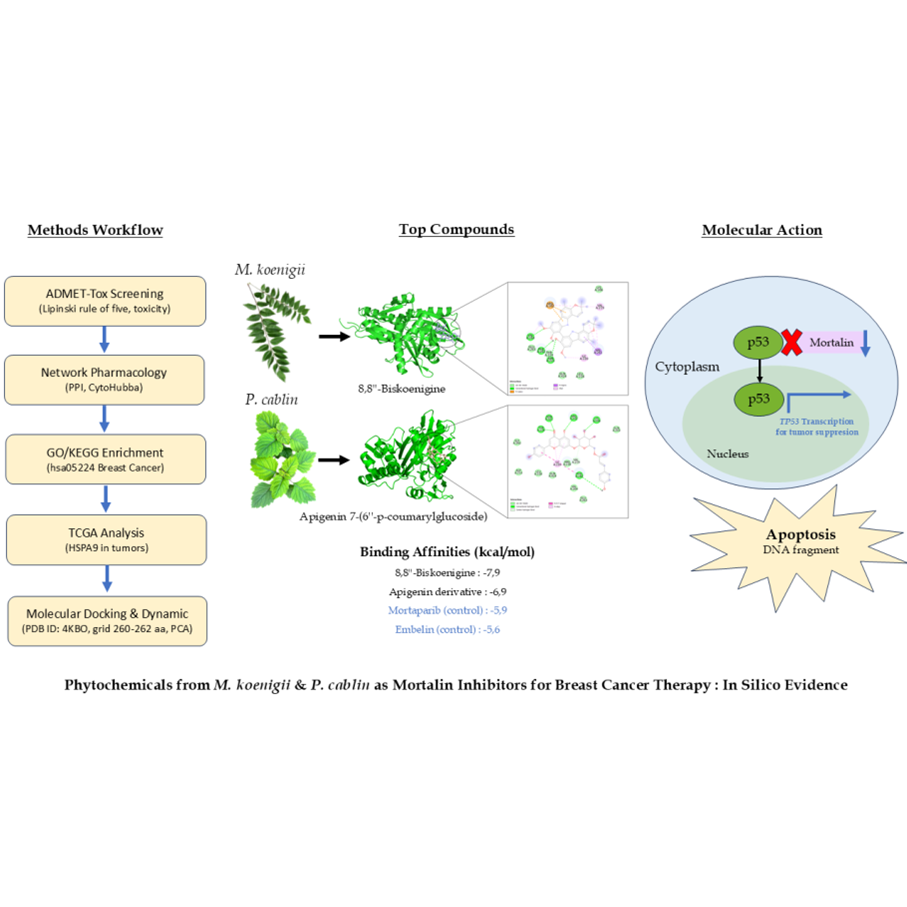
Downloads
References
H Sung, J Ferlay, RL Siegel, M Laversanne, I Soerjomataram, A Jemal and F Bray. Global cancer statistics 2020: Globocan estimates of incidence and mortality worldwide for 36 cancers in 185 countries. CA: A Cancer Journal for Clinicians 2021; 71(3), 209-249.
U Anand, A Dey, AKS Chandel, R Sanyal, A Mishra, DK Pandey, VD Falco, A Upadhyay, R Kandimalla, A Chaudhary, JK Dhanjal, S Dewanjee, J Vallamkondu and JMP de la Lastra. Cancer chemotherapy and beyond: Current status, drug candidates, associated risks and progress in targeted therapeutics. Genes and Diseases 2023; 10(4), 1367-1401.
MR Islam, F Islam, MH Nafady, M Akter, S Mitra, R Das, H Urmee, S Shohag, A Akter, K Chidambaram, FA Alhumaydhi, TB Emran and S Cavalu. Natural small molecules in breast cancer treatment: Understandings from a therapeutic viewpoint. Molecules 2022; 27(7), 2165.
R Ma and HF Kwok. New opportunities and challenges of venom-based and bacteria-derived molecules for anticancer targeted therapy. Seminars in Cancer Biology 2022; 80, 356-369.
NT Telang. Natural products as drug candidates for breast cancer (Review). Oncology Letters 2023; 26(2), 349.
M Yuan, G Zhang, W Bai, X Han, C Li and S Bian. The role of bioactive compounds in natural products extracted from plants in cancer treatment and their mechanisms related to anticancer effects. Oxidative Medicine and Cellular Longevity 2022; 2022, 1429869.
V Iman, S Mohan, SI Abdelwahab, H Karimian, N Nordin, M Fadaeinasab, MI Noordin and SM Noor. Anticancer and anti-inflammatory activities of girinimbine isolated from Murraya koenigii. Drug Design, Development and Therapy 2017; 11, 103-121.
YH Hobani. Cytotoxicity of mahanimbine from curry leaves in human breast cancer cells (mcf-7) via mitochondrial apoptosis and anti-angiogenesis. Molecules 2022; 27(3), 971.
YD Franyoto, A Nurrochmad and N Fakhrudin. Murraya koenigii L. Spreng.: An updated review of chemical composition, pharmacological effects, and toxicity studies. Journal of Applied Pharmaceutical Science 2024; 14(6), 011-027.
S Fatima, I Farzeen, A Ashraf, B Aslam, MU Ijaz, S Hayat, MH Sarfraz, S Zafar, N Zafar, JO Unuofin, SL Lebelo and S Muzammil. A comprehensive review on pharmacological activities of pachypodol: A bioactive compound of an aromatic medicinal plant Pogostemon cablin Benth. Molecules 2023; 28(8), 3469.
JH Chien, SC Lee, KF Chang, XF Huang, YT Chen and NM Tsai. Extract of Pogostemon cablin possesses potent anticancer activity against colorectal cancer cells in vitro and in vivo. Evidence-based Complementary and Alternative Medicine 2020; 2020, 9758156.
II Mrisho, E Musazade, H Chen, H Zhao, J Xing, X Li, J Han and E Cai. Unlocking the therapeutic potential of patchouli leaves: A comprehensive review of phytochemical and pharmacological insights. Plant 2025; 14(7), 1034.
A Elwakeel. Abrogating the interaction between p53 and mortalin (grp75/hspa9/mthsp70) for cancer therapy: The story so far. Frontiers in Cell and Developmental Biology 2022; 10, 879632.
WJ Lu, NP Lee, SC Kaul, F Lan, RTP Poon, R Wadhwa and JM Luk. Mortalin-p53 interaction in cancer cells is stress dependent and constitutes a selective target for cancer therapy. Cell Death and Differentiation 2011; 18, 1046-1056.
S Rampogu, G Lee, AM Kulkarni, D Kim, S Yoon, MO Kim and KW Lee. Computational approaches to discover novel natural compounds for sars-cov-2 therapeutics. Chemistry Open 2021; 10(5), 593-599.
B Ginting, E Sufriadi, E Harnelly, N Isnaini, F Mulana, IH Suparto, A Ilmiawati, Ernawati, S Muhammad, M Syakira and CD Riski. Identification of volatile compounds contained in the therapeutic essential oils from Pogostemon cablin, Melaleuca leucadendra, and Mentha piperita and their purified fractions. Journal of Advanced Pharmaceutical Technology & Research 2023; 14(3), 208-212.
F Husna, FD Suyatna, W Arozal, EH Purwaningsih, M Hanafi, R Razali and CW Asriza. Murraya koenigii extract improving rate limiting enzymes on carbohydrate metabolism and GLUT-4 expression of hyperglycemic rats. Journal of Applied Pharmaceutical Science 2022; 12(12), 143-149.
S Kim, J Chen, T Cheng, A Gindulyte, J He, S He, Q Li, BA Shoemaker, PA Thiessen, B Yu, L Zaslavsky, J Zhang and EE Bolton. PubChem 2025 update. Nucleic Acids Research 2025; 53(1), 1516-1525.
G Stelzer, N Rosen, I Plaschkes, S Zimmerman, M Twik, S Fishilevich, TI Stein, R Nudel, I Lieder, Y Mazor, S Kaplan, D Dahary, D Warshawsky, Y Guan-Golan, A Kohn, N Rappaport, M Safran and D Lancet. The GeneCards suite: From gene data mining to disease genome sequence analyses. Current Protocols in Bioinformatics 2016; 54(1), 1.30.1-1.30.33.
A Hamosh, AF Scott, JS Amberger, CA Bocchini and VA McKusick. Onlined Mendelian Inheritance in Man (OMIM), a knowledgebase of human genes and genetic disorders. Nucleic Acids Research 2005; 30, 515-517.
M Whirl-Carrillo, R Huddart, L Gong, K Sangkuhl, CF Thorn, R Whaley and TE Klein. An evidence-based framework for evaluating pharmacogenomics knowledge for personalized medicine. Clinical Pharmacology and Therapeutics 2021; 110(3), 563-572.
PJ Thul and C Lindskog. The human Protein Atlas - A spatial map of the human proteome. Protein Science 2018; 27(1), 233-244.
P Shannon, A Markiel, O Ozier, NS Baliga, JT Wang, D Ramage, N Amin, B Schwikowski, T Ideker and H affiliations. Cytoscape: A software environment for integrated models of biomolecular interaction networks. Genome Research 2003; 13(11), 2498-2504.
L Li, L Yang, L Yang, C He, Y He, L Chen, Q Dong, H Zhang, S Chen and P Li. Network pharmacology: A bright guiding light on the way to explore the personalized precise medication of traditional Chinese medicine. Chinese Medicine 2023; 18, 146.
M Li, D Li, Y Tang, F Wu and J Wang. Cytocluster: A cytoscape plugin for cluster analysis and visualization of biological networks. International Journal of Molecular Sciences 2017; 18(9), 1880.
CH Chin, SH Chen, HH Wu, CW Ho, MT Ko and CY Lin. cytoHubba: Identifying hub objects and sub-networks from complex interactome. BMC Systems Biology 2014; 8(4), S11.
G Yu, LG Wang, Y Han and QY He. ClusterProfiler: An R package for comparing biological themes among gene clusters. OMICS: A Journal of Integrative Biology 2012; 16(5), 284-287.
W Luo and C Brouwer. Pathview: An R/Bioconductor package for pathway-based data integration and visualization. Bioinformatics 2013; 29(14), 1830-1831.
DS Chandrashekar, B Bashel, SAH Balasubramanya, CJ Creighton, I Ponce-Rodriguez, BVSK Chakravarthi and S Varambally. UALCAN: A portal for facilitating tumor subgroup gene expression and survival analyses. Neoplasia 2017; 19(8), 649-658.
E Cerami, J Gao, U Dogrusoz, BE Gross, SO Sumer, BA Aksoy, A Jacobsen, CJ Byrne, ML Heuer, E Larsson, Y Antipin, B Reva, AP Goldberg, C Sander and N Schultz. The cBio cancer genomics portal: An open platform for exploring multidimensional cancer genomics data. Cancer Discovery 2012; 2(5), 401-404.
AR Allouche. Software news and updates gabedit — a graphical user interface for computational chemistry softwares. Journal of Computational Chemistry 2010; 32(1), 174-182.
J Amick, SE Schlanger, C Wachnowsky, MA Moseng, CC Emerson, M Dare, WI Luo, SS Ithychanda, JC Nix, JA Cowan, RC Page and S Misra. Crystal structure of the nucleotide-binding domain of mortalin, the mitochondrial Hsp70 chaperone. Protein Science 2014; 23(6), 833-842.
FM Afendi, T Okada, M Yamazaki, A Hirai-Morita, Y Nakamura, K Nakamura, S Ikeda, H Takahashi, M Altaf-Ul-Amin, LK Darusman, K Saito and S Kanaya. KNApSAcK family databases: Integrated metabolite-plant species databases for multifaceted plant research. Plant and Cell Physiology 2012; 53(2), e1.
DH Utomo, N Widodo and M Rifa’i. Identifications small molecules inhibitor of p53-mortalin complex for cancer drug using virtual screening. Bioinformation 2012; 8(9), 426-429.
H Land and MS Humble. YASARA: A Tool to Obtain Structural Guidance in Biocatalytic Investigations. Humana Press, New York, 2018, p. 43-67.
FR Mahendra, GM Gholam, M Musthofa, MMA Hasibuan, A Rafiqi, H Zahra, R Pratama, L Ambarsari, IM Artika and W Nurcholis. Unveiling potential therapeutic targets for colon cancer: A comprehensive bioinformatics analysis of miRNA-mediated regulation. Pharmaceutical Sciences Asia 2025; 52(1), 11-29.
B Katta, C Vijayakumar, S Dutta, B Dubashi and VPN Ramakrishnaiah. The incidence and severity of patient-reported side effects of chemotherapy in routine clinical care: A prospective observational study. Cureus 2023; 15(4), 38301.
K Bukowski, M Kciuk and R Kontek. Mechanisms of multidrug resistance in cancer chemotherapy. International Journal of Molecular Sciences 2020; 21(9), 3233.
AL Hopkins. Network pharmacology: The next paradigm in drug discovery. Nature Chemical Biology 2008; 4(11), 682-690.
X Chen, M Xu and Y An. Identifying the essential nodes in network pharmacology based on multilayer network combined with random walk algorithm. Journal of Biomedical Informatics 2021; 114, 103666.
X Fu, W Tan, Q Song, H Pei and J Li. BRCA1 and breast cancer: Molecular mechanisms and therapeutic strategies. Frontiers in Cell and Developmental Biology 2022; 10, 813457.
L Chen, QH Kang, Y Chen, YH Zhang, Q Li, SQ Xie and CJ Wang. Distinct roles of Akt1 in regulating proliferation, migration and invasion in HepG2 and HCT 116 cells. Oncology Reports 2014; 31(2), 737-744.
DLH Chan, E Segelov, RS Wong, A Smith, A Herbertson, BT Li, N Tebbutt, T Price and N Pavlakis. Epidermal growth factor receptor (EGFR) inhibitors for metastatic colorectal cancer. Cochrane Database of Systematic Reviews 2017; 6(6), 007047.
P Zhang, D Zhang, W Zhou, L Wang, B Wang, T Zhang and S Li. Network pharmacology: Towards the artificial intelligence-based precision traditional Chinese medicine. Briefings in Bioinformatics 2024; 25(1), 518.
AF Putri, DH Utomo, WAS Tunjung and WA Putri. Analysis of the anti-Alzheimer potential of bioactive compounds from Citrus hystrix DC. peel, leaf, and essential oil by network pharmacology. Heliyon 2024; 10(13), 33496.
R Zhang, Z Meng, X Wu, M Zhang, S Zhang and T Jin. Mortalin promotes breast cancer malignancy. Experimental and Molecular Pathology 2021; 118, 104593.
D Shi and W Gu. Dual roles of mdm2 in the regulation of p53: Ubiquitination dependent and ubiquitination independent mechanisms of mdm2 repression of p53 activity. Genes and Cancer 2012; 3(3-4), 240-248.
G Arena, MY Cissé, S Pyrdziak, L Chatre, R Riscal, M Fuentes, JJ Arnold, M Kastner, L Gayte, C Bertrand-Gaday, K Nay, C Angebault-Prouteau, K Murray, B Chabi, C Koechlin-Ramonatxo, B Orsetti, C Vincent, F Casas, JC Marine, S Etienne-Manneville, ..., LL Cam. Mitochondrial mdm2 regulates respiratory complex i activity independently of p53. Molecular Cell 2018; 69(4), 594-609.e8.
M Chinnam, C Xu, R Lama, X Zhang, CD Cedeno, Y Wang, AB Stablewski, DW Goodrich and X Wang. MDM2 E3 ligase activity is essential for p53 regulation and cell cycle integrity. PLoS Genetics 2022; 18(5), 1010293.
AN Sari, A Elwakeel, JK Dhanjal, V Kumar, D Sundar, SC Kaul and R Wadhwa. Identification and characterization of MortaparibPlus—A novel triazole derivative that targets Mortalin-p53 interaction and inhibits cancer-cell proliferation by wild-type p53-Dependent and -Independent Mechanisms. Cancers 2021; 13(4), 835.
J Eberhardt, D Santos-Martins, AF Tillack and S Forli. AutoDock Vina 1.2.0: New docking methods, expanded force field, and python bindings. Journal of Chemical Information and Modeling 2021; 61(8), 3891-3898.
CN Pace, H Fu, KL Fryar, J Landua, SR Trevino, D Schell, RL Thurlkill, S Imura, JM Scholtz, K Gajiwala, J Sevcik, L Urbanikova, JK Myers, K Takano, EJ Hebert, BA Shirley and GR Grimsley. Contribution of hydrogen bonds to protein stability. Protein Science 2014; 23(5), 652-661.
N Nigam, A Grover, S Goyal, SP Katiyar, P Bhargava, PC Wang, D Sundar, SC Kaul and R Wadhwa. Targeting mortalin by embelin causes activation of tumor suppressor p53 and deactivation of metastatic signaling in Human Breast Cancer Cells. PLoS One 2015; 10(9), 0138192.
JY Heo, HJ Kim, SM Kim, KR Park, SY Park, SW Kim, D Nam, HJ Jang, SG Lee, KS Ahn, SH Kim, BS Shim, SH Choi and KS Ahn. Embelin suppresses STAT3 signaling, proliferation, and survival of multiple myeloma via the protein tyrosine phosphatase PTEN. Cancer Letters 2011; 308(1), 71-80.
JK Dhanjal, N Nigam, S Sharma, A Chaudhary, SC Kaul, A Grover and R Wadhwa. Embelin inhibits TNF-α converting enzyme and cancer cell metastasis: Molecular dynamics and experimental evidence. BMC Cancer 2014; 14, 775.
JF Putri, P Bhargava, JK Dhanjal, T Yaguchi, D Sundar, SC Kaul, A Grover and R Wadhwa. Mortaparib, a novel dual inhibitor of mortalin and PARP1, is a potential drug candidate for ovarian and cervical cancers. Journal of Experimental and Clinical Cancer Research 2019; 38, 499.
X Che and L Zhang. Blind docking methods have been inappropriately used in most network pharmacology analysis. Frontiers in Pharmacology 2025; 16, 1566772.
O Trott and AJ Olson. AutoDock Vina: Improving the speed and accuracy of docking with a new scoring function, efficient optimization, and multithreading. Journal of Computational Chemistry 2010; 31(2), 455-461.
DB Kitchen, H Decornez, JR Furr and J Bajorath. Docking and scoring in virtual screening for drug discovery: Methods and applications. Nature Reviews Drug Discovery 2004; 3, 935-949.
DEV Pires, TL Blundell and DB Ascher. pkCSM: Predicting small-molecule pharmacokinetic and toxicity properties using graph-based signatures. Journal of Medicinal Chemistry 2015; 58(9), 4066-4072.
CA Lipinski, F Lombardo, BW Dominy and PJ Feeney. Experimental and computational approaches to estimate solubility and permeability in drug discovery and development settings. Advanced Drug Delivery Reviews 1997; 46(1-3), 3-25.
MJ Martinez, MV Sabando, AJ Soto, C Roca, C Requena-Triguero, NE Campillo, JA Páez and I Ponzoni. Multitask deep neural networks for ames mutagenicity prediction. Journal of Chemical Information and Modeling 2022; 62(24), 6342-6351.
C Jyotishi, M Patel, S Prajapati and R Gupta. Therapeutic potential of diosgenin in hepatocellular carcinoma through molecular mechanisms and nanodelivery strategies. Discover Oncology 2026; 17, 282.
MD Smith, JS Rao, E Segelken and L Cruz. Force-field induced bias in the structure of Aβ21–30: A comparison of OPLS, AMBER, CHARMM, and GROMOS force fields. Journal of Chemical Information and Modeling 2015; 55(12), 2587-2595.
C Chothia. Hydrophobic bonding and accessible surface area in proteins. Nature 1974; 248, 338-339.
ZK Bagewadi, TMY Khan, B Gangadharappa, A Kamalapurkar, SM Shamsudeen and DA Yaraguppi. Molecular dynamics and simulation analysis against superoxide dismutase (SOD) target of Micrococcus luteus with secondary metabolites from Bacillus licheniformis recognized by genome mining approach. Saudi Journal of Biological Sciences 2023; 30(9), 103753.
MY Lobanov, NS Bogatyreva and OV Galzitskaya. Radius of gyration as an indicator of protein structure compactness. Molecular Biology 2008; 42(4), 701-706.
E Yamamoto, T Akimoto, A Mitsutake and R Metzler. Universal relation between instantaneous diffusivity and radius of gyration of proteins in aqueous solution. Physical Review Letters 2021; 126, 128101.
MA Moseng, JC Nix and RC Page. Biophysical consequences of EVEN-PLUS syndrome mutations for the function of mortalin. The Journal of Physical Chemistry B 2019; 123(16), 3383-3396.
Downloads
Published
How to Cite
Issue
Section
License
Copyright (c) 2026 Walailak University

This work is licensed under a Creative Commons Attribution-NonCommercial-NoDerivatives 4.0 International License.





