
Revealing the Anti-Breast Cancer Potential of Essential Oil from Jungga Orange Peel (Citrus jambhiri): Network Pharmacology and In Vitro Studies
DOI:
https://doi.org/10.48048/tis.2026.11289Keywords:
Citrus jambhiri, Essential oil, Breast cancer, T47D cells, Network pharmacology, In vitro, DoxorubicinAbstract
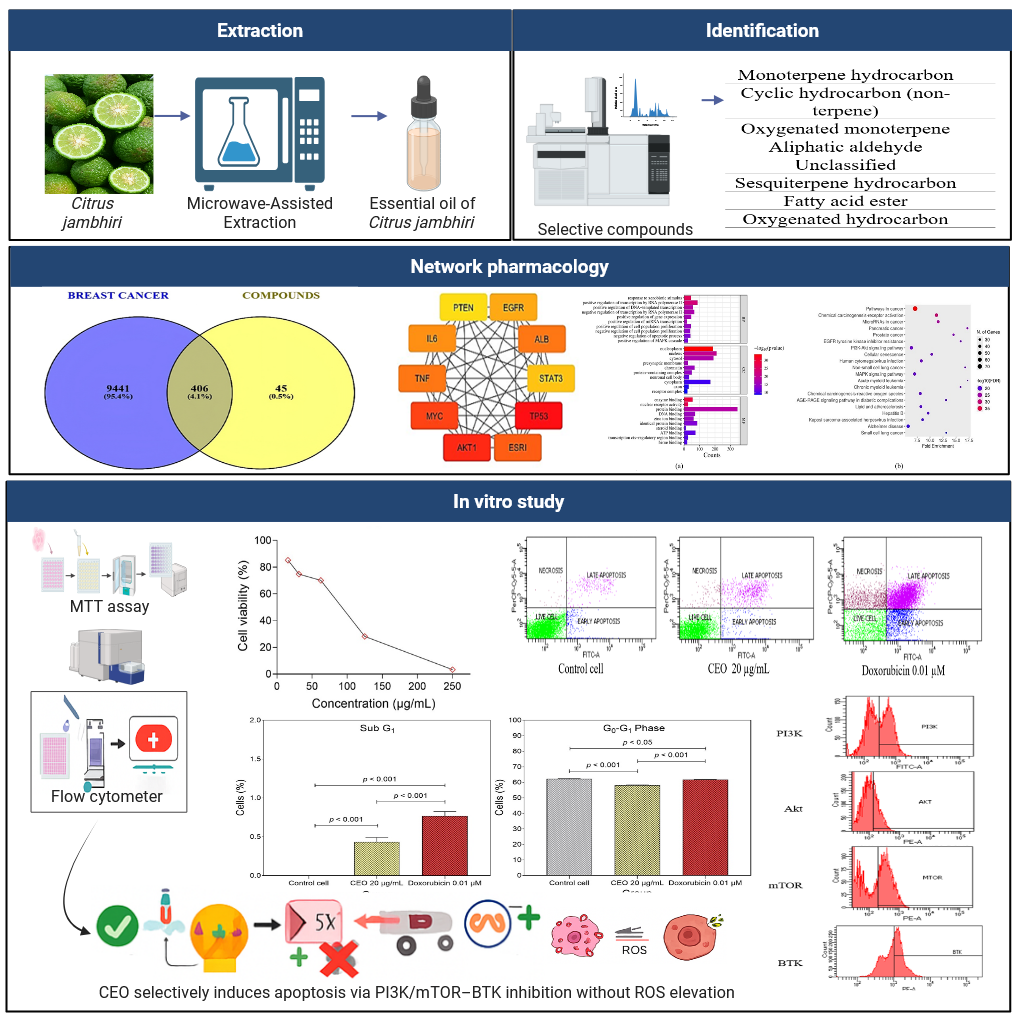
Essential oils from citrus peels, particularly Citrus jambhiri (Jungga orange), are gaining attention for their anticancer properties due to the presence of monoterpenes like D-limonene, γ-terpinene, and β-pinene. Despite its bioactive profile, CEO remains underexplored. This study evaluates the anticancer activity of Citrus jambhiri essential oil (CEO) using GC-MS profiling, network pharmacology, and in vitro testing on T47D breast cancer cells. CEO was extracted via microwave-assisted hydrodistillation, and its constituents were identified through GC-MS. Target genes were predicted using SwissTargetPrediction, PubChem, and CTD, while breast cancer-associated genes were retrieved from GeneCards and Open Targets. Protein-protein interaction and hub genes were analysed using STRING and Cytoscape, with pathway enrichment assessed using DAVID and ShinyGO. Bioactivity was evaluated via MTT, Annexin V/PI, cell cycle, ROS, and protein expression assays targeting PI3K/Akt/mTOR and BTK pathways. CEO was found to be rich in hydrocarbon monoterpenes, mainly D-limonene (35.68%), γ-terpinene (16.14%), and β-pinene (11.84%). Network pharmacology revealed 406 overlapping targets enriched in PI3K/Akt/mTOR and BTK signalling. Key hub genes included AKT1, EGFR, BTK, and TP53. CEO exhibited moderate cytotoxicity (IC50 = 68 µg/mL) with high selectivity (SI = 4.67) compared to doxorubicin. Cell-cycle analysis showed S-phase arrest and sub-G1 elevation, while Annexin V/PI confirmed apoptotic activity with minimal necrosis. ROS levels remained unchanged, and CEO significantly downregulated PI3K, mTOR, and BTK, sparing Akt. CEO demonstrates selective anticancer activity through S-phase arrest, non-oxidative apoptosis, and inhibition of PI3K/mTOR-BTK signalling in T47D cells, suggesting its promise as an adjuvant in breast cancer therapy alongside conventional drugs such as doxorubicin.
HIGHLIGHTS
- GC-MS profiling revealed that Citrus jambhiri essential oil is rich in hydrocarbon monoterpenes, particularlys D-limonene, γ-terpinene, and β-pinene.
- Network pharmacology identified 406 gene targets associated with PI3K/Akt/mTOR and BTK signalling pathways.
- In vitro assays on T47D breast cancer cells showed Citrus jambhiri essential oil induces S-phase cell cycle arrest and apoptosis without elevating ROS levels.
- Protein expression analysis confirmed significant downregulation of PI3K, mTOR, and BTK, while Akt expression was spared.
- Citrus jambhiri essential oil exhibits selective, ROS-neutral anticancer activity and shows promise as an adjuvant agent in breast cancer therapy.
GRAPHICAL ABSTRACT
Downloads
References
IA Al Khalily, S Megantara and DL Aulifa. Targeting molecular pathways in breast cancer using plant-derived bioactive compounds: A comprehensive review. Journal of Experimental Pharmacology 2025; 17, 375-401.
H Sung, J Ferlay, RL Siegel, M Laversanne, I Soerjomataram, A Jemal and F Bray. Global cancer statistics 2022: GLOBOCAN estimates of incidence and mortality worldwide for 36 cancers in 185 countries. CA: A Cancer Journal for Clinicians 2024; 74(3), 229-263.
J Wang and SG Wu. Breast cancer: An overview of current therapeutic strategies, challenges and perspectives. Breast Cancer: Targets and Therapy 2023; 15, 721-730.
A Zafar, S Khatoon, MJ Khan, J Abu and A Naeem. Advancements and limitations in traditional anticancer therapies: A csomprehensive review of surgery, chemotherapy, radiation therapy and hormonal therapy. Discover Oncology 2025; 16(1), 607.
PF Lainetti, AF Leis Filho, R Laufer Amorim, A Battazza and CE Fonseca-Alves. Mechanisms of resistance to chemotherapy in breast cancer and possible targets in drug delivery systems. Pharmaceutics 2020; 12(12), 1193.
FM Abdoul-Latif, A Ainane, IH Aboubaker, J Mohamed and T Ainane. Exploring the potent anticancer activity of essential oils and their bioactive compounds: Mechanisms and prospects for future cancer therapy. Pharmaceuticals 2023; 16, 1086.
DPD Sousa, ROS Damasceno, R Amorati, HA Elshabrawy, RDD Castro, DP Bezerra, VRV Nunes, RC Gomes and TC Lima. Essential oils: Chemistry and pharmacological activities. Biomolecules 2023; 13, 1144.
Y Li, S Liu, C Zhao, Z Zhang, D Nie and Y Li. The chemical composition and antibacterial and antioxidant activities of 5 citrus essential oils. Molecules 2022; 27(20), 7044.
K Rakoczy, N Szymańska, J Stecko, M Kisiel, M Maruszak, M Niedziela and J Kulbacka. Applications of limonene in neoplasms and non neoplastic diseases. International Journal of Molecular Sciences 2025; 26, 6359.
TQ Machado, ACCD Fonseca, ABS Duarte, BK Robbs and DPD Sousa. A narrative review of the antitumor activity of monoterpenes from essential oils: An update. BioMed Research International 2022; 2022, 6317201.
Z Bai, C Yao, J Zhu, Y Xie, XY Ye, R Bai and T Xie. Anti-tumor drug discovery based on natural product β-elemene: Anti-tumor mechanisms and structural modification. Molecules 2021; 26(6), 1499.
Yuandani, S Damayanti, D Satria, SB Waruwu and EDL Putra. Immunostimulant effects of VCO-extract of curcuminoids from turmeric rhizome (Curcuma domestica Val.) in cyclophosphamide and S. aureus infected-immunocomprised rats. South African Journal of Botany 2025; 184, 399-406.
K Petrotos, I Giavasis, K Gerasopoulos, C Mitsagga, C Papaioannou and P Gkoutsidis. Optimization of vacuum-microwave-assisted extraction of natural polyphenols and flavonoids from raw solid waste of the orange-juice industry at industrial scale. Molecules 2021; 26(1), 246.
NA Siregar, EDL Putra, SM Sinaga, D Satria and SB Waruwu. Green synthesis of silver nanoparticles using extract of Kluwih leaves (Artocarpus camansi Blanco.) by microwave-assisted irradiation and their antibacterial properties. Indonesian Journal of Applied Research 2024; 5(3), 164-175.
AA Amar, EDL Putra, D Satria, P Sitorus, HL Lee, SB Waruwu, M Muhammad. Biosynthesis and biological activity of silver nanoparticles from Zanthoxylum acanthopodium fruits. South African Journal of Chemical Engineering 2025; 52, 271-281.
A Dalimunthe, D Satria, P Sitorus, U Harahap, IFD Angela and SB Waruwu. Cardioprotective effect of hydroalcohol extract of andaliman (Zanthoxylum acanthopodium DC.) fruits on doxorubicin-induced rats. Pharmaceuticals 2024; 17(3), 359.
M Chatri, PA Hasibuan, E Meiyanto, DP Putra, EP Septisetyani, D Satria and SB Waruwu. Effect of African leaves (Vernonia amygdalina Delile) on the development of T47D breast cancer cells. Tropical Journal of Natural Product Research 2024; 8(7), 7740.
MJ Rodriguez, MC Perrone, M Riggio, M Palafox, V Salinas, A Elia, ND Salgueiro, AE Werbach, MP Marks, MA Kauffman, L Vellón, V Serra and V Novaro. Targeting mTOR to overcome resistance to hormone and CDK4/6 inhibitors in ER-positive breast cancer models. Scientific Reports 2023; 13(1), 2710.
D Prasad, E Baldelli, EM Blais, J Davis, E El Gazzah, C Mueller, A Gomeiz, A Ibrahim, AV Newrekar, BA Corgiat, R Dunetz, IEF Petricoin, Q Wei and M Pierobon. Functional activation of the AKT-mTOR signalling axis in a real-world metastatic breast cancer cohort. British Journal of Cancer 2024; 131(9), 1543-1554.
W Zhang, D Liu, X Fu, C Xiong and Q Nie. Peel essential-oil composition and antibacterial activities of Citrus×sinensis ‘Tarocco’ and Citrus reticulata Blanco. Horticulturae 2022; 8, 793
Y Wang, R Zhang, J Ma, Y Liu and J Gao. Network pharmacology-based prediction of active ingredients and mechanisms of essential oils against breast cancer. Frontiers in Pharmacology 2022; 13, 908654.
H Hu, H Wang, X Yang, Z Li, W Zhan, H Zhu and T Zhang. Network pharmacology analysis reveals potential targets and mechanisms of proton-pump inhibitors in breast cancer with diabetes. Scientific Reports 2023; 13, 7623.
D Szklarczyk, AL Gable, KC Nastou, D Lyon, R Kirsch, S Pyysalo, N Türei, TN Doncheva, M Legeay, T Fang, P Bork, LJ Jensen and CV Mering. The STRING database 2021: Customizable protein-protein networks and functional characterization of user-uploaded gene sets. Nucleic Acids Research 2021; 49, D605-D612.
MK Elbashir, M Mohammed, H Mwambi and B Omolo. Identification of hub genes associated with breast cancer using integrated gene-expression data with protein-protein interaction network. Applied Sciences 2023; 13, 2403.
BT Sherman, M Hao, J Qiu, X Jiao, MW Baseler, HC Lane, T Imamichi and W Chang. DAVID 2021 update: A web server for functional enrichment analysis and functional annotation of gene lists. Nucleic Acids Research 2022; 50, W216-W221.
F Karami, M Osanloo, H Alipanah, E Zarenezhad, F Moghimi and A Ghanbariasad. Comparison of the efficacy of alginate nanoparticles containing Cymbopogon citratus essential oil and citral on melanoma and breast cancer cell lines under normoxic and hypoxic conditions. BMC Complementary Medicine and Therapies 2024; 24(1), 372.
PAZ Hasibuan, D Satria, ER Wikantyasning, RM Harahap and M Zarlinda. Induction of apoptosis and cell-cycle arrest by Syzygium polyanthum extract in T47D breast-cancer cells. Journal of Applied Pharmaceutical Science 2022; 12, 106-113.
D Satria, PAZ Hasibuan, M Muhammad, SB Waruwu, RY Utomo and SH Ghoran. Cytotoxic and apoptotic effect of Vernonia amygdalina Delile. fractions against Hs578t triple-negative breast cancer cell lines. Phytomedicine Plus 2024; 4(4), 100640.
NP Hapsari, DR Rahmawati, N Nugraheni, M Hanifa, D Satria, PAZ Hasibuan and E Meiyanto. Africa leaf (Vernonia amygdalina Delille.) DCM extract synergistically supports growth suppression effect of doxorubicin on MCF7 and MCF7/HER2 with different effects on cell cycle progression and apoptosis evidence. Journal of Applied Pharmaceutical Science 2024; 14(7), 075-081.
DR Rahmawati, N Nugraheni, NP Hapsari, M Hanifa, RF Kastian, PW Prasetyaningrum, D Satria, PAZ Hasibuan, EP Septisetyani and E Meiyanto. Dichloromethane fraction of Vernonia amygdalina Delile synergistically enhances cytotoxicity of doxorubicin on 4T1 triple negative breast cancer cells through apoptosis induction and cell cycle modulation. Indonesian Journal of Pharmacy 2025; 36(2), 216-224.
J Ma, C Dong, YZ Cao and BL Ma. Dual target of EGFR and mTOR suppresses triple negative breast cancer cell growth by regulating the phosphorylation of mTOR downstream proteins. Breast Cancer: Targets and Therapy 2023; 15, 11-24.
H Dostálová, R Jorda, E Řezníčková and V Kryštof. Anticancer effect of Zanubrutinib in HER2 positive breast cancer cell lines. Investigational New Drugs 2023; 41(2), 210 219.
PAZ Hasibuan, RKUAB Sitorus, A Hermawan, F Huda, SB Waruwu, D Satria. Anticancer activity of the ethylacetate fraction of Vernonia amygdalina Delile towards overexpression of HER-2 breast cancer cell lines. Pharmacia 2024; 71, 1–8.
JM Kim, J Park, EM Noh, HK Song, SY Kang, SH Jung, JS Kim, BH Park, YR Lee and HJ Youn. Bruton’s agammaglobulinemia tyrosine kinase (Btk) regulates TPA-induced breast-cancer cell invasion via PLCγ2/PKCβ/NF-κB/AP-1-dependent matrix metalloproteinase-9 activation. Oncology Reports 2021; 45(5), 56.
D Mandal, P Patel, S K Verma, B R Sahu and T Parija. Proximal discrepancy in intrinsic atomic interaction arrests G2/M phase by inhibiting Cyclin B1/CDK1 to infer molecular and cellular biocompatibility of d limonene. Scientific Reports 2022; 12(1), 18184.
J Sun, P Sun, C Kang, L Zhang, L Guo and Y Kou. Chemical composition and biological activities of essential oils from 6 Lamiaceae folk medicinal plants. Frontiers in Plant Science 2022; 13, 919294.
P Agarwal, Z Sebghatollahi, M Kamal, A Dhyani, A Shrivastava, KK Singh, M Sinha, N Mahato, A K Mishra and KH Baek. Citrus essential oils in aromatherapy: Therapeutic effects and mechanisms. Antioxidants 2022; 11, 2374.
S Nayak, RB Hegde, AS Rao and R Poojary. Unlocking the potential of essential oils in aromatic plants: A guide to recovery, modern innovations, regulation and AI integration. Planta 2025; 262(1), 6.
MD Esclapez, JV García-Pérez, A Mulet and JA Cárcel. Ultrasound-assisted extraction of natural products. Food Engineering Reviews 2020; 3(2), 108-120.
TN dongwe, BA Witika, NP Mncwangi, MS Poka, PP Skosana, PH Demana, B Summers and XS Noundou. Iridoid derivatives as anticancer agents: An updated review from 1970-2022. Cancers 2023; 15, 770.
W Saengha, T Karirat, B Buranrat, T Katisart, NL Ma and V Luang In. Cytotoxicity and antiproliferative activity of essential oils from lemon, wild orange and petitgrain against MCF 7, HepG2 and HeLa cancer cells. Notulae Botanicae Horti Agrobotanici Cluj Napoca 2022; 50(3), 12713.
RE Kased and DME Kersh. GC-MS profiling of naturally extracted essential oils: Antimicrobial and beverage preservative actions. Life 2022; 12, 1587.
D Mandal, P Patel, SK Verma, BR Sahu and T Parija. Proximal discrepancy in intrinsic atomic interaction arrests G2/M phase by inhibiting Cyclin B1/CDK1 to infer molecular and cellular biocompatibility of d limonene. Scientific Reports 2022; 12(1), 18184.
NM Alotaibi, MO Alotaibi, N Alshammari, M Adnan and M Patel. Network pharmacology combined with molecular docking, molecular dynamics, and in vitro experimental validation reveals the therapeutic potential of Thymus vulgaris L. essential oil (thyme oil) against human breast cancer. ACS Omega 2023; 8, 48344-48359.
M Li, J Zhang, X Chen, J Zhang and Z Chen. Screening and identification of core genes and key pathways in breast cancer using bioinformatics analysis. Journal of Oncology 2021; 2021, 8434035.
B Salehi, S Upadhyay, IE Orhan, AK Jugran, SLD Jayaweera, DA Dias, F Sharopov, Y Taheri, N Martins, N Baghalpour, WC Cho and J Sharifi-Rad. Therapeutic potential of α- and β-Pinene: A miracle gift of nature. Biomolecules 2019; 9(11), 738.
S Yu, C Wang, J Ouyang, T Luo, F Zeng, Y Zhang, L Gao, S Huang and X Wang. Identification of candidate biomarkers correlated with the pathogenesis of breast cancer patients. Scientific Reports 2025; 15(1), 8770.
W Hu, D Xu and N Li. Research status of systemic adjuvant therapy for early breast cancer. Cancer Control 2023; 30, 10732748231209193.
A Golestan, A Tahmasebi, N Maghsoodi, SN Faraji, C Irajie and A Ramezani. Unveiling promising breast cancer biomarkers: An integrative approach combining bioinformatics analysis and experimental verification. BMC Cancer 2024; 24(1), 155.
FM Uckun and T Venkatachalam. Targeting solid tumors with Bruton’s tyrosine kinase inhibitors. Frontiers in Cell and Developmental Biology 2021; 9, 650414.
G Maitisha, J Zhou, Y Zhao, S Han, Y Zhao, A Abliz and G Liu. Network pharmacology-based approach to investigate the molecular targets of essential oil obtained from lavender for treating breast cancer. Heliyon 2023; 9(11), e21759.
K Grabowska, A Galanty, L Pecio, A Stojakowska, J Malarz, P Zmudzki, P Zagrodzki and I Podolak. Selectivity screening and structure-cytotoxic activity observations of selected oleanolic acid (OA)-type saponins from the Amaranthaceae family on a wide panel of human cancer cell lines. Molecules 2024; 29(16), 3794.
S Sanshita, N Devi, B Bhattacharya, A Sharma, I Singh, P Kumar, K Huanbutta and T Sangnim. From citrus to clinic: Limonene’s journey through preclinical research, clinical trials, and formulation innovations. International Journal of Nanomedicine 2025; 20, 4433-4460.
AR Terry and N Hay. Emerging targets in lipid metabolism for cancer therapy. Trends in Pharmacological Sciences 2024; 45(6), 537-551.
RS Ezzat, A Abdel-Moneim, KMA Zoheir, EE Mohamed, HS Abou-Seif, M Hefnawy and OM Ahmed. Anti-carcinogenic effects and mechanisms of actions of Citrus limon fruit peel hydroethanolic extract and limonene in diethylnitrosamine/2-acetylaminofluorene-induced hepatocellular carcinoma in Wistar rats. American Journal of Cancer Research 2024; 14, 5193-5215.
J Adamczyk-Grochala, D Bloniarz, K Zielinska, A Lewinska and M Wnuk. DNMT2/TRDMT1 gene knockout compromises doxorubicin induced unfolded protein response and sensitizes cancer cells to ER stress induced apoptosis. Apoptosis 2023; 28(1), 166-185.
GE Lombardo, C Russo, A Maugeri and M Navarra. Sirtuins as players in the signal transduction of Citrus flavonoids. International Journal of Molecular Sciences 2024; 25(4), 1956.
SA Mir, A Dar, SA Alshehri, S Wahab, L Hamid, MAA Almoyad, T Ali and GN Bader. Exploring the mTOR signalling pathway and its inhibitory scope in cancer. Pharmaceuticals 2023; 16(7), 1004.
X Wu, Y Xu, Q Liang, X Yang, J Huang, J Wang, H Zhang and J Shi. Recent advances in dual PI3K/mTOR inhibitors for tumour treatment. Frontiers in Pharmacology 2022; 13, 875372.
Z Zuo, Z Zhou, Y Chang, Y Liu, Y Shen, Q Li and L Zhang. Ribonucleotide reductase M2 (RRM2): Regulation, function and targeting strategy in human cancer. Genes & Diseases 2024; 11(1), 218-233.
F Bellanti, ARD Coda, MI Trecca, A Lo Buglio, G Serviddio and G Vendemiale. Redox imbalance in inflammation: The interplay of oxidative and reductive stress. Antioxidants 2025; 14(6), 656.
R Wang, J Shang and X Zhao. Alpha pinene induces apoptosis through oxidative stress and PI3K/AKT/NF-κB signalling pathway in MDA MB 231 human breast cancer cells. International Journal of Pharmacology 2021; 17(6), 391 399.
X Zhang, R Gao, Z Zhou, X Tang, J Lin, L Wang, X Zhou and T Shen. A network pharmacology-based approach for predicting active ingredients and potential mechanism of Lianhuaqingwen capsule in treating COVID 19. International Journal of Medical Sciences 2021; 18(8), 1866-1876.
FM Abdoul-Latif, A Ainane, IH Aboubaker, J Mohamed and T Ainane. Exploring the potent anticancer activity of essential oils and their bioactive compounds: Mechanisms and prospects for future cancer therapy. Pharmaceuticals 2023; 16(8), 1086.
N Gautam, AK Mantha and S Mittal. Essential oils and their constituents as anticancer agents: A mechanistic view. BioMed Research International 2014; 2014(1), 154106.
A Terasaki, H Kurokawa, H Ito, Y Komatsu, D Matano, M Terasaki, H Bando, H Hara and H Matsui. Elevated production of mitochondrial reactive oxygen species via hyperthermia enhanced cytotoxic effect of doxorubicin in human breast cancer cell lines MDA-MB-453 and MCF-7. International Journal of Molecular Sciences 2020; 21(24), 9522.
P Wigner, K Zielinski, M Labieniec-Watala, A Marczak and M Szwed. Doxorubicin-transferrin conjugate alters mitochondrial homeostasis and energy metabolism in human breast cancer cells. Scientific Reports 2021; 11(1), 4544.
Published
How to Cite
Issue
Section
License
Copyright (c) 2025 Walailak University

This work is licensed under a Creative Commons Attribution-NonCommercial-NoDerivatives 4.0 International License.





