
The Potential of Clove (Syzygium aromaticum) Essential Oil as Sunscreen and Anti-Aging Agents: An In Vitro and In Silico Study
DOI:
https://doi.org/10.48048/tis.2024.8209Keywords:
Antiaging, Antioxidant, Clove (Syzygium aromaticum), Molecular docking, Sunscreen, SPFAbstract
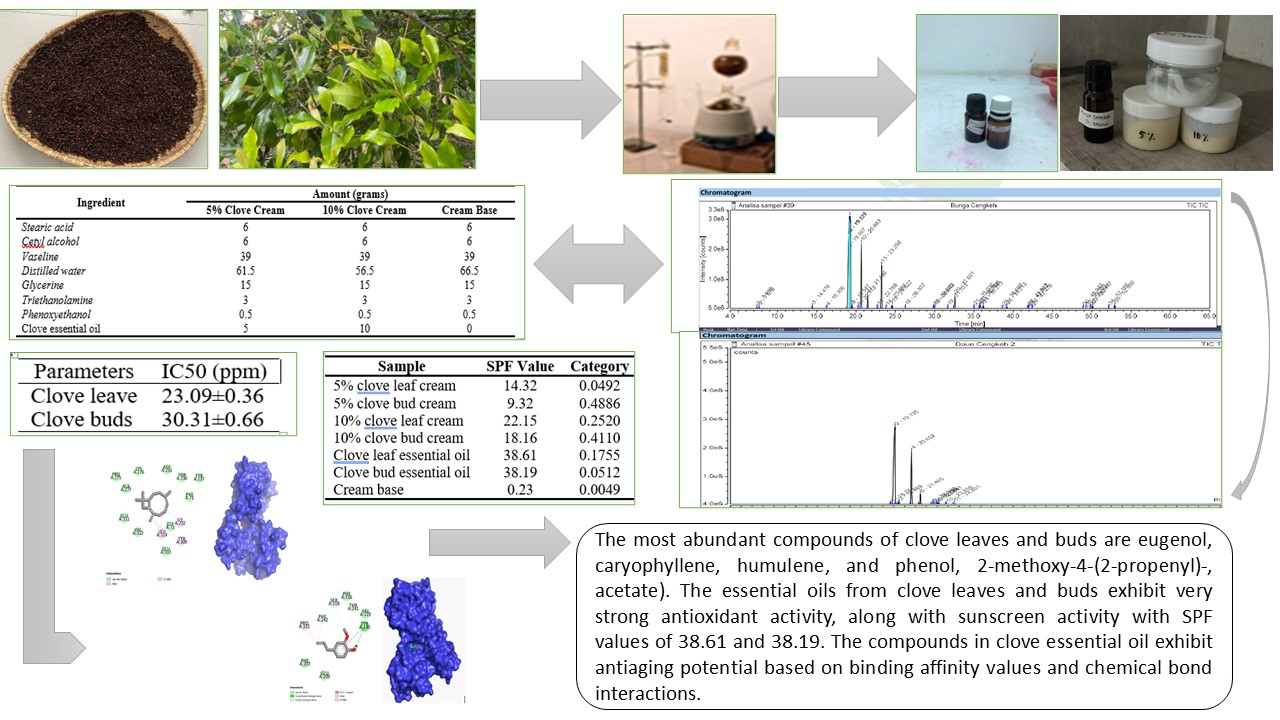
The earth thermal conditions increase exposure to sunlight, triggering skin damage. The skin has defense mechanisms but needs additional protection to prevent photoaging. Using sunscreen is an effort to reduce the harmful effects of sun exposure. Natural ingredients with antioxidant activity can be developed into sunscreen and antiaging products, including cloves. This study aims to assess the antioxidant, sun protection, and anti-aging properties of essential oils derived from clove leaves and buds. The antioxidant activity was assessed by the DPPH system and then formulated into 5 and 10 % clove leaves cream, as well as 5 and 10 % clove bud cream. The SPF values were assessed using a spectrophotometer and the Mansur formula. The antiaging potential was assessed using the in silico method with MMP-1 protein employing the Auto Dock Vina software, followed by analysis and visualization using BIOVIA Discovery Studio. The essential oils from clove leaves and buds have DPPH IC50 values of 23.09 and 30.31 ppm. The SPF values of clove leaves essential oil, 5 % leaves cream, and 10 % leaves cream are 38.61, 14.32, and 22.15. Meanwhile, the SPF values of clove bud essential oil, 5 % bud cream, and 10 % bud cream are 38.19, 9.32, and 18.16. The in silico test revealed that caryophyllene, eugenol, humulene, and phenol, 2-methoxy-4-(2-propenyl), acetate) have strong interactions because they can interact with the active site of proteins using hydrogen, hydrophobic, and van der Waals bonds. The essential oils from clove leaves and buds exhibit very strong antioxidant activity and offer ultra-protection as a sunscreen. The cream formulations still exhibit sunscreen activity, albeit at a lower level compared to pure essential oil. Caryophyllene, eugenol, humulene, and phenol, 2-methoxy-4-(2-propenyl)-, acetate), have potential as antiaging agents, as indicated by their binding affinity and chemical bond interactions observed in the in silico test.
HIGHLIGHTS
- Clove buds and leaves exhibit antioxidant properties.
- Essential oil from clove buds and leaves demonstrates a substantial Sun Protection Factor (SPF).
- The compounds contained in clove essential oil exhibit promise as prospective agents in anti-aging applications.
GRAPHICAL ABSTRACT
Downloads
References
J Pontoan. Uji aktivitas antioksidan dan tabir surya dari ekstrak daun alpukat (Persea americana M.). Indones. Nat. Res. Pharmaceut. J. 2016; 1, 55-66.
S Pratiwi and P Husni. Artikel tinjauan: Potensi penggunaan fitokonstituen tanaman Indonesia sebagai bahan aktif tabir surya. Farmaka 2017; 15, 18-25.
TD Wahyuningsih, TJ Raharjo and I Tahir. Synthesis of 3,4-dimethoxy isoamyl cinnamic as the sunscreen compound from clove oil and fusel oil. Indones. J. Chem. 2010; 2, 55-63.
A Mu’nisa, T Wresdiyati, N Kusumorini and W Manalu. Aktivitas antioksidan ekstrak daun cengkeh. Jurnal Veteriner 2012; 13, 272-7.
W Wahyulianingsih, S Handayani and A Malik. Penetapan kadar flavonoid total ekstrak daun cengkeh (Syzygium aromaticum (L.) Merr & Perry). Jurnal Fitofarmaka Indonesia 2016; 3, 188-93.
K Mohtar, F Fatimawali, EM Rumondor, OS Datu and TE Tallei. Studi in silico senyawa eugenol cengkeh (Syzygium aromaticum L.) terhadap reseptor ER-α, ER-Î2 dan HER-2 pada kanker payudara. Pharmacon 2021; 10, 1001-8.
NLPL Dewi and NMA Ginarsih. Molecular docking ellagic acid sebagai agen anti-photoaging secara in silico. Acta Holistica Pharmaciana 2021; 3, 22-30.
W Pangkahila. Memperlambat penuaan meningkatkan kualitas hidup. Penerbit Buku Kompas, Jakarta, Indonesia, 2019.
AF Haque, DW Fauziah and NS Dayanie. Formulasi dan uji iritasi krim M/A dari ekstrak etanol beras hitam (Oryza sativa L. indica). Jurnal Penelitian dan Kajian Ilmiah Kesehatan Politeknik Medica Farma Husada Mataram 2019; 5, 53-8.
A Zahruddin and D Damayanti. Penuaan kulit: Patofisiologi dan manifestasi klinis. Berkala Ilmu Kesehatan Kulit dan Kelamin 2018; 30, 208-15.
S Soesilo. Materia medika Indonesia jilid V. Departemen Kesehatan RI, Jakarta, Indonesia, 1989.
W Qarani, F Husna, W Yulia, Z Zulkarnain, D Syahrizal, BA Gani, NL Sary and BWK Wardhani. Antioxidant and antiaging activity of Cinnamomum burmannii and Michelia champaca extract and combinations. Narra J 2023; 3, e111.
C Angilia, NL Sary, R Indah, S Suryawati, BS Farsa, HA Zeir, F Fajri and F Husna. Wound healing effect of nutmeg (Myristica fragrans) cream on second-degree burn in animal model. Narra J 2024; 4, e621.
H Kikuzaki, M Hisamoto, K Hirose, K Akiyama and H Taniguchi. Antioxidant properties of ferulic acid and its related compounds. J. Agr. Food Chem. 2002; 20, 2161-8.
Z Salas, DSH Seno and L Ambarsari. Penambatan molekuler secara in silico dan aktivitas antioksidan nanoenkapsulat kurkuminoid secara in vitro sebagai potensi anti penuaan dini. IPB University, Bogor, Indonesia, 2017.
U Suhendar and M Fathurrahman. Aktivitas antibakteri ekstrak metanol bunga cengkeh (Syzygium aromaticum) terhadap bakteri Streptococcus mutans. FITOFARMAKA: Jurnal Ilmiah Farmasi 2019; 9, 26-34.
A Azizah, I Suswati and SM Agustin. Efek anti mikroba ekstrak bunga cengkeh (Syzygium aromaticum) terhadap methicillin-resistant Staphylococcus aureus (MRSA) secara in vitro. Saintika Medika 2017; 13, 31-5.
DM Taher, DD Solihin, U Cahyaningsih and P Sugita. Ekstrak metanol cengkeh (Syzygium aromaticum (L.) Merry & Perry) varietas tuni buru selatan sebagai antimalaria. Acta Vet. Indones. 2018; 6, 38-47.
CIDY Dewi, DK Ernawati and IAA Widhiartini. Uji efektivitas ekstrak etanol daun cengkeh (Syzygium aromaticum L.) terhadap pertumbuhan methicillin resistant Staphylococcus aureus secara in vitro. e-Jurnal Medika Udayana 2021; 10, 79-85.
S Safe, A Jayaraman, RS Chapkin, M Howard, K Mohankumar and R Shrestha. Flavonoids: Structure-function and mechanisms of action and opportunities for drug development. Toxicol. Res. 2021; 37, 147-62.
M Fraga-Corral, P Otero, L Cassani, J Echave, P Garcia-Oliveira, M Carpena, F Chamorro, C Lourenço-Lopes, MA Prieto and J Simal-Gandara. Traditional applications of tannin rich extracts supported by scientific data: Chemical composition, bioavailability and bioaccessibility. Foods 2021; 10, 251.
MNI Bhuiyan. Constituents of the essential oil from leaves and buds of clove (Syzigium caryophyllatum (L.) Alston). Afr. J. Pharm. Pharmacol. 2012; 6, 1260-3.
IBD Kapelle, HJ Sohilait and ML Haluruk. Analisis minyak atsiri dari bunga dan gagang cengkeh (Syzygium aromaticum L.) asal Pulau Saparua Maluku. Teknotan: Jurnal Industri Teknologi Pertanian 2023; 17, 131-6.
E Afrendi, ME Prastya, RI Astuti, WT Wahyuni and I Batubara. Bioactivity of the ethanol extract of clove (Syzygium aromaticum) as antitoxin. Int. J. Food Sci. 2023; 2023, 1-8.
J Rontani. Use of gas chromatography-mass spectrometry techniques (GC-MS, GC-MS/MS and GC-QTOF) for the characterization of photooxidation and autoxidation products of lipids of autotrophic organisms in environmental samples. Molecules 2022; 27, 1629.
MF Nisar, M Khadim, M Rafiq, J Chen, Y Yang and CC Wan. Pharmacological properties and health benefits of eugenol: A comprehensive review. Oxid. Med. Cell. Longev. 2021; 2021, 2497354.
H Nam and M Kim. Eugenol with antioxidant activity inhibits MMP-9 related to metastasis in human fibrosarcoma cells. Food Chem. Toxicol. 2013; 55, 106-12.
CE Ferland, F Beaudry and P Vachon. Antinociceptive effects of eugenol evaluated in a monoiodoacetate‐induced osteoarthritis rat model. Phytother. Res. 2012; 26, 1278-85.
M Karin, Z Liu and E Zandi. AP-1 function and regulation. Curr. Opin. Cell Biol. 1997; 9, 240-6.
MA Calleja, JM Vieites, T Montero- Meléndez, MI Torres, MJ Faus, A Gil and A Suárez. The antioxidant effect of β-caryophyllene protects rat liver from carbon tetrachloride-induced fibrosis by inhibiting hepatic stellate cell activation. Br. J. Nutr. 2013; 109, 394-401.
F Fedia. Nilai sun protecting factor (SPF) krim tabir surya minyak cengkeh secara in vitro dan stabilitas fisiknya. Universitas Islam Indonesia, Yogyakarta, Indonesia, 2012.
D Rahmasari, NS Putri, EN Pranita, N Nadifa and AD Anggraeni. Development of emulsion gel sunscreen containing olive oil and clove oil. KnE Med. 2022; 2022, 141-8.
P Gupta and S Phulara. Biotechnology of terpenoid production from microbial cell factories. Academic Press, Massachusetts, 2021.
I Al-Sharif, A Remmal and A Aboussekhra. Eugenol triggers apoptosis in breast cancer cells through E2F1/survivin down-regulation. BMC Canc. 2013; 13, 600.
SK Jaganathan, A Mazumdar, D Mondhe and M Mandal. Apoptotic effect of eugenol in human colon cancer cell lines. Cell Biol. Int. 2011; 35, 607-15.
DE Kim, YS Hwang, BY Chang, DS Kim, HK Cho and SY Kim. Effects of the Syzygium aromaticum L. extract on antioxidation and inhibition of matrix metalloproteinase in human dermal fibroblast. Asian Pac. J. Trop. Biomed. 2019; 9, 53-9.
LFS Gushiken, FP Beserra, MF Hussni, MT Gonzage, VP Ribeiro, PFD Souza, JCL Campos, TNC Massaro, CA Hussni, RK Takahira, PD Marcato, JK Bastos and CH Pellizzon. Beta-caryophyllene as an antioxidant, anti-inflammatory and re-epithelialization activities in a rat skin wound excision model. Oxid. Med. Cell Longev. 2022; 2022, 9004014.
SA Anwar, RI Astuti and DD Solihin. Activity of ethanol-derived fraction of clove leaves and eugenol compound as antiaging agent in the yeast model organism Schizosaccharomyces pombe. In: Proceedings of the 3rd KOBI Congress, International and National Conferences, Atlantis Press. 2020.
T Tong, R Geng, S Kang, X Li and K Huang. Revitalizing photoaging skin through eugenol in UVB-exposed hairless mice: Mechanistic insights from integrated multi-omics. Antioxidants 2024; 13, 168.
Downloads
Published
How to Cite
Issue
Section
License
Copyright (c) 2024 Walailak University

This work is licensed under a Creative Commons Attribution-NonCommercial-NoDerivatives 4.0 International License.





