
Antibacterial Activity of Ethanol Extract of Aceh Patchouli Leaves (Pogostemon cablin Benth.) against Enterococcus faecalis: A Potential Alternative for Root Canal Infections
DOI:
https://doi.org/10.48048/tis.2024.8467Keywords:
Enterococcus faecalis, Antibacterial, Minimum inhibitory concentration (MIC), Pogostemon cablin Benth, Ethanol extract, Gas chromatography - mass spectrometry (GC-MS)Abstract
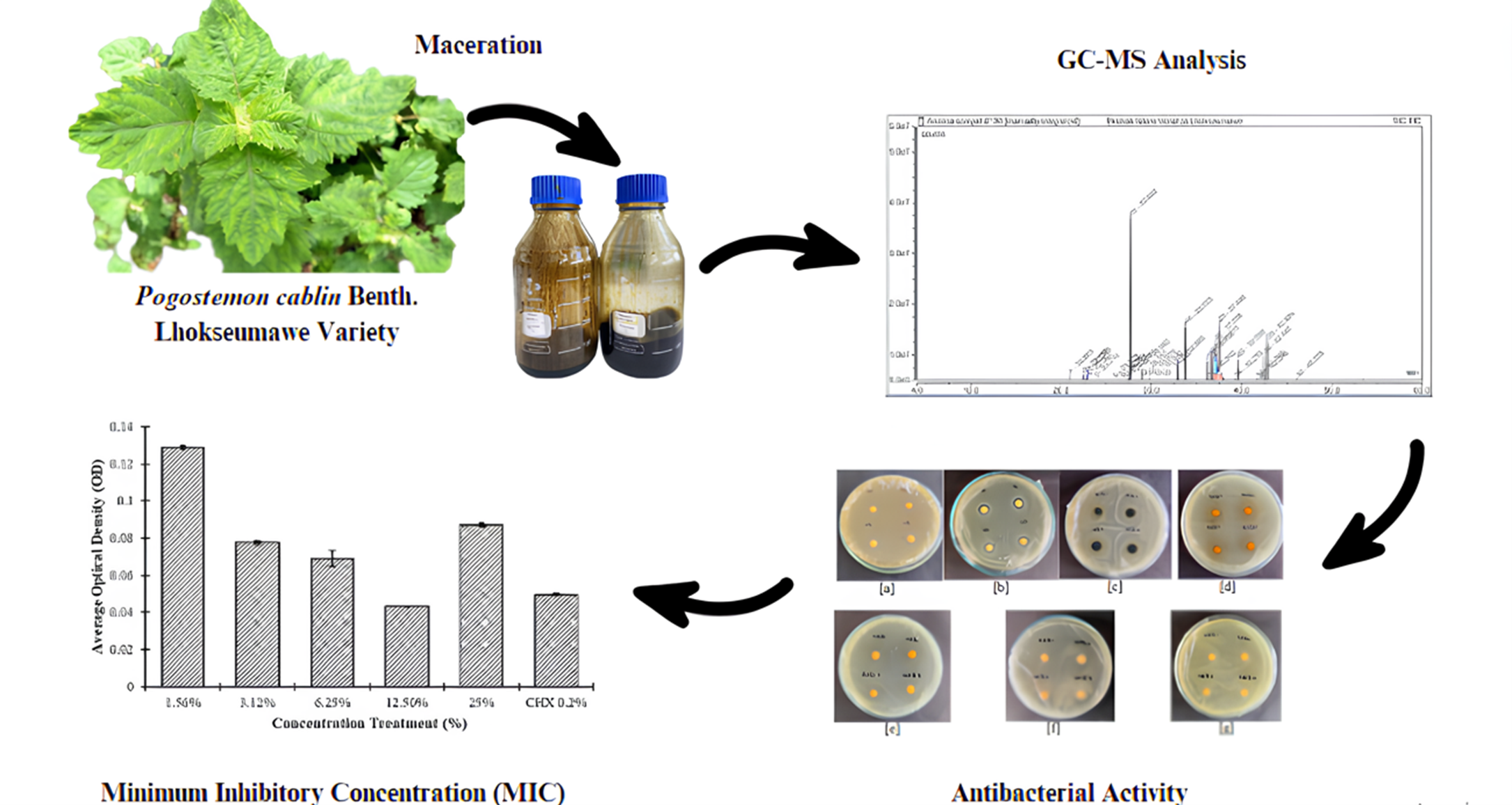
The persistence of bacterial infections and antibiotic resistance in secondary root canal infections necessitate effective antimicrobial approaches utilizing natural compounds. This study aimed to evaluate the extraction efficiency, phytochemical composition, and antibacterial activity of the ethanol extract of Aceh patchouli leaves (Pogostemon cablin Benth.) against Enterococcus faecalis. The maceration method was employed for extraction and phytochemical analysis was conducted using gas chromatography-mass spectrometry (GC-MS). Antibacterial activity was assessed using the Kirby-Bauer method, and the minimum inhibitory concentration (MIC) was determined using UV-vis spectrophotometry. The results indicated a total extract yield of 17.25 % and significant antibacterial activity against E. faecalis. The active compounds in the extract were primarily sesquiterpenes and fatty acids, with patchouli alcohol as the most prominent. The MIC value was 12.5 %, suggesting the potential of Aceh patchouli extract as an alternative or adjunctive treatment for root canal infections. This study has the potential to make Aceh's indigenous Pogostemon cablin Benth. plant as an alternative or adjunctive treatment for root canal infections leading to safe and effective treatments that minimize the risk of antibiotic resistance.
HIGHLIGHTS
- The ethanol extract of Aceh patchouli leaves (Pogostemon cablin Benth.) was obtained using the maceration method, yielding a total extract value of 17.25 %.
- The active compounds of the extract were primarily sesquiterpenes and fatty acids, with patchouli alcohol being the most prominent.
- The ethanol extract exhibited significant antibacterial activity against Enterococcus faecalis, a common bacterium responsible for secondary root canal infections.
- The MIC of the extract was 12.5 %, indicating its potential effectiveness as an antimicrobial agent.
- This study suggests that the Aceh patchouli leaves could serve as an alternative or adjunctive treatment for root canal infections, addressing the challenges of bacterial persistence and antibiotic resistance.
GRAPHICAL ABSTRACT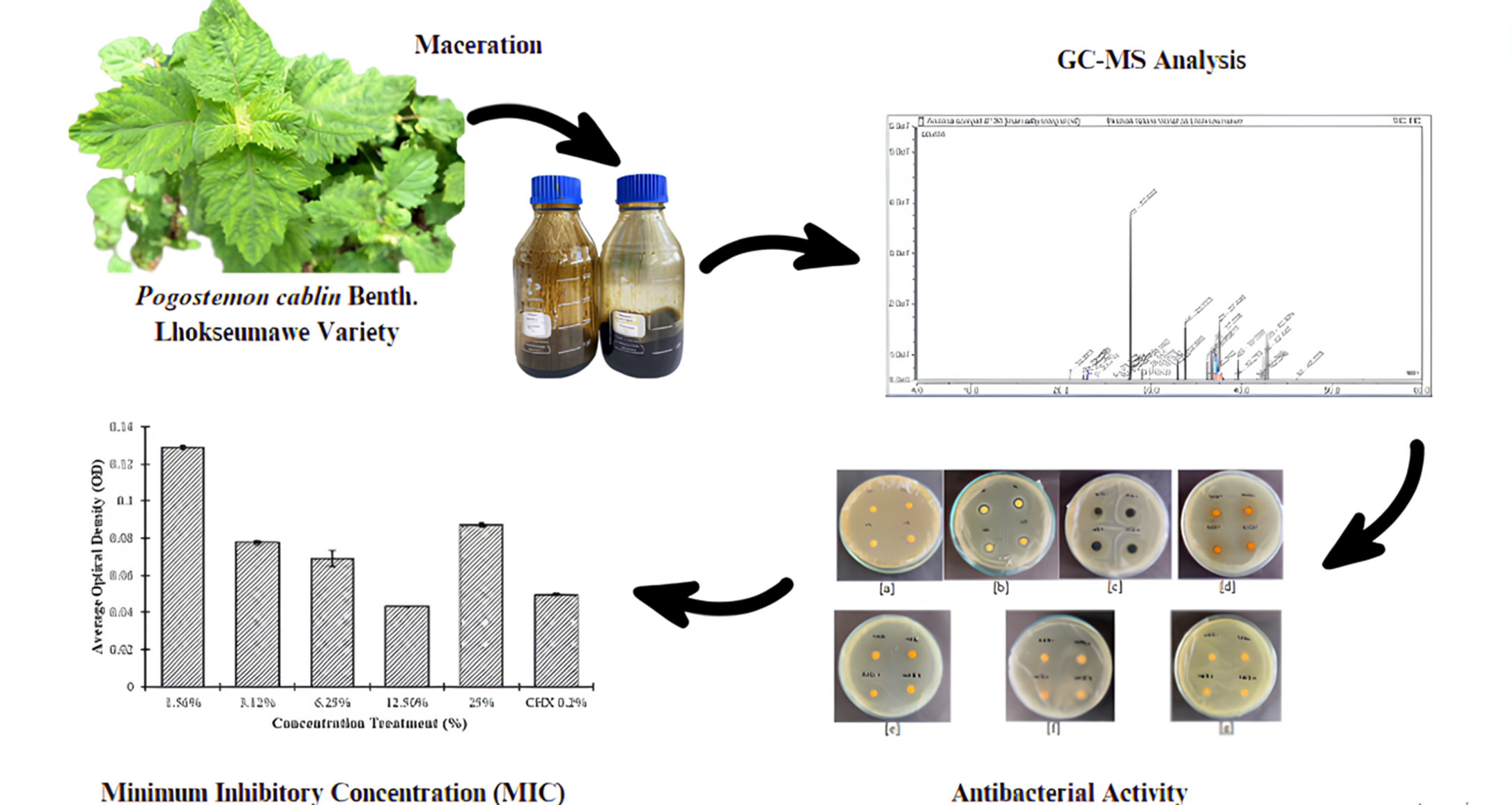
Downloads
References
JF Siqueira and IN Rocas. Present status and future directions: Microbiology of endodontic infections. Int. Endod. J. 2022; 55, 512-30.
SN Usta, C Solana, M Ruiz-Linares, P Baca, CM Ferrer-Luque, M Cabeo and MT Arias-Moliz. Effectiveness of conservative instrumentation in root canal disinfection. Clin. Oral Investig. 2023; 27, 3181-8.
J Wong, D Manoil, P Nasman, GN Belibasakis and P Neelakantan. Microbiological aspect of root canal infections and disinfection strategies: An update review on the current knowledge and challenges. Front. Oral Health 2021; 2, 672887.
G John, KP Kumar, SS Gopal, S Kumari and BK Reddy. Enterococcus faecalis, a nightmare to endodontists: A Systematic Review. Afr. J. Microbiol. Res. 2015; 9, 898-908.
T Mukhtar, HP Widayat and Y Abubakar. Analisis kualitas minyak nilam dan faktor yang mempengaruhi keputusan petani dalam memilih jenis ketel penyulingnya. Jurnal Teknologi dan Industri Pertanian Indonesia 2020; 12, 78-85.
NNMN Rahimi, I Natrah, J Loh, FKE Ranzil, M Gina, SE Lim, K Lai and C Chong. Phytocompounds as an alternative antimicrobial approach in aquaculture. Antibiotics 2022; 11, 469.
M Silalahi. Botani, manfaat dan bioaktivitas nilam Pogostemon cablin. Edumatsains: Jurnal Pendidikan, Matematika dan Sains 2019; 4, 29-40.
Y Aisyah and SH Anwar. Physico-chemical properties of patchouli oils (Pogostemon cablin) separated by fractional distillation method. In: Proceedings of the 2nd Annual International Conference, Syiah Kuala University 2012 & the 8th IMT-GT Uninet Biosciences Conference, Aceh, Indonesia. 2012, p. 355-359.
R Widowati, S Handayani and I Lasdi. Aktivitas antibakteri minyak nilam (Pogostemon cablin) terhadap beberapa spesies bakteri uji. J. Pro-Life 2019; 6, 237-49.
A Abbas, SAR Naqvi, MH Rasool, A Noureen, MS Mubarik and RB Tareen. Phytochemical analysis, antioxidant and antimicrobial screening of Seriphidium oliverianum plant extracts. Dose Response. 2021; 19, 1-9.
BND Rori, JA Khoman and ASR Supit. Uji konsentrasi hambat minimum ekstrak daun gedi (Abelmoschus manihot L. Medik) terhadap pertumbuhan Streptococcus mutans. e-GiGi 2018; 6, 83-90.
M Tahir, A Muflihunna and Syafrianti. Penentuan kadar fenolik total ekstrak etanol daun nilam (Pogostemon cablin Bent.) dengan metode spektrofotometri UV-vis. Jurnal Fitofarmaka Indonesia 2017; 4, 215-8.
NS Pangestu, Nurhamidah and Elvinawati. Aktivitas antioksidan dan antibakteri ekstrak daun Jatropha gossypifolia L. ALOTRP 2017; 1, 15-9.
ES syamsul, O Anugerah and R Supriningrum. Penetapan rendemen ekstrak daun jambu mawar (Syzygium jambos L. Alston) berdasarkan variasi konsentrasi etanol dengan metode maserasi. Jurnal Riset Kefarmasian Indonesia 2020; 2, 147-57.
E Nurnasari and H Prabowo. Pengaruh ukuran sampel dan lama waktu destilasi terhadap rendemen minyak atsiri tembakau lokal Indonesia. Buletin Tanaman Tembakau, Serat & Minyak Industri 2019; 11, 47-57.
VD Sheneni, OS Usman and Q Musa. Phytochemical constituent, percentage yield and phenolic content estimation of different solvent systems of Carica papaya leaves. Korean J. Food Health Convergence 2018; 4, 17-23.
M Maulani, S Nurjanah and E Lembong. Uji aktivitas antijamur pada α-guaiene minyak nilam terhadap Microsporum gypseum ATCC 14683 dan Tricophyton mentagrophytes ATCC 16404. J. Keteknikan Pertanian Tropis Biosist. 2022; 10, 74-83.
H Lee, J Lee, D Smolensky and S Lee. Potential benefits of patchouli alcohol in prevention of human diseases: A mechanistic review. Int. Immunopharmacol. 2020; 89, 107056.
S Srivastava, RK Lal, VR Singh, PK Rout, RC Padalia, AK Yadav, L Bawitlung, D Bhatt, AK Maurya, A Pal, DU Bawankule, A Mishra, P Gupta and CS Chanotiya. Chemical investigation and biological ativities of patchouli (Pogostemon cablin (Blanco) Benth.) essential oil. Ind. Crops Prod. 2022; 188, 115504.
K Mazumder, A Nabila, A Aktar and A Farahnaky. Bioactive variability and in vitro and in vivo antioxidant activity of unprocessed and processed flour of nine cultivars of Australian lupin species: A comprehensive substantiation. Antioxidants 2020; 9, 282.
M Kaltschmitt and H Hoffbauer. Biomass Convers.Biorefinery. In: T Ganesan, M Subhan, DBC Leslee, SB Kuppannan and P Seedevi (Eds). Structural characterization of n-hexadecanoic acid from the leaves of Ipomoea eriocarpa and its antioxidant and antibacterial activities. Springe Nature, Berlin, Germany, 2022.
AS Adegoke, OV Jerry and OG Ademola. GC-MS analysis of phytochemical constituents in methanol extract of wood bark from Durio zibethinus Murr. Int. J. Med. Plants Nat. Prod. 2019; 5, 1-11.
A Qadir, M Aqil, A Ali, FJ Ahmad, S Ahmad, M Arif and N Khan. GC-MS analysis of the methanolic extracts of Smilax china and Salix alba and their antioxidant activity. Turk. J. Chem. 2020; 44, 352-63.
DG Riski, RGR Maulana, E Permana, I Lestari and IL Tarigan. Profile analysis of fatty acids of Tengkawang (Shorea sumatrana) oil using GC-MS and antibacterial activity. Indones. J. Chem. Res. 2020; 8, 114-9.
ANEM Haerussana and HF Chairunnisa. Essential oil constituents and pharmacognostic of Java citronella (Cymbopogon winterianus) stem from Bandung West Java, Indonesia. Open Access Maced. J. Med. Sci. 2022; 10, 1338-46.
S Sunarti, N Lahay, MF Latief and R Gondipon. Antibacterial activity Moringa oleifera leaf and red ginger extract as natural feed additives. Hasanuddin J. Anim. Sci. 2022; 4, 58-67.
W Huang, Y Wang, W Tian, X Cui, P Tu, J Li, S Shi and X Liu. Biosynthesis investigations of terpenoid, alkaloid and flavonoid antimicrobial agents derived from medicinal plants. Antibiotics 2022; 11, 1380.
PR Noviyandri, R Andayani and E Rizky. Potensi ekstrak alga merah Gracilaria verrucosa sebagai penghambat perkembangan pembentukan biofilm Enterococcus faecalis pada infeksi saluran akar gigi. J. Syiah Kuala Dent. Soc. 2018; 3, 6-15.
A Guimaraes and A Venancio. The potential of fatty acids and their derivatives as antifungal agents: A Review. Toxins 2022; 14, 188.
S Sunawan, T Kurnia and H Asari. Pengaruh ekstrak etanol biji ganitri (Elaecarpus sphaericus Schum.) terhadap pertumbuhan bakteri penyebab disentri basiler secara in vitro. J. Biosense 2018; 1, 15-25.
C Pullagummi, NB Rao, BCS Singh, AJ Bheemagani, P kumar, K Venkatesh and AR Rani. Comparative studies on antibacterial activity of patchouli (Pogostemon cablin (Blanco)) and geranium (Pelargonium graveolens) aromatic medicinal plants. Afr. J. Biotechnol. 2014; 13, 2379-84.
J Liang, X Huang and G Ma. Antimicrobial activities and mechaisms of extract and components of herbs in East Asia. RSC Adv. 2022; 12, 29197-213.
S Kolarevic, D Milovanovic, M Avdovic, M Oalde, J Kostic, K Sunjog, B Nikolic, J Knezevic-Vukcevic and B Vukovic-Gacic. Optimization of the microdilution method for detection of minimum inhibitory concentration values in selected bacteria. Bot. Serb. 2016; 40, 29-36.
I Ahmad, MY Alshahrani, S Wahab, AI Al-Harbi, N Nisar, Y Alraey, A Alqahtani, MA Mir, S Irfan and M Saeed. Zinc oxide nanoparticle: an effective antibacterial agent against pathogenic bacterial isolates. J. King Saud Univ. Sci. 2022; 34, 102110.
P Parvekar, J Palaskar, S metgud, R Maria and S Dutta. The minimum inhibitory concentration (MIC) and minimum bactericidal concentration (MBC) of silver nanoparticles against Staphylococcus aureus. Biomater. Investig. Dent. 2020; 7, 105-9.
B Kowalska-Krochmal and R Dudek-wicher. The minimum inhibitory concentration of antibiotics: methods, interpretation, clinical relevance. Pathogens 2021; 10, 165.
CR belanger and REW Hancock. Testing physiologically relevant conditions in minimal inhibitory concentrations assays. Nat. Protoc. 2021; 16, 3761-74.
IL Elisha, FS Botha, LJ McGaw and JN Eloff. The antibacterial activity of extracts of nine plant species with good activity against Escherichia coli against five other bacteria and cytotoxicity of extract. BMC Complementary Altern. Med. 2017; 17, 133.
Downloads
Published
How to Cite
Issue
Section
License
Copyright (c) 2024 Walailak University

This work is licensed under a Creative Commons Attribution-NonCommercial-NoDerivatives 4.0 International License.





