
Secretome from Human Umbilical Cord Mesenchymal Stem Cells Ameliorates Ovarian Aging in a Murine Model
DOI:
https://doi.org/10.48048/tis.2026.13489Keywords:
Secretome, Aging, MSCs, Hormone therapyAbstract
Ovarian aging represents a complex biological process characterized by follicular depletion, hormonal dysregulation, and chronic inflammation. We investigated the therapeutic potential of the secretome derived from human umbilical cord mesenchymal stem cells (S-HUMCMSCs) in naturally aged female mice. Administration of S-HUMCMSCs significantly reduced serum FSH levels (from 5.43 ± 1.59 to 3.07 ± 2.69 mIU/mL, p < 0.05), decreased senescent cell percentage (from 27.35 ± 0.82% to 8.37 ± 0.85%, p < 0.001), and modulated inflammatory markers with reduction in TNF-α (from 188.23 ± 83.31 to 4.55 ± 4.78 ng/mL, p < 0.001) and elevation in IL-10 (7.55 ± 7.77 ng/mL, p < 0.05). Additionally, S-HUMCMSCs treatment decreased p53 expression {179.17 ± 170.48 vs. 549.67 ± 243.62 in aged controls, p < 0.025} and preserved ovarian follicular architecture. A comparative analysis with 17β‑estradiol therapy demonstrated comparable efficacy in improving ovarian parameters. Although no formal toxicological or long‑term safety assessments were conducted, no adverse clinical signs or behavioral abnormalities were observed during the study period. These findings establish S-HUMCMSCs as a promising cell-free regenerative approach for managing age-related ovarian dysfunction by modulating multiple pathways involved in senescence, inflammation, and hormonal homeostasis.
HIGHLIGHTS
- Restoration of HPO Axis Homeostasis: Administration of S-HUMCMSC secretome significantly ameliorated age-related hormonal dysregulation, evidenced by the normalization of serum FSH levels in a naturally aged murine model.
- Attenuation of Cellular Senescence: The intervention demonstrated potent senolytic properties, significantly reducing the percentage of senescent cells and downregulating p53 expression in ovarian tissue.
- Modulation of the Inflammatory Microenvironment: S-HUMCMSC therapy shifted the systemic cytokine profile towards an anti-inflammatory state, characterized by a significant reduction in TNF-α and upregulation of IL-10.
- Comparable Efficacy to 17β‑Estradiol: The cell‑free secretome demonstrated therapeutic efficacy comparable to standard hormone replacement therapy (17β‑estradiol) in preserving follicular architecture, without evidence of adverse effects during the study period.
GRAPHICAL ABSTRACT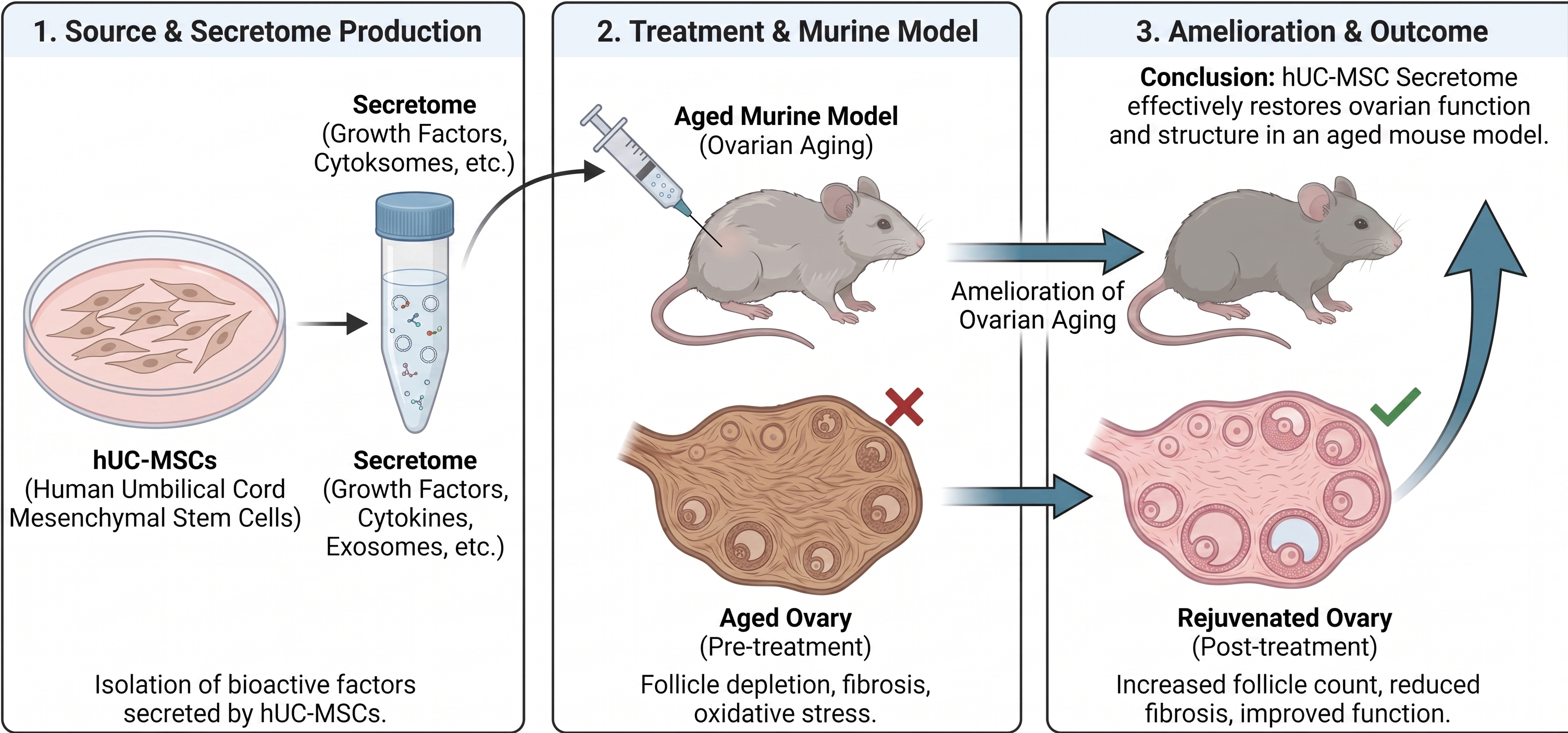
Downloads
References
K Shirasuna and H Iwata. Effect of aging on the female reproductive function. Contraception and Reproductive Medicine 2017; 2, 23.
R Costa, TP Tuomainen, J Virtanen, L Niskanen and E Bertone-Johnson. Associations of reproductive factors with postmenopausal follicle stimulating hormone. Womenʼs Midlife Health 2022; 8, 8.
JVV Isola, JD Hense, CAP Osório, S Biswas, J Alberola-Ila, SR Ocañas, A Schneider and MB Stout. Reproductive ageing: Inflammation, immune cells, and cellular senescence in the aging ovary. Reproduction 2024; 168(2), 230499.
M Dean, BT Murphy and JE Burdette. Phytosteroids beyond estrogens: Regulators of reproductive and endocrine function in natural products. Molecular and Cellular Endocrinology 2017; 442, 98-105.
J Zhao, D Li, H Tang and L Tang. Association of vascular endothelial growth factor polymorphisms with polycystic ovarian syndrome risk: A meta-analysis. Reproductive Biology and Endocrinology 2020; 18, 18.
AL Fitzgerald, AA Osman, TX Xie, A Patel, H Skinner, V Sandulache and JN Myers. Reactive oxygen species and p21Waf1/Cip1 are both essential for p53-mediated senescence of head and neck cancer cells. Cell Death & Disease 2015; 6, 1678.
Q Chen, X Sun, X Luo, J Wang, J Hu and Y Feng. PIK3R3 inhibits cell senescence through p53/p21 signaling. Cell Death & Disease 2020; 11, 798.
R Rajah, B Valentinis and P Cohen. Insulin-like growth factor (IGF)-binding protein-3 induces apoptosis and mediates the effects of transforming growth factor-β1 on programmed cell death through a p53- and IGF-independent mechanism. Journal of Biological Chemistry 1997; 272(18), 12181-12188.
JD Amaral, JM Xavier, CJ Steer and CMP Rodrigues. Targeting the p53 Pathway of Apoptosis. Current Pharmaceutical Design 2010; 16, 2493-2503.
YW Prajoko, A Putra, BT Dirja, AM Muhar and ND Amalina. The Ameliorating effects of MSCs in controlling Treg-mediated B-Cell depletion by Indoleamine 2, 3-dioxygenase induction in PBMC of SLE patients. Open Access Macedonian Journal of Medical Sciences 2022; 10, 6-11.
L Restimulia, S Ilyas, D Munir, A Putra, T Madiadipoera, F Farhat, RJ Sembiring, M Ichwan, ND Amalina and I Alif. The CD4+CD25+FoxP3+ Regulatory T cells regulated by MSCs suppress plasma cells in a mouse model of allergic rhinitis. Medical Archives 2021; 75(4), 256-261.
MHB Kusumo, SA Husain and ND Amalina. Secretome MSCs restore α-Smooth muscle actin protein tissue expression in croton oil-induced hemorrhoid rats. 2023; 2(4), 138-146.
BT Dirja, EH Wardoyo, A Putra and ND Amalina. Enhanced third degree burn wound healing by hypoxic mesenchymal stem cells’ secretome: IL-10 upregulation and TNF-α/PGE2 suppression. Trends in Sciences 2024; 21(10), 8288.
MM Hartanto, YW Prajoko, A Putra and ND Amalina. The combination of mesenchymal stem cells and bovine colostrum in reducing α-SMA expression and NLR levels in wistar rats after 50% fibrotic liver resection. Open Access Macedonian Journal of Medical Sciences 2022; 10, 1634-1639.
D Munir, IP Nasution, L Restimulia, A Putra and ND Amalina. The role of mesenchymal stem cells in allergic rhinitis and its relationship with IL-10, plasma cells and regulatory T cells. Medicinski Glasnik 2023; 20(2), 175-180.
NF Hamra, A Putra, A Tjipta5, ND Amalina and T Nasihun. Hypoxia mesenchymal stem cells accelerate wound closure improvement by controlling α-smooth muscle actin expression in the full-thickness animal model. Open Access Macedonian Journal of Medical Sciences 2021; 8, 35-41.
S Bartaula-Brevik, AI Bolstad, K Mustafa and TO Pedersen. Secretome of mesenchymal stem cells grown in hypoxia accelerates wound healing and vessel formation in vitro. International Journal of Stem Cell Research & Therapy 2017; 4(1), 045.
Q Zhao, K Larios, Y Naaldijk, LS Sherman, A Chemerinski, K Okereke, P Rameshwar, A Lemenze, NC Douglas and SS Morelli. Mesenchymal stem cell secretome alters gene expression and upregulates motility of human endometrial stromal cells. Reproduction 2023; 166(2), 161-174.
TO Ribeiro, BM Silveira, MC Meira, ACO Carreira, MC Sogayar, R Meyer and V Fortuna. Investigating the potential of the secretome of mesenchymal stem cells derived from sickle cell disease patients. PLoS One 2019; 14(10), 0222093.
RM Chugh, H Park, S Esfandyari, A Elsharoud, M Ulin and A Al-Hendy. Mesenchymal stem cell-conditioned media regulate steroidogenesis and inhibit androgen secretion in a PCOS cell model via BMP-2. International Journal of Molecular Sciences 2021; 22(17), 9184.
H Wang, X Feng, T Wang, J Pan, Z Zheng, Y Su, H Weng, L Zhang, L Chen, L Zhou and L Zheng. Role and mechanism of the p-JAK2/p-STAT3 signaling pathway in follicular development in PCOS rats. General and Comparative Endocrinology 2023; 330, 114138.
YI Mayasari, P Subchan, A Putra, C Chodijah, A Hussana, T Sumarawati, ND Amalina and RCS Irawan. Secretome hypoxia mesenchymal stem cells inhibited ultraviolet radiation by inhibiting interleukin-6 through nuclear factor-kappa beta pathway in hyperpigmentation animal models. Open Access Macedonian Journal of Medical Sciences 2023; 11, 188-194.
Z Zukhiroh, A Putra, C Chodidjah, T Sumarawati, P Subchan, S Trisnadi, N Hidayah and ND Amalina. Effect of secretome-hypoxia mesenchymal stem cells on regulating SOD and MMP-1 mRNA expressions in skin hyperpigmentation rats. Open Access Macedonian Journal of Medical Sciences 2022; 10, 1-7.
M Fredianto, H Herman, YD Ismiarto, A Putra, I Alif, ND Amalina and MA Nazar. Secretome of hypoxia-preconditioned mesenchymal stem cells enhance the expression of HIF-1a and bFGF in a rotator cuff tear model. Medicinski Glasnik 2023; 20(2), 242-248.
AM Muhar, F Makharim, D Hermansyah, A Putra, N Hidayah, ND Amalina and I Alif. Hypoxic mesenchymal stem cell-conditioned medium accelerates wound healing by regulating IL-10 and TGF-β levels in a full-thickness-wound rat model. Indonesian Journal of Biotechnology 2022; 27(4), 187-194.
J Angelina, A Putra, S Trisnadi, D Hermansyah, E Setiawan, T Sumarawati and ND Amalina. Hypoxia-conditioned mesenchymal stem cells (MSC) exosomes attenuate ultraviolet-B (UVB)-mediated malondialdehyde (MDA) and matrix metalloproteinase-1 (MMP-1) upregulation in collagen loss models. Medicinski Glasnik 2025; 22(1), 9-14.
P Drawina, A Putra, T Nasihun, YW Prajoko, BT Dirja and ND Amalina. Increased serial levels of platelet‐derived growth factor using hypoxic mesenchymal stem cell‐conditioned medium to promote closure acceler‐ ation in a full‐thickness wound. Indonesian Journal of Biotechnology 2022; 27(1), 36-42.
FT Zohora, M Aliyu and AA Saboor-Yaraghi. Secretome-based acellular therapy of bone marrow-derived mesenchymal stem cells in degenerative and immunological disorders: A narrative review. Heliyon 2023; 9(7), 18120.
RM Chugh, H Park, AE Andaloussi, A Elsharoud, S Esfandyari, M Ulin, L Bakir, A Aboalsoud, M Ali, D Ashour, P Igboeli, N Ismail, J McAllister and A Al-Hendy. Mesenchymal stem cell therapy ameliorates metabolic dysfunction and restores fertility in a PCOS mouse model through interleukin-10. Stem Cell Research & Therapy 2021; 12, 388.
FZ Stanczyk, SA Winer, JM Foidart and DF Archer. Comparison of estrogenic components used for hormonal contraception. Contraception 2024; 130, 110310.
EA Ariazi and VC Jordan. Estrogen-related receptors as emerging targets in cancer and metabolic disorders. Current Topics in Medicinal Chemistry 2006; 6(3), 203-215.
S Wang, EA Konorev, S Kotamraju, J Joseph, S Kalivendi and B Kalyanaraman. Doxorubicin induces apoptosis in normal and tumor cells via distinctly different mechanisms: Intermediacy of H2O2- and p53-dependent pathways. Journal of Biological Chemistry 2004; 279(24), 25535-25543.
W Xue, L Zender, C Miething, RA Dickins, E Hernando, V Krizhanovsky, C Cordon-Cardo and SW Lowe. Senescence and tumour clearance is triggered by p53 restoration in murine liver carcinomas. Nature 2007; 445, 656-660.
V Reyhani, M Tsioumpekou, T van Wieringen, L Rask, J Lennartsson and K Rubin. PDGF-BB enhances collagen gel contraction through a PI3K-PLCγ-PKC-cofilin pathway. Scientific Reports 2017; 7, 8924.
A Makker, MM Goel, V Das and A Agarwal. PI3K-Akt-mTOR and MAPK signaling pathways in polycystic ovarian syndrome, uterine leiomyomas and endometriosis: An update. Gynecological Endocrinology 2012; 28(3), 175-181.
X He, Z Dong, Y Cao, H Wang, S Liu, L Liao, Y Jin, L Yuan and B Li. MSC-derived exosome promotes M2 polarization and enhances cutaneous wound healing. Stem Cells International 2019; 2019(1), 7132708.
D Li, D Li, Z Wang, J Li, KA Shahzad, Y Wang and F Tan. Signaling pathways activated and regulated by stem cell-derived exosome therapy. Cell & Bioscience 2024; 14, 105.
M Hadidi, K Karimabadi, E Ghanbari, L Rezakhani and M Khazaei. Stem cells and exosomes: As biological agents in the diagnosis and treatment of polycystic ovary syndrome (PCOS). Frontiers in Endocrinology 2023; 14, 1269266.
F Tan, X Li, Z Wang, J Li, K Shahzad and J Zheng. Clinical applications of stem cell-derived exosomes. Signal Transduction and Targeted Therapy 2024; 9, 17.
P Hu, Q Yang, Q Wang, C Shi, D Wang, U Armato, ID Prà and A Chiarini. Mesenchymal stromal cells-exosomes: A promising cell-free therapeutic tool for wound healing and cutaneous regeneration. Burns & Trauma 2019; 7, 38.
D Bian, Y Wu, G Song, R Azizi and A Zamani. The application of mesenchymal stromal cells (MSCs) and their derivative exosome in skin wound healing: A comprehensive review. Stem Cell Research & Therapy 2022; 13, 24.
Published
How to Cite
Issue
Section
License
Copyright (c) 2026 Walailak University

This work is licensed under a Creative Commons Attribution-NonCommercial-NoDerivatives 4.0 International License.





