
In silico and In vivo Studies of Raja Banana Peel Extract as Anti-Obesity on Lipid Profile and Adipokines in Male Rats with Obesity
DOI:
https://doi.org/10.48048/tis.2026.11243Keywords:
Adipokine levels, DPP-4 specific activity, Lipid profile, Obesity, Quercetin, Raja banana peel extractAbstract
Banana peels contain nutrients and active compounds that have anti-obesity effects. Quercetin and flavonoids identified in banana peels have emerged as a promising candidate for developing novel therapeutics to address obesity. Quercetin can reduce fat accumulation by regulating lipogenesis. Research on in silico on banana peel extract and the effects of banana peel on lipid profiles and adipokine levels is still limited. This study aimed to analyze the effects of raja banana peel extract (RBPE) on lipid profiles, dipeptidyl peptidase-4 (DPP-4) specific activity, leptin, and adiponectin levels in male Wistar rats with obesity. Molecular docking was performed to demonstrate the interaction between quercetin and DPP-4, leptin, and adiponectin receptors in carbohydrate and fat regulation. An in vivo study used a pre-posttest control group design in 30 male Wistar rats with obesity. This study measured total cholesterol (TC), low-density lipoprotein cholesterol (LDL-C), high-density lipoprotein cholesterol (HDL-C), triglyceride (TG), DPP-4 specific activity, leptin, and adiponectin levels. The results showed that the RBPE administration decreased significantly TC (p < 0.001) and LDL-C levels (p < 0.001), increased HDL-C level (p < 0.001), increased DPP-4 specific activity (p < 0.001), and reduced leptin levels, but did not increase adiponectin levels (p = 0.274). In conclusion, RBPE administration might offer a promising therapeutic approach for obesity by regulating cholesterol and lipid metabolism.
HIGHLIGHTS
- Raja Banana Peel Extract (RBPE) contains quercetin, which has anti-obesity effects.
- Quercetin potentially interacts with DPP-4 protein, leptin, and adiponectin receptors.
- RBPE significantly lowers TC, LDL-C, and leptin levels.
- RBPE significantly increases HDL-C levels and DPP-4 specific activity.
GRAPHICAL ABSTRACT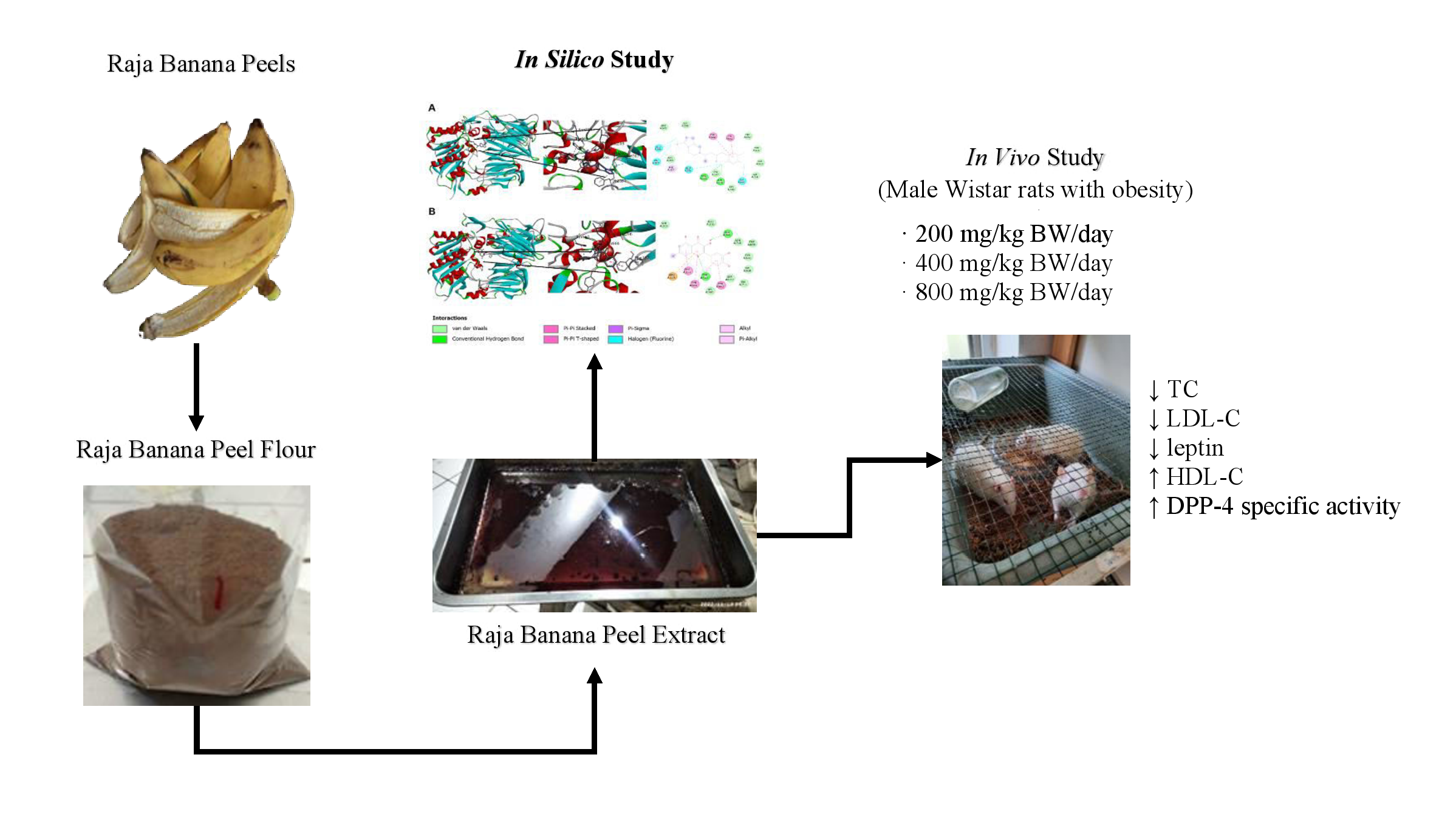
Downloads
References
P Kumar, K Nara and Mastram. Benefits of yogic practice on body fat composition in obese adults. International Journal of Experimental Research and Review 2024; 45, 96-105.
VV Krishna, S Ramaswamy and P Suganthirababu. Neuromuscular electrical stimulator as a therapeutic tool in obesity. International Journal of Experimental Research and Review 2024; 46, 313-325.
AA Alfadda, RM Sallam and J Park. Diet and nutrition for body weight management. Journal of Obesity 2019; 2019, 6798096.
X Lin and H Li. Obesity: Epidemiology, pathophysiology, and therapeutics. Frontiers in Endocrinology 2021; 12, 706978.
KR Feingold. Obesity and dyslipidemia. MDText.com Inc, Massachusetts, United States, 2020.
Kemenkes RI. 2025, Keputusan Menteri Republik Indonesia Nomor HK.01.07/MENKES/509/2025 tentang Pedoman Nasional Pelayanan Klinis Tata Laksana Obesitas Dewasa. Kemenkes RI, Jakarta.
World Obesity Federation. World Obesity Atlas 2025. World Obesity Federation, London, 2025.
Kemenkes RI. Survei Kesehatan Indonesia (SKI) Dalam Angka. Kementerian Kesehatan RI, Jakarta, Indonesia, 2023.
World Obesity Federation. World Obesity Atlas 2023. World Obesity Federation, London, 2023.
B Sarkar, P Biswas, CK Acharya, SK Jana, N Nahar, S Ghosh, D Dasgupta, SK Ghorai and NR Madhu. Obesity epidemiology: A serious public health concern in India. Chettinad Health City Medical Journal 2022; 11(1), 21-28.
ML Endalifer and G Diress. Epidemiology, predisposing factors, biomarkers, and prevention mechanism of obesity: A systematic review. Journal of Obesity 2020; 2020, 6134362.
DC Fonseca, P Sala, BDAM Ferreira, J Reis, RS Torrinhas, I Bendavid and DL Waitzberg. Body weight control and energy expenditure. Clinical Nutrition Experimental 2018; 20, 55-59.
RH Ahmed, HZ Huri, S Muniandy, Z Al-Hamodi, B Al-Absi, A Alsalahi and MFM Razil. Altered circulating concentrations of active glucagon-like peptide (GLP-1) and dipeptidyl peptidase 4 (DPP4) in obese subjects and their association with insulin resistance. Clinical Biochemistry 2017; 50(13-14), 746-749.
JS Flier and RS Ahima. Leptin physiology and pathophysiology: Knowns and unknowns 30 years after its discovery. The Journal of Clinical Investigation 2024; 134(1), e174595.
H Bhat, JA Bhat, MH Bhat, M Rashid, R Jan and D Afroze. Leptin in obesity and hypertension. Arterial Hypertension 2022; 26(1), 26-31.
L He, W Xuan, D Liu, J Zhong, H Luo, H Cui, X Zhang and W Chen. The role of adiponectin in the association between abdominal obesity and type 2 diabetes: A mediation analysis among 232,438 Chinese participants. Frontiers in Endocrinology 2024; 15, 1327716.
T Vilariño-García, ML Polonio-González, A Pérez-Pérez, J Ribalta, F Arrieta, M Aguilar, JC Obaya, JA Gimeno-Orna, P Iglesias, J Navarro, S Durán, J Pedro-Botet and V Sánchez-Margalet. Role of leptin in obesity, cardiovascular disease, and type 2 diabetes. International Journal of Molecular Sciences 2024; 25(4), 2338.
A Ruban, K Stoenchev, H Ashrafian and J Teare. Current treatments for obesity. Clinical Medicine 2019; 19(3), 205-212.
E Gjermeni, AS Kirstein, F Kolbig, M Kirchhof, L Bundalian, JL Katzmann, U Laufs, M Blühe, A Garten and DL Duc. Obesity - An update on the basic pathophysiology and review of recent therapeutic advances. Biomolecules 2021; 11(10), 1426.
HE Bays, A Fitch, S Christensen, K Burridge and J Tondt. Anti-obesity medications and investigational agents: An Obesity Medicine Association (OMA) Clinical Practice Statement (CPS) 2022. Obesity Pillars 2022; 2, 100018.
UR Rajesh and S Dhanaraj. A critical review on quercetin bioflavonoid and its derivatives: Scope, synthesis, and biological applications with future prospects. Arabian Journal of Chemistry 2023; 16, 104881.
PY Konda, V Poondla, KK Jaiswal, S Dasari, R Uyyala, VP Surtineni, JY Egi, AJA Masilamani, L Bestha, S Konanki, M Muthulingam, LK Lingamgunta, BP Aloor, S Tirumalaraju, A Sade, VR Kamsala, S Nagaraja, R Ramakrishnan and V Natesan. Pathophysiology of high fat diet induced obesity: Impact of probiotic banana juice on obesity associated complications and hepatosteatosis. Scientific Reports 2020; 10, 16894.
Badan Pusat Statistik, Available at: https://www.bps.go.id/id/statistics-table/2/NjIjMg==/produksi-tanaman-buah-buahan.html, accessed June 2025.
WM Hikal, HAHSA Ahl, A Bratovcic, KG Tkachenko, J Sharifi-Rad, M Kacaniova, M Elhourri and M Atanassova. Banana peels: A waste treasure for human being. Evidence-Based Complementary Alternative Medicine 2022; 2022, 7616452.
A Pereira and M Maraschin. Banana (Musa spp) from peel to pulp: Ethnopharmacology, source of bioactive compounds and its relevance for human health. Journal of Ethnopharmacology 2015; 160, 149-163.
F Zou, C Tan, B Zhang, W Wu and N Shang. The valorization of banana by-products: Nutritional and future development. Foods 2022; 11(20), 3170.
PS Kumar, S Durgadevi, A Saravanan and S Uma. Antioxidant potential and antitumour activities of Nendran banana peels in breast cancer cell line. Indian Journal of Pharmaceutical Sciences 2019; 81(3), 464-473.
AM Aboul-Enein, ZA Salama, AA Gaafar, HF Aly, FA Bou-Elella and HA Ahmed. Identification of phenolic compounds from banana peel (Musa paradaisica L.) as antioxidant and antimicrobial agents. Journal of Chemical and Pharmaceutical Research 2016; 8(4), 46-55.
KE Devina, D Indarto and TN Susilawati. Identification of quercetin and chrysin in banana peel extracts using high performance liquid chromatography and liquid chromatography mass spectrometer for obesity treatment. Engineering Headway 2025; 14, 81-88.
KE Devina, D Indarto, TN Susilawati and B Wiboworini. The effects of raja banana (Musa acuminata) peel extract on body weight , body mass index , body fat percentage, and visceral fat mass in male rats with obesity. Jurnal Gizi dan Dietetik Indonesia 2024; 12(2), 115-125.
KE Devina, D Indarto and TN Susilawati. Development of the obesity nutraceutical from raja and kepok banana peels. Proceedings of the International Conference on Nursing and Health Sciences 2023; 4(1), 289-296.
MN Ilyas, MKR Adzim, NB Simbak and AB Atif. Sample size calculation for animal studies using degree of freedom (E); an easy and statistically defined approach for metabolomics and genetic research. Current Trends in Biomedical Engineering and Biosciences 2017; 10(2), 555785.
I Sundari, D Indarto and P Dirgahayu. Dual extracts of star fruit leaves and Toddalia accuelata leaves as antiobesity in rats. Jurnal Aisyah: Jurnal Ilmu Kesehatan 2022; 7(1), 93-100.
I Dono, D Dwipajati, P Dirgahayu, YC Wibowo and YM Pratama. Acute effects of breakfast fruits meal sequence and postprandial exercise on the blood glucose level and DPP4 activity among type 2 diabetes mellitus patients: A pilot study. Journal of Obesity 2022; 2022, 4875993.
P Kalhotra, VCSR Chittepu, G Osorio-Revilla and T Gallardo-Velázquez. Structure-activity relationship and molecular docking of natural product library reveal chrysin as a novel dipeptidyl peptidase-4 (DPP-4) inhibitor: An integrated in silico and in vitro study. Molecules 2018; 23(6), 1368.
RA Saxton, NA Caveney, MD Moya-Garzon, KD Householder, GE Rodriguez, KA Burdsall, JZ Long and KC Garcia. Structural insights into the mechanism of leptin receptor activation. Nature Communications 2023; 14, 1797.
M Muratore and AM Komai. Theoretical study of the adiponectin receptors: Binding site characterization and molecular dynamics of possible ligands for drug design. SN Applied Sciences 2020; 2, 533.
C Zheng, Y Liu, C Xu, S Zeng, Q Wang, Y Guo, J Li, S Li, M Dong, X Luo and Q Wu. Association between obesity and the prevalence of dyslipidemia in middle-aged and older people: An observational study. Scientific Reports 2024; 14, 11974.
Y Alshuweishi, AA Almufarrih, A Abudawood, Dl Alfayez, AY Alkhowaiter, H AlSudais and AM Almuqrin. Patterns of lipid abnormalities in obesity: A comparative analysis in normoglycemic and prediabetic obese individuals. Journal of Personalized Medicine 2024; 14(9), 980.
A Yang and EP Mottillo. Adipocyte lipolysis: From molecular mechanisms of regulation to disease and therapeutics. Biochemical Journal 2020; 477(5), 985-1008.
S Ding, J Jiang, G Zhang, Y Bu, G Zhang and X Zhao. Resveratrol and caloric restriction prevent hepatic steatosis by regulating SIRT1-autophagy pathway and alleviating endoplasmic reticulum stress in high-fat diet-fed rats. PLoS One 2017; 12(8), e0183541.
R Indriawati and FU Atiyah. Antihyperglycemic and hypolipidemic potential of kepok banana peel in diabetic rats. In: Proceedings of the 4th International Conference on Sustainable Agriculture, Yogyakarta, Indonesia. 2022, p. 12040.
AM Tsatsakisa, L Vassilopouloub, L Kovatsic, C Tsitsimpikoud, M Karamanoue, G Leona, J Liesivuorig, AW Hayesh and DA Spandidos. The dose response principle from philosophy to modern toxicology: The impact of ancient philosophy and medicine in modern toxicology science. Toxicology Reports 2018; 5, 1107-1113.
KN Berawi and MA Bimandama. The effect of giving extract etanol of kepok banana peel (Musa acuminata) toward total cholesterol level on male mice (Mus musculus L.) strain deutschland-denken-yoken (ddy) obese. Biomedical and Pharmacoogy Journal 2018; 11(2), 769-774.
ZM Mosa and AF Khalil. The effect of banana peels supplemented diet on acute liver failure rats. Annals of Agricultural Sciences 2015; 60(2), 373-379.
CH Jung and KM Choi. Impact of high‐carbohydrate diet on metabolic parameters in patients with type 2 diabetes. Nutrients 2017; 9(4), 322.
TM Lu, HF Chiu, YC Shen, CC Chung, K Venkatakrishnan and CK Wang. Hypocholesterolemic efficacy of quercetin rich onion juice in healthy mild hypercholesterolemic adults: A pilot study. Plant Foods for Human Nutrition 2015; 70(4), 395-400.
R Tabrizi, OR Tamtaji, N Mirhosseini, KB Lankarani, M Akbari, ST Heydari, E Dadgostar and Z Asemi. The effects of quercetin supplementation on lipid profiles and inflammatory markers among patients with metabolic syndrome and related disorders: A systematic review and meta-analysis of randomized controlled trials. Critical Reviews in Food Science and Nutrition 2020; 60(11), 1855-1868.
JF Zhou, WJ Wang, ZP Yin, GD Zheng, JG Chen, JE Li, LL Chen and QF Zhang. Quercetin is a promising pancreatic lipase inhibitor in reducing fat absorption in vivo. Food Bioscience 2021; 43, 101248.
D Dwipajati, D Indarto and P Dirgahayu. Reduction of dipeptidyl peptidase 4 activity in patients with type 2 diabetes mellitus who consumed fruits before meals. Annals of Tropical Medicine and Public Health 2019; 11, 1-9.
AK Singh, PK Patel, K Choudhary, J Joshi, D Yadav and JO Jin. Quercetin and coumarin inhibit dipeptidyl peptidase-IV and exhibits antioxidant properties: In silico, in vitro, ex vivo. Biomolecules 2020; 10(2), 207.
YS Seo, OH Kang, SB Mun, DH Kang, DW Yang, JG Choi, YM Lee, DK Kang, HS Lee and DY Kwon. Quercetin prevents adipogenesis by regulation of transcriptional factors and lipases in OP9 cells. International Journal of Molecular Medicine 2015; 35(6), 1779-1785.
X Ma, D Wang, W Zhao and L Xu. Deciphering the roles of PPARγ in adipocytes via dynamic change of transcription complex. Frontiers in Endocrinology 2018; 9, 473.
K Wyskida, G Franik, T Wikarek, A Owczarek, A Delroba, J Chudek, J Sikora and M Olszanecka-Glinianowicz. The levels of adipokines in relation to hormonal changes during the menstrual cycle in young, normal-weight women. Endocrine Connections 2017; 6(8), 892-900.
Q Guo, B Chang, QL Yu, ST Xu, XJ Yi and SC Cao. Adiponectin treatment improves insulin resistance in mice by regulating the expression of the mitochondrial-derived peptide MOTS-c and its response to exercise via APPL1-SIRT1-PGC-1α. Diabetologia 2020; 63(12), 2675-2688.
V Harries, M Corley and RG Bribiescas. The impact of thawing duration on leptin and adiponectin levels in frozen human milk samples. American Journal of Human Biology 2024; 36(1), e23971.
A Biyabani, F Ghorbani, M Koushki, K Nedaei, M Hemmati, NMN Mahalleh and D Ghadimi. Quercetin and calorie restriction improve leptin/adiponectin balance through reducing high-fat diet-induced oxidative stress in male BALB/c mice. Biochemical and Biophysical Research Communications 2025; 742, 151073.
M Boccellino and S D’Angelo. Anti-obesity effects of polyphenol intake: Current status and future possibilities. International Journal of Molecular Sciences 2020; 21(16), 5642.
U Hikmah and A Triastuti. Mechanism and immunomodulator bioactive compounds of Phyllanthus niruri (meniran) (in Indonesian). Jurnal Ilmiah Farmasi 2022; 18(2), 205-218.
Published
How to Cite
Issue
Section
License
Copyright (c) 2025 Walailak University

This work is licensed under a Creative Commons Attribution-NonCommercial-NoDerivatives 4.0 International License.





