
Effect of ZnO/gamma Chitosan Nanocomposites for Antifungal Activity on Phytophthora palmivora, a Disease-causing Fungus Using Para Rubber Trees
DOI:
https://doi.org/10.48048/tis.2026.13154Keywords:
ZnO/gamma chitosan nanocomposites, Zinc oxide nanoparticles, Characterization, Phytophthora palmivora, Antifungal activity, Para rubber tree, DiseaseAbstract
In this study focused on the antifungal activity of Zinc oxide nanoparticles (ZnO NPs) and ZnO/gamma chitosan nanocomposites (ZnO/g-Chi NCs) against Phytophthora palmivora, a disease-causing fungus that affects para rubber trees. The phase purity, crystallite size, morphology, chemical composition, and optical absorption properties of the synthesized materials were examined using various techniques. The X-ray diffraction (XRD) analysis revealed characteristic diffraction peaks corresponding to the crystal planes of the hexagonal wurtzite structure of ZnO NPs, which have the particle size of 31 nm. Moreover, they have confirmed the composite of both ZnO NPs and g-chitosan. The FTIR spectroscopy was recorded the successful interaction between ZnO NPs (31 nm) and γ-chitosan (γ-Chi), which chitosan exposed to gamma radiation at sterilizing dosages of 40 kGy. The SEM and TEM images observed clusters of rod-shaped particulates for the ZnO/g-chitosan NCs; according to the EDS profile, they confirmed the synthesis of ZnO/g-chitosan NCs which found that nitrogen composition in the structure. UV-vis absorption spectra revealed a shift in the optical absorption toward lower wavelengths for the ZnO/g-Chi NCs (355 nm) than for the ZnO NPs (365 nm). Upon assessing the antifungal activity, the results showed that ZnO/g-Chi NCs were effective against P. palmivora, with an inhibition percentage of 90%. The SEM images showed that the damage to the fungal cell membrane caused by ZnO/g-Chi NCs treatment significantly altered the outer shape of P. palmivora. These findings indicated that g-chitosan and ZnO NPs may complement each other, exhibiting synergistic effects.
HIGHLIGHTS
- The study examined ZnO/gamma-chitosan nanocomposites (ZnO/γ-Chi NCs) antifungal efficacy against Phytophthora palmivora, a disease that affects para rubber trees.
- The characterization of ZnO/γ-Chi NCs was crystalline structure and rod-shaped clusters.
- The ZnO/γ-Chi NCs demonstrated a 90% inhibition of palmivora, and the SEM imaging showed significant damage to fungal cell membranes, altering their exterior morphology.
- The complementary properties of γ-chitosan and ZnO nanoparticles (ZnO NPs) suggest promising synergistic potential for antifungal applications.
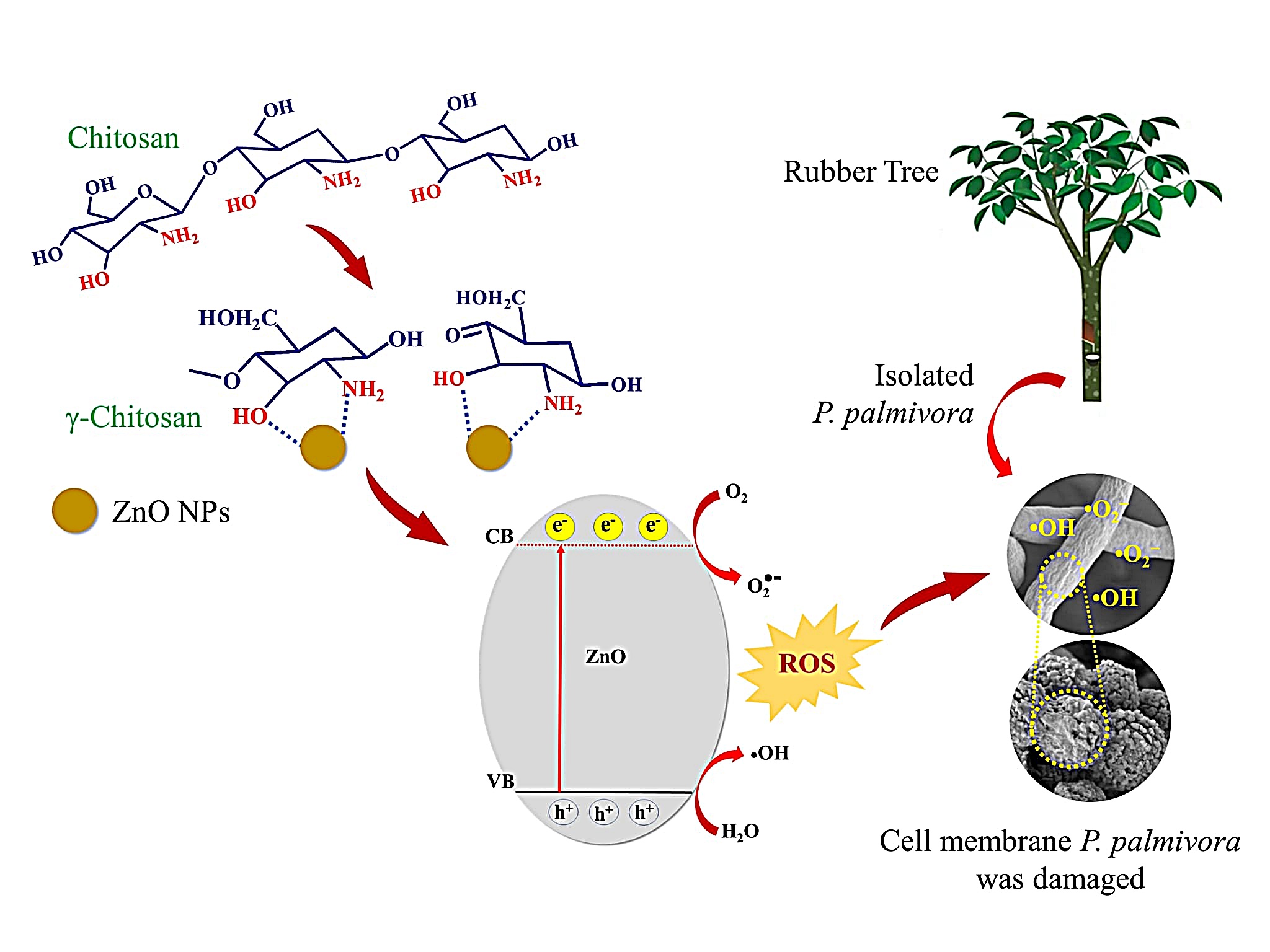
GRAPHICAL ABSTRACT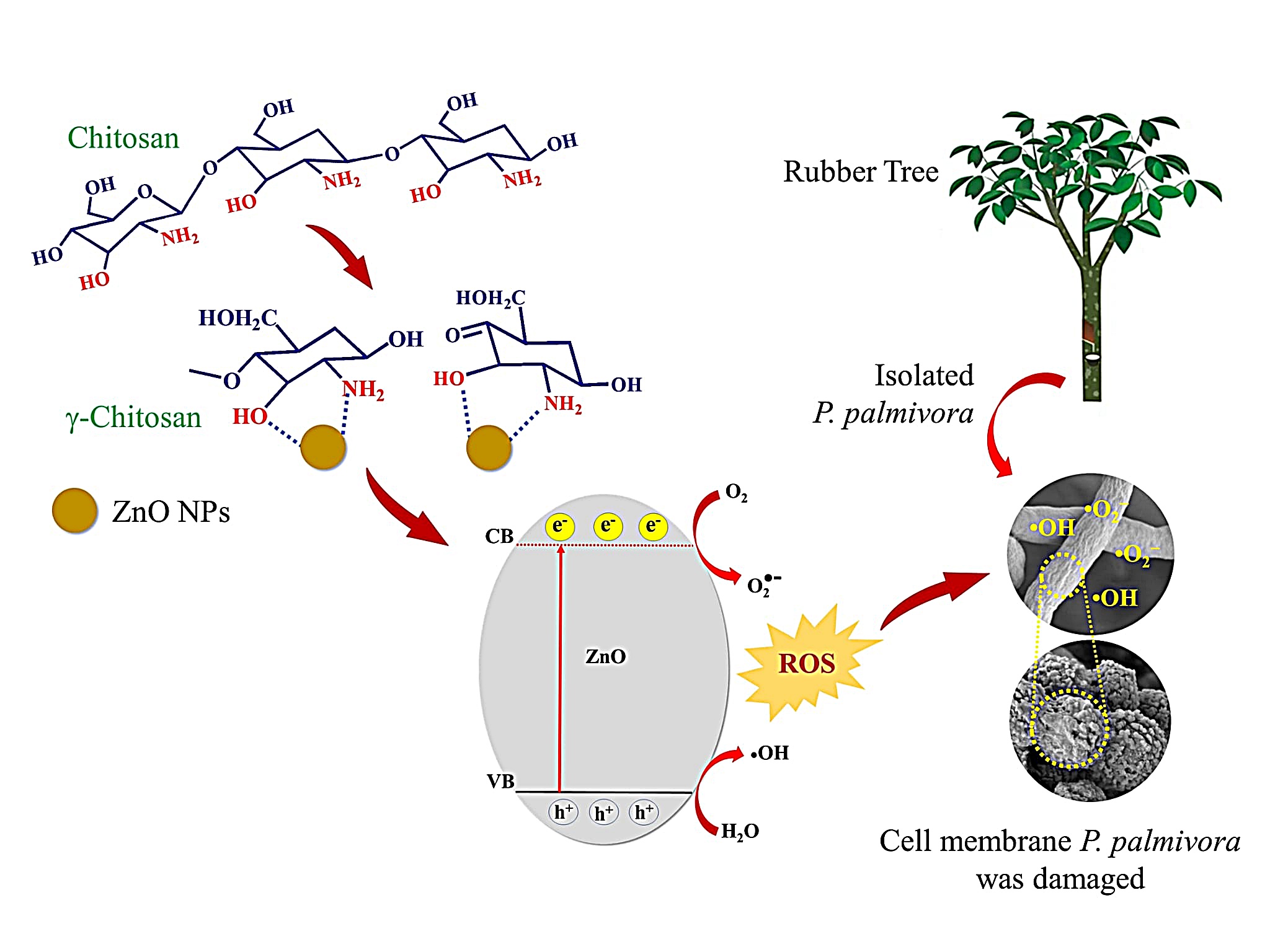
Downloads
References
Association of Natural Rubber Producing Countries. Monthly NR statistical report, Available at: https://www.anrpc.org/news/anrpc-releases-monthly-nr-statistical-report%2C-september-2025, accessed September 2025.
J Fox and JC Castella. Expansion of rubber (Hevea brasiliensis) in mainland Southeast Asia: What are the prospects for smallholders? The Journal of Peasant Studies 2013; 40(1), 155-170.
Z Li and JM Fox. Mapping rubber tree growth in mainland Southeast Asia using time-series MODIS 250 m NDVI and statistical data. Applied Geography 2012; 32(2), 420-432.
C Pornsuriya, T Chairin, N Thaochan and A Sunpapao. Identification and characterization of Neopestalotiopsis fungi associated with a novel leaf fall disease of rubber trees (Hevea brasiliensis) in Thailand. Journal of Phytopathology 2020; 168(7-8), 416-427.
B Laohasakul, P Boonyapipat and P Plodpai. First report of Phytophthora citrophthora causing leaf fall of para rubber tree (Hevea brasiliensis) in Thailand. Plant Disease 2017; 101(6), 1057.
N Churngchow and M Rattarasarn. Biosynthesis of scopoletin in Hevea brasiliensis leaves inoculated with Phytophthora palmivora. Journal of Plant Physiology 2001; 158(7), 875-882.
U Krishnan, M Kaur, K Singh, M Kumar and A Kumar. A synoptic review of MoS2: Synthesis to applications. Superlattice. Superlattices and Microstructures 2019; 128, 274-297.
Y Saijo and EP Loo. Plant immunity in signal integration between biotic and abiotic stress responses. New Phytologist 2020; 225(1), 87-104.
P Kongtragoul. In vitro fungicidal effect of chitosan with different molecular weights on fungicide-resistant Phytophthora fruit rot on durian from the export market. Acta Horticulturae 2018; 1210, 65-72.
V Tsikourkitoudi, B Henriques-Normark and GA Sotiriou. Inorganic nanoparticle engineering against bacterial infections. Current Opinion in Chemical Engineering 2022; 38, 100872.
SB Mayegowda, G Sarma, MN Gadilingappa, S Alghamdi, A Aslam, B Refaat, M Almehmadi, M Allahyani, AA Alsaiari, A Aljuaid and IS Al-Moraya. Green-synthesized nanoparticles and their therapeutic applications: A review. Green Processing and Synthesis 2023; 12(1), 20230001.
AW Alshameri and M Owais. Antibacterial and cytotoxic potency of the plant-mediated synthesis of metallic nanoparticles Ag NPs and ZnO NPs: A review. OpenNano 2022; 8, 100077.
MNVR Kumar. A review of chitin and chitosan applications. Reactive and Functional Polymers 2000; 46(1), 1-27.
F Shahidi, JKV Arachchi and YJ Jeon. Food applications of chitin and chitosans. Trends in Food Science & Technology 1999; 10, 37-51.
T Jan, J Iqbal, M Ismail and A Mahmood. Synthesis of highly efficient antibacterial agent Ag doped ZnO nanorods: Structural, raman and optical properties. Journal of Applied Physics 2014; 115(15), 154308.
K Vijayalakshmi and D Sivaraj. Enhanced antibacterial activity of Cr doped ZnO nanorods synthesized using microwave processing. RSC Advances 2015; 5(84), 68461-68469.
H Sashiwa and SI Aiba. Chemically modified chitin and chitosan as biomaterials. Progress in Polymer Science 2004; 29(9), 887-908.
AB Muley, SA Chaudhari, KH Mulchandani and RS Singhal. Extraction and characterization of chitosan from prawn shell waste and its conjugation with cutinase for enhanced thermo-stability. International Journal of Biological Macromolecules 2018; 111, 1047-1058.
AB Muley, AS Thorat, SG Dalvi, MI Talib and VR Parate. Comparative studies and correlation between physicochemical and functional properties of chitosan from marine sources. Trends in Biosciences 2015; 8(22), 6267-6274.
FCK Ocloo1, A Adu-Gyamfi, EA Quarcoo, Y Serfor-Armah, DK Asare and C Owulah. Effect of gamma irradiation on antibacterial properties of sea crab shell chitosan. European Journal of Food Research & Review 2012; 2(3), 69-78.
I Perelshtein, E Ruderman, N Perkas, T Tzanov, J Beddow, E Joyce, TJ Mason, M Blanes, K Mollá, A Patlolla, AI Frenkel and A Gedanken. Chitosan and chitosan-ZnO-based complex nanoparticles: Formation, characterization, and antibacterial activity. Journal of Materials Chemistry B 2013; 1, 1968-1976.
A Charlesby. Crosslinking and degradation of polymers. Radiation Physics and Chemistry 1981; 18(1-2), 59-66.
LQ Luan and NHP Uyen. Radiation degradation of (1→3)-β-d-glucan from yeast with a potential application as a plant growth promoter. International Journal of Biological Macromolecules 2014; 69, 165-170.
I Zainol, HM Akil and A Mastor. Effect of γ-irradiation on the physical and mechanical properties of chitosan powder. Materials Science and Engineering: C 2009; 29(1), 292-297.
M Cho, BY Kim and JH Rhim. Degradation of alginate solution and powder by gamma irradiation. Food Engineering Progress 2003; 7, 141–145.
S Mirajkar, P Rathod, B Pawar, S Penna and S Dalvi. γ irradiated chitosan mediates enhanced synthesis and antimicrobial properties of chitosan-silver (Ag) nanocomposites. American Chemical Society 2021; 6, 34812-34822.
TA Dar, M Uddin, MM Khan, A Ali, SA Mir and L Varshney. Effect of Co-60 gamma irradiated chitosan and phosphorus fertilizer on growth, yield and trigonelline content of Trigonella foenum-graecum L. Journal of Radiation Research and Applied Sciences 2015; 8(3), 446-458.
KT Karthikeyan, A Nithya and K Jothivenkatachalam. Photocatalytic and antimicrobial activities of chitosan-TiO2 nanocomposite. International Journal of Biological Macromolecules 2017; 104, 1762-1773.
S Kumar, F Ye, S Dobretsov and J Dutta. Chitosan nanocomposite coatings for food, paints, and water treatment applications. Applied Sciences 2019; 9(12), 2409.
L Al-Naamani, S Dobretsov, J Dutta and JG Burgess. Chitosan-zinc oxide nanocomposite coatings for the prevention of marine biofouling. Chemosphere 2017; 168, 408-417.
A Gamliel, J Katan and E Cohen. Toxicity of chloronitrobenzenes to Fusarium oxysporum and Rhizoctonia solani as related to their structure. Phytoparasitica 1989; 17, 101-106.
LH Li, JC Deng, HR Deng, ZL Liu and XL Li. Preparation, characterization and antimicrobial activities of chitosan/Ag/ZnO blend films. Chemical Engineering Journal 2010; 160(1), 378-382.
M Shoeb, BR Singh, JA Khan, W Khan, BN Singh, HB Singh and AH Naqvi. ROS-dependent anticandidal activity of zinc oxide nanoparticles synthesized by using egg albumen as a biotemplate. Advances in Natural Sciences: Nanoscience and Nanotechnology 2013; 4, 035015.
A H Bashal, SM Riyadh, W Alharbi, KH Alharbi, TA Farghaly and KD Khalil. Bio-based (Chitosan-ZnO) nanocomposite: Synthesis, characterization, and its use as recyclable, ecofriendly biocatalyst for synthesis of thiazoles tethered azo groups. Polymers 2022; 14(3), 386.
ER El-Sayed, HK Abdelhakim and Z Zakaria. Extracellular biosynthesis of cobalt ferrite nanoparticles by Monascus purpureus and their antioxidant, anticancer and antimicrobial activities: Yield enhancement by gamma irradiation. Materials Science and Engineering: C 2020; 107, 110318.
I Perelshtein, Y Ruderman, N Perkas, K Traeger, T Tzanov, J Beddow, E Joyce, TJ Mason, M Blanes, K Molla and A Gedanken. Enzymatic pre-treatment as a means of enhancing the antibacterial activity and stability of ZnO nanoparticles sonochemically coated on cotton fabrics. Journal of Materials of Chemistry 2012; 22, 10736-10742.
SY Han, BK Paul and CH Chang. Nanostructured ZnO as biomimetic anti-reflective coatings on textured silicon using a continuous solution process. Journal of Materials of Chemistry 2012; 22, 22906-22912.
Y Qin, S Li, Y Li, F Pan, L Han, ZM Chen, XZ Yin, LX Wang and H Wang. Mechanically robust polybenzoxazine/reduced graphene oxide wrapped-cellulose sponge towards highly efficient oil/water separation, and solar-driven for cleaning up crude oil. Composites Science and Technology 2020; 197, 108254.
X Liu, J Tian, Y Li, N Sun, S Mi, Y Xie and Z Chen. Enhanced dyes adsorption from wastewater via Fe3O4 nanoparticles functionalized activated carbon. Journal of Hazardous Materials 2019; 373, 397-407.
SHS Dananjaya, RS Kumar, M Yang, C Nikapitiya, J Lee and M De Zoysa. Synthesis, characterization of ZnO-chitosan nanocomposites and evaluation of its antifungal activity against pathogenic Candida albicans. International Journal of Biological Macromolecules 2018; 108, 1281-1288.
P Porrawatkul, R Pimsen, A Kuyyogsuy, N Teppaya, A Noypha, S Chanthai and P Nuengmatcha. Microwave-assisted synthesis of Ag/ZnO nanoparticles using Averrhoa carambola fruit extract as the reducing agent and their application in cotton fabrics with antibacterial and UV protection properties. RSC Advances 2022; 12(24), 15008-150019.
L Sindhu, K Gopal, K Arunodhayam, C Ruth and B Srinivasulu. Evaluation of fungicides against Phytophthora palmivora in vitro. The Pharma Innovation Journal 2022; 11(8), 776-779.
K Jariyachawalid, P Laowanapiban, V Meevootisom and S Wiyakrutta. Effective enhancement of Pseudomonas stutzeri D-phenylglycine aminotransferase functional expression in Pichia pastoris by co-expressing Escherichia coli GroEL-GroES. Microbial Cell Factories 2012; 11, 47.
S Gurunathan, M Qasim, C Park, H Yoo, JH Kim and K Hong. Cytotoxic potential and molecular pathway analysis of silver nanoparticles in human colon cancer cells HCT116. International Journal of Molecular Science 2018; 19(8), 2269.
A Popova, DY Advakhova, AN Shevevko, KA Kuptsov, P Slukin, SG Ignatov, A Ilniskava, RV Timoshenko, AS Erofeev, AA Kuchmizhak, B Subramanian and DV shtansky. Synergistic bactericidal effect of Zn2+ ions and reactive oxygen species generated in response to either UV or X-ray irradiation of Zn-doped plasma electrolytic oxidation TiO2 coatings. ACS Applied Bio Materials 2024; 7(8), 5579-5596.
AM Mohammed, M Mohammed, JK Oleiwi, FH Ihmedee, T Adam, BO Betar and SCB Gopinath. Comprehensive review on zinc oxide nanoparticle production and the associated antibacterial mechanisms and therapeutic potential. Nano Trends 2025; 11, 100145.
W Elmer and JC White. The Future of nanotechnology in plant pathology. Annual Review of Phytopathology 2018; 56(1), 111-133.
S Gaba, A Varma and A Goel. Protective and curative activity of biogenic copper oxide nanoparticles against Alternaria blight disease in oilseed crops: A review. Journal of Plant Diseases and Protection 2022; 129(2), 215-229.
P Amornpitoksuk, S Suwanboon, S Sangkanu, A Sukhoom, N Muensit and J Baltrusaitis. Synthesis, characterization, photocatalytic and antibacterial activities of Ag-doped ZnO powders modified with a diblock copolymer. Powder Technology 2012; 219, 158-164.
RS Kumar, SHS Dananjaya, M De Zoysa and M Yang. Enhanced antifungal activity of Ni-doped ZnO nanostructures under dark conditions. RSC Advances 2016; 6(110), 108468-108476.
K Hirota, M Sugimoto, M Kato, K Tsukagoshi, T Tanigawa and H Sugimoto. Preparation of zinc oxide ceramics with a sustainable antibacterial activity under dark conditions. Ceramics International 2010; 36(2), 497-506.
JD Torres, EA Faria, JR SouzaDe and AG Prado. Preparation of photoactive chitosan-niobium (V) oxide composites for dye degradation. Journal of Photochemistry and Photobiology A: Chemistry 2006; 182(2), 202-206.
R Jiang, H Zhu, J Yao, Y Fu and Y Guan. Chitosan hydrogel films as a template for mild biosynthesis of CdS quantum dots with highly efficient photocatalytic activity. Applied Surface Science 2012; 258(8), 3513-3518.
SHS Dananjaya, RS Kumar, M Yang, C Nikapitiya, J Lee and M De Zoysa. Synthesis, characterization of ZnO-chitosan nanocomposites and evaluation of its antifungal activity against pathogenic Candida albicans. International Journal of Biological Macromolecules 2018; 108, 1281-1288.
H Cui, Z Zhang, T Wang, J Hong, L Lei and S Wei. Uptake and translocation of ZnO nanoparticles in rice tissues studied by single particle-ICP-MS. Atomic Spectroscopy 2023; 44(5), 343-353.
OA Capraru, B Lungu, M Virgolici, M Constantin, M Cutrubinis, L Chirila, LO Cinteza and I Stanculescu. Gamma irradiation and Ag and ZnO nanoparticles combined treatment of cotton textile materials. Materials 2022; 15(8), 2734.
M Kaloti and A Kumar. Synthesis of chitosan-mediated silver coated γ-Fe2O3 (Ag−γ-Fe2O3@Cs) superparamagnetic binary nanohybrids for multifunctional applications. Journal of Physical Chemistry C 2016; 120, 17627-17644.
AA Wardana, P Kingwascharapong, LP Wigati, F Tanaka and F Tanaka. The antifungal effect against Penicillium italicum and characterization of fruit coating from chitosan/ZnO nanoparticle/Indonesian sandalwood essential oil composites. Food Packaging and Shelf Life 2022; 32, 100849.
AR Chowdhuri, S Tripathy, S Chandra, S Roy and SK Sahu. A ZnO decorated chitosan-graphene oxide nanocomposite shows significantly enhanced antimicrobial activity with ROS generation. RSC Advances 2015; 5(59), 49420-49428.
K Hirota, M Sugimoto, M Kato, K Tsukagoshi, T Tanigawa and H Sugimoto. Preparation of zinc oxide ceramics with a sustainable antibacterial activity under dark conditions. Ceramics International 2010; 36(2), 497-506.
HN Fones, DP Bebber, TM Chaloner, WT Kay, G Steinberg and SJ Gurr. Threats to global food security from emerging fungal and oomycete crop pathogens. Nature Food 2020; 1, 332-342.
Published
How to Cite
Issue
Section
License
Copyright (c) 2026 Walailak University

This work is licensed under a Creative Commons Attribution-NonCommercial-NoDerivatives 4.0 International License.





