
Harnessing Natural Aryl Aldehydes to Synthesize Bromochalcones as Anticancer Candidates Targeting Proliferative Pathways
DOI:
https://doi.org/10.48048/tis.2026.13123Keywords:
Brominated-Chalcones, IC50, Docking, Molecular Dynamics, PCNA, DFT, ADMET, Brominated-chalcones, IC50, Docking, Molecular dynamics, PCNA, DFT, ADMETAbstract
Current cancer therapies are limited by sustainability, drug resistance, and off-target effects. Bromochalcones are suitable candidates for targeted therapies, owing to their designable structure that can engage proliferative pathways. This study aimed to synthesize bromochalcones from natural aryl aldehydes and to evaluate their structural features and in vitro and in silico anticancer properties. Six bromochalcones were synthesized and identified by FTIR, GC-MS, and NMR. The in vitro MTT assay showed that all brominated chalcones were more cytotoxic toward HeLa cells than toward MCF-7, T47D, and Vero cells. Compound (E)-1-(4-bromophenyl)-3-(4-hydroxy-3-methoxyphenyl) prop-2-en-1-one (referred to 2D), derived from vanillin, achieved the best results (IC50 = 5 µg/mL; SI = 90.71), outperforming doxorubicin (IC50 = 15 µg/mL). Molecular docking studies on several proliferation proteins indicate that PCNA had the highest correlation between binding affinity and the in vitro IC50 trend. 2D-PCNA complex exhibited the strongest binding affinity by forming hydrogen bonds with Glu25, Met40, and His44. A 100 ns molecular dynamics simulation also shows a stable interaction with a strong binding affinity. Reactivity analysis from DFT calculations indicates that bromochalcones 2A and 2D were the 2 most potent compounds in driving interactions, including hydrogen bonding. Furthermore, ADMET predictions assessment reveals the safety and potential of these compounds as drug candidates. In conclusion, vanillin-derived bromochalcone, 2D, emerges as the lead compound, demonstrating the best in vitro anticancer activity, a favorable in silico profile, and the highest potential for development into various formulations.
HIGHLIGHTS
- Six bromochalcones derived from natural aryl aldehydes were screened for their effects on breast and cancer cells in vitro and in silico.
- Vanillin-derived bromochalcone 2D inhibited HeLa cell viability (IC₅₀ = 5 µg/mL, 48 h), showing ~3-fold higher potency than the reference drug doxorubicin under the same assay conditions.
- Integrated docking, molecular dynamics, DFT descriptors, and ADMET predictions suggest that bromochalcone 2D has stable binding to PCNA and a favorable drug-likeness profile, supporting its prioritization for further mechanistic validation.
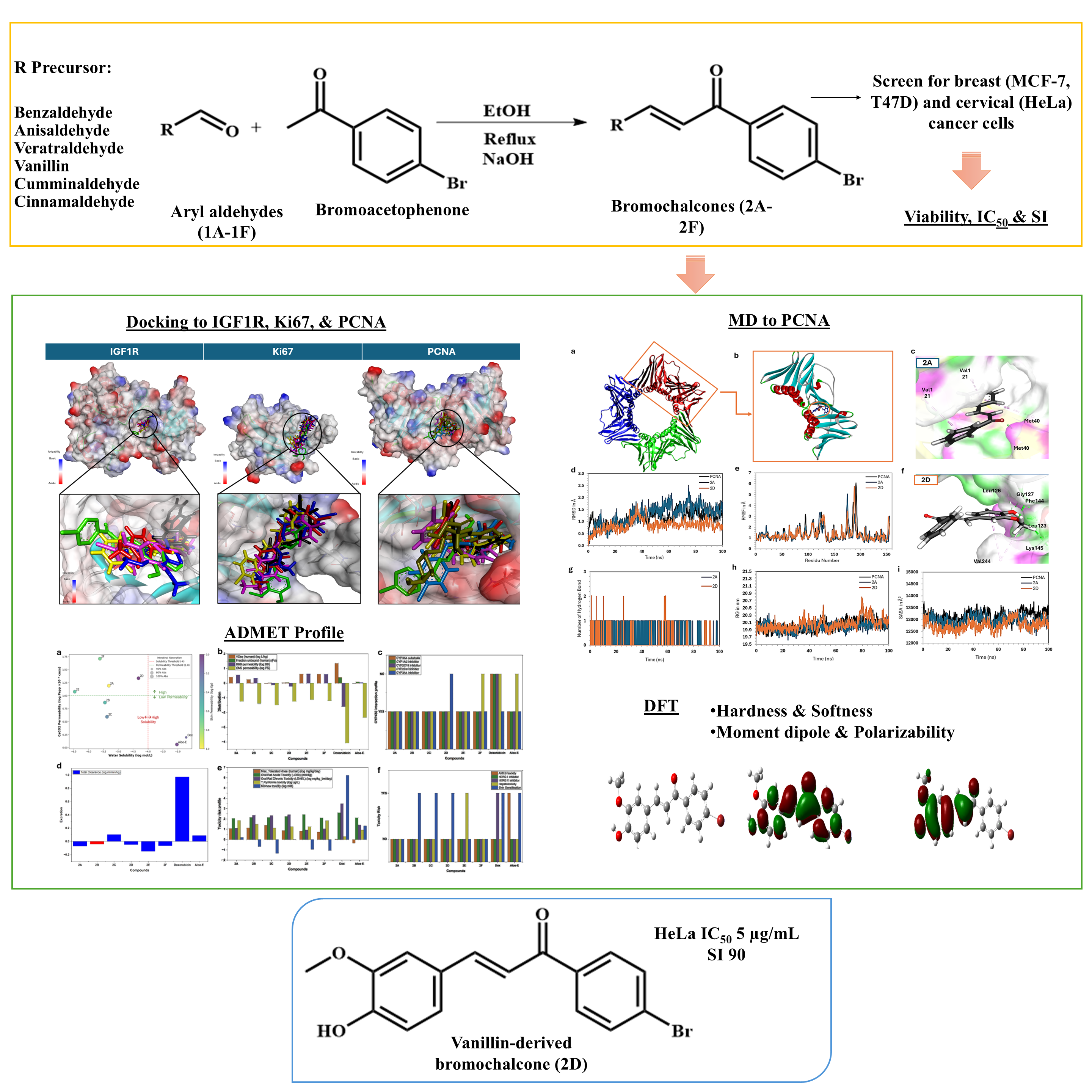
GRAPHICAL ABSTRACT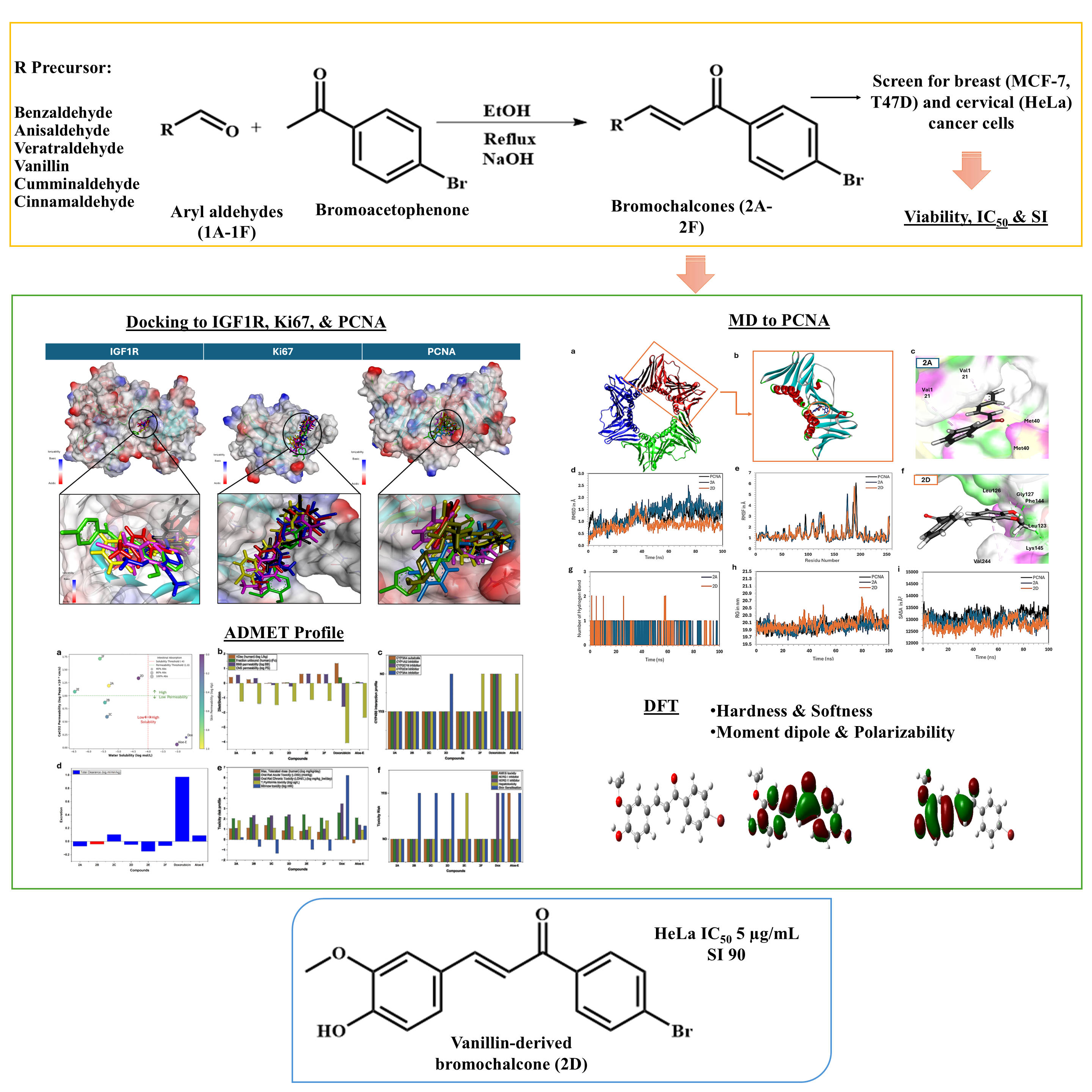
Downloads
References
F Bray, M Laversanne, H Sung, J Ferlay, RL Siegel, I Soerjomataram and A Jemal. Global cancer statistics 2022: GLOBOCAN estimates of incidence and mortality worldwide for 36 cancers in 185 countries. CA: A Cancer Journal for Clinicians 2024; 74(3), 229-263.
JR Wei, MY Lu, TH Wei, JS Fleishman, H Yu, XL Chen, XT Kong, SL Sun, NG Li, Y Yang and HW Ni. Overcoming cancer therapy resistance: From drug innovation to therapeutics. Drug Resistance Updates 2025; 81, 101229.
ZA Mahdi, BSA Almjalawi, M Naimuzzaman, M Hasan, FT Al-Alaq, HOM Al-Dahmoshi, A Kumer, NSK Al-Khafaji, SAM Al-Yasiri and M Saki. Exploring camptothecin derivatives from the Chinese tree of Camptotheca acuminata as breast cancer protease inhibitors: Insights from multi-scale computational analysis. The Open Bioinformatics Journal 2025; 18(1), e18750362369549.
T Nakaphan, M Teerachaisakul, K Sawanyawisuth and K Pongpirul. Herbal product availability and consumption patterns: A comprehensive scoping review. Natural Resources for Human Health 2025; 5(4), 522-531.
J Tauchen, L Huml, M Jurášek, JM Regenstein and F Ozogul. Synthetic and semi-synthetic antioxidants in medicine and food industry: A review. Frontiers in Pharmacology 2025; 16, 1599816.
B Goel and SK Jain. Semisynthesis: Bridging natural products and novel anticancer therapies. European Journal of Medicinal Chemistry Reports 2024; 12, 100218.
D Pereira, RT Lima, A Palmeira, H Seca, J Soares, S Gomes, L Raimundo, C Maciel, M Pinto, E Sousa, M Helena Vasconcelos, L Saraiva and H Cidade. Design and synthesis of new inhibitors of p53-MDM2 interaction with a chalcone scaffold. Arabian Journal of Chemistry 2019; 12(8), 4150-4161.
S Safe. Natural products as anticancer agents and enhancing their efficacy by a mechanism-based precision approach. Exploration of Drug Science 2024; 2(4), 408-427.
K Ganesan, C Xu, B Du, J Che, F Gao, C Zheng and J Chen. Isoliquiritigenin: A natural compound with a promising role in inhibiting breast cancer lung metastasis. Journal of Traditional and Complementary Medicine 2024; 15(7), 702-713.
R Palanisamy, NI Kahingalage, D Archibald, I Casari and M Falasca. Synergistic anticancer activity of plumbagin and xanthohumol combination on pancreatic cancer models. International Journal of Molecular Sciences 2024; 25(4), 2340.
K Okoniewska, MT Konieczny, K Lemke and T Grabowski. Pharmacokinetic studies of oxathio-heterocycle fused chalcones. European Journal of Drug Metabolism and Pharmacokinetics 2017; 42(1), 49-58.
E Winter, C Dal Pizzol, C Locatelli, AH Silva, A Conte, LD Chiaradia-Delatorre, RJ Nunes, RA Yunes and TB Creckzynski-Pasa. In vitro and in vivo effects of free and chalcones-loaded nanoemulsions: Insights and challenges in targeted cancer chemotherapies. International Journal of Environmental Research and Public Health 2014; 11(10), 10016-10035.
S Chowdhary, Preeti, Shekhar, N Gupta, R Kumar and V Kumar. Advances in chalcone-based anticancer therapy: Mechanisms, preclinical advances, and future perspectives. Expert Opinion on Drug Discovery 2024; 19(12), 1417-1437.
R Hassan, S Emam, D Hwang, G Do Kim, S Hassanin, M Khalil, A Abdou and A Sonousi. Design, synthesis and evaluation of anticancer activity of new pyrazoline derivatives by down-regulation of VEGF: Molecular docking and apoptosis inducing activity. Bioorganic Chemistry 2022; 118, 105487.
RA Sheldon, ML Bode and SG Akakios. Metrics of green chemistry: Waste minimization. Current Opinion in Green and Sustainable Chemistry 2022; 33, 100569.
A Kumar, G Soumya, V Kanchana, K Singh, N Maurya, S Kumar, A Singh, J Kumar, K Srinivas, D Chanda, S Luqman, S Misra, A Meena and B Balakishan. Design, synthesis, and in silico docking studies of novel cinnamaldehyde-chalcone derivatives with anti-cancer potential and in vivo acute oral toxicity profiling. RSC Advances 2025; 15(37), 30627-30638.
HH Wang, KM Qiu, HE Cui, YS Yang, M Xing, XY Qiu, LF Bai and HL Zhu. Synthesis, molecular docking and evaluation of thiazolyl-pyrazoline derivatives containing benzodioxole as potential anticancer agents. Bioorganic & Medicinal Chemistry 2013; 21(2), 448-455.
M Saifullah, A Hasan, M Kaleem, E Raneem, A Gupta, M Amir, M Mumtaz Alam, M Akhter, S Tasneem and M Shaquiquzzaman. A comprehensive review of structure activity relationships: Exploration of chalcone derivatives as anticancer agents, target-based and cell line-specific insights. Medicine in Drug Discovery 2025; 28, 100230.
R Michalkova, M Kello, M Cizmarikova, A Bardelcikova, L Mirossay and J Mojzis. Chalcones and gastrointestinal cancers: Experimental evidence. International Journal of Molecular Sciences 2023; 24(6), 5964.
C Gracesella, H Patintingan and M Louisa. Anticancer potential of chalcone and its derivatives against triple negative breast cancer. Journal of Chemical Health Risks 2024; 14(3), 309-316.
L Gu, R Lingeman, F Yakushijin, E Sun, Q Cui, J Chao, W Hu, H Li, R Hickey, J Stark, Y Yuan, Y Chen, S Vonderfecht, T Synold, Y Shi, K Reckamp, D Horne and L Malkas. The anticancer activity of a first-in-class small-molecule targeting PCNA. Clinical Cancer Research 2018; 24(23), 6053-6065.
S Hong, C Liow, J Yuk, H Byon, Y Yang, E Cho, J Yeom, G Park, H Kang, S Kim, Y Shim, M Na, C Jeong, G Hwang, H Kim, H Kim, S Eom, S Cho, H Jun, ..., HM Lee. Reducing time to discovery: Materials and molecular modeling, imaging, informatics, and integration. ACS Nano 2021; 15(3), 3971-3995.
R Peach, A Arnaudon and M Barahona. Relative, local and global dimension in complex networks. Nature Communications 2022; 13(1), 3088.
AG Atanasov, SB Zotchev, VM Dirsch and CT Supuran. Natural products in drug discovery: Advances and opportunities. Nature Reviews Drug Discovery 2021; 20(3), 200-216.
FS Li and JK Weng. Demystifying traditional herbal medicine with modern approach. Nature Plants 2017; 3(8), 1-7.
M Verni and F Casanova. The potential of food by-products: Bioprocessing, bioactive compounds extraction and functional ingredients utilization. Foods 2022; 11(24), 4092.
H El-Ramady, P Hajdú, G Törős, K Badgar, X Llanaj, A Kiss, N Abdalla, AE Omara, T Elsakhawy, H Elbasiouny, F Elbehiry, M Amer, ME El-Mahrouk and J Prokisch. Plant nutrition for human health: A pictorial review on plant bioactive compounds for sustainable agriculture. Sustainability 2022; 14(14), 8329.
DJ Newman and GM Cragg. Natural products as sources of new drugs over the nearly four decades from 01/1981 to 09/2019. Journal of Natural Products 2020; 83(3), 770-803.
T Rodrigues. Harnessing the potential of natural products in drug discovery from a cheminformatics vantage point. Organic & Biomolecular Chemistry 2017; 15(44), 9275-9282.
M Ghasemi, T Turnbull, S Sebastian and I Kempson. The MTT assay: Utility, limitations, pitfalls, and interpretation in bulk and single-cell analysis. International Journal of Molecular Sciences 2021; 22(23), 12827.
Y Song and S Zhang. ComProliM: A cell growth assay robust to initial cell number in co-culture system. Heliyon 2023; 9(9), e19433.
I Falke, FM Troschel, H Palenta, MT Löblein, K Brüggemann, K Borrmann, HT Eich, M Götte and B Greve. Knockdown of the stem cell marker Musashi-1 inhibits endometrial cancer growth and sensitizes cells to radiation. Stem Cell Research & Therapy 2022; 13(1), 212.
P Tanamatayarat, P Limtrakul, S Chunsakaow and C Duangrat. Screening of some rubiaceous plants for cytotoxic activity against cervix carcinoma (kb-3-1) cell line. The Thai Journal of Pharmaceutical Sciences 2003; 27(3), 167-172.
Y Cai, M Prochazkova, YS Kim, C Jiang, J Ma, L Moses, K Martin, V Pham, N Zhang, SL Highfill, RP Somerville, DF Stroncek and P Jin. Assessment and comparison of viability assays for cellular products. Cytotherapy 2024; 26(2), 201-209.
BK Shoichet. Screening in a spirit haunted world. Drug Discovery Today 2006; 11(13-14), 607-615.
JP Hughes, S Rees, SB Kalindjian and KL Philpott. Principles of early drug discovery. British Journal of Pharmacology 2011; 162(6), 1239-1249.
MA Mahmood, AH Abd and EJ Kadhim. Assessing the cytotoxicity of phenolic and terpene fractions extracted from Iraqi Prunus arabica against AMJ13 and SK-GT-4 human cancer cell lines. F1000Research 2024; 12, 433.
M Nafie, I Shawish, S Fahmy, M Diab, M Abdelfattah, B Hassen, K Darwish, A El-Faham and A Barakat. Recent advances in the halogenated spirooxindoles as novel anticancer scaffolds: Chemistry and bioactivity approach. RSC Advances 2025; 15(28), 22336-22375.
M Furqan, FS Wahyuni, M Susanti and D Hamidi. Evaluation of Garcinia cowa leaf extract as a potential anticancer agent: Cytotoxicity, selectivity, and apoptotic effects on MCF-7/HER-2 cells. Tropical Journal of Natural Product Research 2025; 9(2), 846-852.
A Chhikara, PK Roayapalley, H Sakagami, S Amano, K Satoh, Y Uesawa, U Das, S Das, EA Borrego, CD Guerena, CR Hernandez, RJ Aguilera and JR Dimmock. Novel unsymmetric 3, 5-bis (benzylidene)-4-piperidones that display tumor-selective toxicity. Molecules 2022; 27(19), 6718.
ID Zlotnikov, NV Dobryakova, AA Ezhov and EV Kudryashova. Achievement of the selectivity of cytotoxic agents against cancer cells by creation of combined formulation with terpenoid adjuvants as prospects to overcome multidrug resistance. International Journal of Molecular Sciences 2023; 24(9), 8023.
T Mukohara, H Shimada, N Ogasawara, R Wanikawa, M Shimomura, T Nakatsura, G Ishii, JO Park, PA Jänne, N Saijo and H Minami. Sensitivity of breast cancer cell lines to the novel insulin-like growth factor-1 receptor (IGF-1R) inhibitor NVP-AEW541 is dependent on the level of IRS-1 expression. Cancer Letters 2009; 282(1), 14-24.
H Hartog, W Graaf, H Boezen and J Wesseling. Treatment of breast cancer cells by IGF1R tyrosine kinase inhibitor combined with conventional systemic drugs. Anticancer Research 2012; 32(4), 1309-1318.
A Stanley, G Ashrafi, A Seddon and H Modjtahedi. Synergistic effects of various HER inhibitors in combination with IGF1R, C-MET and SRC targeting agents in breast cancer cell lines. Scientific Reports 2017; 7, 3964.
J Adjo Aka and SX Lin. Comparison of functional proteomic analyses of human breast cancer cell lines T47D and MCF7. PLoS One 2012; 7(2), e31532.
T Pantsar, PD Kaiser, M Kudolo, M Forster, U Rothbauer and SA Laufer. Decisive role of water and protein dynamics in residence time of p38α MAP kinase inhibitors. Nature Communications 2022; 13(1), 569.
R Lazim, D Suh and S Choi. Advances in molecular dynamics simulations and enhanced sampling methods for the study of protein systems. International Journal of Molecular Sciences 2020; 21(17), 6339.
S Rathod, P Chavan, D Mahuli, S Rochlani, S Shinde, S Pawar, P Choudhari, R Dhavale, P Mudalkar and F Tamboli. Exploring biogenic chalcones as DprE1 inhibitors for antitubercular activity via in silico approach. Journal of Molecular Modeling 2023; 29(4), 113.
T Wang and Z Wang. Targeting the “Undruggable”: Small-molecule inhibitors of proliferating cell nuclear antigen (PCNA) in the spotlight in cancer therapy. Journal of Medicinal Chemistry 2025; 68(3), 2058-2088.
VK Bhardwaj and R Purohit. A new insight into protein-protein interactions and the effect of conformational alterations in PCNA. International Journal of Biological Macromolecules 2020; 148, 999-1009.
F Li, A Phadte, M Bhatia, S Barndt, A Carlo, CFD Hou, R Yang, S Strock and A Pluciennik. Structural and molecular basis of PCNA-activated FAN1 nuclease function in DNA repair. Nature Communications 2025; 16(1), 4411.
I Ahmad, V Jagatap and H Patel. Application of density functional theory (DFT) and response surface methodology (RSM) in drug discovery, phytochemistry. In: C Egbuna, M Rudrapal and H Tijjani (Eds.). Phytochemistry, computational tools and databases in drug discovery. Elsevier, Amsterdam, Netherlands, 2023.
TN Mohammed Musthafa, K Snigdha, AM Asiri, TR Sobahi and M Asad. Green synthesis of chromonyl chalcone and pyrazoline as potential antimicrobial agents: DFT, molecular docking and antimicrobial studies. Journal of Molecular Structure 2023; 1271, 133993.
M Enneiymy, HA Mohammad-Salim, A Oubella, JV de Julián-Ortiz, HM Tsahnang Fofack, SA Alotaibi, MM Mbake and MYA Itto. In-silico analysis of benzo-selenadiazole hybrids: Reactivity and anticancer potential assessed through DFT, molecular dynamics, molecular docking, and ADMET. Polycyclic Aromatic Compounds 2025; 45(8), 1536-1558.
A Mahal, M Al-Janabi, V Eyüpoğlu, A Alkhouri, S Chtita, MM Kadhim, AJ Obaidullah, JM Alotaibi, X Wei and MRF Pratama. Molecular docking, drug-likeness and DFT study of some modified tetrahydrocurcumins as potential anticancer agents. Saudi Pharmaceutical Journal 2024; 32(1), 101889.
A Das, A Das and BK Banik. Influence of dipole moments on the medicinal activities of diverse organic compounds. Journal of the Indian Chemical Society 2021; 98(2), 100005.
J Darlami and S Sharma. The role of physicochemical and topological parameters in drug design. Frontiers in Drug Discovery 2024; 4, 1424402.
G Ferraro and A Merlino. Investigation of metallodrug/protein interaction by X-ray crystallography and complementary biophysical techniques. Inorganic Chemistry Frontiers 2025; 12(9), 3345-3366.
VM Patil, SP Gupta, N Masand and K Balasubramanian. Experimental and computational models to understand protein-ligand, metal-ligand and metal-DNA interactions pertinent to targeted cancer and other therapies. European Journal of Medicinal Chemistry Reports 2024; 10, 100133.
MD Mellaoui, K Zaki, K Abbiche, A Imjjad, R Boutiddar, A Sbai, A Jmiai, SE Issami, AM Lamsabhi and H Zejli. In silico anticancer activity of isoxazolidine and isoxazolines derivatives: DFT study, ADMET prediction, and molecular docking. Journal of Molecular Structure 2024; 1308, 138330.
P Bhadra, P Yadav, S Kaur, PT Hanumantharayudu and S Arunachalam. The role of ferroptosis in doxorubicin-induced cardiotoxicity - An update. Life Sciences 2025; 380, 123945.
Published
How to Cite
Issue
Section
License
Copyright (c) 2026 Walailak University

This work is licensed under a Creative Commons Attribution-NonCommercial-NoDerivatives 4.0 International License.





