
Green In-situ Synthesis of AgNPs and Myristic Acid Coating for Antibacterial and Hydrophobic Functionalization of Naturally Dyed Cotton Fabrics
DOI:
https://doi.org/10.48048/tis.2026.13182Keywords:
Cotton, Hydrophobic surface, Antibacterial, Natural dye, Green processAbstract
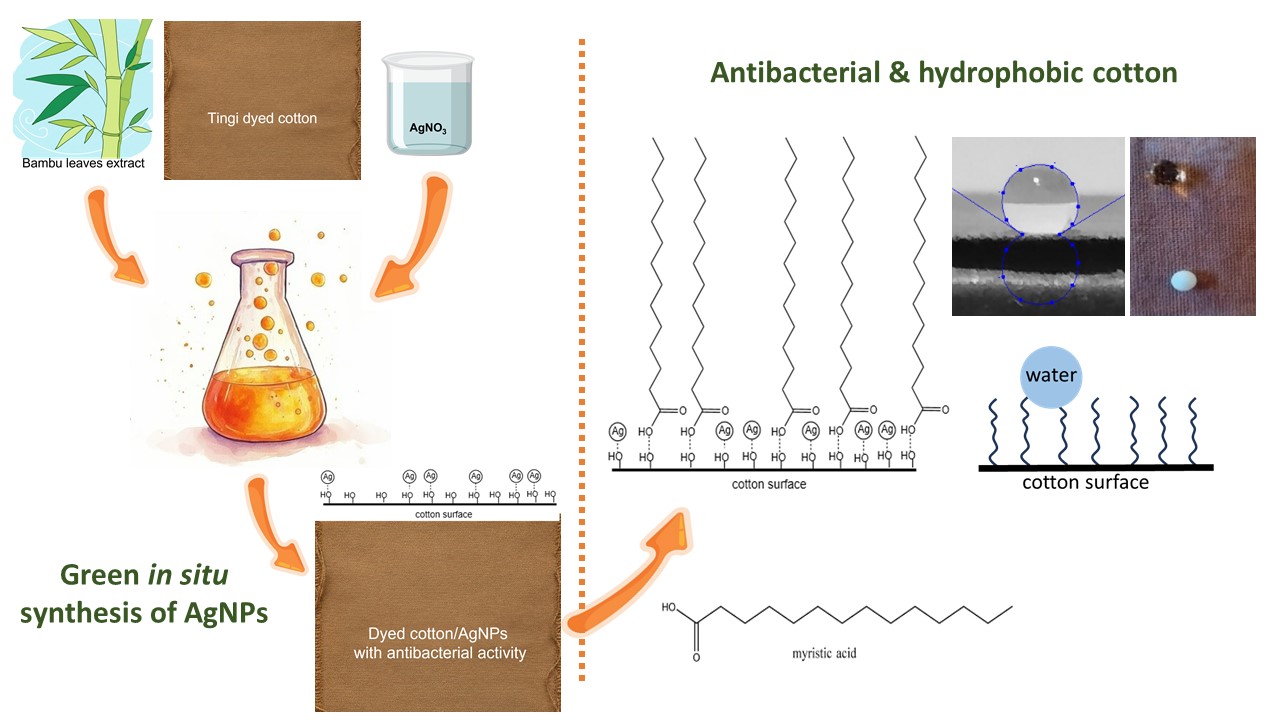
Green synthesis of silver nanoparticles (AgNPs) has drawn increasing attention for antibacterial surface applications. However, integrating additional functionalities, such as hydrophobicity, may affect antibacterial performance. In this study, AgNPs were synthesized in situ on cotton substrates using bamboo leaf extract as an eco-friendly reducing agent, followed by hydrophobic surface modification with naturally derived organic acids. The AgNPs coating and surface modification of the cotton were confirmed by SEM-EDX, XPS, and FTIR spectroscopy. The prepared AgNP-coated cotton exhibited effective antibacterial activity against both Streptococcus aureus and Escherichia coli, with inhibition zones ranging from 12.0 to 13.5 mm. While hydrophobic treatment significantly increased water contact angles up to 148°, indicating enhanced surface repellency. Notably, a reduction in antibacterial performance was observed after hydrophobic modification, suggesting a functional trade-off associated with altered surface accessibility and ion diffusion. These results highlight an important design consideration for multifunctional antibacterial surfaces prepared via green synthesis routes, emphasizing the need to balance antibacterial efficacy and surface engineering strategies.
HIGHLIGHTS
- Green in situ synthesis of silver nanoparticles (AgNPs) was applied to functionalize naturally dyed cotton fabrics using Ceriops tagal
- The treated cotton exhibited antibacterial activity against aureus and E. coli and high hydrophobicity after myristic acid coating.
- A clear trade-off between antibacterial performance and hydrophobicity was identified for textile end-use applications.
GRAPHICAL ABSTRACT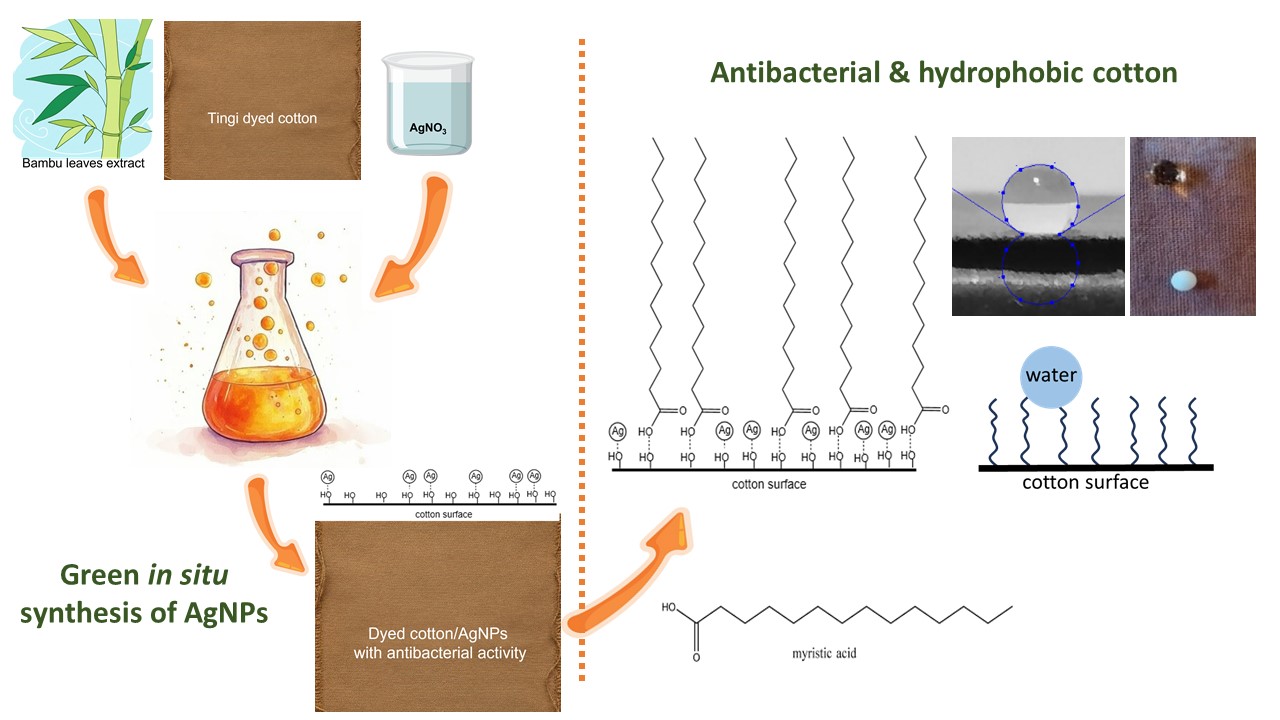
Downloads
References
S Riaz, M Ashraf, T Hussain, MT Hussain, A Rehman, A Javid, K Iqbal, A Basit and H Aziz. Functional finishing and coloration of textiles with nanomaterials. Coloration Technology 2018; 134(5), 327-346.
Y Wu, Y Yang, Z Zhang, Z Wang, Y Zhao and L Sun. Fabrication of cotton fabrics with durable antibacterial activities finishing by Ag nanoparticles. Textile Research Journal 2018; 89(5), 867-880.
M Pigłowski. Pathogenic and non-pathogenic microorganisms in the rapid alert system for food and feed. International Journal of Environmental Research and Public Health 2019; 16(3), 477.
I Kartini, SN Halimah and E Rahayuningsih. Enhanced wash-fastness of cotton fabric dyed with a composite of chitosan-natural dyes extract of Ceriops tagal. IOP Conference Series: Materials Science and Engineering 2021; 1053, 012022.
ZO Basyigit and H Coskun. Enhancing antibacterial and water-repellent properties for the production of high-performance fabrics in Home Textiles. Fibers and Polymers 2024; 25(5), 1789-1804.
F Qian, M Chen, C Zhou, Z Li, R Li and X Ren. The antibacterial and hydrophobic cotton fabrics constructed by multifunctional polysiloxane and TiO2 nanoparticles. Fibers and Polymers 2023; 24(2), 779-787.
N Sasunthon, S Laksee and P Pisitsak. Preparation of hemp fabrics with durable UV-protective and antibacterial properties using silver nanoparticles. Journal of Nanotechnology 2025; 2025, 9695944.
T Tandel, A Govekar and S Deogaonkar-Baride. Development of excellent antimicrobial and wash durable fabric with biosynthesized silver nanoparticles using soluble starch, maize starch and rice extract. Journal of Applied Polymer Science 2025; 142, 56926.
M Alauhdin, R Adnan, AD Hatmanto and I Kartini. Phytosynthesized-silver nanoparticles for functionalization of cotton fabric: A systematic literature review. International Journal of Technology 2024; 15(3), 753-769.
M Rehan, GE Ibrahim, HM Mashaly, M Hasanin, HG Rashad and S Mowafi. Simultaneous dyeing and multifunctional finishing of natural fabrics with Hibiscus flowers extract. Journal of Cleaner Production 2022; 374, 133992.
M Sadeghi-Kiakhani, AR Tehrani-Bagha, FS Miri, E Hashemi and M Safi. Eco-friendly procedure for rendering the antibacterial and antioxidant of cotton fabrics via phyto-synthesized AgNPs with Malva sylvestris (MS) natural colorant. Frontiers in Bioengineering and Biotechnology 2021; 9, 814374.
H Arshad, M Saleem, U Pasha and S Sadaf. Synthesis of Aloe vera-conjugated silver nanoparticles for use against multidrug-resistant microorganisms. Electronic Journal of Biotechnology 2022; 55, 55-64.
M Khan, MA Saeed, S Ullah, MR Repon, AD Pranta, N Yunusov and MM Hossain. Development of self-cleaning and antibacterial properties on cotton fabric using silver nanoparticles and PFOTS. SPE Polymers 2024; 5(4), 568-575.
Z Yu, J Liu, H He, Y Wang, Y Zhao, Q Lu, Y Qin, Y Ke and Y Peng. Green synthesis of silver nanoparticles with black rice (Oryza sativa L.) extract endowing carboxymethyl chitosan modified cotton with high anti-microbial and durable properties. Cellulose 2021; 28(3), 1827-1842.
M Wu, B Ma, T Pan, S Chen and J Sun. Silver-nanoparticle-colored cotton fabrics with tunable colors and durable antibacterial and self-healing superhydrophobic properties. Advanced Functional Materials 2015; 26(4), 569-576.
S Yasin, L Liu and JM Yao. Biosynthesis of silver nanoparticles by bamboo leaves extract and their antimicrobial activity. Journal of Fiber Bioengineering and Informatics 2013; 6(1), 77-84.
N Jayarambabu, K Saraswathi, A Akshaykranth, N Anitha, TV Rao and RR kumar. Bamboo-mediated silver nanoparticles functionalized with activated carbon and their application for non-enzymatic glucose sensing. Inorganic Chemistry Communications 2023; 147, 110249.
J Peng, L Wu, H Zhang, B Wang, Y Si, S Jin and H Zhu. Research progress on eco-friendly superhydrophobic materials in environment, energy and biology. Chemical Communications 2022; 58(80), 11201-11219.
R Cai, K Glinel, DD Smet, M Vanneste, N Mannu, B Kartheuser, B Nysten and AM Jonas. Environmentally friendly super-water-repellent fabrics prepared from water-based suspensions. ACS Applied Materials & Interfaces 2018; 10(18), 15346-15351.
SMR Razavi, J Oh, S Sett, L Feng, X Yan, MJ Hoque, A Liu, RT Haasch, M Masoomi, R Bagheri and N Miljkovic. Superhydrophobic surfaces made from naturally derived hydrophobic materials. ACS Sustainable Chemistry & Engineering 2017; 5(12), 11362-11370.
AA Hebeish, MH El-Rafie, FA Abdel-Mohdy, ES Abdel-Halim and HE Emam. Carboxymethyl cellulose for green synthesis and stabilization of silver nanoparticles. Carbohydrate Polymers 2010; 82(3), 933-941.
HE Emam and MK El-Bisi. Merely Ag nanoparticles using different cellulose fibers as removable reductant. Cellulose 2014; 21, 4219-4230.
MC Lite, RR Constantinescu, EC Tănăsescu, A Kuncser, C Romanițan, I Lăcătuşu and N Badea. Design of green silver nanoparticles based on Primula officinalis Extract for textile preservation. Materials 2022; 15(21), 7695.
M Rehan, S Zaghloul, FA Mahmoud, AS Montaser and A Hebeish. Design of multi-functional cotton gauze with antimicrobial and drug delivery properties. Materials Science and Engineering: C 2017; 80, 29-37.
P OhadiFar, S Shahidi and D Dorranian. Synthesis of silver nanoparticles and exhaustion on cotton fabric simultaneously using laser ablation method. Journal of Natural Fibers 2020; 17(9), 1295-1306.
MM El-Zawahry, HSE Khatib, GM Shokry and HG Rashad. One-pot robust dyeing of cotton fabrics with multifunctional Chamomile Flower dyes. Fibers and Polymers 2022; 23(8), 2234-2249.
S Nam, GW Selling, MB Hillyer, BD Condon, MS Rahman and S Chang. Brown cotton fibers self-produce Ag nanoparticles for regenerating their antimicrobial surfaces. ACS Applied Nano Materials 2021; 4(12), 13112-13122.
R Mia, MS Sk, ZBS Oli, T Ahmed, S Kabir and MA Waqar. Functionalizing cotton fabrics through herbally synthesized nanosilver. Cleaner Engineering and Technology 2021; 4, 100227.
M Rehan, HM Mashaly, S Mowafi, AA El-Kheir and HE Emam. Multi-functional textile design using in-situ Ag NPs incorporation into natural fabric matrix. Dyes and Pigments 2015; 118, 9-17.
V Hospodarova, E Singovszka and N Stevulova. Characterization of cellulosic fibers by FTIR spectroscopy for their further implementation to building materials. American Journal of Analytical Chemistry 2018; 9(6), 303-310.
NA Nikonenko, DK Buslov, NI Sushko and RG Zhbankov. Spectroscopic manifestation of stretching vibrations of glycosidic linkage in polysaccharides. Journal of Molecular Structure 2005; 752(1), 20-24.
E Richard, RV Lakshmi, ST Aruna and BJ Basu. A simple cost-effective and eco-friendly wet chemical process for the fabrication of superhydrophobic cotton fabrics. Applied Surface Science 2013; 277, 302-309.
R Zeng, MZ Rong, MQ Zhang, HC Liang and HM Zeng. Laser ablation of polymer-based silver nanocomposites. Applied Surface Science 2002; 187(3-4), 239-247.
Shahid-Ul-Islam, BS Butola and A Kumar. Green chemistry based in-situ synthesis of silver nanoparticles for multifunctional finishing of chitosan polysaccharide modified cellulosic textile substrate. International Journal of Biological Macromolecules 2020; 152, 1135-1145.
HE Emam, S Mowafi, HM Mashaly and M Rehan. Production of antibacterial colored viscose fibers using in situ prepared spherical Ag nanoparticles. Carbohydrate Polymers 2014; 110, 148-155.
MS Sk, R Mia, E Hoque, B Ahmed, MJI Amin, SMM Kabir and S Mahmud. Antimicrobial performance of silver–copper–zeolite microparticle-treated organic cotton fabric using versatile methods. Surface Innovations 2023; 11(4), 223-230.
M Raffi, F Hussain, TM Bhatti, JI Akhter, A Hameed and MM Hasan. Antibacterial characterization of silver nanoparticles against E. coli ATCC-15224. Journal of Material Science and Technology 2008; 24(2), 192-196.
K Chaloupka, Y Malam and AM Seifalian. Nanosilver as a new generation of nanoproduct in biomedical applications. Trends in Biotechnology 2010; 28(11), 580-588.
G Franci, A Falanga, S Galdiero, L Palomba, M Rai, G Morelli and M Galdiero. Silver nanoparticles as potential antibacterial agents. Molecules 2015; 20(5), 8856-8874.
S Ghosh, S Yadav and N Reynolds. Antibacterial properties of cotton fabric treated with silver nanoparticles. The Journal of The Textile Institute 2010; 101(10), 917-924.
MS Khalil-Abad and ME Yazdanshenas. Superhydrophobic antibacterial cotton textiles. Journal of Colloid and Interface Science 2010; 351(1), 293-298.
CA Arenas-Chávez, LM de Hollanda, AA Arce-Esquivel, A Alvarez-Risco, S Del-Aguila-Arcentales, JA Yáñez and C Vera-Gonzales. Antibacterial and antifungal activity of functionalized cotton fabric with nanocomposite based on silver nanoparticles and carboxymethyl chitosan. Processes 2022; 10(6), 1088.
PR More, S Pandit, AD Filippis, G Franci, I Mijakovic and M Galdiero. Silver nanoparticles: Bactericidal and mechanistic approach against drug resistant pathogens. Microorganisms 2023; 11(2), 369.
HH Afandy, DK Sabir and SB Aziz. Antibacterial activity of the green synthesized plasmonic silver nanoparticles with crystalline structure against gram-positive and gram-negative bacteria. Nanomaterials 2023; 13(8), 1327.
M Guzman, J Dille and S Godet. Synthesis and antibacterial activity of silver nanoparticles against gram-positive and gram-negative bacteria. Nanomedicine: Nanotechnology, Biology and Medicine 2012; 8(1), 37-45.
A Ivask, A Elbadawy, C Kaweeteerawat, D Boren, H Fischer, Z Ji, CH Chang, R Liu, T Tolaymat, D Telesca, JI Zink, Y Cohen, PA Holden and HA Godwin. Toxicity mechanisms in Escherichia coli vary for silver nanoparticles and differ from ionic silver. ACS Nano 2014; 8(1), 374-386.
A Khoddami, SS Shokohi and ZM Sebdani. A facile method for anti-bacterial finishing of cotton fabrics using silver nanoparticles. Industria Textila Journal 2012; 63(1), 20-26.
M Zhang, P Wang, H Sun and Z Wang. Superhydrophobic surface with hierarchical architecture and bimetallic composition for enhanced antibacterial activity. ACS Applied Materials & Interfaces 2014; 6(24), 22108-22115.
A Granados, R Pleixats and A Vallribera. Recent advances on antimicrobial and anti-inflammatory cotton fabrics containing nanostructures. Molecules 2021; 26(10), 3008.
Z Mazrouei-Sebdani and A Khoddami. Alkaline hydrolysis: A facile method to manufacture superhydrophobic polyester fabric by fluorocarbon coating. Progress in Organic Coatings 2011; 72(4), 638-646.
Downloads
Published
How to Cite
Issue
Section
License
Copyright (c) 2026 Walailak University

This work is licensed under a Creative Commons Attribution-NonCommercial-NoDerivatives 4.0 International License.





