
Analysis of Alkaloids Compounds and Antimalarial Activity of Coleus amboinicus Leaves from Indonesia
DOI:
https://doi.org/10.48048/tis.2026.11508Keywords:
Antimalarial assay, Coleus amboinicus, EECAL, Molecular docking, Plasmodium falciparum, Antimalarial assay, Coleus amboinicus, Molecular docking, Plasmodium falciparumAbstract
Malaria is still considered a major health problem and has a high number of death cases in developing countries. In addition, it is exacerbated by the emergence of resistance to available malaria drugs that encourages the discovery of potential alternative drugs that do not cause resistance and provide better efficacy. There are ten nitrogen compounds belonging to the alkaloid group contained in the ethanolic extract of C. amboinicus leaves that have been identified, studied and correlated with their potential as antimalarials in vitro and molecular docking. In vitro studies of the ethanolic extract of C. amboinicus leaves tested on P. falciparum strain 3D7 and FCR3 parasites provided inhibition with activity values (IC50) of 13.176 ± 0.006 µg/mL (SI 38.024 ± 0.005) and 49.683 ± 0.007 µg/mL (SI 10.084 ± 0.001), respectively. The results of molecular docking studies of ten N compounds, compounds (4) and (8), showed better binding affinity to the falciparum-2 receptor with binding energy (‒6.5 kcal/mol) and better than chloroquine (‒5.8 kcal/mol) and native ligand (‒6.0 kcal/mol). Each compound contained in the ethanolic extract of C. amboinicus leaves provides potential antimalarial activity by inhibiting the falciparum-2 receptor. Based on the research data obtained, it provides more supporting evidence for the traditional use of the ethanolic extract of C. amboinicus leaves in traditional malaria treatment, and in the future, it provides hope for its development as a more potential antimalarial agent.
HIGHLIGHTS
- This is the first report on the antimalarial activity of the ethanolic extract of amboinicus leaves originating from North Sumatra, Indonesia.
- The ethanolic extract consists of alkaloid compounds 1.043 ± 0.001 mg CE/g d.w. ethanolic extract.
- The ethanolic extract demonstrated potential antimalarial activity based on in vitro testing on falciparum strains 3D7 and FCR3.
- Molecular docking studies of ten nitrogen-containing compounds (alkaloids) in the ethanolic extract showed the potential to exert antimalarial activity and inhibit the malaria receptor falcipain-2.
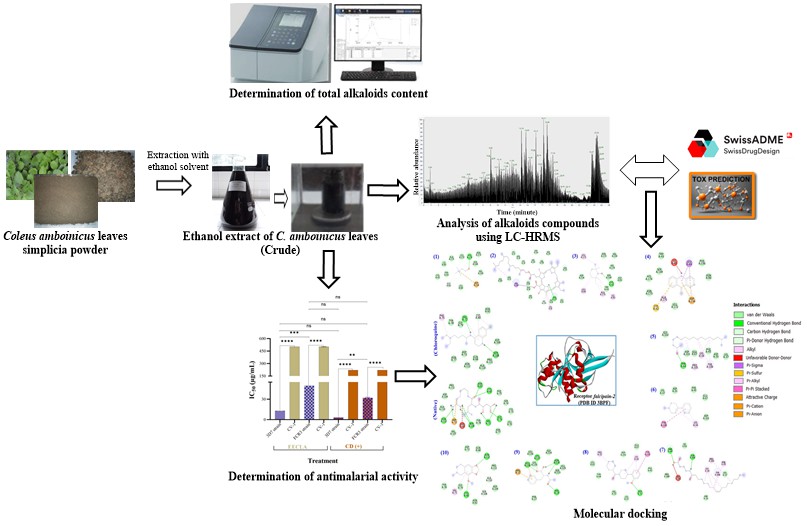
GRAPHICAL ABSTRACT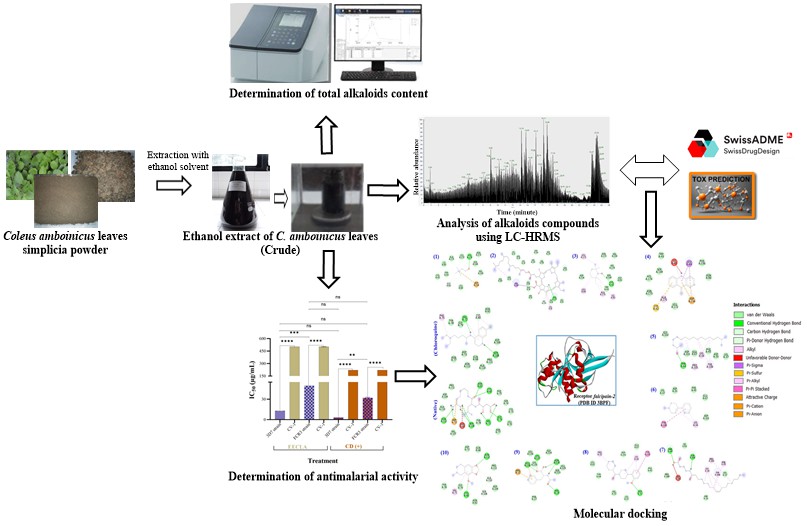
Downloads
References
KA Babatunde and OF Adenuga. Neutrophils in malaria: A double-edged sword role. Frontiers in Immunology 2022; 13, 1-9.
P Venkatesan. WHO world malaria report 2024. Lancet Microbe 2025; 6,101073.
Q Liu, W Jing, L Kang, J Liu and M Liu. Trends of the global, regional and national incidence of malaria in 204 countries from 1990 to 2019 and implications for malaria prevention. Journal of Travel Medicine 2021; 28(5), 045.
DJ Weiss, PA Dzianach, A Saddler, J Lubinda, A Browne, M McPhail, SF Rumisha, F Sanna, Y Gelaw, JB Kiss, S Hafsia, R Jayaseelen, HS Baggen, P Amratia, A Bertozzi-Villa, O Nesbit, J Whisnant, KE Battle, M Nguyen, KA Alene, …, PW Gething. Mapping the global prevalence, incidence, and mortality of Plasmodium falciparum and Plasmodium vivax malaria, 2000–22: A spatial and temporal modelling study. The Lancet 2025; 405(10483), 979-990.
L Gujjari, H Kalani, SK Pindiprolu, BP Arakareddy and G Yadagiri. Current challenges and nanotechnology-based pharmaceutical strategies for the treatment and control of malaria. Parasite Epidemiology and Control 2022; 17, 00244.
WE Nanda, K Gurning RT Swasono and W Haryadi. Bioactive compounds and antimalarial potential of sponge Aaptos suberitoides. Journal of Applied Pharmaceutical Science 2025; 15(4), 252-261.
W Haryadi, K Gurning, J Fachiroh and E Astuti. Potential of bioactive compounds in Coleus amboinicus, Lour., leaves against breast cancer by assessment using a network pharmacology approach and cytotoxic test. Journal of Multidisciplinary Applied Natural Science 2025; 5(1), 267-287.
K Gurning, G Primahana, E Astuti and W Haryadi. In Vitro cytotoxic and molecular docking studies of the network pharmacology approach from bioactive compounds of Coleus amboinicus leaves against lung and breast cancer cells. Advances in Pharmacological and Pharmaceutical Sciences 2025; 2025(1), 5946648.
K Gurning, W Haryadi and H Sastrohamidjojo. Isolation and characterization of antioxidant compounds of bangun-bangun (Coleus amboinicus, L.) leaves from north sumatera, Indonesia. RASĀYAN Journal of Chemistry (RJC) 2021; 14(1), 248-253.
F Laila, D Fardiaz, ND Yuliana, MRM Damanik and FNA Dewi. Methanol extract of Coleus amboinicus (Lour) exhibited antiproliferative activity and induced programmed cell death in colon cancer cell WiDr. International Journal of Food Science 2020; 2020(1), 9068326.
K Gurning and W Haryadi. Potential antioxidants of secondary metabolite isolates ethyl acetate fraction Coleus amboinicus Lour. Leaves. ScienceRise: Pharmaceutical Science 2022; 5(39), 100-105.
S Slusarczyk, A Cieslak, YR Yanza, M Szumacher-Strabel, Z Varadyova, M Stafiniak, D Wojnicz and A Matkowski. Phytochemical profile and antioxidant activities of Coleus amboinicus Lour. cultivated in Indonesia and Poland. Molecules 2021; 26(10), 2915.
P Astuti, DK Pratoko, R Rollando, GW Nigroho, S Wahyuono, T Hertiani and A Nurrochmad. Bioactivities of a major compound from Arthrinium rasikravindrae an endophytic fungus of Coleus amboinicus Lour. FABAD Journal of Pharmaceutical Sciences 2021; 46(1), 23-30.
PF Uzor. Alkaloids from plants with antimalarial activity: A review of recent studies. Evidence-Based Complementary and Alternative Medicine 2020; 2020(1), 8749083.
K Gurning, S Suratno, E Astuti and W Haryadi. Untargeted LC/HRMS metabolomics analysis and anticancer activity assay on MCF-7 and A549 cells from Coleus amboinicus Lour leaf extract. Iranian Journal of Pharmaceutical Research (IJPR) 2024; 23(1), 143494.
SP Sinaga, RFR Situmorang, N Singarimbun, W Lestari and K Gurning. Determination of total phytochemical compounds from ethanol extract nangka (Artocarpus heterophyllus Lam.) leaves and antioxidant activity from North Sumatera, Indonesia. RASĀYAN Journal of Chemistry (RJC) 2023; 16(1), 19-23.
IYB Tambunan, E Siringo-Ringo, MJ Butar-Butar and K Gurning. GC-MS analysis of bioactive compounds and antibacterial activity of nangka leaves (Artocarpus heterophyllus Lam). Pharmacia 2023; 70(1), 67-72.
K Gurning, RFR Situmorang, ET Sinaga, N Singarimbun, SP Sinaga and S Silaban. Determination of tannins content and antibacteria activity test of ethanol extract of sirih merah (Piper crocatum Ruiz and Pav.) leaf from North Sumatera Province Indonesia. Oriental Journal of Chemistry 2022; 38(4), 967-971.
RK Patel, JB Patel and PD Trivedi. Spectrophotometric method for the estimation of total alkaloids in the Tinospora Cordifolia M. and its herbal formulations. International Journal of Pharmacy and Pharmaceutical Science 2015; 7(10), 249-251.
H Yisak, M Redi-Abshiro, BS Chandravanshi. New fluorescence spectroscopic method for the simultaneous determination of alkaloids in aqueous extract of green coffee beans. Chemistry Central Journal 2018; 12(1), 59.
K Sridhar and AL Charles. In vitro antioxidant activity of Kyoho grape extracts in DPPH and ABTS assays: Estimation methods for EC50 using advanced statistical programs. Food Chemistry 2019; 275, 41-49.
DK Sari, DNW Hidayat, DR Fatmawati, S Triono, YS Kurniawan and J Jumina. Synthesis and antimalarial activity assay of C-Arylcalix[4]Pyrogallolarenes using Heme Polymerization Inhibition Activity (HPIA) method. Materials Science Forum 2022; 1061, 187-193.
SA Nisa, Jumina, MID Mardjan and YS Kurniawan. Synthesis, activity test and molecular docking of novel Nitrophenylcalix[4]-2-methylresorcinarene derivatives as antimalarial agent. Molekul 2023; 18(3), 404-413.
RR Putri, HD Pranowo, YS Kurniawan, HA Fatimi and J Jumina. Synthesis of Calix[4]resorcinarene derivatives as antimalarial agents through heme polymerization inhibition assay. Indonesian Journal of Chemistry 2023; 23(4), 1032-1041.
W Haryadi, K Gurning and E Astuti. Molecular target identification of two Coleus amboinicus leaf isolates toward lung cancer using a bioinformatic approach and molecular docking-based assessment. Journal of Applied Pharmaceutical Science 2024; 14(5), 203-210.
I Ahmad, Rissyelly, A Kurniawan and A Mun’Im. Screening of extraction method for alkaloid enrichment of Peperomia pellucida (L.) kunth. Asian Journal of Pharmaceutical and Clinical Research 2017; 10(7), 214-219.
S Bhambhani, KR Kondhare and AP Giri. Diversity in chemical structures and biological properties of plant alkaloids. Molecules 2021; 26(11), 3374.
T Sharma, R Gamit, R Acharya and VJ Shukla. Quantitative estimation of total tannin, alkaloid, phenolic, and flavonoid content of the root, leaf, and whole plant of Byttneria herbacea roxb. Journal of Research in Ayurveda 2023; 42(3), 143-147.
EP Gutierrez-Grijalva, LX Lopez-Martinez, LA Contreras-Angulo, CA Elizalde-Romero and JB Heredia. Plant alkaloids: Structures and bioactive properties. Plant-derived Bioactives 2020; 2020(1), 85-117.
GS Lima, NM Lima, JV Roque, DVA de Aguiar, JVA Oliveira, GF dos Santos, AR Chaves and BG Vaz. LC-HRMS/MS-based metabolomics approaches applied to the detection of antifungal compounds and a metabolic dynamic assessment of orchidaceae. Molecules 2022; 27(22), 7937.
C Aydogan. Recent advances and applications in LC-HRMS for food and plant natural products: A critical review. Analytical and Bioanalytical Chemistry 2020; 412(9), 1973-1991.
ML Pulung, RT Swasono, EN Sholikhah, R Yogaswara, G Primahana and TJ Raharjo. Antiplasmodial and metabolite profiling of Hyrtios sp. sponge extract from southeast sulawesi marine using LC-HRMS, molecular docking, pharmacokinetic, drug-likeness, toxicity, and molecular dynamics simulation. Journal of Multidisciplinary Applied Natural Science 2025; 5(2), 487-508.
S Bieber, T Letzel and A Kruve. Electrospray ionization efficiency predictions and analytical standard free quantification for SFC/ESI/HRMS. Journal of the American Society for Mass Spectrometry 2023; 34(7), 1511-1518.
M Ivanovic, D Grujic, J Cerar, MI Razborsek, L Topalic-Trivunovic, A Savic, D Kocar and M Kolar. Extraction of bioactive metabolites from Achillea millefolium L. with choline chloride based natural deep eutectic solvents: A study of the antioxidant and antimicrobial activity. Antioxidants 2022; 11(4), 724.
BS Baumel, PM Doraiswamy, M Sabbagh and R Wurtman. Potential neuroregenerative and neuroprotective effects of Uridine/Choline-Enriched multinutrient dietary intervention for mild cognitive impairment: A narrative review. Neurology and Therapy 2021; 10(1), 43-60.
S Duan, R Wang, R Wang, J Tang, X Xiao, N Li, W Guo, Q Yang, G Ren and S Zhang. In vivo antimalarial activity and pharmacokinetics of artelinic acid-choline derivative liposomes in rodents. Parasitology 2020; 147(1), 58-64.
Saraswati, PE Giriwono, D Iskandriati, CP Tan and N Andarwulan. In-vitro anti-inflammatory activity, free radical (DPPH) scavenging, and ferric reducing ability (FRAP) of Sargassum cristaefolium lipid-soluble fraction and putative identification of bioactive compounds using UHPLC-ESI-ORBITRAP-MS/MS. Food Research International 2020; 137, 109702.
HA Mohammed, MS Al-Omar, MZ El-Readi, AH Alhowail, MA Aldubayan and AAH Abdellatif. Formulation of ethyl cellulose microparticles incorporated pheophytin a isolated from Suaeda vermiculata for antioxidant and cytotoxic activities. Molecules 2019; 24(8), 1501.
JO Olanlokun, AB Owolabi, A Odedeyi, SO Oderinde, O Bodede, P Steenkamp, NA Koorbanally and OO Olorunsogo. Mechanism of antimalarial action and mitigation of infection-mediated mitochondrial dysfunction by phyto-constituents of Andrographis paniculata ((Burm f.) Wall. ex Nees) in Plasmodium berghei-infected mice. Journal of Ethnopharmacology 2024; 331, 118241.
U Khasanah, AF Shalas, BRP Ihsan, LAA Wulandari, NC Nurtyas, Waril, I Alipiani and UM Sholiha. Evaluation of selectivity index and phytoconstituents profile of various extracts from the stem of Strychnos lucida R. Br. as anti-malarial. Pharmacognosy Research 2023; 15(4), 733-750.
T Wiyono, A Frediansyah, EN Sholikhah and WR Pratiwi. UHPLC-ESI-MS analysis of Javanese Tamarindus indica leaves from various tropical zones and their beneficial properties in relation to antiobesity. Journal of Applied Pharmaceutical Science 2022; 12(8), 137-147.
H Kartikaningsih, N Fitriana, IL Anggraeni, B Semedi and MP Koentjoro. The potential of Sonneratia caseolaris mangrove leaves extract as a bioactive food ingredient using various water extract. F1000Research 2025; 13, 249.
M Kozurkova, D Sabolova and P Kristian. A new look at 9-substituted acridines with various biological activities. Journal of Applied Toxicology 2021; 41(1), 175-189.
P Varakumar, K Rajagopal, B Aparna, K Raman, G Byran, CMG Lima, S Rashid, MH Nafady, TB Emran and S Wybraniec. Acridine as an anti-tumour agent: A critical review. Molecules 2023; 28(1), 193.
M Garberova, I Potocnak, M Tvrdonova, M Majirska, M Bago-Pilatova, S Bekesova, A Kovac, P Takac, K Khiratkar, Z Kudlickova, J Elecko and M Vilkova. Derivatives incorporating acridine, pyrrole, and thiazolidine rings as promising antitumor agents. Molecules 2023; 28(18), 6616.
VM de Sousa, SS Duarte, DKF Silva, RC Ferreira, RO de Moura, MASP Segundo, D Farias, L Vieira, JCR Goncalves and MV Sobral. Cytotoxicity of a new spiro-acridine derivative: Modulation of cellular antioxidant state and induction of cell cycle arrest and apoptosis in HCT-116 colorectal carcinoma. Naunyn-Schmiedeberg's Archives of Pharmacology 2024; 397, 1901-1913.
R Tanvir, A Javeed and Y Rehman. Fatty acids and their amide derivatives from endophytes: New therapeutic possibilities from a hidden source. FEMS Microbiology Letters 2018; 365(12), 114.
MDLA Vieira and LH Rosa. Neotropical plant-associated endophytic fungi: A source of promising macromolecules for use in biotechnology. Neotropical Endophytic Fungi 2021; 2021(1), 297-319.
V Tounta, Y Liu, A Cheyne and G Larrouy-Maumus. Metabolomics in infectious diseases and drug discovery. Molecular Omics 2021; 17(3), 376-393.
H Yuca. Capsicum annuum L. Novel Drug Targets with Traditional Herbal Medicines 2022; 2022(1), 95-108.
P Perumal, D Chong, D Chong and D Chong. Pharmacological evaluation of green chilli in alzheimer’s disease. Pharmacognosy Research 2022; 14(1), 61-70.
HS Lim and G Park. Artemisinin protects dopaminergic neurons against 1-methyl-4-phenyl-1,2,3,6-tetrahydropyridine-induced neurotoxicity in a mouse model of Parkinson’s disease. Biomedicine & Pharmacotherapy 2024; 170(1), 115972.
Faheem, BK Kumar, KVGC Sekhar, S Chander, S Kunjiappan and S Murugesan. Medicinal chemistry perspectives of 1,2,3,4-tetrahydroisoquinoline analogs - Biological activities and SAR studies. RSC Advances 2021; 11(20), 12254-12287.
A Nora, DJC Hutabarat, HN Lioe, E Prangdimurti, M Rafi, H Saraswati and ND Yuliana. UHPLC-HRMS-based metabolomics and antioxidant compounds of culinary mushrooms grow in Indonesia. Journal of Food Measurement and Characterization 2025; 19, 4133-4146.
AS Anggraeni, LPM Alam, ID Utami, Y Khasanah, L Nurfahmi, IMP Noviana, A Windarsih and Suratno. Untargeted metabolomic LC-HRMS combined with chemometric reveal metabolites change from sorghum flakes affected by food processing. Case Studies in Chemical and Environmental Engineering 2025; 11, 101034.
T Kalita, A Choudhury, A Shakya, SK Ghosh, UP Singh and HR Bhat. A review on synthetic thiazole derivatives as an antimalarial agent. Current Drug Discovery Technologies 2024; 21(5), 240124226141.
J Javid, A ur‐Rehman, MA Abbasi, SZ Siddiqui, J Iqbal, NA Virk, S Rasool, HA Ali, M Ashraf, W Shahid, S Hussain and SAA Shah. Comparative conventional and microwave assisted synthesis of heterocyclic oxadiazole analogues having enzymatic inhibition potential. Journal of Heterocyclic Chemistry 2021; 58(1), 93-110.
F Appetecchia, S Consalvi, C Scarpecci, M Biava and G Poce. SAR analysis of small molecules interfering with energy-metabolism in Mycobacterium tuberculosis. Pharmaceuticals (Basel) 2020; 13(9), 227.
F Fauziah, D Dinni and A Bakhtra. LC-HRMS profile of chemical compounds in Penicillium citrinum XT6 extract. International Journal of Pharmaceutical Sciences and Medicine 2023; 8(6), 80-102.
NM Ammar, MO Kadry, ASA Elkarim, RS Ibrahim, IE Sallam, AENGEl Gendy, SM Afifi, T Esatbeyoglu, MA Farag and AI Elshamy. Amaranthus spinosus Linn. extract as an innovative strategy to regulate biomarkers for ovarian hyperthecosis via circular RNA (hsa-circ-0001577): Evidence from biochemical, metabolomics, histological, and phytochemical profiling. Food Science & Nutrition 2025; 13(5), 70314.
J Zhou, X Qin, S Zhou, KR MacKenzie and F Li. CYP3A-Mediated carbon–carbon bond cleavages in drug metabolism. Biomolecules 2024; 14(9), 1125.
F Nemati, AAB Asl and P Salehi. Synthesis and modification of noscapine derivatives as promising future anticancer agents. Bioorganic Chemistry 2024; 153, 107831.
Y Su, Z Wang, Y Yu and Q Zheng. Correlation between the redox activity of Polygonum multiflorum extract and its extraction technology with chinese liquor (Baijiu): An electrochemistry-based study. Heliyon 2022; 8(7), 09940.
A Nzila and L Mwai. In vitro selection of Plasmodium falciparum drug-resistant parasite lines. Journal of Antimicrobial Chemotherapy 2010; 65(3), 390-398.
GED Souza, RV Bueno, JO De Souza, CL Zanini, FC Cruz, G Oliva, RVC Guido and ACC Aguiar. Antiplasmodial profile of selected compounds from malaria box: In vitro evaluation, speed of action and drug combination studies. Malaria Journal 2019; 18, 447.
AR Hidayati, A Widyawaruyanti, H Ilmi, M Tanjung, T Widiandani, Siswandono, D Syafruddin and AF Hafid. Antimalarial activity of flavonoid compound isolated from leaves of Artocarpus altilis. Pharmacognosy Journal 2020; 12(4), 835-842.
R Yogaswara, HD Pranowo, N Prasetyo and ML Pulung. Investigation of new 4-benzyloxy-2-trichloromethylquinazoline derivatives as plasmodium falciparum dihydrofolate reductase-thymidylate synthase inhibitors: qsar, adme, drug-likeness, toxicity, molecular docking and molecular dynamics simulation. Journal of Multidisciplinary Applied Natural Science 2025; 5(2), 456-486.
AK Ganguly, G Verma and NS Bhavesh. The N-terminal RNA recognition motif of PFSR1 confers semi-specificity for pyrimidines during RNA recognition. Journal of Molecular Biology 2019; 431(3), 498-510.
YS Kurniawan, Harizal, N Fatmasari, E Yudha, Jumina, HD Pranowo and EN Sholikhah. Rational design of chlorinated hydroxyxanthone as anticancer agent: Molecular docking, molecular dynamic simulation, admet, one-pot synthesis, and in vitro evaluation. Cell Biochemistry and Biophysics 2025; 83, 4679-4693.
Published
How to Cite
Issue
Section
License
Copyright (c) 2025 Walailak University

This work is licensed under a Creative Commons Attribution-NonCommercial-NoDerivatives 4.0 International License.





