
Herbal Multi-Target Strategy Against Ovarian Cancer: In Silico Evaluation of Elephantopus scaber Phytoconstituents Targeting PI3K, BCL-2, and VEGFR-2
DOI:
https://doi.org/10.48048/tis.2026.13057Keywords:
Elephantopus scaber, BCL2, Ovarian cancer, Molecular docking, PI3K, VEGFR-2, In silico, PhytochemicalsAbstract
Ovarian cancer continues to be one of the deadliest gynecologic cancers, mainly due to delayed diagnosis and treatment resistance. For the treatment of ovarian cancer, a multi-target therapeutic approach that targets key signaling pathways, including PI3K-mediated cell survival, BCL-2-regulated apoptosis, and VEGFR-2-driven angiogenesis, is considered promising. Therefore, using an in silico approach targeting VEGFR-2, BCL-2, and PI3K, this work sought to explore the anticancer potential of phytochemical compounds from the Elephantopus scaber L. extract. After identifying bioactive chemicals from E. scaber by LC-HRMS analysis, AutoDock Vina was used to perform molecular docking against VEGFR-2, BCL-2, and PI3K. SwissADME was used to predict drug-likeness and pharmacokinetic properties, and pkCSM was used to investigate toxicity profiles. Several compounds from the E. scaber extract exhibited substantial binding affinities for the selected targets, as determined by molecular docking. Genistin (−10.1 kcal/mol), apigenin-7-O-glucuronide (−9.9 kcal/mol), and luteolin (−9.6 kcal/mol) demonstrated stronger interactions with VEGFR-2 than the reference inhibitor nintedanib (−7.0 kcal/mol). Additionally, apigenin-7-O-glucuronide had a greater affinity for binding BCL-2 (−7.5 kcal/mol) than obatoclax (−6.8 kcal/mol). While slightly weaker than alpelisib (−10.5 kcal/mol), apigenin-7-O-glucuronide (−9.7 kcal/mol), genistin (−9.3 kcal/mol), and scutellarin (−9.2 kcal/mol) showed the most advantageous contacts in PI3K docking. Most selected compounds fulfilled drug-likeness criteria and displayed low predicted toxicity. The findings highlight E. scaber as a promising source of multi-target anticancer phytochemicals, with apigenin-7-O-glucuronide and genistin emerging as the most potent candidates for further experimental validation.
HIGHLIGHTS
- Apigenin-7-O-glucuronide and genistin showed stronger binding affinities than reference inhibitors toward VEGFR-2 and BCL-2
- Key phytoconstituents demonstrated stable interactions with PI3K, supporting their role in inhibiting survival signaling pathways
- Drug-likeness, pharmacokinetic, and toxicity predictions indicated favorable safety and bioavailability profiles for selected compounds.
- scaber can be considered as a promising source of multi-target herbal candidates for ovarian cancer therapy.
GRAPHICAL ABSTRACT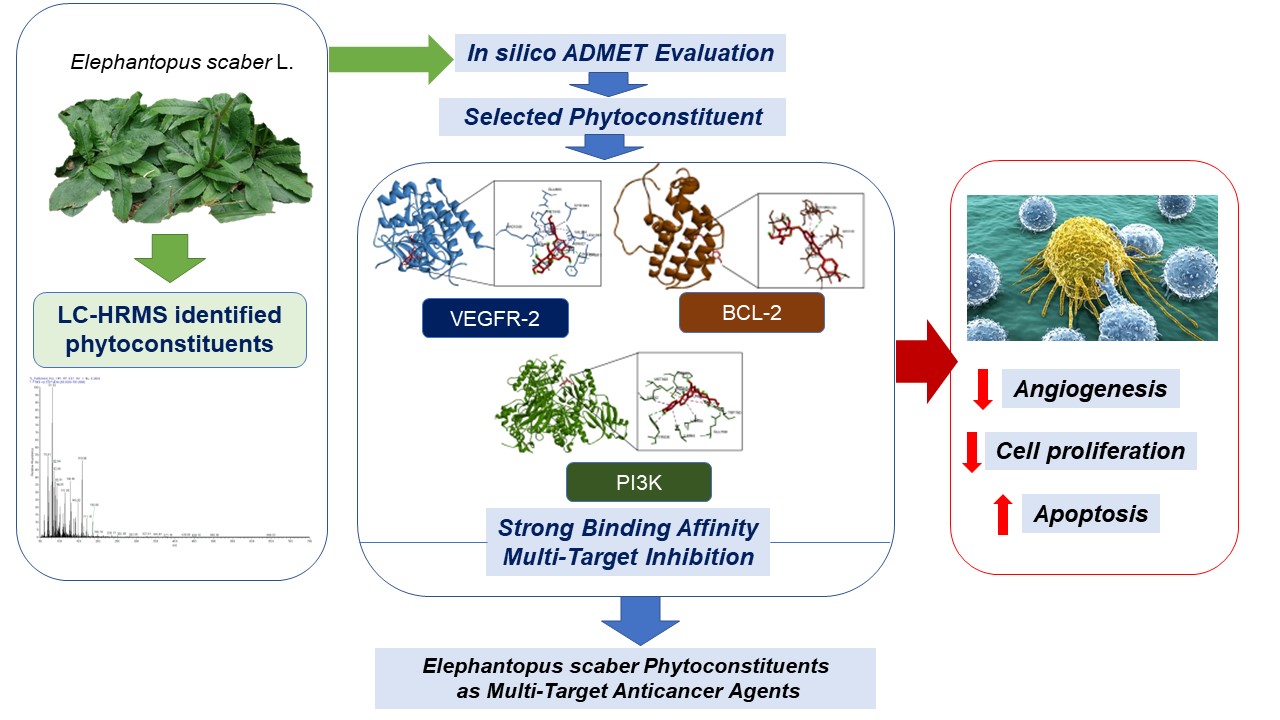
Downloads
References
MK Hong and DC Ding. Early diagnosis of ovarian cancer: A comprehensive review of the advances, challenges, and future directions. Diagnostics 2025; 15(4), 406.
VM Ettorre, A AlAshqar, N Sethi and AD Santin. Personalized treatment in ovarian cancer: A review of disease monitoring, biomarker expression, and targeted treatments for advanced, recurrent ovarian cancers. Cancers 2025; 17(11), 1822.
World Ovarian Cancer Coalition. Ovarian Cancer Data Briefing 2024. Available at: https://worldovariancancercoalition.org/wp-content/uploads/2024/04/2024-Global-Priority.pdf, accessed December 2025.
Globocan. Estimated number of new cases from 2022 to 2050, Incidence, Both sexes, age [0-85+]. Globocan 2022 (version 1.1) - 08.02.2024. International Agency for Research on Cancer (IARC) 2022. Available at: https://gco.iarc.fr/tomorrow/en/dataviz/tables?cancers=25&single_unit=10000&years=2050, accessed December 2025.
The International Association for Cryptologic Research. Data visualization tools for exploring the global cancer burden in 2022. Available at: https://gco.iarc.who.int/today, accessed December 2025.
S Linus-Lojikip, V Subramaniam, L Wei-Yin Lim and H Amar-Singh. Survival of patients with advanced and recurrent ovarian cancer treated using integrative medicine in Malaysia: A case series. Complementary Therapies in Clinical Practice 2019; 37, 73.
C Lliberos, G Richardson and A Papa. Oncogenic pathways and targeted therapies in ovarian cancer. Biomolecules 2024; 14(5), 585.
YI Christina, M Rifa’i, N Widodo and MS Djati The combination of Elephantopus scaber and Phaleria macrocarpa leaf extracts promotes anticancer activity via downregulation of ER-α, Nrf2, and the PI3K/AKT/mTOR pathway. Journal of Ayurveda and Integrative Medicine 2022; 13(4), 100674.
MDT Hossain and MdA Hossain. Targeting PI3K in cancer treatment: A comprehensive review with insights from clinical outcomes. European Journal of Pharmacology 2025; 996, 177432.
TT Huang, EJ Lampert, C Coots and JM Lee. Targeting the PI3K pathway and DNA damage response as a therapeutic strategy in ovarian cancer. Cancer Treatment Reviews 2020; 86, 102021.
M Vogler, Y Braun, VM Smith, MA Westhoff, RS Pereira, NM Pieper, M Anders, M Callens, T Vervliet, M Abbas, S Macip, R Schmid, G Bultynck and MJ Dyer. The BCL2 family: From apoptosis mechanisms to new advances in targeted therapy. Signal Transduction and Targeted Therapy 2025; 10, 91
FH Shah, YS Nam, JY Bang, IS Hwang, DH Kim, M Ki and HW Lee. Targeting vascular endothelial growth receptor-2 (VEGFR-2): Structural biology, functional insights, and therapeutic resistance. Archives of Pharmacal Research 2025; 48(5), 404.
MS Djati and YI Christina. Traditional Indonesian rempah-rempah as a modern functional food and herbal medicine. Functional Foods in Health and Disease 2019; 9(4), 241-264.
MS Djati, YI Christina and M Rifa’i. The combination of Elephantopus scaber and Sauropus androgynus promotes erythroid lineages and modulates follicle-stimulating hormone and luteinizing hormone levels in pregnant mice infected with Escherichia coli. Veterinary World 2021; 14(5), 1398-1404.
FA Kabeer, DS Rajalekshmi, MS Nair, R Prathapan. In vitro and in vivo antitumor activity of deoxyelephantopin from a potential medicinal plant Elephantopus scaber against Ehrlich ascites carcinoma. Biocatalysis and Agricultural Biotechnology 2019; 19, 101106.
CK Chan, G Chan, K Awang and HA Kadir. Deoxyelephantopin from Elephantopus scaber inhibits HCT116 human colorectal carcinoma cell growth through apoptosis and cell cycle arrest. Molecules 2016; 21(3), 385.
YI Christina, W Nafisah, MF Atho’Illah, M Rifa’i, N Widodo and MS Djati. Anti-breast cancer potential activity of Phaleria macrocarpa (Scheff.) Boerl. leaf extract through in silico studies. Journal of Pharmacy & Pharmacognosy Research 2021; 9(6), 824-845.
AE Alghoull, SR Firdausi, YI Christina, S Widyarti, M Rifa’i and MS Djati. Evaluating the efficacy of ethanolic extract of Tapak Liman (Elephantopus scaber L.) leaf in inhibiting pulmonary fibrosis: Mechanisms through anti-fibrotic cytokine promotion. Open Veterinary Journal 2025; 15(1), 118-125.
S Pellacani, C Citti, L Strani, B Benedetti, PP Becchi, V Pizzamiglio, S Michelini, G Cannazza, ADE Juan, M Cocchi and C Durante. Comparative analysis of features extraction protocols for LC-HRMS untargeted metabolomics in mountain cheese ‘identitation’. Microchemical Journal 2024; 207, 111863.
W Nafisah, F Fatchiyah, MH Widyananda, YI Christina, M Rifa’i, N Widodo and MS Djati. Potential of bioactive compound of Cyperus rotundus L. rhizome extract as inhibitor of PD-L1/PD-1 interaction: An in silico study. Agriculture and Natural Resources 2022; 56(4), 751-760.
MH Widyananda, ST Wicaksono, K Rahmawati, S Puspitarini, SM Ulfa, YD Jatmiko, M Masruri and N Widodo. A potential anticancer mechanism of finger root (Boesenbergia rotunda) extracts against a breast cancer cell line. Scientifica 2022; 2022, 9130252.
LK Muharrami, M Santoso and S Fatmawati. Chemical profiles, in silico pharmacokinetic and toxicity prediction of bioactive compounds from Boesenbergia rotunda. Case Studies in Chemical and Environmental Engineering 2024; 10, 100992.
A Shofiah, YI Christina, DR Dwijayanti, A Soewondo, N Widodo and MS Djati. Exploring the inflammatory pathway modulation of Phaleria macrocarpa: Evidence from in vitro and in silico studies. Pharmacia 2025; 72, 1-14.
SH Abdullahi, AT Moin, A Uzairu, AB Umar, MT Ibrahim, MT Usman, N Nawal, I Bayil and T Zubair. Molecular docking studies of some benzoxazole and benzothiazole derivatives as VEGFR-2 target inhibitors: In silico design, MD simulation, pharmacokinetics and DFT studies. Intelligent Pharmacy 2024; 2(2), 232-250.
C Kirubhanand, J Selvaraj, UV Rekha, V Vishnupriya, V Sivabalan, M Manikannan, D Nalini, P Vijayalakshmi, M Rajalakshmi and R Ponnulakshmi. Molecular docking analysis of Bcl-2 with phyto-compounds. Bioinformation 2020; 16(6), 468-473.
X Liu, S Yang, JR Hart, Y Xu, X Zou, H Zhang, Q Zhou, T Xia, Y Zhang, D Yang, M Wang and PK Vogt. Cryo-EM structures of PI3Kα reveal conformational changes during inhibition and activation. Proceedings of the National Academy of Sciences 2021; 118(45), e2109327118,
MH Widyananda, N Rosyada, L Muflikhah, N Widodo, DR Dwijayanti and SM Ulfa. Lagerstroemin from Lagerstroemia speciosa as antibreast cancer candidate targeting AURKA, EGFR and SRC Protein: A comprehensive computational study. Trends in Sciences 2024; 21(10), 8205.
MH Widyananda, F Fatchiyah, L Muflikhah, SM Ulfa and N Widodo. Computational examination to reveal Kaempferol as the most potent active compound from Euphorbia hirta against breast cancer by targeting AKT1 and ERα. Egyptian Journal of Basic and Applied Sciences 2023; 10(1), 753-767.
HS Tuli, P Rath, A Chauhan, K Sak, D Aggarwal, R Choudhary, U Sharma, K Vashishth, S Sharma, M Kumar, V Yadav, T Singh, MB Yerer and S Haque. Luteolin, a potent anticancer compound: From chemistry to cellular interactions and synergetic perspectives. Cancers 2022; 14(21), 5373.
K Mogi, Y Koya, M Yoshihara, M Sugiyama, R Miki, E Miyamoto, H Fujimoto, K Kitami, S Iyoshi, S Tano, K Uno, S Tamauchi, A Yokoi, Y Shimizu, Y Ikeda, N Yoshikawa, K Niimi, Y Yamakita, H Tomita, K Shibata, A Nawa, Y Tomoda and H Kajiyama. 9-oxo-ODAs suppresses the proliferation of human cervical cancer cells through the inhibition of CDKs and HPV oncoproteins. Scientific Reports 2023; 13(1), 19208.
M Redka, S Baumgart, D Kupczyk, T Kosmalski and R Studzińska. Lipophilic studies and in silico ADME profiling of biologically active 2-Aminothiazol-4(5H)-one derivatives. International Journal of Molecular Sciences 2023; 24(15), 12230.
S Chander, CR Tang, HM Al-Maqtari, J Jamalis, A Penta, TB Hadda, HM Sirat, YT Zheng and M Sankaranarayanan. Synthesis and study of anti-HIV-1 RT activity of 5-benzoyl-4-methyl-1,3,4,5-tetrahydro-2H-1,5-benzodiazepin-2-one derivatives. Bioorganic Chemistry 2017; 72, 74-79.
LZ Benet, CM Hosey, O Ursu and TI Oprea. BDDCS, the Rule of 5 and drugability. Advanced Drug Delivery Reviews 2016; 101, 89-98.
ANS Kamble and AA Mitkar. Swiss ADME predictions of pharmacokinetics and drug-likeness properties of secondary metabolites present in Trigonella foenum-graecum. Journal of Pharmacognosy and Phytochemistry 2023; 12(5), 341-349.
S Yan, S Xue, T Wang, R Gao, H Zeng, Q Wang and X Jia. Efficacy and safety of nintedanib in patients with non-small cell lung cancer, and novel insights in radiation-induced lung toxicity. Frontiers in Oncology 2023; 13, 1086214.
J Li, J Xu and Z Li. Obatoclax, the pan-Bcl-2 inhibitor sensitizes hepatocellular carcinoma cells to promote the anti-tumor efficacy in combination with immune checkpoint blockade. Translational Oncology 2021; 14, 101116.
F André, E Ciruelos, G Rubovszky, M Campone, S Loibl, HS Rugo, H Iwata, P Conte, IA Mayer, B Kaufman, T Yamashita, L Yen-Shen, K Inoue, M Takahashi, Z Pápai, L Anne-Sophie, D Mills, C Wilke, S Hirawat, D Juric and SOLAR-1 Study Group. Alpelisib for PIK3CA-Mutated, hormone receptor-positive advanced breast cancer. The New England Journal of Medicine 2019; 380(20), 1929-1940.
J Zeng, Q Deng, Z Chen, S Yan, Q Dong, Y Zhang, Y Cui, L Li, Y He and J Shi. Recent development of VEGFR small molecule inhibitors as anticancer agents: A patent review (2021 - 2023). Bioorganic Chemistry 2024; 146, 107278.
Z Amiri, M Bayat and D Gheidari. Synthesis of thiazoloquinolinone derivatives: Molecular docking, MD simulation, and pharmacological evaluation as VEGFR-2 inhibitors. BMC Chemistry 2025; 19, 90.
Z Javed, K Khan, J Herrera-Bravo, S Naeem, MJ Iqbal, H Sadia, QR Qadri, S Raza, A Irshad, A Akbar, Ž Reiner, A Al-Harrasi, A Al-Rawahi, D Satmbekova, M Butnariu, IC Bagiu, RV Bagiu and J Sharifi-Rad. Genistein as a regulator of signaling pathways and microRNAs in different types of cancers. Cancer Cell International 2021; 21, 388.
S D’Aguanno and DD Bufalo. Inhibition of anti-apoptotic Bcl-2 proteins in preclinical and clinical studies: Current overview in cancer. Cells 2020; 9(5), 1287.
MM Liu, RH Ma, ZJ Ni, K Thakur, CL Cespedes-Acuña, L Jiang and ZJ Wei. Apigenin 7-O-glucoside promotes cell apoptosis through the PTEN/PI3K/AKT pathway and inhibits cell migration in cervical cancer HeLa cells. Food and Chemical Toxicology 2020; 146, 111843.
IM Bastos, S Rebelo and VLM Silva. A comprehensive review on phosphatidylinositol-3-kinase (PI3K) and its inhibitors bearing pyrazole or indazole core for cancer therapy. Chemico-Biological Interactions 2024; 398, 111073.
C Chen, S Zhong, H Wu, J Ge and Q Wang. Apigenin-7-glucoside induces apoptosis and ROS accumulation in lung cancer cells, and inhibits PI3K/Akt/mTOR pathway. Tropical Journal of Pharmaceutical Research 2023; 22(5), 937-943.
N Kumar, D Sood, R Tomar and R Chandra. Antimicrobial peptide designing and optimization employing large-scale flexibility analysis of protein-peptide fragments. ACS Omega 2019; 4(25), 21370-21380.
TL Wargasetia, H Ratnawati, N Widodo and MH Widyananda. Bioinformatics study of sea cucumber peptides as antibreast cancer through inhibiting the activity of overexpressed protein (EGFR, PI3K, AKT1, and CDK4). Cancer Informatics 2021; 20, 117693512110318.
Published
How to Cite
Issue
Section
License
Copyright (c) 2026 Walailak University

This work is licensed under a Creative Commons Attribution-NonCommercial-NoDerivatives 4.0 International License.





