
Salacca zalacca Skin as a Potential Adjuvant for Metabolic Syndrome Therapy: Integrative In Vitro and Computational Approaches
DOI:
https://doi.org/10.48048/tis.2025.10678Keywords:
Salacca zalacca skin; Metabolic syndrome; Metabolomic; in vitro; in silicoAbstract
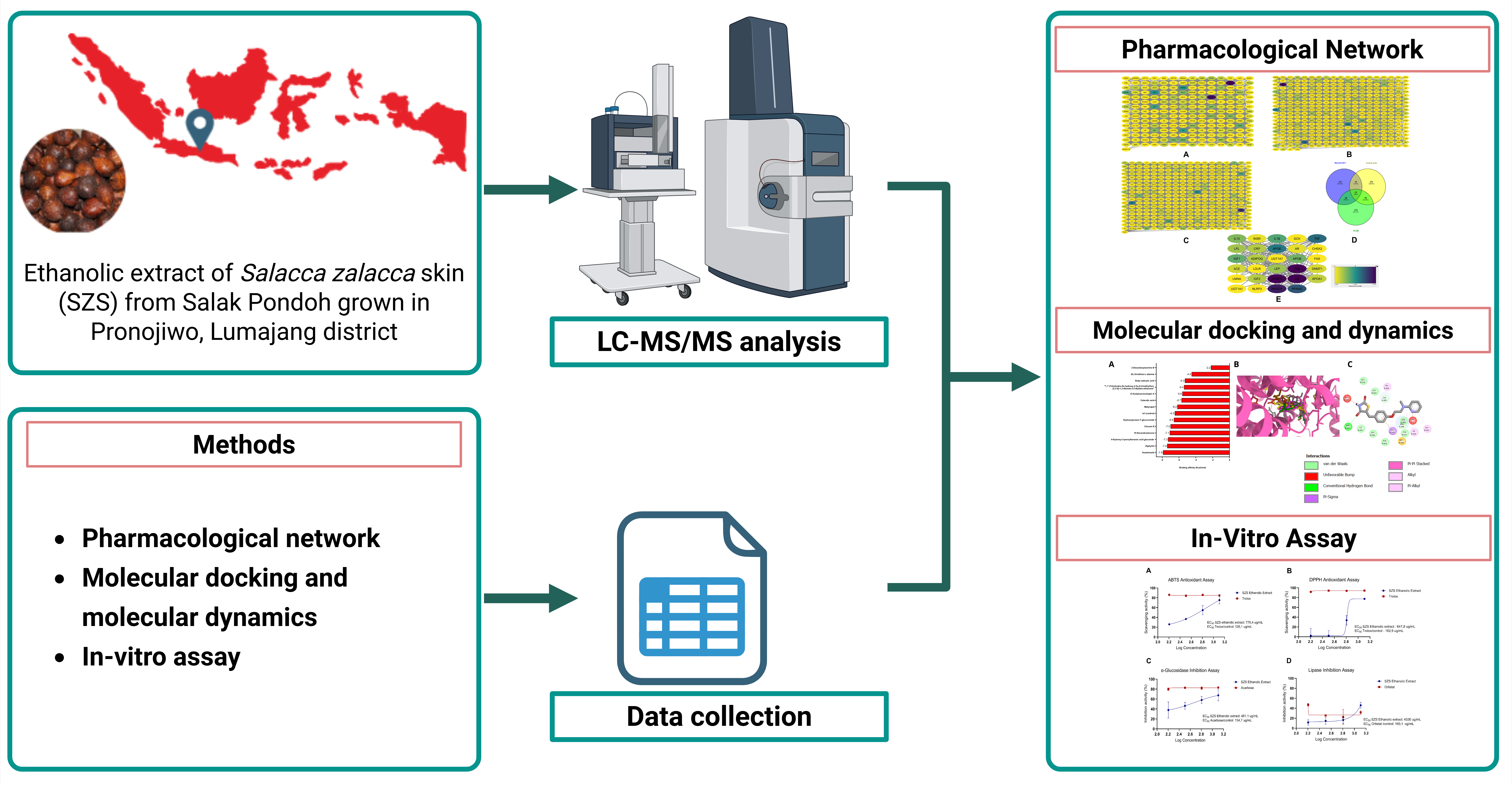
Metabolic syndrome (MetS) remains a health concern condition characterized by hyperglycemia, obesity, and hypertension, requiring effective interventions such as antioxidant support and inhibition of digestive enzymes. Salacca zalacca skin (SZS), traditionally used for its antioxidant, anti-inflammatory, and lipid-lowering properties, shows promise in addressing MetS, though its molecular mechanisms remain underexplored. This study evaluated the potential of ethanol extract of SZS in managing MetS through in vitro and in silico approaches. LC-MS/MS analysis identified 16 bioactive compounds. Network pharmacology and molecular docking revealed that diphyllin, 19-norandosterone, and anastrozole exhibited strong and stable binding affinities to MetS-related targets: TNF-α (−6.7, –6.6, and –6.1 kcal/mol) and PPARG (−7.4, –7.1, and –7.9 kcal/mol), supported by molecular dynamics simulations. Antioxidant assays demonstrated moderate activity, with EC₅₀ values of 776.4 µg/mL (ABTS) and 647.8 µg/mL (DPPH). SZS inhibited lipase (EC₅₀ = 4,330 µg/mL) and α-glucosidase (EC₅₀ = 481.1 µg/mL), indicating its potential to regulate lipid and glucose metabolism. These findings suggest that SZS may exert multi-targeted effects by scavenging free radicals, inhibiting digestive enzymes, and modulating inflammatory and metabolic pathways. This study is the 1st to integrate in vitro and in silico evidence for SZS in MetS management, laying the groundwork for its development as a nutraceutical. Future research should focus on formulation refinement, compound synergy, and long-term clinical validation.
HIGHLIGHTS
- Sixteen bioactive compounds from SZS identified via LC-MS/MS Q-ToF.
- Dyphyllin shows strong and stable binding to TNF-α and PPARG proteins.
- The enhanced antioxidant activity of SZS, along with its ability to inhibit lipase and α-glucosidase, suggests a potential role in modulating and managing metabolic syndrome (MetS).
- SZS demonstrates potential as an adjuvant agent, with the ability to synergize with existing metabolic syndrome (MetS) therapies to enhance disease management and therapeutic outcomes.
GRAPHICAL ABSTRACT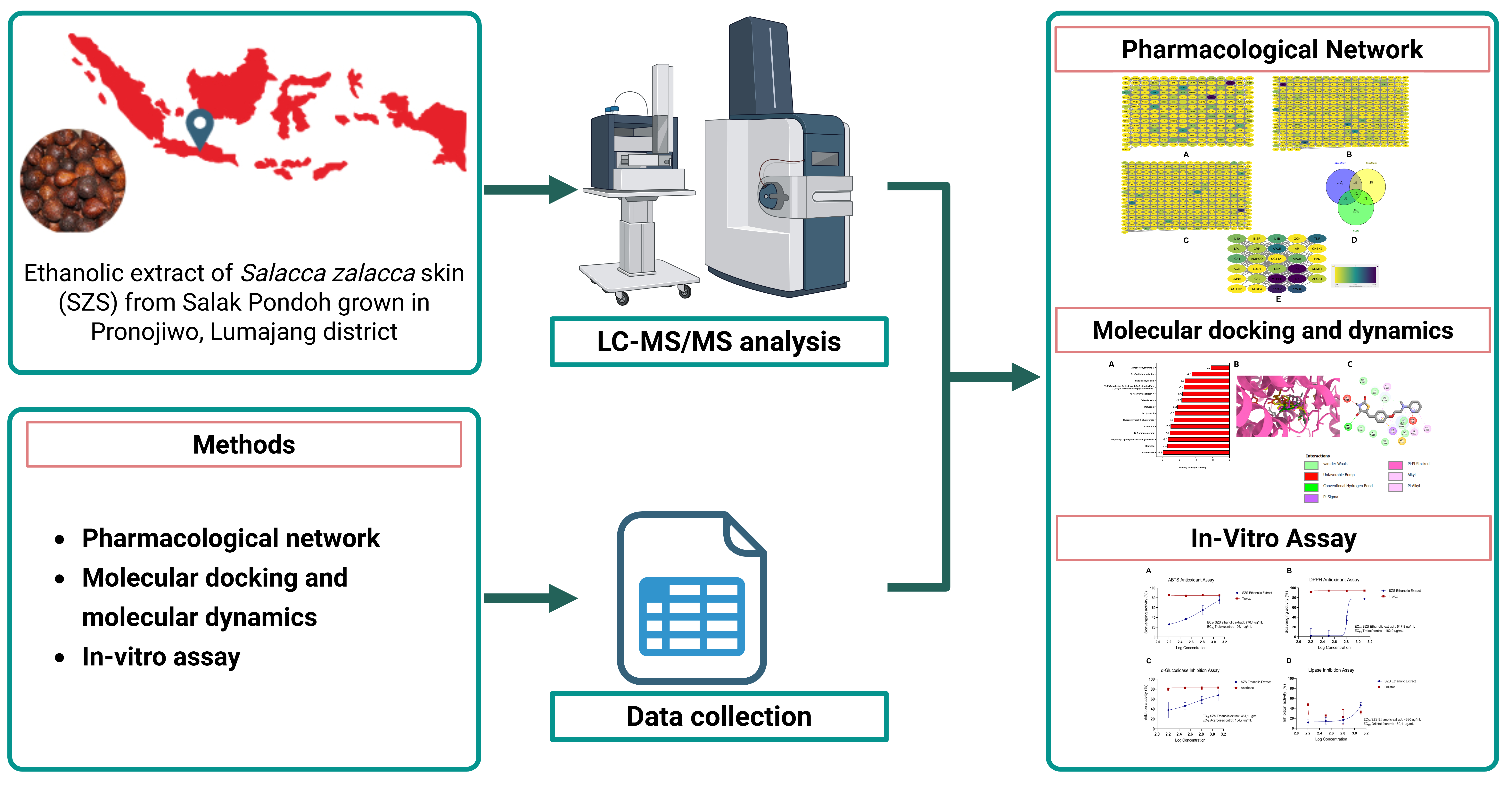
Downloads
References
HH Wang, DK Lee, M Liu, P Portincasa and DQH Wang. Novel insights into the pathogenesis and management of the metabolic syndrome. Pediatric Gastroenterology, Hepatology & Nutrition 2020; 23(3), 189-230.
EH Herningtyas and TS Ng. Prevalence and distribution of metabolic syndrome and its components among provinces and ethnic groups in Indonesia. BMC Public Health 2019; 19(1), 377.
G Hirode and RJ Wong. Trends in the prevalence of metabolic syndrome in the United States, 2011-2016. JAMA 2020; 323(24), 2526-2528.
S Uddin, PR Brooks and TD Tran. Chemical characterization, α-glucosidase, α-amylase and lipase inhibitory properties of the Australian honey bee propolis. Foods 2022; 11(13), 1964.
M Hawash, N Jaradat, S Shekfeh, M Abualhasan, AM Eid and L Issa. Molecular docking, chemo-informatic properties, alpha-amylase, and lipase inhibition studies of benzodioxol derivatives. BMC Chemistry 2021; 15, 40.
JK Sethi and GS Hotamisligil. Metabolic messengers: Tumour necrosis factor. Nature Metabolism 2021; 3(10), 1302-1312.
M Botta, M Audano, A Sahebkar, CR Sirtori, N Mitro and M Ruscica. PPAR agonists and metabolic syndrome: An established role? nternational Journal of Molecular Sciences 2018; 19(4), 1197.
Q Haguet, FL Joubioux, V Chavanelle, H Groult, N Schoonjans, C Langhi, A Michaux, YF Otero, N Boisseau, SL Peltier, P Sirvent and T Maugard. Inhibitory potential of α-amylase, α-glucosidase, and pancreatic lipase by a formulation of five plant extracts: TOTUM-63. International Journal of Molecular Sciences 2023; 24(4), 3652.
MM Algandaby. Crocin prevents metabolic syndrome in rats via enhancing PPAR-gamma and AMPK. Saudi Journal of Biological Sciences 2020; 27(5), 1310-1316.
E Girsang, INE Lister, CN Ginting, A Khu, B Samin, W Widowati, S Wibowo and R Rizal. Chemical constituents of snake fruit (Salacca zalacca (gaert.) voss) peel and in silico anti-aging analysis. Molecular and Cellular Biomedical Sciences 2019; 3(2), 122-128.
M Kanlayavattanakul, N Lourith, D Ospondpant, U Ruktanonchai, S Pongpunyayuen and C Chansriniyom. Salak plum peel extract as a safe and efficient antioxidant appraisal for cosmetics. Bioscience, Biotechnology, and Biochemistry 2013; 77(5), 1068-1074.
M Marzuki, E Girsang, AN Nasution and INE Lister. Anti-diabetic effect of snake fruit skin extract in alloxan-induced Wistar rat. International Journal of Health and Pharmaceutical 2022; 3(1), 146-153.
S Utami, MFR Syaban, DY Putri, VAG Hose, H Khotimah and Y Yueniwati. Bioinformatics examination of quercetin from Salacca zalacca skin, fruit, and seed as a potent active compounds against hypercholesterolemia via PCSK9 inhibition. Trends in Science 2025; 22(4), 9237.
A Daina, O Michielin and V Zoete. SwissADME: A free web tool to evaluate pharmacokinetics, drug-likeness and medicinal chemistry friendliness of small molecules. Scientific Reports 2017; 7(1), 42717.
MFR Syaban, RF Muhammad, B Adnani, GFA Putra, NE Erwan, SD Arviana, AD Krisnayana and DB Kurniawan. Molecular docking studies of interaction curcumin against beta-secretase 1, amyloid A4 Protein, gamma-secretase and glycogen synthase kinase-3β as target therapy for Alzheimer disease. Research Journal of Pharmacy and Technology 2022; 15(7), 3069-3074.
DA Filimonov, AA Lagunin, TA Gloriozova, AV Rudik, DS Druzhilovskii, PV Pogodin and VV Poroikov. Prediction of the biological activity spectra of organic compounds using the pass online web resource. Chemistry of Heterocyclic Compounds 2014; 50(3), 444-457.
AL Lomize and ID Pogozheva. Physics-based method for modeling passive membrane permeability and translocation pathways of bioactive molecules. Journal of Chemical Information and Modeling 2019; 59(7), 3198-3213.
EF Pettersen, TD Goddard, CC Huang, EC Meng, GS Couch, TI Croll, JH Morris and TE Ferrin. UCSF CHIMERAX: Structure visualization for researchers, educators, and developers. Protein Science 2021; 30(1), 70-82.
W Luo, J Deng, J He, L Yin, R You, L Zhang, J Shen, Z Han, F Xie, J He and Y Guan. Integration of molecular docking, molecular dynamics and network pharmacology to explore the multi-target pharmacology of fenugreek against diabetes. Journal of Cellular and Molecular Medicine 2023; 27(14), 1959-1974.
O Daoui, S Elkhattabi and S Chtita. Rational design of novel pyridine-based drugs candidates for lymphoma therapy. Journal of Molecular Structure 2022; 1270, 133964.
SD Arviana, Y Yueniwati, M Rahayu and MFR Syaban. 7,8-dihydroxyflavone as a neuroprotective agent in ischemic stroke through the regulation of HIF-1α protein. Research Journal of Pharmacy and Technology 2022; 15(9), 3980-3986.
EC Meng, TD Goddard, EF Pettersen, GS Couch, ZJ Pearson, JH Morris and TE Ferrin. UCSF ChimeraX: Tools for structure building and analysis. Protein Science 2023; 32(11), e4792.
Wahono CS, Syaban MFR, Pratama MZ, et al. Exploring the potential of phytoconstituents from Phaseolus vulgaris L against C-X-C motif chemokine receptor 4 (CXCR4): A bioinformatic and molecular dynamic simulations approach. Egyptian Journal of Medical Human Genetics 2024; 25(1), 52.
DVD Spoel, E Lindahl, B Hess, G Groenhof, AE Mark and HJC Berendsen. GROMACS: Fast, flexible, and free. Journal of Computational Chemistry 2005; 26(16), 1701-1718.
M Yang, Z Bo, T Xu, B Xu, D Wang and H Zheng. Uni-GBSA: An open-source and web-based automatic workflow to perform MM/GB(PB)SA calculations for virtual screening. Briefings in Bioinformatics 2023; 24(4), bbad218.
MS Valdés-Tresanco, ME Valdés-Tresanco, PA Valiente and E Moreno. gmx_MMPBSA: A new tool to perform end-state free energy calculations with GROMACS. Journal of Chemical Theory and Computation 2021; 17(10), 6281-6291.
T Shimamura, Y Sumikura, T Yamazaki, A Tada, T Kashiwagi, H Ishikawa, T Matsui, N Sugimoto, H Akiyama and H Ukeda. Applicability of the DPPH assay for evaluating the antioxidant capacity of food additives - inter-laboratory evaluation study. Analytical Sciences 2014; 30(7), 717-721.
F Nurkolis, Hardinsyah, VM Yusuf, M Yusuf, RJ Kusuma, WB Gunawan, IW Hendra, S Radu, NA Taslim, N Mayulu, N Sabrina, A Tsopmo, R Kurniawan, CF Theodorea, E Idrus and TE Tallei. Metabolomic profiling, in vitro antioxidant and cytotoxicity properties of caulerpa racemosa: Functional food of the future from algae. Europe PMC. 2024. https://doi.org/10.21203/rs.3.rs-2158307/v2
J Unuofin, G Otunola and A Afolayan. In vitro α-amylase, α-glucosidase, lipase inhibitory and cytotoxic activities of tuber extracts of Kedrostis africana (L.) Cogn. Heliyon 2018; 4(9), e00810.
HK Permatasari, F Nurkolis, WB Gunawan, VM Yusuf, M Yusuf, RJ Kusuma, N Sabrina, FR Muharram, NA Taslim, N Mayulu, SC Batubara, M Samtiya, H Hardinsyah and A Tsopmo. Modulation of gut microbiota and markers of metabolic syndrome in mice on cholesterol and fat enriched diet by butterfly pea flower kombucha. Current Research in Food Science 2022; 5(7), 1251-1265.
AS Marchev, LV Vasileva, KM Amirova, MS Savova, ZP Balcheva-Sivenova and MI Georgiev. Metabolomics and health: from nutritional crops and plant-based pharmaceuticals to profiling of human biofluids. Cellular and Molecular Life Sciences 2021; 78(19-20), 6487-6503.
JL Wolfender, G Marti, A Thomas and S Bertrand. Current approaches and challenges for the metabolite profiling of complex natural extracts. Journal of Chromatography A 2015; 1382, 136-164.
J Dai and RJ Mumper. Plant phenolics: Extraction, analysis and their antioxidant and anticancer properties. Molecules 2010; 15(10), 7313-7352.
F Shahidi and P Ambigaipalan. Phenolics and polyphenolics in foods, beverages and spices: Antioxidant activity and health effects - a review. Journal of Functional Foods 2015; 18(B), 820-897.
H Khan, M Saeedi, SM Nabavi, MS Mubarak and A Bishayee. Glycosides from medicinal plants as potential anticancer agents: Emerging trends towards future drugs. Current Medicinal Chemistry 2019; 25(13), 2389-2406.
L Wu, MI Georgiev, H Cao, L Nahar, HR El-Seedi, SD Sarker, J Xiao and B Lu. Therapeutic potential of phenylethanoid glycosides: A systematic review. Medicinal Research Reviews 2020; 40(6), 2605-2649.
DS Arora and H Sood. In vitro antimicrobial potential of extracts and phytoconstituents from Gymnema sylvestre R.Br. leaves and their biosafety evaluation. AMB Express 2017; 7(1), 115.
F Marangoni, C Agostoni, C Borghi, AL Catapano, H Cena, A Ghiselli, CL Vecchia, G Lercker, E Manzato, A Pirillo, G Riccardi, P Risé, F Visioli and A Poli. Dietary linoleic acid and human health: Focus on cardiovascular and cardiometabolic effects. Atherosclerosis 2020; 292, 90-98.
E Girsang, INE Lister, CN Ginting, A Khu, B Samin, W Widowati, S Wibowo and R Rizal. Chemical constituents of snake fruit (Salacca zalacca (Gaert.) Voss) Peel and in silico anti-aging analysis. Molecular and Cellular Biomedical Science 2019; 3(2), 122.
M Marzuki, E Girsang, AN Nasution and INE Lister. Anti-diabetic effect of snake fruit skin extract in alloxan-induced Wistar rat. International Journal of Health and Pharmaceutical 2022; 3, 146-153.
JF Xiao, B Zhou and HW Ressom. Metabolite identification and quantitation in LC-MS/MS-based metabolomics. TrAC Trends in Analytical Chemistry 2012; 32, 1-14.
E Gorrochategui, J Jaumot, S Lacorte and R Tauler. Data analysis strategies for targeted and untargeted LC-MS metabolomic studies: Overview and workflow. TrAC Trends in Analytical Chemistry 2016; 82(1), 425-442.
Tiwari BK. Ultrasound: A clean, green extraction technology. TrAC Trends in Analytical Chemistry 2015; 71, 100-109.
S Sasidharan, Y Chen, D Saravanan, KM Sundram and LY Latha. Extraction, isolation and characterization of bioactive compounds from plants’ extracts. African Journal of Traditional, Complementary and Alternative Medicines 2011; 8(1), 1-10.
S Shen, C Zhan, C Yang, AR Fernie and J Luo. Metabolomics-centered mining of plant metabolic diversity and function: Past decade and future perspectives. Molecular Plant 2023; 16(1), 43-63.
CA Lipinski, F Lombardo, BW Dominy and PJ Feeney. Experimental and computational approaches to estimate solubility and permeability in drug discovery and development settings. Advanced Drug Delivery Reviews 2001; 46(1-3), 3-26.
PD Leeson and B Springthorpe. The influence of drug-like concepts on decision-making in medicinal chemistry. Nat Rev Drug Discov 2007; 6(11), 881-890.
U Vijay, S Gupta, P Mathur, P Suravajhala and P Bhatnagar. Microbial mutagenicity assay: Ames test. Bio-protocol 2018; 8(6), e2763.
C Stergiopoulos, F Tsopelas and K Valko. Prediction of hERG inhibition of drug discovery compounds using biomimetic HPLC measurements. ADMET & DMPK 2021; 9(3), 191-207.
S Kalyaanamoorthy, SM Lamothe, X Hou, TC Moon, HT Kurata, M Houghton and KH Barakat. A structure-based computational workflow to predict liability and binding modes of small molecules to hERG. Scientific Reports 2020; 10(1), 16262.
P Francis and VJ Navarro. Drug-induced hepatotoxicity. StatPearls Publishing, Treasure Island, Florida, USA, 2025.
GH Ta, CF Weng and MK Leong. In silico prediction of skin sensitization: Quo vadis? Frontiers in Pharmacology 2021; 12, 655771.
F Cheng, J Shen, Y Yu, W Li, G Liu, PW Lee and Y Tang. In silico prediction of Tetrahymena pyriformis toxicity for diverse industrial chemicals with substructure pattern recognition and machine learning methods. Chemosphere 2011; 82(11), 1636-1643.
H Pajouhesh and GR Lenz. Medicinal chemical properties of successful central nervous system drugs. NeuroRx 2005; 2(4), 541-553.
J Menche, A Sharma, M Kitsak, S Ghiassian, M Vidal, J Loscalzo and AL Barabási. Uncovering disease-disease relationships through the incomplete human interactome. Science 2015; 347(6224), 1257601.
C Durón, Y Pan, DH Gutmann, J Hardin and A Radunskaya. Variability of betweenness centrality and its effect on identifying essential genes. Bulletin of Mathematical Biology 2019; 81(9), 3655-3673.
C Liu, X Feng, Q Li and M Hua. Adiponectin, TNF-α and inflammatory cytokines and risk of type 2 diabetes: A systematic review and meta-analysis. Cytokine 2016; 86, 100-109.
H Alzamil. Elevated serum tnf-α is related to obesity in type 2 diabetes mellitus and is associated with glycemic control and insulin resistance. Journal of Obesity 2020; 2020(3), 5076858.
C Popa, MG Netea, PLCMV Riel, JWMVD Meer and AFH Stalenhoef. The role of TNF-alpha in chronic inflammatory conditions, intermediary metabolism, and cardiovascular risk. Journal of Lipid Research 2007; 48(4), 751-762.
GD Kalliolias and LB Ivashkiv. TNF biology, pathogenic mechanisms and emerging therapeutic strategies. Nature Reviews Rheumatology 2016; 12(1), 49-62.
S Hussain, A Iqbal, S Hamid, PP Putra and M Ashraf. Identifying alkaline phosphatase inhibitory potential of cyclooxygenase-2 inhibitors: Insights from molecular docking, MD simulations, molecular expression analysis in MCF-7 breast cancer cell line and in vitro investigations. International Journal of Biological Macromolecules 2024; 277(P2), 132721.
A Floegel, DO Kim, SJ Chung, SI Koo and OK Chun. Comparison of ABTS/DPPH assays to measure antioxidant capacity in popular antioxidant-rich US foods. Journal of Food Composition and Analysis 2011; 24(7), 1043-1048.
R Vona, L Gambardella, C Cittadini, E Straface and D Pietraforte. Biomarkers of oxidative stress in metabolic syndrome and associated diseases. Oxidative Medicine and Cellular Longevity 2019; 2019, e8267234.
IR Suica-Bunghez, S Teodorescu, ID Dulama, OC Voinea, S imionescu and RM Ion. Antioxidant activity and phytochemical compounds of snake fruit (Salacca Zalacca). IOP Conference Series: Materials Science and Engineering 2016; 133(1), 012051.
H Khotimah, SNP Alita, D Aninditha, A Weningtyas, WE Prima, U Kalsum, M Rahayu, D Handayani and SK Nandar. Ethanolic extract of Salacca zalacca peel reduce IL-1β and apoptosis in high glucose induced zebrafish embryo. GSC Biological and Pharmaceutical Sciences 2021; 16(03), 024-033.
E Rohaeti, MR Fauzi and I Batubara. Inhibition of α-glucosidase, total phenolic content and flavonoid content on skin fruit and flesh extracts of some varieties of snake fruits. IOP Conference Series Earth and Environmental Science 2017; 58(1), 012066.
T Ashcheulova, G Demydenko, T Ambrosova, K Kateryna, N Gerasimchuk and O Kochubiei. Carbohydrate and lipid disorders and adipokines levels in relation to body mass index in hypertensive patients. Revista Mexicana de Cardiología 2018; 29(2), 74-82.
YK Denisenko, OY Kytikova, TP Novgorodtseva, MV Antonyuk, TA Gvozdenko and TA Kantur. Lipid-induced mechanisms of metabolic syndrome. Journal of Obesity 2020; 2020, 5762395.
O Pionova and O Kovalyova. Carbohydrate and lipid metabolism disorders in hypertensive patients with overweight and obesity PP.LB3.446. Journal of Hypertension 2011; 29, e570.
ND Ribatul, F Prasetya and S Badawi. Effect of Salak fruit skin tea (Salacca zalacca) on blood glucose levels in alloxan induced mice. Jurnal Sains dan Kesehatan 2023; 5(1), 52-58.
TT Liu, XT Liu, QX Chen and Y Shi. Lipase Inhibitors for Obesity: A review. Biomedicine & Pharmacotherapy 2020; 128, 110314.
JA Prieto-Rodríguez, KP Lévuok-Mena, JC Cardozo-Muñoz, JP Emilio, F López-Vallejo, LE Cuca and O Patino. In vitro and in silico study of the α-glucosidase and lipase inhibitory activities of chemical constituents from piper cumanense (Piperaceae) and synthetic analogs. Plants 2022; 11(17), 2188.
Published
How to Cite
Issue
Section
License
Copyright (c) 2025 Walailak University

This work is licensed under a Creative Commons Attribution-NonCommercial-NoDerivatives 4.0 International License.





