
Fermentation Associated Changes in Phenolic Profile, Antioxidant Capacity, and In Vitro Apoptotic Activity of Soursop Leaf Kombucha Against T47D Breast Cancer Cells
DOI:
https://doi.org/10.48048/tis.2026.12886Keywords:
Soursop leaf kombucha, Fermentation, Antioxidant activity, Anticancer potentialAbstract
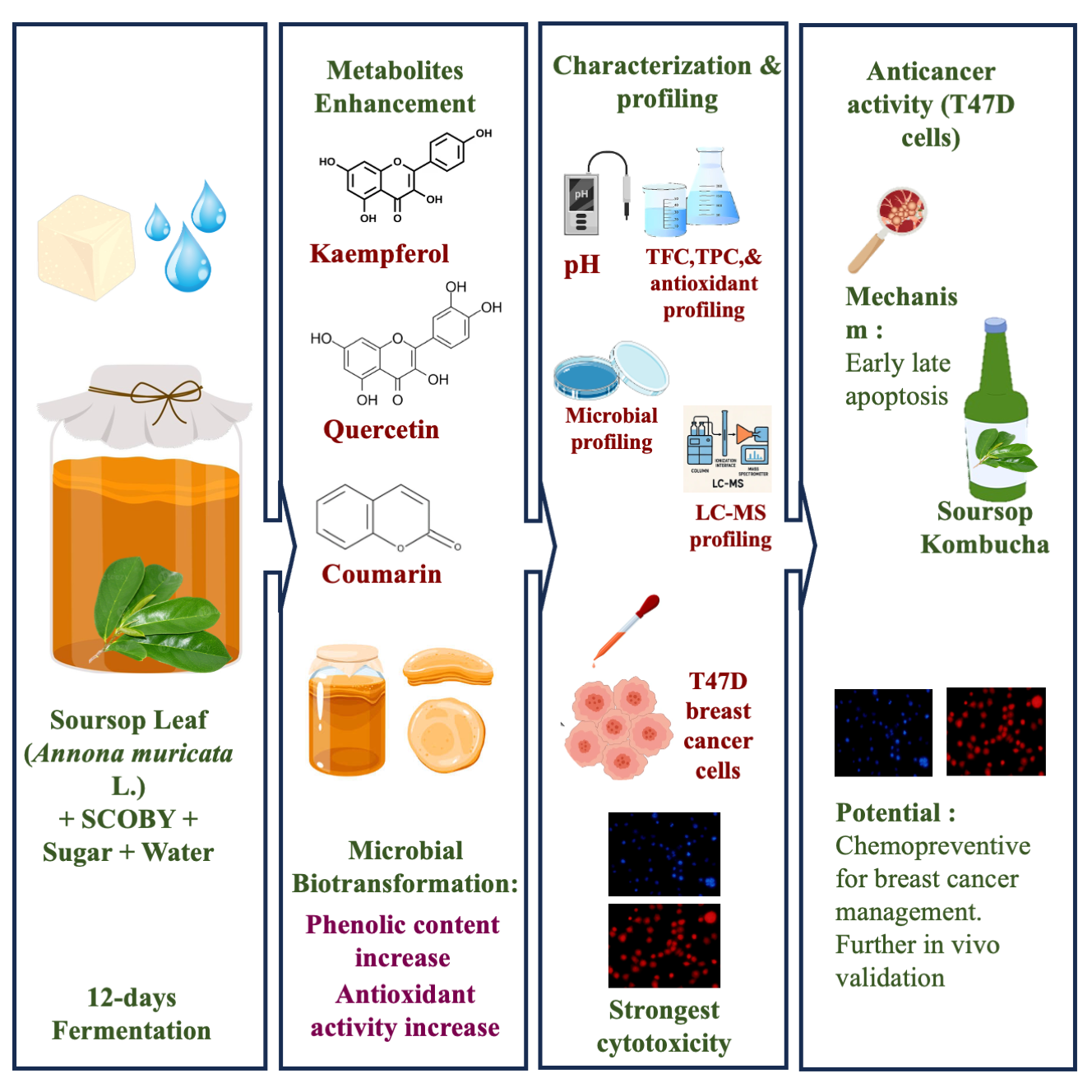
Kombucha fermentation of soursop leaves is associated with changes in functional properties through post-fermentation physicochemical and metabolite profile modifications. This study was evaluated for its effects on physicochemical properties, qualitative LC-MS metabolite profiles, antioxidant capacity, and in vitro anticancer activity against T47D breast cancer cells. Fermentation was carried out for 12 days using leaf concentrations of 0.6% - 2.0%, followed by measurements of pH, total microbial counts, total phenolic and flavonoid contents, antioxidant activity, and LC-MS metabolite profiling. Cytotoxicity and apoptosis induction were assessed using CCK-8 assays, morphological observations, fluorescence imaging (DAPI, Annexin V-FITC/PI), and flow cytometry. At a 1.4% leaf concentration, endpoint comparison between day 0 and day 12 showed an increase in total viable counts from 6.77 to 7.65 log CFU/mL and a marked increase in total phenolic content from 198.13 to 322.03 mg GAE/mL, accompanied by the greatest reduction in antioxidant IC₅₀ values (from 252.29 to 99.73 ppm). Qualitative LC-MS profiling revealed differences in detected compounds between fermented and unfermented samples, including the presence of aglycone flavonoids in fermented kombucha. Acidic soursop kombucha demonstrated the strongest cytotoxicity toward T47D cells (IC₅₀ = 2.35 mg/mL), followed by neutralized kombucha (IC₅₀ = 3.87 mg/mL) and soursop leaf drink (IC₅₀ = 7.37 mg/mL). Flow cytometry indicated a marked shift toward apoptotic populations in fermented samples, with combined early and late apoptosis reaching 83.56% in acidic kombucha treated cells. Kombucha fermentation under acidic conditions was associated with enhanced antioxidant capacity and in vitro anticancer related activity of soursop leaves.
HIGHLIGHTS
- Kombucha fermentation significantly changed physicochemical properties and metabolite profiles.
- Optimal leaf concentrations (1.4%) were identified using Zeleny’s method based on pre–post fermentation improvements in total phenolics and antioxidant IC₅₀.
- Qualitative LC-MS showed broader metabolite profiles after fermentation with improved bioactivity.
- Soursop leaf kombucha showed the strongest cytotoxicity toward T47D breast cancer cells (IC₅₀ = 2.35 mg/ml).
- Fermented samples induced higher early and late apoptosis, supporting their chemopreventive potential.
GRAPHICAL ABSTRACT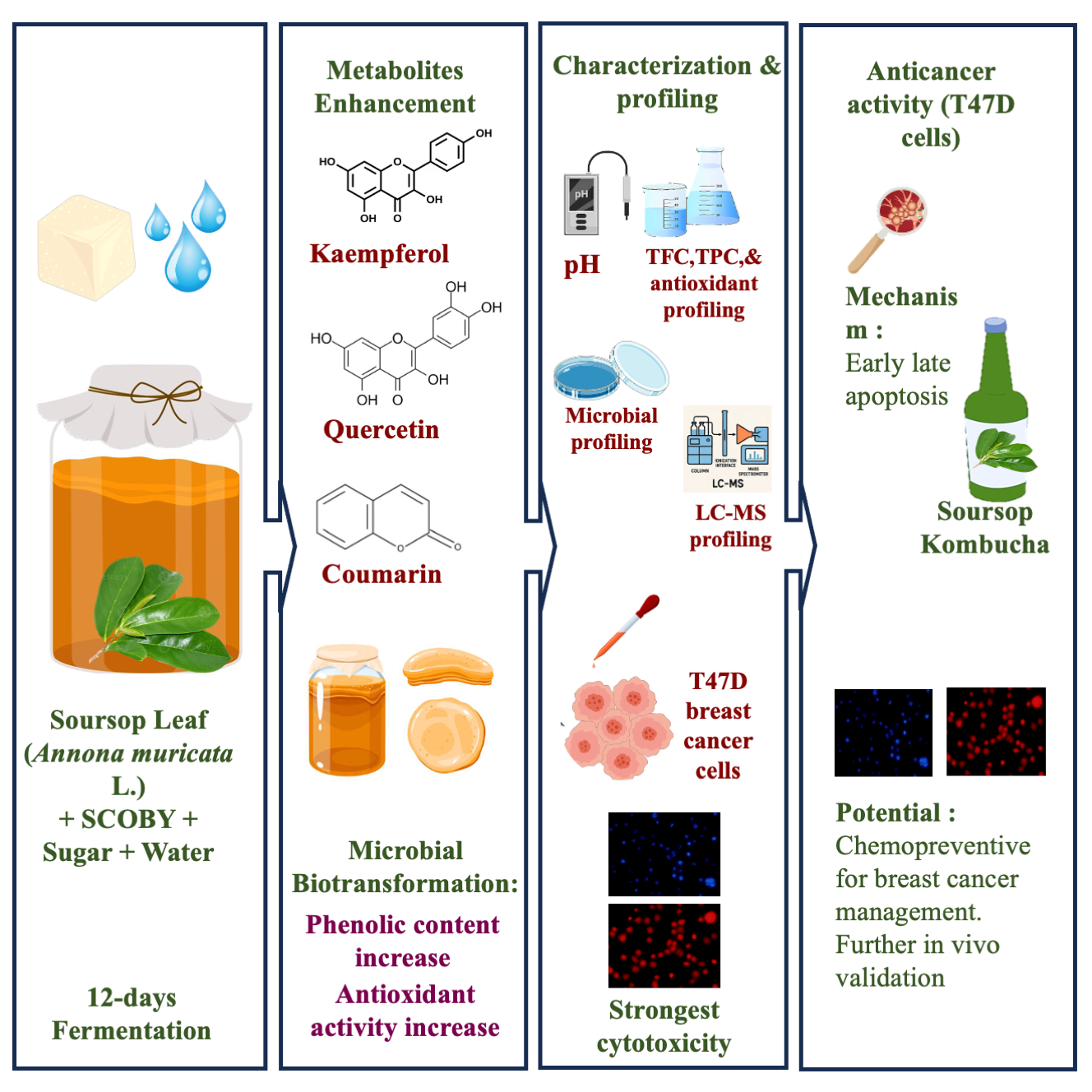
Downloads
References
M Praveen and S Brogi. Microbial fermentation in food and beverage industries: Innovations, challenges, and opportunities. Foods 2025; 14(1), 114.
RH Abdallah, R Al-Sayed Al-Attar, YM Shehata, DM Abdel-Fattah, RM Atta, OI Fantoukh and AM Mustafa. Comprehensive chemical profiling and mechanistic insight into anticancer activity of Annona muricata leaves extract. Pharmaceuticals 2024; 17(5), 614.
MJ Rendón-Barrón, E Pérez-Arteaga, I Delgado-Waldo, J Coronel-Hernández, C Pérez-Plasencia, F Rodríguez-Izquierdo, R Linares, AR González-Esquinca, I Álvarez-González and NJ Jacobo-Herrera. Laherradurin inhibits tumor growth in an azoxymethane/dextran sulfate sodium colorectal cancer model in vivo. Cancers 2024; 16(3), 573.
IS Sharafutdinov, GD Ozhegov, AE Sabirova, VV Novikova, SA Lisovskaya, AM Khabibrakhmanova, AR Kurbangalieva, MI Bogachev, AR Kayumov. Increasing susceptibility of drug-resistant candida albicans to fluconazole and terbinafine by 2(5H)-furanone derivative. Molecules 2020; 25(3), 642.
E Zubaidah, EC Dea and H Sujuti. Physicochemical and microbiological characteristics of kombucha based on various concentration of Javanese turmeric (Curcuma xanthorrhiza). Biocatalysis and Agricultural Biotechnology 2022; 44, 102467.
SF Tan, NL Chin, TP Tee and SK Chooi. Physico-chemical changes, microbiological properties, and storage shelf life of cow and goat milk from industrial high-pressure processing. Processes 2020; 8(6), 697.
NTT Hạnh, NN Cham, NT Trang and CTN Anh. Effect of low temperature storage period on some quality attributes of soursop (Annona Muricata L.) juice fermented using lactobacillus plantarum and saccharomyces bayanus. Current Research in Nutrition and Food Science Journal 2025; 13(1), 243-257.
J Nanyondo, S Byakika and IM Mukisa. Production of a probiotic Soy-Soursop yogurt containing lactobacillus rhamnosus yoba 2012. European Journal of Agriculture and Food Sciences 2023; 5(4), 60-64.
F Bray, M Laversanne, H Sung, J Ferlay, RL Siegel, I Soerjomataram and A Jemal. Global cancer statistics 2022: GLOBOCAN estimates of incidence and mortality worldwide for 36 cancers in 185 countries. CA: A Cancer Journal for Clinicians 2024; 74(3), 229-263.
Herwin, Fitriana and S Nuryanti. Production of kombucha from Muntingia calabura L. leaves and evaluation of its antibacterial activity and total flavonoid content. Journal of Applied Pharmaceutical Science 2022; 12(8), 187-192.
LT Phung, H Kitwetcharoen, N Chamnipa, N Boonchot, S Thanonkeo, P Tippayawat, P Klanrit, M Yamada and P Thanonkeo. Changes in the chemical compositions and biological properties of kombucha beverages made from black teas and pineapple peels and cores. Scientific Reports 2023; 13, 7859.
JT Oliveira, FM da Costa, TG da Silva, GD Simões, EDS Pereira, PQ da Costa, R Andreazza, PC Schenkel and S Pieniz. Green tea and kombucha characterization: Phenolic composition, antioxidant capacity and enzymatic inhibition potential. Food Chemistry 2023; 408, 135206.
AN Mfopa, R Kemzeu, R Fokom, LRT Yamthe, D Dize and FF Boyom. Phenolic compounds, antioxidant and antileishmanial activities of kombucha as affected by fermentation time. Heliyon 2024; 10(22), e40463.
S Wang, L Zhang, L Qi, H Liang, X Lin, S Li, C Yu and C Ji. Effect of synthetic microbial community on nutraceutical and sensory qualities of kombucha. International Journal of Food Science & Technology 2020; 55(10), 33327-3333.
KR Lee, K Jo, KS Ra, HJ Suh and KB Hong. Kombucha fermentation using commercial kombucha pellicle and culture broth as starter. Food Science and Technology 2022; 42, e70020.
S Moghadamtousi, M Fadaeinasab, S Nikzad, G Mohan, H Ali and H Kadir. Annona muricata (Annonaceae): A review of its traditional uses, isolated acetogenins and biological activities. International Journal of Molecular Sciences 2015; 16(7), 15625-15658.
P Mohitha and H Shanmugam. Chemometric analysis and quantification of major anti-cancer activity compounds from leaves of soursop (Annona muricata Linn.). Chemical Papers 2023; 77(10), 6069-6081.
CC Egbo, DC Igboaka and PF Uzor. Antimicrobial assay and GC-MS profile of the extract of the endophytic fungus from Annona muricata (Annonaceae) leaf. Tropical Journal of Natural Product Research 2024; 8(4), 7030-7034.
E Zubaidah and Y Hasfiani. Physicochemical properties and anti-cancer activity of javanese turmeric kombucha (Curcuma xanthorrhiza) against T47D cell line. Trends in Sciences 2025; 22(9), 10417.
E Zubaidah, ZM Putri, H Sujuti, AP Rahayu and T Ardyati. Physicochemical characteristics of kombucha based on various concentration of white turmeric (Curcuma zedoaria (Berg.) Roscoe). Biocatalysis and Agricultural Biotechnology 2024; 56, 102998.
S Khosravi, M Safari, Z Emam-Djomeh and MT Golmakani. Development of fermented date syrup using kombucha starter culture. Journal of Food Processing and Preservation 2019; 43(8), e13872.
S Muhammad, R Attia, M Shehata, D Zaki and G Hussein. Synthesis, characterization and application of a novel extracting agent 2-(4-methylphenyl)-8,9-dihydro-8,8-dimethyl-7H-pyrazolo[1,5-a]quinazolin-6-one (MPHPQ) for U(VI) removal from sulfate aqueous solutions. Egyptian Journal of Chemistry 2023; 66(3), 197-207.
J Jeremic, I Vongluanngam A Ricci, GP Parpinello and A Versari. The oxygen consumption kinetics of commercial oenological tannins in model wine solution and chianti red wine. Molecules 2020; 25(5), 1215.
S Shi, Y Wei, X Lin, H Liang, S Zhang, Y Chen, L Dong and C Ji. Microbial metabolic transformation and antioxidant activity evaluation of polyphenols in kombucha. Food Bioscience 2023; 51, 102287.
D Pebiyanti, R Widiantie and A Prianto. Analysis of chemical characteristics, flavonoids, and organoleptics on shallot skin (Allium cepa) kombucha. Jurnal Pendidikan Biologi 2021; 6(2), 166-177.
J Hou, R Luo, H Ni, K Li, FC Mgomi, L Fan and L Yuan. Antimicrobial potential of kombucha against foodborne pathogens. Quality Assurance and Safety of Crops & Foods 2021; 13(3), 53-61.
YN Rao. Variation of the content and antioxidant activity of active substances in the kombucha fermentation of mulberry leaves. Highlights in Science, Engineering and Technology 2024; 91, 396-401.
AN Artanti, A Febriyanty, F Prihapsara and DE Ermawati. Formulation optimization and antioxidant test for self-nano emulsifying drug delivery system of soursop leaves (Annona muricata L.) chloroform extract using candlenut oil as oil phase. Pharmaciana 2021; 11(1), 143.
K Jakubczyk, Ł Łopusiewicz, J Kika, K Janda and K Skonieczna‐Żydecka. Fermented tea as a food with functional value—its microbiological profile, antioxidant potential and phytochemical composition. Foods 2023; 13(1), 50.
Y Liu, Y Zheng, W Wang, Z Wang, S Han and P Zhou. Kombucha enables to inhibit digestive enzymes activity and adipocyte differentiation of OP9 cells. Journal of Food Science 2024; 89(12), 10053-10063.
CM Park, GM Kim and GS Cha. Biotransformation of flavonoids by newly isolated and characterized Lactobacillus pentosus NGI01 strain from kimchi. Microorganisms 2021; 9(5), 1075.
Ż Arciszewska, S Gama, M Kalinowska, G Świderski, R Świsłocka, E Gołębiewska, M Naumowicz, M Worobiczuk, A Cudowski and B Godlewska-Żyłkiewicz. Caffeic Acid/Eu(III) complexes: Solution equilibrium studies, structure characterization and biological activity. International Journal of Molecular Sciences 2022; 23(2), 888.
A Zeb. Concept, Mechanism, and Applications of phenolic antioxidants in foods. Journal of Food Biochemistry 2020; 44(9), e13394.
H Kim, J Jeon, J Lee, C Song, B Gu, NM Kim, Y Tae-Hui, S Oh, S Park, K Pal, GJ Kim and D Kim. Utilizing kombucha culture for coffee fermentation and biochemical characteristic analysis. Current Research in Food Science 2025; 10, 100996.
SA Villarreal-Soto, S Beaufort, J Bouajila, S Jean-Pierre, T Renard, S Rollan and P Taillandier. Impact of fermentation conditions on the production of bioactive compounds with anticancer, anti-inflammatory and antioxidant properties in kombucha tea extracts. Process Biochemistry 2019; 83, 44-54.
H Kitwetcharoen, Y Phannarangsee, P Klanrit, S Thanonkeo, P Tippayawat, P Klanrit, P Klanrit, M Yamada and P Thanonkeo. Functional kombucha production from fusions of black tea and indian gooseberry (Phyllanthus emblica L.). Heliyon 2024; 10(24), e40939.
S Selvaraj and K Gurumurthy. Metagenomic, organoleptic profiling, and nutritional properties of fermented kombucha tea substituted with recycled substrates. Frontiers in Microbiology 2024; 15, 1367697.
WC Tan, BJ Muhialdin and ASM Hussin. Influence of storage conditions on the quality, metabolites, and biological activity of soursop (Annona muricata L.) kombucha. Frontiers in Microbiology 2020; 11, 603481.
RI Limón, E Peñas, MI Torino, C Martínez‐Villaluenga, M Dueñas and J Frı́as. Fermentation enhances the content of bioactive compounds in kidney bean extracts. Food Chemistry 2015; 172, 343-352.
DM Kopustinskiene, V Jakstas, A Savickas and J Bernatoniene. Flavonoids as anticancer agents. Nutrients 2020; 12(2), 457.
C George Vazhappilly, M Amararathna, AC Cyril, R Linger, R Matar, M Merheb, WS Ramadan, R Radhakrishnan and HPV Rupasinghe. Current methodologies to refine bioavailability, delivery, and therapeutic efficacy of plant flavonoids in cancer treatment. Journal of Nutritional Biochemistry 2021; 94, 108623.
Z He, H Zhang, T Wang, R Wang and X Luo. Effects of five different lactic acid bacteria on bioactive components and volatile compounds of oat. Foods 2022; 11(20), 3230.
C Bas-Bellver, C Barrera and L Seguí. Impact of thermophysical and biological pretreatments on antioxidant properties and phenolic profile of broccoli stem products. Foods 2024; 13(22), 3585.
J Yang, H Lee, J Sung, Y Kim, HS Jeong and J Lee. Conversion of rutin to quercetin by acid treatment in relation to biological activities. Preventive Nutrition and Food Science 2019; 24(3), 313-320.
TP Van, QK Phan, HP Quang, GB Pham, NHN Thi, HTT Thi and AD Do. Multi-strain probiotics enhance the bioactivity of cascara kombucha during microbial composition-controlled fermentation. Preventive Nutrition and Food Science 2023; 28(4), 502-513.
DP Sinaga, DKA Tampubolon, RF Kembaren and MM Martgrita. Fermentation process effect to enhance antioxidant and antibacterial activity of phenolic compounds and its possible application to galactomannan polysaccharides: A review. IOP Conference Series: Earth and Environmental Science 2022; 1097(1), 12027.
R Jafari, NS Naghavi, K Khosravi‐Darani, M Doudi and K Shahanipour. Isolation, molecular and phylogenetic identification of microorganisms from kombucha solution and evaluation of their viability using flow cytometery. Food Science and Technology 2022; 42, 63220.
ADF Nascimento, SMT Ramos, VN Bergamo, EDS Araujo and GA Valencia. Pickering emulsions stabilized using bacterial cellulose from kombucha. Starch 2025; 77(2), 2400103.
NF Lima, GM Maciel, IDAA Fernandes and CWI Haminiuk. Optimising the production process of bacterial nanocellulose: Impact on growth and bioactive compounds. Food Technology and Biotechnology 2023; 61(4), 494-504.
J Gong, S Rao, X Liu, S Cheng, X Cong and D Zhu. Microbiome-metabolome integration reveals fermentation-driven divergence in bioactive compound profiles of cardamine violifolia leaf pickles. Current Research in Food Science 2025; 11, 101121.
JY Kim, TTP Dao, K Song, SB Park, H Jang, MK Park, SU Gan and YS Kim. Annona muricata leaf extract triggered intrinsic apoptotic pathway to attenuate cancerous features of triple negative breast cancer MDA-MB-231 cells. Evidence-Based Complementary and Alternative Medicine 2018; 2018, 7972916.
I Rady, MB Bloch, NC Roxane-Cherille, SB Mbeumi, MR Anwar, H Mohamed, AS Babatunde, K Jules-Roger, FK Noubissi, KAE Sayed, GK Whitfield and JC Chamcheu. Anticancer properties of graviola (Annona muricata): A comprehensive mechanistic review. Oxidative Medicine and Cellular Longevity 2018; 2018, 1826170.
C Cho, A Teghanemt, MA Apicella and WM Nauseef. Modulation of phagocytosis-induced cell death of human neutrophils by Neisseria gonorrhoeae. Journal of Leukocyte Biology 2020; 108(5), 1543-1553.
Z Pan, X Zhang, P Yu, X Chen, P Lu, M Li, X Liu, Z Li, F Wei, K Wang, Q Zheng and D Li. Cinobufagin induces cell cycle arrest at the G2/M phase and promotes apoptosis in malignant melanoma cells. Frontiers in Oncology 2019; 9, 853.
Published
How to Cite
Issue
Section
License
Copyright (c) 2026 Walailak University

This work is licensed under a Creative Commons Attribution-NonCommercial-NoDerivatives 4.0 International License.





