
Bioinformatics Examination of Quercetin from Salacca zalacca Skin, Fruit, and Seed as a Potent Active Compounds Against Hypercholesterolemia Via PCSK9 Inhibition
DOI:
https://doi.org/10.48048/tis.2025.9237Keywords:
PCSK9 inhibitor, Hypercholesterolemia, Salacca zalacca, Bioinformatics, Quercetin, Molecular docking, Molecular dynamicsAbstract
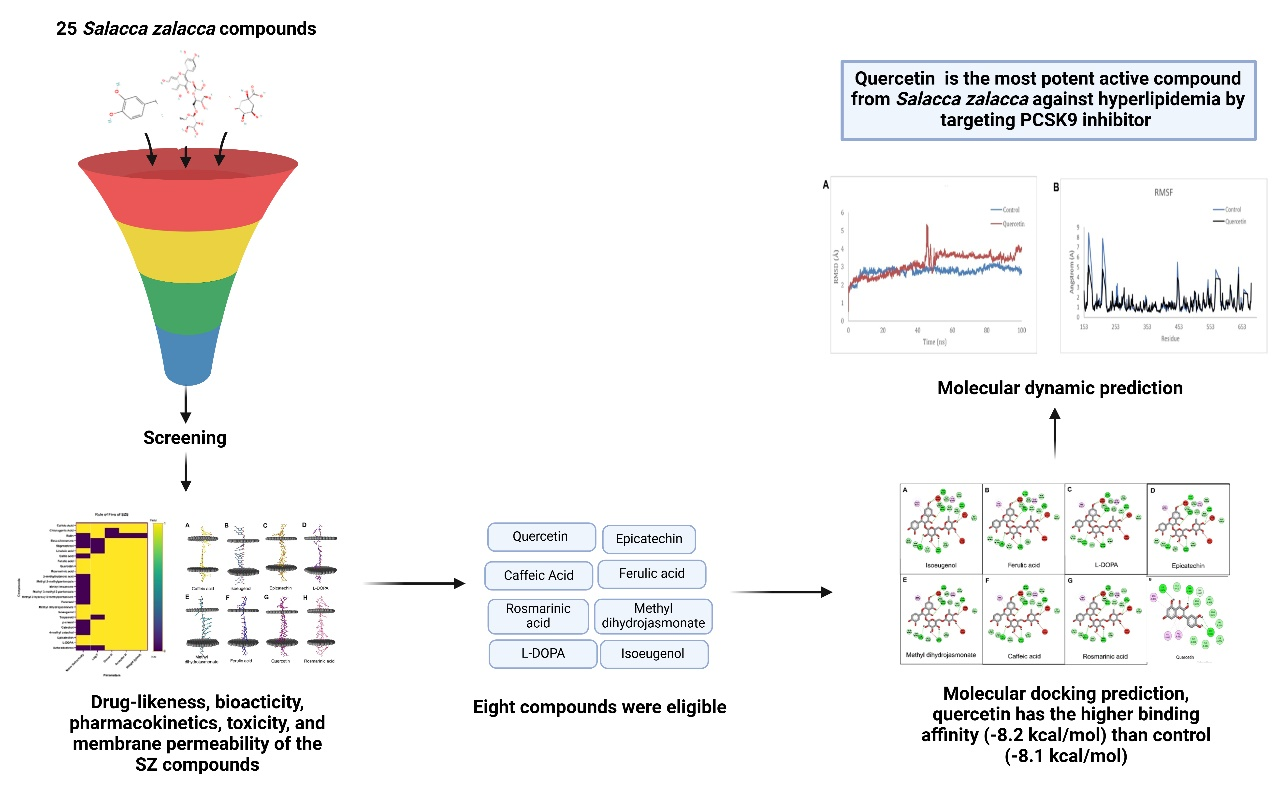
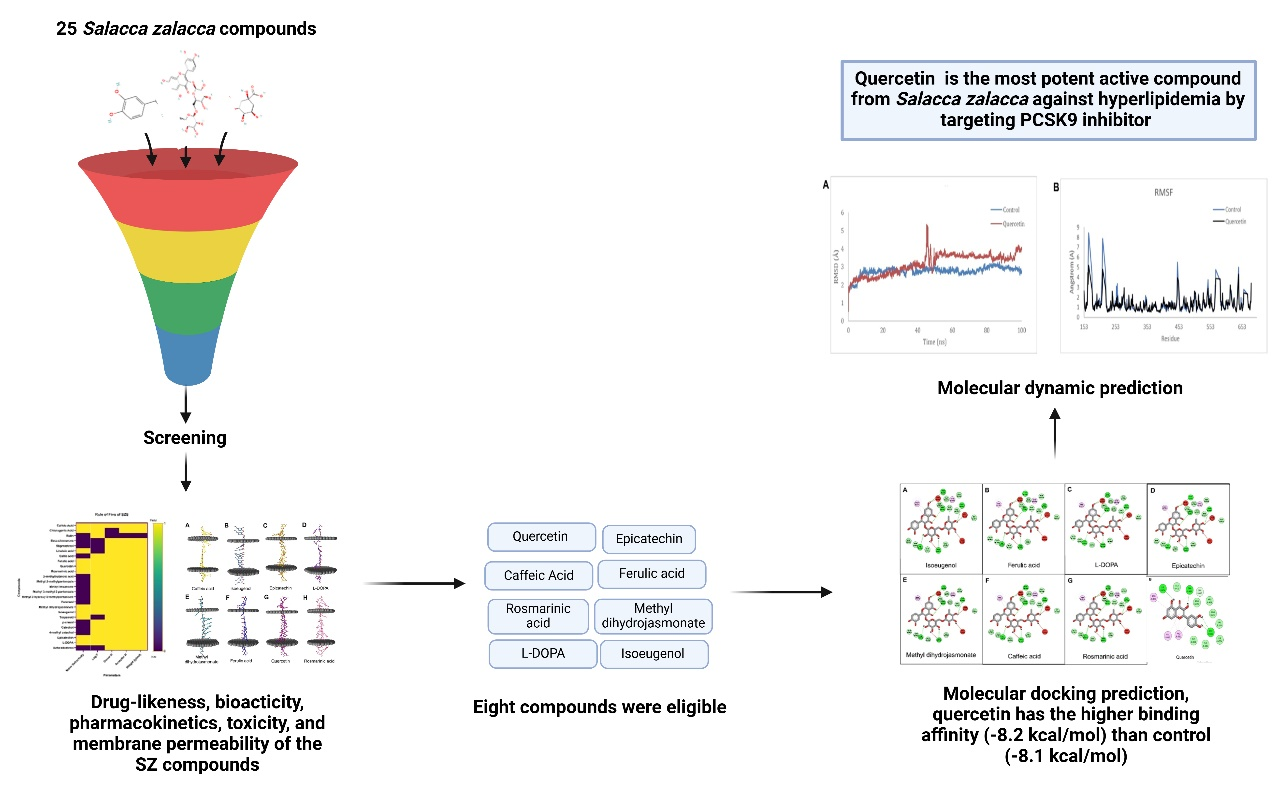
Hypercholesterolemia is a high-risk factor for cardiovascular disease. The increasing prevalence of hypercholesterolemia necessitates effective therapy. One of the novel targets is proprotein convertase subtilisin/kexin type 9 (PCSK9). However, the high cost of PCSK9 inhibitors limits their availability in low-income and middle-income countries. Salacca zalacca (SZ) is an herbal plant with various pharmacological properties, especially cholesterol metabolism. Novel PCSK9 inhibitors from herbal plants may be promising for drug development based on bioinformatic predictive analysis. This study identified SZ compounds as antihypercholesterolemic agents targeting PCSK9 inhibitors and their mechanisms. Pharmacokinetic properties and biological activities were analyzed using the pkCSM and Way2 drug PASS online databases. Molecular docking was performed using PyRx v9.0, PyMOL, and molecular dynamics using the YASARA software. 4-{[(1R)-6-methoxy-1-methyl-1-{2-oxo-2-[(13-thiazol-2-yl)amino]ethyl}-1,2,3,4 tetrahydroiso-quinolin-7-yl]oxy}benzoic acid (PV7) was used as the control. 25 compounds were identified in SZ, and 8 compounds showed good oral bioavailability. Molecular docking showed that quercetin had the strongest binding affinity for PCSK9 (8.167 ± 0.153 kcal/mol). It was not significantly stronger than the control (8.067 ± 0.153 kcal/mol) and bound to the same binding residues (TRP 461, ASP 360, SER 462, ARG 357, ARG 458, VAL 333, THR 335, PRO 331, and CYS 358). In addition, molecular dynamic simulation showed a stable interaction between quercetin and PCSK9 with an average RMSD of 3.5 Å. Therefore, quercetin, a phytochemical compound from SZ, is a promising candidate for anti-hypercholesterolemia by targeting PCSK9 inhibitors.
HIGHLIGHTS
- PCSK9 inhibitors are considered novel agents and effective treatments for hypercholesterolemia.
- PCSK9 contained several critical residues at ASP360, ARG357, ARG458, and ARG476.
- Salacca zalacca compounds show promising anticholesterol properties through PCSK9 inhibition.
- Quercetin has the highest binding affinity among the SZ compounds and interacts stably with the PCSK9 protein.
GRAPHICAL ABSTRACT
Downloads
References
SS Sundararaman, Y Doring and EPCVD Vorst. PCSK9: A multi-faceted protein that is involved in cardiovascular biology. Biomedicines 2021; 9(7), 793.
K Fujisue and K Tsujita. Current status of lipid management in acute coronary syndrome. Journal of Cardiology 2017; 70(2), 101-106.
EA Rosei and M Salvetti. Management of hypercholesterolemia, appropriateness of therapeutic approaches and new drugs in patients with high cardiovascular risk. High Blood Pressure & Cardiovascular Prevention 2016; 23, 217-230.
A Smith, D Johnson, J Banks, SW Keith and DG Karalis. Trends in PCSK9 inhibitor prescriptions before and after the price reduction in patients with atherosclerotic cardiovascular disease. Journal of Clinical Medicine 2021; 10(17), 3828.
Y Handelsman and NE Lepor. PCSK9 inhibitors in lipid management of patients with diabetes mellitus and high cardiovascular risk: A review. Journal of the American Heart Association 2018; 7(13), e008953.
Q Jia, H Cao, D Shen, S Li, L Yan, C Chen, S Xing and F Dou. Quercetin protects against atherosclerosis by regulating the expression of PCSK9, CD36, PPARγ, LXRα and ABCA1. Internationnal Journal of Molecular Medicine 2019; 44(3), 893-902.
M Mbikay, F Sirois, S Simoes, J Mayne and M Chretien. Quercetin‐3‐glucoside increases low‐density lipoprotein receptor (LDLR) expression, attenuates proprotein convertase subtilisin/kexin 9 (PCSK9) secretion, and stimulates LDL uptake by Huh7 human hepatocytes in culture. FEBS Open Bio 2014; 4(1), 755-762.
S Li, H Cao, D Shen, Q Jia, C Chen and SL Xing. Quercetin protects against ox‑LDL‑induced injury via regulation of ABCAl, LXR‑α and PCSK9 in RAW264.7 macrophages. Molecular Medicine Report 2018; 18(1), 799-806.
OJ Lara-Guzman, JH Tabares-Guevara, YM Leon-Varela, RM Alvarez, M Roldan, JA Sierra, JA Londono-Londono and JR Ramirez-Pineda. Proatherogenic macrophage activities are targeted by the flavonoid quercetin. Journal of Pharmacology and Experimental Therapeutics November 2012; 343(2), 296-306.
S Egert, A Bosy-Westphal, J Seiberl, C Kurbitz, U Settler, S Plachta-Danielzik, AE Wagner, J Frank, J Schrezenmeir, G Rimbach, S Wolffram and MJ Muller. Quercetin reduces systolic blood pressure and plasma oxidised low-density lipoprotein concentrations in overweight subjects with a high-cardiovascular disease risk phenotype: a double-blinded, placebo-controlled cross-over study. British Journal of Nutrition 2009; 102, 1065-1074.
CS Wahono, MFR Syaban, MZ Pratama, PA Rahman and NE Erwan. Exploring the potential of phytoconstituents from Phaseolus vulgaris L against C-X-C motif chemokine receptor 4 (CXCR4): A bioinformatic and molecular dynamic simulations approach. Egyptian Journal of Medical Human Genetics 2024; 25, 52.
MSM Saleh, MJ Siddiqui, A Mediani, NH Ismail, QU Ahmed, SZM So’ad and S Saidi-Besbes. Salacca zalacca: A short review of the palm botany, pharmacological uses and phytochemistry. Asian Pacific Journal of Tropical Medicine 2018; 11(12), 645-652.
E Girsang, INE Lister, CN Ginting, A Khu, B Samin, W Widowati, S Wibowo and R Rizal. Chemical constituents of snake fruit (Salacca zalacca (Gaert.) Voss) peel and in silico anti-aging analysis. Molecular and Cellular Biomedical Sciences 2019; 3(2), 122-128.
LZ Benet, CM Hosey, O Ursu and TI Oprea. BDDCS, the rule of 5 and drugability. Advanced Drug Delivery Reviews 2016; 101, 89-98.
D Vijh and P Gupta. GC–MS analysis, molecular docking, and pharmacokinetic studies on dalbergia sissoo barks extracts for compounds with anti-diabetic potential. Scientific Reports 2024; 14, 24936.
AL Lomize, JM Hage, K Schnitzer, K Golobokov, MB LaFaive, AC Forsyth and ID Pogozheva. PerMM: A web tool and database for analysis of passive membrane permeability and translocation pathways of bioactive molecules. Journal of Chemical Information and Modeling 2019; 59(7), 3094-3099.
DS Druzhilovskiy, AV Rudik, DA Filimonov, TA Gloriozova, AA Lagunin, AV Dmitriev, PV Pogodin, VI Dubovskaya, SM Ivanov, OA Tarasova, VM Bezhentsev, KA Murtazalieva, MI Semin, IS Maiorov, AS Gaur, GN Sastry and VV Poroikov. Computational platform Way2Drug: From the prediction of biological activity to drug repurposing. Russian Chemical Bulletin 2017; 66, 1832-1841.
SD Handari, MS Rohman, D Sargowo, Aulanni’am, RA Nugraha, B Lestari and D Oceandy. Novel impact of colchicine on interleukin-10 expression in acute myocardial infarction: An integrative approach. Journal of Clinical Medicine 2024; 13(16), 4619.
WL Petrilli, GC Adam, RS Erdmann, P Abeywickrema, V Agnani, X Ai, J Baysarowich, N Byrne, JP Caldwell, W Chang, E DiNunzio, Z Feng, R Ford, S Ha, Y Huang, B Hubbard, JM Johnston, M Kavana, JM Lisnock, R Liang, …, JE Imbriglio. From screening to targeted degradation: Strategies for the discovery and optimization of small molecule ligands for PCSK9. Cell Chemical Biology 2020; 27(1), 32-40.
BJ Oso, I Olaoye and OT Oso. Experimental and hypothetical appraisal on inhibition of glucose-induced glycation of bovine serum albumin by quercetin. Journal of Genetic Engineering and Biotechnology 2023; 21(1), 123.
MH Widyananda, F Fatchiyah, L Muflikhah, SM Ulfa and N Widodo. Computational examination to reveal Kaempferol as the most potent active compound from Euphorbia hirta against breast cancer by targeting AKT1 and ERα. Egyptian Journal of Basic and Applied Sciences 2023; 10(1), 753-767.
K Kochl, T Schopper, V Durmaz, L Parigger, A Singh, A Krassnigg, M Cespugli, W Wu, X Yang, Y Zhang, WW Wang, C Selluski, T Zhao, X Zhang, C Bai, L Lin, Y Hu, Z Xie, Z Zhang, J Yan, …, CC Gruber. Optimizing variant-specific therapeutic SARS-CoV-2 decoys using deep-learning-guided molecular dynamics simulations. Scientific Reports 2023; 13, 774.
S Aralas, M Mohamed and MFA Bakar. Antioxidant properties of selected salak (Salacca zalacca) varieties in Sabah, Malaysia. Nutrition & Food Science 2009; 39(3), 243-250.
NA Ismail and MFA Bakar. Salak— Salacca zalacca. Elsevier Science, Amsterdam, Netherlands, 2018.
TH Simatupang, S Hartini, DA Mustika, A Purwoto, M Junef, A Sanusi, Firdaus, TWA Nugroho, J Mareta, A Jazuli and I Firdaus. Salak from indonesia: Legal protection, potential geographical indications and development practices toward international markets. Cogent Social Sciences 2024; 10(1), 2341963.
MSM Saleh, MJ Siddiqui, HA Alshwyeh, NA Al-Mekhlafi, A Mediani, Z Ibrahim, NH Ismail and Y Kamisah. Metabolomics-based profiling with chemometric approach to identify bioactive compounds in Salacca zalacca fruits extracts and in silico molecular docking. Arabian Journal of Chemistry 2021; 14(4), 103038.
NAM Zaini, A Osman, AA Hamid, A Ebrahimpour and N Saari. Purification and characterization of membrane-bound polyphenoloxidase (mPPO) from snake fruit [salacca zalacca (gaertn.) voss]. Food Chemistry 2013; 136(2), 407-414.
M Marzuki, E Girsang, AN Nasution and INE Lister. Anti-diabetic effect of snake fruit skin extract in alloxan-induced wistar rat. International Journal of Health and Pharmaceutical 2022; 3(1), 146-153.
M Kanlayavattanakul, N Lourith, D Ospondpant, U Ruktanonchai, S Pongpunyayuen and C Chansriniyom. Salak plum peel extract as a safe and efficient antioxidant appraisal for cosmetics. Bioscience, Biotechnology, and Biochemistry 2013; 77(5), 1068-1074.
SS Tan, ST Tan and CX Tan. Antioxidant, hypoglycemic and anti-hypertensive properties of extracts derived from peel, fruit and kernel of Salak. British Food Journal 2020; 122(10), 3029-3038.
R Roskoski. Properties of FDA-approved small molecule protein kinase inhibitors. Pharmacological Research 2019; 200, 107059.
SM Prijadi, S Aulia, A Afinasari, L Aristawidya, MDS Hikam and M Muchtaridi. In silico study of sesquiterpene and monoterpene compounds from valerian roots (valerian officinalis) as acetylcholinesterase inhibitor. Indonesian Journal of Computational Biology 2022; 1(1), 1-6.
DSF Ramadhan, TM Fakih and A Arfan. Activity prediction of bioactive compounds contained in etlingera elatior against the SARS-CoV-2 main protease: An in silico approach. Borneo Journal of Pharmacy 2020; 3(4), 235-242.
Fatimawali, TE Tallei, BJ Kepel, W Bodhi, AE Manampiring and F Nainu. Molecular Insight into the pharmacological potential of clerodendrum minahassae leaf extract for Type-2 diabetes management using the network pharmacology approach. Medicina 2023; 59(11), 1899.
M Kulkarni, M Basanagouda, VB Jadhav and RN Rao. Computer aided prediction of biological activity spectra: Study of correlation between predicted and observed activities for Coumarin-4-Acetic acids. Indian Journal of Pharmaceutical Sciences 2011; 73(1), 88-92.
H Cheng, N Xu, W Zhao, J Su, M Liang, Z Xie, X Wu and Q Li. (‐)‐Epicatechin regulates blood lipids and attenuates hepatic steatosis in rats fed high‐fat diet. Molecular Nutrition & Food Research 2017; 61(11), 1700303.
Y Yeh, Y Lee, H Hsieh and D Hwang. Dietary caffeic acid, ferulic acid and coumaric acid supplements on cholesterol metabolism and antioxidant activity in rats. Journal of Food and Drug Analysis 2020; 17(2), 123-132.
Z Luo, M Li, J Yang, J Li, Y Zhang, F Liu, E El-Omar, L Han, J Bian, L Gong and M Wang. Ferulic acid attenuates high-fat diet-induced hypercholesterolemia by activating classic bile acid synthesis pathway. Frontiers in Nutrition 2022; 9, 976638.
L Xiao, L Liu, X Guo, S Zhang, J Wang, F Zhou, L Liu, Y Tang and P Yao. Quercetin attenuates high fat diet-induced atherosclerosis in apolipoprotein E knockout mice: A critical role of NADPH oxidase. Food and Chemical Toxicology 2017; 105, 22-33.
H Yi, H Peng, X Wu, X Xu, T Kuang, J Zhang, L Du and G Fan. The therapeutic effects and mechanisms of quercetin on metabolic diseases: Pharmacological data and clinical evidence. Oxidative Medicine and Cellular Longevity 2021; 2021, 6678662.
Y Shao, Y Yu, C Li, J Yu, R Zong and C Pei. Synergistic effect of quercetin and 6-gingerol treatment in streptozotocin induced type 2 diabetic rats and poloxamer P-407 induced hyperlipidemia. RSC Advances 2016; 6(15), 12235-12242.
A Rauf, M Imran, IA Khan, M Ur‐Rehman, SA Gilani, Z Mehmood and MS Mubarak. Anticancer potential of quercetin: A comprehensive review. Phytotherapy Research 2018; 32(11), 2109-2130.
RB Pingili, SR Challa, AK Pawar, V Toleti, T Kodali and S Koppula. A systematic review on hepatoprotective activity of quercetin against various drugs and toxic agents: Evidence from preclinical studies. Phytotherapy Research 2020; 31(1), 5-32.
J Roslan, N Giribabu, K Karim and N Salleh. Quercetin ameliorates oxidative stress, inflammation and apoptosis in the heart of streptozotocin-nicotinamide-induced adult male diabetic rats. Biomedicine & Pharmacotherapy 2017; 86, 570-582.
E Tomou, P Papakyriakopoulou, E Saitani, G Valsami, N Pippa and H Skaltsa. Recent advances in nanoformulations for quercetin delivery. Pharmaceutics 2023; 15(6), 1656.
V Venkatraman. FP-ADMET: A compendium of fingerprint-based ADMET prediction models. Journal of Cheminformatics 2021; 13, 75.
AS Setlur, C Karunakaran, V Panhalkar, S Sharma, M Sarkar and V Niranjan. Multifaceted computational profiling of thymol and geraniol against the human proteome for bio-repellent alternatives: Toxicity predictions, degradation analysis, and quantum mechanical approaches. Acta Tropica 2024; 258, 107359.
PC Agu, CA Afiukwa, OU Orji, EM Ezeh, IH Ofoke, CO Ogbu, EI Ugwuja and PM Aja. Molecular docking as a tool for the discovery of molecular targets of nutraceuticals in diseases management. Scientific Reports 2023; 13, 13398.
Y Yueniwati, MFR Syaban, IFD Faratisha, KC Yunita, DB Kurniawan, GFA Putra and NE Erwan. Molecular docking approach of natural compound from herbal medicine in java against severe acute respiratory syndrome coronavirus-2 Receptor. Open Access Macedonian Journal of Medical Science 2021; 9, 1181-1186.
Y Yueniwati, MFR Syaban, DB Kurniawan, AA Azam, DM Alvenia, YN Savira, RF Muhammad, B Adnani, AH Violita, SD Arviana, A Hasibuan, E Norahmawati, Y Fatmasari, A Mufidah, KA Savitri, UR Zulfikri, DY Putri and S Utami. 7,8‑Dihydroxyflavone functions as an antioxidant through the inhibition of Kelch‑like ECH‑associated protein 1: Molecular docking and an in vivo approach in a rat model of ischemia‑reperfusion brain injury. World Academy of Sciences Journal 2024; 6(2), 15.
MFR Syaban, NE Erwan, MRR Syamsuddin, FA Zahra and FL Sabila. Molecular docking approach of viscosin as antibacterial for methicillin-resistant staphylococcus aureus Via Î2-Lactamase inhibitor mechanism. Clinical and Research Journal in Internal Medicine 2021; 2(2), 187-192.
S Singh and VK Singh. Molecular dynamics simulation: Methods and application. Springer Nature, London, 2020.
L Martinez. Automatic identification of mobile and rigid substructures in molecular dynamics simulations and fractional structural fluctuation analysis. PLoS ONE 2015; 10(3), e0119264.
TL Wargasetia, H Ratnawati, N Widodo and MH Widyananda. Bioinformatics study of sea cucumber peptides as antibreast cancer through inhibiting the activity of overexpressed protein (EGFR, PI3K, AKT1, and CDK4). Cancer Informatics 2021; 20, 11769351211031864.
Downloads
Published
How to Cite
Issue
Section
License
Copyright (c) 2024 Walailak University

This work is licensed under a Creative Commons Attribution-NonCommercial-NoDerivatives 4.0 International License.





