
Physicochemical Properties and Anti-cancer Activity of Javanese Turmeric Kombucha (Curcuma xanthorrhiza) Against T47D Cell Line
DOI:
https://doi.org/10.48048/tis.2025.10417Keywords:
Kombucha, Fermentation, Javanese turmeric, Anti-cancer, T47D cellsAbstract
Breast cancer constitutes a growing global health crisis, with rising incidence and mortality alongside therapy-limiting adverse effects. Kombucha, a fermented beverage made from tea using a symbiotic culture of bacteria and yeast (SCOBY), has demonstrated various health-promoting properties. This study explores a novel substrate, Javanese turmeric (C. xanthorrhiza), an indigenous Indonesian herb known for its hepatoprotective, antioxidant, antidiabetic, and antimicrobial properties. The anti-cancer potential of Javanese turmeric kombucha (JTK) was evaluated as a complementary therapy against T47D cells by comparing its physicochemical and antioxidant properties with those of unfermented Javanese turmeric beverage (JTB), and assessing its cytotoxicity, morphological effects, and ability to induce apoptosis. Data were analyzed using analysis of variance (ANOVA), followed by post hoc tests such as Fisher’s method (α = 0.05). Statistical analyses were conducted using Minitab 17.0 programs. The results showed that JTK exhibited significantly higher levels of total phenols (162.61 ± 0.32 mgGAE/mL) and antioxidant activity (IC50 157.07 ± 2.75 ppm) compared to unfermented JTB. JTK also induced apoptosis in more than 22% of the T47D cell population, indicating a promising cytotoxic potential. The findings highlight that fermentation enhances the physicochemical characteristics and anti-cancer properties of Javanese turmeric, suggesting that kombucha derived from this plant may serve as a promising complementary beverage in breast cancer therapy.
HIGHLIGHTS
- Kombucha was produced using Curcuma xanthorrhiza (Javanese turmeric) as a novel substrate.
- Javanese turmeric kombucha (JTK) exhibited higher total phenols, flavonoids, and antioxidant activity than the unfermented beverage.
- JTK induced apoptosis in over 22% of T47D breast cancer cells, as shown by Annexin V-FITC/PI staining and flow cytometry.
- This is the first report on the anti-cancer potential of JTK, emphasizing the role of fermentation in enhancing its bioactivity and supporting its promise as a complementary functional beverage for breast cancer therapy.
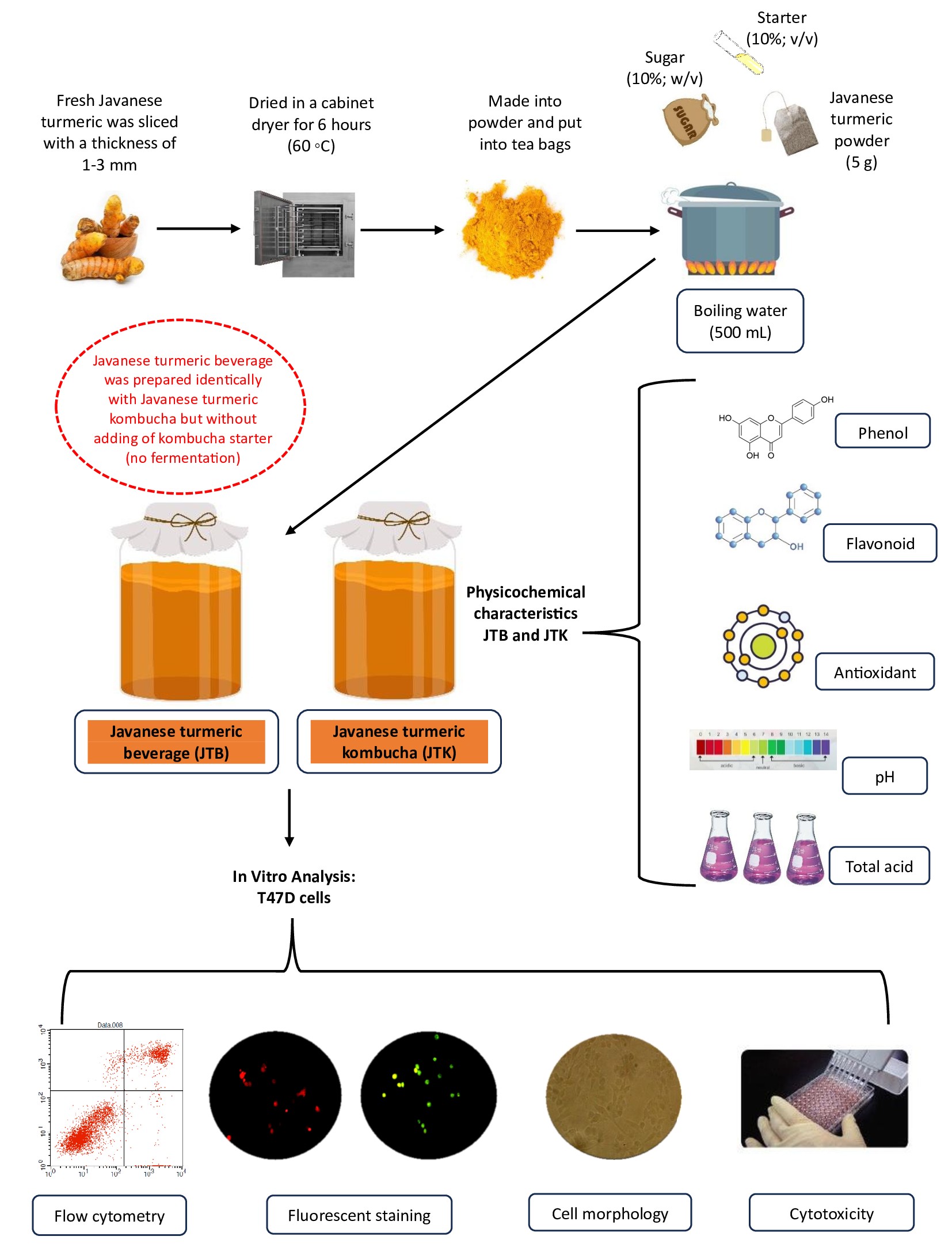
GRAPHICAL ABSTRACT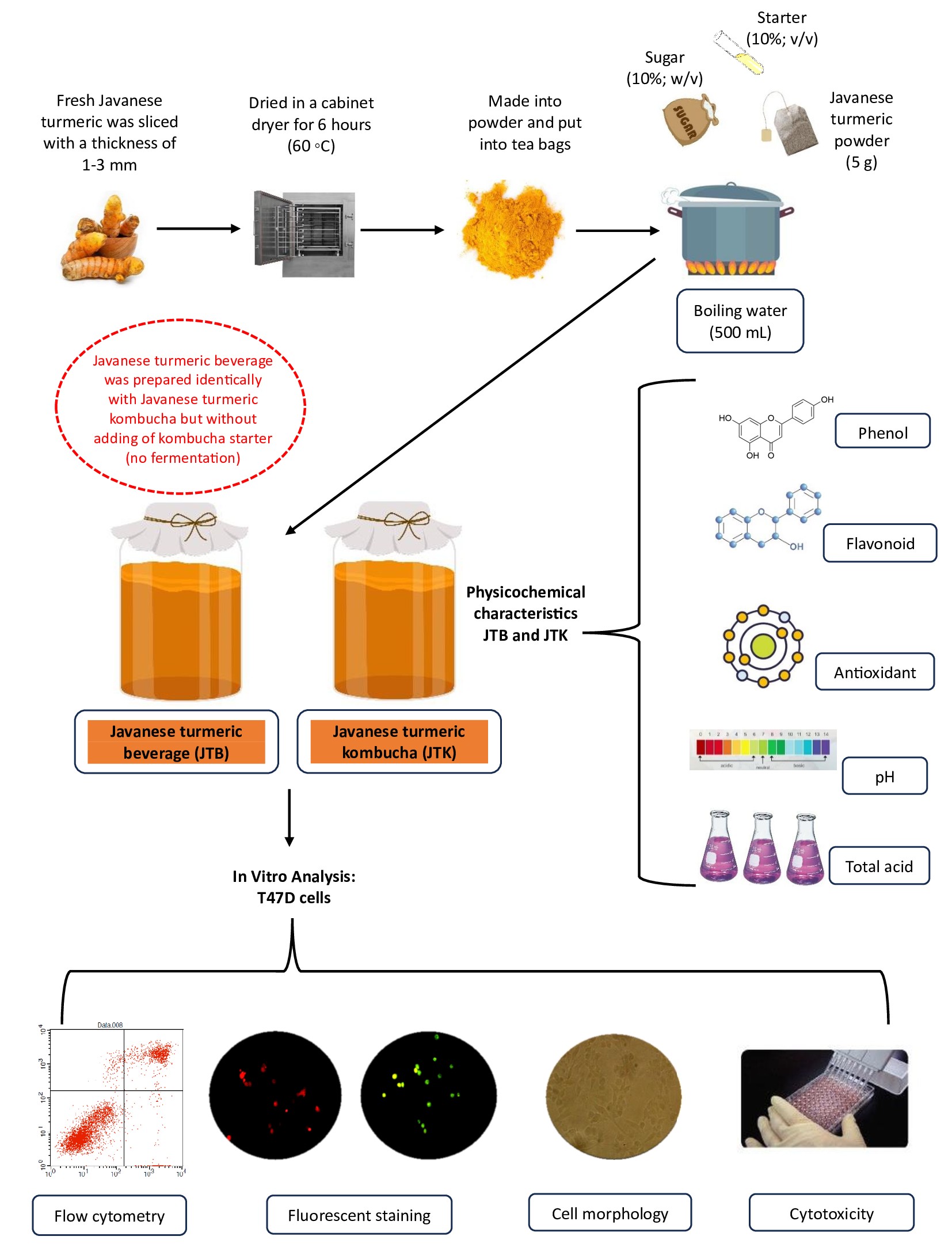
Downloads
References
H Sung, J Ferlay, RL Rebecca, M Laversanne, I Soerjomataram, A Jemal and F Bray. Global cancer statistics 2020: GLOBOCAN estimates of incidence and mortality worldwide for 36 cancers in 185 countries. CA: A Cancer Journal for Clinicians 2021; 71(3), 209-249.
M Moradzadeh, A Hosseini, S Erfanian and H Rezaei. Epigallocatechin-3-gallate promotes apoptosis in human breast cancer T47D cells through down-regulation of PI3K/AKT and Telomerase. Pharmacological Reports 2017; 69(5), 924-928.
T Kaewkod, S Bovonsombut and Y Tragoolpua. Efficacy of kombucha obtained from green, oolong and black teas on inhibition of pathogenic bacteria, antioxidation, and toxicity on colorectal cancer cell line. Microorganisms 2019; 7(12), 700.
SA Villarreal-Soto, S Beaufort, J Bouajila, JP Souchard, T Renard, S Rollan and P Taillandier. Impact of fermentation conditions on the production of bioactive compounds with anticancer, anti-inflammatory and antioxidant properties in kombucha tea extracts. Process Biochemistry 2019; 83, 44-54.
S Salafzoon, HM Hosseini and R Halabian. Evaluation of the antioxidant impact of ginger-based kombucha on the murine breast cancer model. Journal of Complementary and Integrative Medicine 2018; 15(1), 20170071.
E Zubaidah, I Susanti, H Sujuti, E Martati, AP Rahayu, I Srianta and I Tewfik. The distinctive hepatoprotective activity of turmeric kombucha (Curcuma longa) induced by diethylnitrosamine in Balb/C mice. Food Bioscience 2023; 55, 103043.
E Zubaidah, EC Dea, AP Rahayu, K Fibrianto, E Saparianti, H Sujuti, L Godelive, I Srianta and I Tewfik. Enhancing immunomodulatory properties of Javanese turmeric (Curcuma xanthorrhiza) kombucha against diethylnitrosamine in male Balb/c mice. Process Biochemistry 2023; 133, 303-308.
Yuandani, I Jantan, AS Rohani and IB Sumantri. Immunomodulatory effects and mechanisms of Curcuma species and their bioactive compounds: A Review. Frontiers in Pharmacology 2021; 12, 643119.
E Lukitaningsih, A Rohman, M Rafi, AF Nurrulhidayah and A Windarsih. In vivo antioxidant activities of Curcuma longa and Curcuma xanthorrhiza: A review. Food Research 2020; 4(1), 13-19.
U Hani, BHJ Gowda, A Siddiqua, S Wahab, MY Begum, P Sathishbabu, S Usmani and MP Ahmad. Herbal approach for treatment of cancer using curcumin as an anticancer agent: A review on novel drug delivery systems. Journal of Molecular Liquids 2023; 390(B), 123037.
A Simamora, KH Timotius, H Setiawan, MB Yerer, RA Ningrum and A Mun’im. Xanthorrhizol: Its bioactivities and health benefits. Journal of Applied Pharmaceutical Science 2024; 14(2), 27-39.
JM Leal, LV Suárez, R Jayabalan, JH Oros and A Escalante-Aburto. A review on health benefits of kombucha nutritional compounds and metabolites. CyTA - Journal of Food 2018; 16(1), 390-399.
P Bishop, ER Pitts, D Budner and KA Thompson-Witrick. Chemical composition of kombucha. Beverages 2022; 8(3), 45.
N Fitriana, M Rifa’i, Masruri, ST Wicaksono and N Widodo. Anticancer effects of Curcuma zedoaria (Berg.) Roscoe ethanol extract on a human breast cancer cell line. Chemical Papers 2023; 77, 399-411.
AM Araya-Sibaja, F Vargas-Huertas, S Quesada, G Azofeifa, JR Vega-Baudrit and M Navarro-Hoyos. Characterization, antioxidant and cytotoxic evaluation of demethoxycurcumin and bisdemethoxycurcumin from Curcuma longa cultivated in Costa Rica. Separations 2024; 11(1), 23.
O Taupiqurrohman, LP Hastuti, D Oktavia, BO Al-Najjar, M Yusuf, Y Suryani and S Gaffar. From fermentation to cancer prevention: The anticancer potential of Kombucha. Phytomedicine Plus 2024; 4(4), 100633.
E Zubaidah, YK Nisak, I Susanti, TD Widyaningsih, I Srianta and I Tewfik. Turmeric Kombucha as effective immunomodulator in Salmonella typhi-infected experimental animals. Biocatalysis and Agricultural Biotechnology 2021; 37, 102181.
JT Oliveira, FMD Costa, TGD Silva, GD Simões, EDS Pereira, PQD Costa, R Andreazza, PC Schenkel and S Pieniz. Green tea and kombucha characterization: Phenolic composition, antioxidant capacity and enzymatic inhibition potential. Food Chemistry 2022; 408, 135206.
H Shahbazi, HH Gahruie, MT Golmakani, MH Eskandari and M Movahedi. Effect of medicinal plant type and concentration on physicochemical, antioxidant, antimicrobial, and sensorial properties of kombucha. Food Science and Nutrition 2018; 6(8), 2568-2577.
J Vitas, S Vukmanović, J Čakarević, L Popović and R Malbaša. Kombucha fermentation of six medicinal herbs: Chemical profile and biological activity. Chemical Industry and Chemical Engineering Quarterly 2020; 26(2), 157-170.
XF Gao, QL Li, HL Li, HY Zhang, JY Su, B Wang, P Liu and AQ Zhang. Extracts from Curcuma zedoaria inhibit proliferation of human breast cancer cell MDA-MB-231 in vitro. Evidence-based Complementary and Alternative Medicine 2014; 2014, 730678.
H Fan, J Li, J Wang and Z Hu. Long non-coding RNAs (lncRNAs) tumor-suppressive role of lncRNA on chromosome 8p12 (TSLNC8) inhibits tumor metastasis and promotes apoptosis by regulating interleukin 6 (IL-6)/signal transducer and activator of transcription 3 (STAT3)/hypoxia-inducible factor 1-alpha (HIF-1α) signaling pathway in non-small cell lung cancer. Medical Science Monitor 2019; 25, 7624-7633.
K Im, S Mareninov, MFP Diaz and WH Yong. An introduction to performing immunofluorescence staining. Methods in Molecular Biology 2019; 1897, 299-311.
K Neffe-Skocińska, B Sionek, I Ścibisz and D Kołożyn-Krajewska. Acid contents and the effect of fermentation condition of Kombucha tea beverages on physicochemical, microbiological and sensory properties. CyTA - Journal of Food 2017; 15(4), 601-607.
JFD Miranda, LF Rius, CB Silva, TM Uekane, KA Silva, AGM Gonzalez, FF Fernandes and AR Lima. Kombucha: A review of substrates, regulations, composition, and biological properties. Journal of Food Science 2022; 87(2), 503-527.
RR Elfirta, PR Ferdian, RH Setyawan, I Saskiawan, Mahani, N Nurjanah, A Pribadi, S Anggita and ESD Manullang. Changes in titrable acidity, pH, and reducing sugars of ganoderma kombucha with honey after the fermentation process. In: Proceedings of the 5th International Conference on Biosciences, Bogor, Indonesia. 2023, p. 12078.
RR Cardoso, RO Neto, CTDS D’Almeida, TPD Nascimento, CG Pressete, L Azevedo, HSD Martino, LC Cameron, MSL Ferreira and FARD Barros. Kombuchas from green and black teas have different phenolic profile, which impacts their antioxidant capacities, antibacterial and antiproliferative activities. Food Research International 2020; 128, 108782.
F Gaggìa, L Baffoni, M Galiano, DS Nielsen, RR Jakobsen, JL Castro-Mejía, S Bosi, F Truzzi, F Musumeci, G Dinelli and DD Giola. Kombucha beverage from green, black and rooibos teas: A comparative study looking at microbiology, chemistry and antioxidant activity. Nutrients 2019; 11(1), 1.
K Jakubczyk, J Kałduńska, J Kochman and K Janda. Chemical profile and antioxidant activity of the kombucha beverage derived from white, green, black and red tea. Antioxidants 2020; 9(5), 447.
J Pei, W Jin, AMA El-Aty, DA Baranenko, X Gou, H Zhang, J Geng, L Jiang, D Chen and T Yue. Isolation, purification, and structural identification of a new bacteriocin made by Lactobacillus plantarum found in conventional kombucha. Food Control 2020; 110, 106923.
BET Öztürk, B Eroğlu, E Delik, M Çiçek and E Çiçek. Comprehensive evaluation of three important herbs for kombucha fermentation. Food Technology and Biotechnology 2023; 61(1), 127-137.
E Zubaidah, FJ Dewantari, FR Novitasari, I Srianta and PJ Blanc. Potential of snake fruit (Salacca zalacca (Gaerth.) Voss) for the development of a beverage through fermentation with the Kombucha consortium. Biocatalysis and Agricultural Biotechnology 2018; 13, 198-203.
E Zubaidah, CA Afgani, U Kalsum, I Srianta and PJ Blanc. Comparison of in vivo antidiabetes activity of snake fruit Kombucha, black tea Kombucha and metformin. Biocatalysis and Agricultural Biotechnology 2019; 17, 465-469.
S Aryal, MK Baniya, K Danekhu, P Kunwar, R Gurung and N Koirala. Total phenolic content, flavonoid content and antioxidant potential of wild vegetables from western Nepal. Plants 2019; 8(4), 96.
CI Kim, SS Shin and SS Park. Growth inhibition and induction of apoptosis in human bladder cancer cells induced by fermented citrus Kombucha. Journal of the Korean Society of Food Science and Nutrition 2016; 45(10), 1422-1429.
E Zubaidah, EC Dea and H Sujuti. Physicochemical and microbiological characteristics of kombucha based on various concentration of Javanese turmeric (Curcuma xanthorrhiza). Biocatalysis and Agricultural Biotechnology 2022; 44, 102467.
HR Nasution, Y Yuandani, AW Septama, T Ernawati, NA Khairunnisa, SE Nugraha, S Sufitni and DS Utami. Ethanolic extract of Curcuma domestica Val. and Curcuma xanthorrhiza Roxb.: A comparative study in vitro and in silico antibacterial effect against methicillin-resistant Staphylococcus aureus. Trends in Sciences 2025; 22(5), 9458.
PS Sirait, I Setyaningsih and K Tarman. Anticancer activity of spirulina cultivated in walne and organic media (in Indonesian). Jurnal Pengolahan Hasil Perikanan Indonesia 2019; 22(1), 50-59.
SF Oon, M Nallappan, TT Tee, S Shohaimi, NK Kassim, MSF Sa’ariwijaya and YH Cheah. Xanthorrhizol: A review of its pharmacological activities and anticancer properties. Cancer Cell International 2015; 15, 100.
H Antolak, D Piechota and A Kucharska. Kombucha tea—A double power of bioactive compounds from tea and symbiotic culture of bacteria and yeasts (SCOBY). Antioxidants 2021; 10(10), 1541.
E Zubaidah, ZM Putri, H Sujuti, AP Rahayu and T Ardyati. Physicochemical characteristics of kombucha based on various concentration of white turmeric (Curcuma zedoaria (Berg.) Roscoe). Biocatalysis and Agricultural Biotechnology 2024; 56, 102998.
P Singh, S Singh, IPS Kapoor, G Singh, V Isidorov and L Szczepaniak. Chemical composition and antioxidant activities of essential oil and oleoresins from Curcuma zedoaria rhizomes, part-74. Food Bioscience 2013; 3, 42-48.
S Singh, B Sharma, SS Kanwar and A Kumar. Lead phytochemicals for anticancer drug development. Frontiers in Plant Science 2016; 7, 1667.
D Priyandoko, W Widowati, W Widodo, K Kusdianti, H Hernawati, WS Widodo, KY Gunawan and IA Sholihah. The potential of Moringa oleifera leaf ethanolic extract as anticancer against lung adenocarcinoma (A549) cells and its toxicity on normal mammary cells (MCF-12A). Trends in Sciences 2022; 19(7), 3202.
B Pakbin, S Allahyari, SP Dibazar, A Peymani, MK Haghverdi, K Taherkhani and R Mahmoudi. Anticancer properties of Saccharomyces boulardii metabolite against colon cancer cells. Probiotics and Antimicrobial Proteins 2024; 16(1), 224-232.
B Pakbin, S Allahyari, SP Dibazar, L Zolghadr, NK Chermahini, WM Brück and R Mahmoudi. Effects of probiotic Saccharomyces boulardii supernatant on viability, nano-mechanical properties of cytoplasmic membrane and pro-inflammatory gene expression in human gastric cancer AGS cells. International Journal of Molecular Sciences 2023; 4(9), 7945.
Published
How to Cite
Issue
Section
License
Copyright (c) 2025 Walailak University

This work is licensed under a Creative Commons Attribution-NonCommercial-NoDerivatives 4.0 International License.





