
Synthesis of MWCNTs/AC-Based Supercapacitor Electrode Composite and Analysis Using a Three-Electrode System with Various Electrolyte Concentrations
DOI:
https://doi.org/10.48048/tis.2026.12541Keywords:
Supercapacitor, MWCNTs, Activated carbon, H2SO4, Electrolyte concentrationAbstract
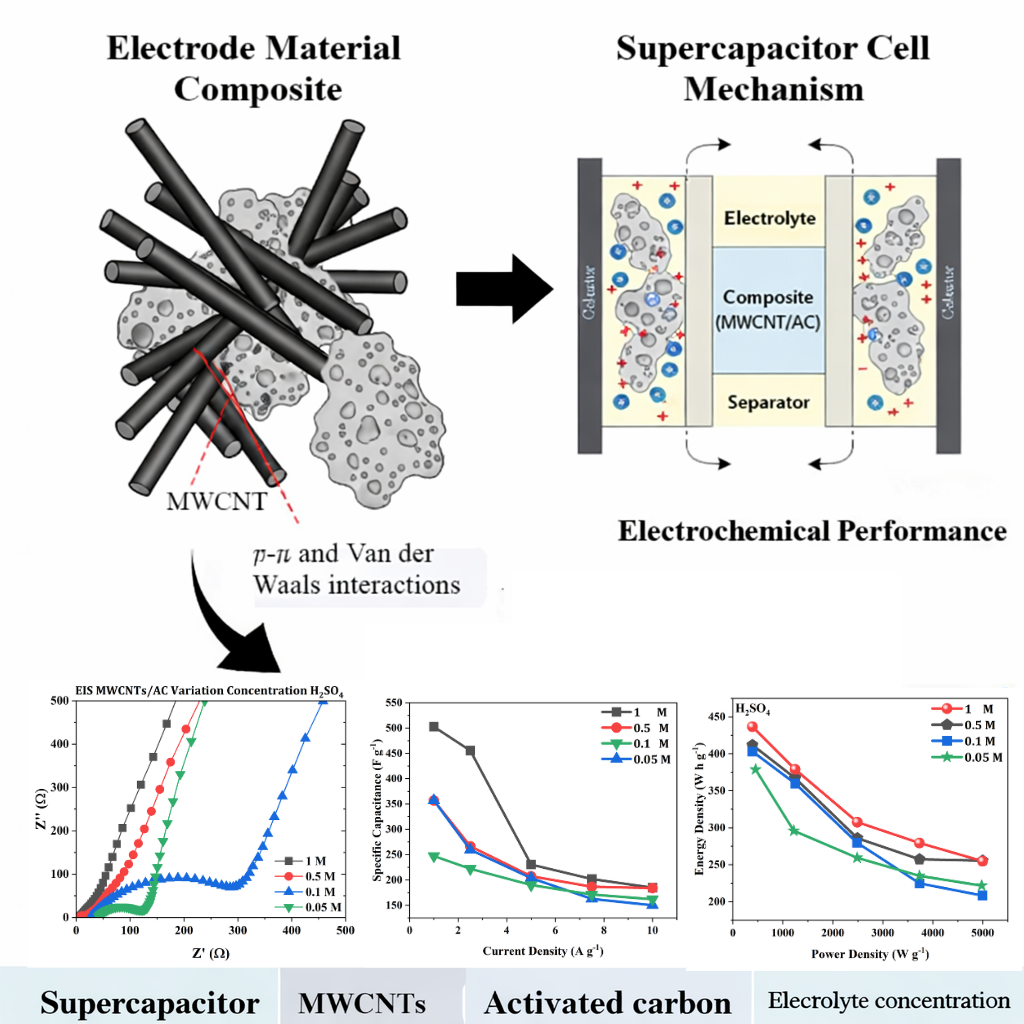
The limited electrical conductivity and pore utilization of conventional activated-carbon-based electrodes often restrict the achievable energy density of supercapacitors, especially when electrolyte conditions are not optimally engineered. This study aims to overcome these limitations by developing a multiwalled carbon nanotubes/activated carbon (MWCNTs/AC) composite electrode and systematically elucidating the role of H2SO4 electrolyte concentration on its electrochemical performance using a three-electrode configuration. The MWCNTs/AC composite was fabricated via a simple physical–chemical route and deposited on copper foil, while its structural and morphological characteristics were confirmed by XRD, SEM, and TEM analyses, which demonstrated successful integration of conductive MWCNT networks within the porous AC matrix. Electrochemical behavior was evaluated by cyclic voltammetry, galvanostatic charge–discharge, and electrochemical impedance spectroscopy at H2SO4 concentrations of 0.05, 0.1, 0.5, and 1 M to clarify the correlation between ion availability, charge-transfer resistance, and double-layer formation. Optimized electrolyte engineering at 1 M H2SO4 yielded a high specific capacitance of 528.57 F g⁻¹, with an energy density of 436.73 Wh g⁻¹, a power density of 391 and excellent cycling stability of 98.89% after 5,000 cycles, indicating efficient ion transport and low internal resistance. Compared with previous carbon-based systems, the combined strategy of tailoring both the MWCNTs/AC composite architecture and electrolyte concentration provides a clear pathway to simultaneously enhance capacitance, energy density, and durability, highlighting the MWCNTs/AC electrode as a promising candidate for high-performance aqueous supercapacitors.
HIGHLIGHTS
- A simple physical–chemical route was used to synthesize MWCNT/AC composite electrodes.
- The influence of H₂SO₄ electrolyte concentration (0.05 - 1 M) on supercapacitor performance was systematically investigated.
- The composite exhibited excellent electrochemical behavior with a maximum specific capacitance of 528.57 F g⁻¹ at 1 M H₂SO₄.
- EIS analysis revealed reduced charge transfer resistance and improved ion diffusion at higher electrolyte concentrations.
- The MWCNT/AC electrode demonstrated high energy density (436.73 Wh kg⁻¹) and good cycling stability, confirming its potential for high-performance energy storage devices.
GRAPHICAL ABSTRACT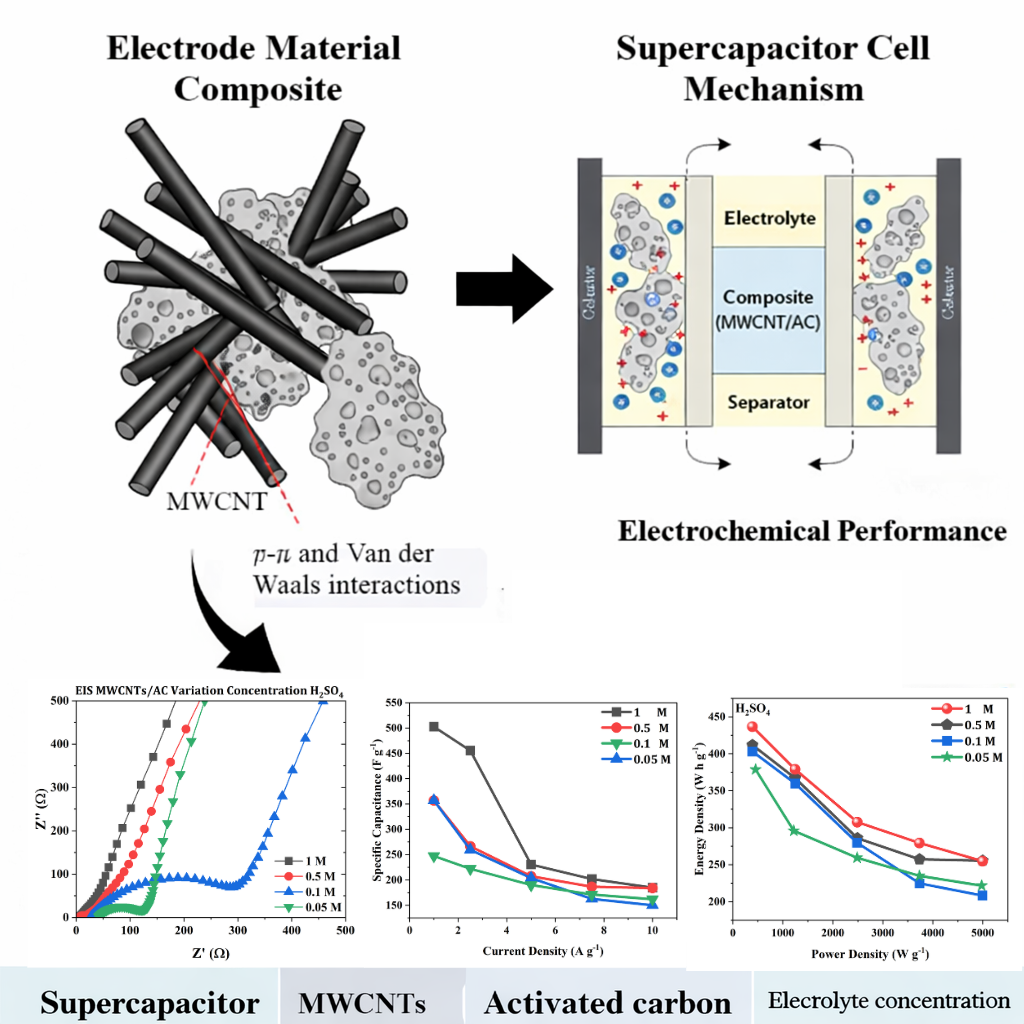
Downloads
References
N Swain, A Tripathy, A Thirumurugan, B Saravanakumar, L Schmidt-Mende and A Ramadoss. A brief review on stretchable, compressible, and deformable supercapacitors for smart devices. Chemical Engineering Journal 2022; 446(P3), 136876
M Zhong, M Zhang and X Li. Carbon nanomaterials and their composites for supercapacitors. Carbon Energy 2022; 4(5), 950-985.
X Chen, H Zhang, Y Gao, JH Liu, X Cao, C Zhan, S Wang, J Wang, SX Dou and D Cao. Zinc-ion hybrid supercapacitors: Design strategies, challenges, and perspectives. Carbon Neutralization 2022; 1(2), 159-188.
MM Hasan, T Islam, SS Shah, A Awal, MA Aziz and AJS Ahammad. Recent advances in carbon and metal-based supramolecular technology for supercapacitor applications. Chemical Record 2022; 22(7), e202200041.
B Freitas, WG Nunes, DM Soares, FC Rufino, CM Moreira, LMD Silva and H Zanin. Robust, flexible, freestanding, and high surface area activated carbon and multi-walled carbon nanotubes composite material with outstanding electrode properties for aqueous-based supercapacitors. Materials Advances 2021; 2(13), 4264-4276.
G Wang, X Duan, D Wang, X Dong and X Zhang. Polyvinylidene fluoride effects on the electrocatalytic properties of air cathodes in microbial fuel cells. Bioelectrochemistry 2018; 120, 138-144.
B Pal, S Yang, S Ramesh, V Thangadurai and R Jose. Electrolyte selection for supercapacitive devices: A critical review. Nanoscale Advances 2019; 1(10), 3807-3835.
A Mendhe and HS Panda. A review on electrolytes for supercapacitor device. Discover Materials 2023. https://doi.org/10.1007/s43939-023-00065-3
I Ishita, P Sahoo, PK Sow and R Singhal. Unlocking the potential of KI as redox additive in supercapacitor through synergistic enhancement with H2SO4 as a co-electrolyte. Electrochimica Acta 2023; 451, 142286.
PEP Sari, A Subagio and NAK Umiati. Fabrication of MWCNT/S/AC battery electrodes using the doctor blade method with cyclic voltammetry (CV) testing of kcl electrolyte variations to determine specific capacitance values. International Journal of Scientific Research in Science and Technology 2025; 12(1), 563-566.
DD Ristiana, M Handayani, MA Anggoro, BW Widagdo, E Angelina, H Sutanto, I Anshori, E Febriana, F Firdiyono, E Sulistiyono, AB Prasetyo, Lusiana and INGP Astawa. Reduced graphene oxide/nano-silica (rGO/n-SiO2) nanocomposite for electrode materials of supercapacitor with a high cycling stability. South African Journal of Chemical Engineering 2024; 48, 130-137.
B Bagautdinov, K Ohara and AA Babaev. High-energy X-Ray diffraction study of multiwalled carbon nanotubes fabricated by arc discharge plasma process. Carbon NY 2022; 191, 75-83.
A Awadallah-F and S Al-Muhtaseb. Carbon nanoparticles-decorated carbon nanotubes. Scientific Reports 2020; 10(1), 4878.
R Yang, X Dong, G Chen, F Lin, Z Huang, M Manzo and H Mao. Novel terahertz spectroscopy technology for crystallinity and crystal structure analysis of cellulose. Polymers 2020; 13(1), 6.
J Li, PHQ Pham, W Zhou, TD Pham and PJ Burke. Carbon-nanotube-electrolyte interface: Quantum and electric double layer capacitance. ACS Nano 2018; 12(10), 9763-9774.
H Wu, X Wang, L Jiang, C Wu, Q Zhao, X Liu, B Hu and L Yi. The effects of electrolyte on the supercapacitive performance of activated calcium carbide-derived carbon. Journal of Power Sources 2013; 226, 202-209.
M Javed, SM Abbas, M Siddiq, D Han and L Niu. Mesoporous silica wrapped with graphene oxide-conducting PANI nanowires as a novel hybrid electrode for supercapacitor. Journal of Physics and Chemistry of Solids 2018; 113, 220-228.
M Reza, L Ernawati, A Hariyadi, RK Wardhani, TW Sari and N Sylvia. Analysis of KCl and H2SO4 electrolyte concentration variations on specific capacitance of electrodes (CNT/PVA) through cyclic voltammetry (CV). 2025; 10(2), 12956-12961.
L Tang, X Ji, P Wu, H Luo, Y Zhu, L Deng, S Cheng and M Liu. Achievement of high energy carbon based supercapacitors in acid solution enabled by the balance of SSA with abundant micropores and conductivity. Electrochimica Acta 2020; 353, 136562.
BJ Choudhury and VS Moholkar. Ultrasound-assisted facile one-pot synthesis of ternary MWCNT/MnO2/rGO nanocomposite for high performance supercapacitors with commercial-level mass loadings. Ultrason Sonochem. 2021; 82, 105896.
M Zhong, M Zhang and X Li. Carbon nanomaterials and their composites for supercapacitors. Carbon Energy 2022; 4(5), 950-985.
MW Hakim, I Ali, S Fatima, H Li, SHM Jafri and S Rizwan. Enhanced electrochemical performance of MWCNT-assisted molybdenum-titanium carbide MXene as a potential electrode material for energy storage application. ACS Omega 2024; 9(8), 8763-8772.
NA Mukti, HR Taufiq, H Sutanto, M Diantoro, W Meevasana, A Purwanto and A Subsgio. MWCNT/AC electrode synthesis on supercapacitor performance with NaCl electrolyte. International Journal of Scientific Research in Science and Technology 2023; 10(6), 119-125.
M Rosi, MNZ Fatmizal, DH Siburian, A Ismardi and NH Abdullah. Electrochemical properties of activated carbon electrodes for supercapacitor application: The effect of various electrolyte concentrations of Na2SO4. Jurnal Ilmiah Pendidikan Fisika Al-Biruni 2023; 12(2), 243-250.
SB Aziz, PO Hama, PA Mohammed, MB Ahmed, RM Abdullah, NM Sadiq, MFZ Kadir and HJ Woo. Electrochemical properties of plasticized PVA-based electrolyte inserted with alumina nanoparticles for EDLC application with enhanced dielectric constant. Journal of Energy Storage 2024; 103(A), 114264.
K Takeshita, Z Zhi and K Dokko. Li-Ion intercalation kinetics at LiMn2O4 thin film electrode/localized high-concentration electrolyte interface. ECS Meeting Abstracts 2024; 67, 4532.
LS Kremer, T Danner, S Hein, A Hoffmann, B Prifling, V Schmidt, A Latz and M Wohlfahrt-Mehrens. Influence of the electrolyte salt concentration on the rate capability of ultra-thick NCM 622 electrodes. Batter Supercaps 2020; 3(11), 1172-1182.
HJ Yang, D Han, J Kim, YH Kim and JH Bae. Constant phase element affected by ion transport in nanoporous electrodes. Journal of Electroanalytical Chemistry 2022; 922, 116766.
M Janssen and J Bisquert. Locating the frequency of turnover in thin-film diffusion impedance. The Journal of Physical Chemistry C 2021; 125(28), 15737-15741.
Z Ma, WL Dacayan, C Chatzichristodoulou, KS Mølhave, FM Chiabrera, W Zhang and SB Simonsen. Electrochemical impedance spectroscopy integrated with environmental transmission electron microscopy. Small Methods 2023; 7(7), e2201713.
Published
How to Cite
Issue
Section
License
Copyright (c) 2025 Walailak University

This work is licensed under a Creative Commons Attribution-NonCommercial-NoDerivatives 4.0 International License.





